Dogecoin, launched in 2013 by Billy Markus and Jackson Palmer, has evolved from a meme-based cryptocurrency into the 10th largest digital currency globally, with 6.6 million holders and a $23.4 billion market cap as of January 2026. This comprehensive guide explores Dogecoin's decentralized blockchain architecture, Scrypt-based Proof-of-Work mechanism, and inflationary tokenomics designed to encourage usage over hoarding. Beyond technical fundamentals, the article examines its market performance, current trading at $0.13916 on Gate.com, vibrant community engagement across social platforms, and real-world applications in payments, tipping, and charitable initiatives. Whether you're a newcomer or experienced participant, this article provides essential insights into Dogecoin's unique position as an accessible, community-driven digital currency.
Dogecoin's Positioning and Significance
In 2013, Billy Markus and Jackson Palmer launched Dogecoin (DOGE), aiming to address the exclusivity and intimidating nature of early cryptocurrency adoption.
As a community-driven, fun-focused digital currency, Dogecoin plays a key role in peer-to-peer payments, microtransactions, and tipping culture.
As of 2026, Dogecoin has become the 10th largest cryptocurrency by market capitalization, with over 6.6 million holders and an active development community.
This article will provide an in-depth analysis of its technical architecture, market performance, and future potential.
Origin and Development History
Birth Background
Dogecoin was created by Billy Markus and Jackson Palmer in December 2013, aiming to solve the barrier to entry and serious tone that limited broader cryptocurrency adoption.
It emerged during the early wave of alternative cryptocurrencies, with the goal of creating a lighthearted, accessible digital currency with greater appeal beyond Bitcoin's core audience through its foundation on the popular Doge meme.
Dogecoin's launch brought fresh possibilities to everyday users seeking simple, low-cost transactions and online communities.
Major Milestones
- 2013: Mainnet launched on December 8, implementing Scrypt-based proof-of-work mining.
- 2014: Dogecoin community raised funds for various charitable causes, establishing its reputation for community engagement.
- 2021: Gained mainstream attention with price surges, attracting millions of new users.
- 2023-2026: Continued ecosystem development with improved adoption for payments and tipping across social platforms.
With support from its dedicated community and development team, Dogecoin continues to optimize its network security and real-world utility.
How Dogecoin Works
No Central Control
Dogecoin operates on a decentralized network of computers (nodes) distributed globally, free from control by banks or governments.
These nodes collaborate to verify transactions, ensuring system transparency and attack resistance, granting users greater autonomy and enhancing network resilience.
Blockchain Foundation
Dogecoin's blockchain is a public, immutable digital ledger that records every transaction.
Transactions are grouped into blocks and linked through cryptographic hashes to form a secure chain.
Anyone can view the records, establishing trust without intermediaries.
Based on Litecoin's codebase with Scrypt algorithm implementation, it ensures accessible mining and efficient transaction processing.
Ensuring Fairness
Dogecoin employs Proof-of-Work (PoW) with Scrypt algorithm to validate transactions and prevent fraud such as double-spending.
Miners maintain network security through computational work to solve cryptographic puzzles and receive DOGE rewards.
Its innovation includes lower mining difficulty and faster block generation (1 minute) compared to Bitcoin, enabling quicker transaction confirmations.
Secure Transactions
Dogecoin uses public-private key cryptography to protect transactions:
- Private keys (like secret passwords) are used to sign transactions
- Public keys (like account numbers) are used to verify ownership
This mechanism ensures fund security while maintaining pseudonymous transaction privacy.
The open-source nature allows continuous community auditing and security improvements.
Circulation Overview
As of January 13, 2026, Dogecoin's circulating supply stands at 168,274,793,126.579 DOGE, with a total supply of 168,294,373,126.5791 DOGE, representing a circulation ratio of approximately 99.99%. Dogecoin operates on an inflationary model without a maximum supply cap, meaning new coins continue to enter circulation over time. This inflationary mechanism is designed to encourage usage and tipping rather than hoarding, aligning with the coin's original purpose as a fun and accessible cryptocurrency.
Price Volatility
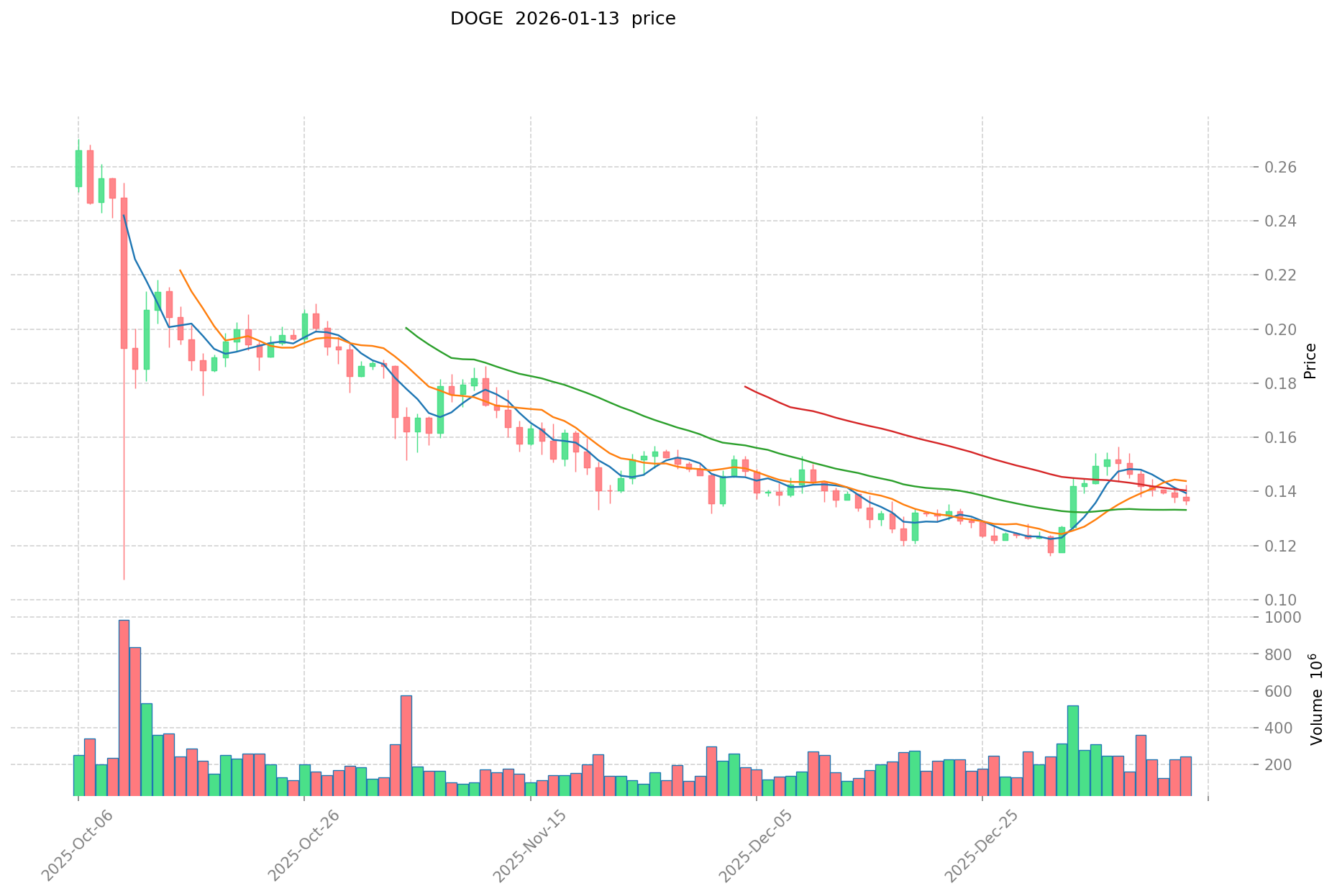
Dogecoin reached its all-time high of $0.731578 on May 8, 2021, driven by significant social media attention, celebrity endorsements, and broader cryptocurrency market enthusiasm during that period. Its lowest recorded price of $0.0000869 occurred on May 6, 2015, reflecting the early stages of the project when adoption and awareness were limited. As of the latest data, DOGE is trading at $0.13916, showing price changes of +0.35% over the past hour, -0.65% over 24 hours, -8.15% over 7 days, +0.77% over 30 days, and -58.59% over the past year. These fluctuations reflect evolving market sentiment, adoption trends, macroeconomic factors, and the broader cryptocurrency market cycles.
Click to view current DOGE market price
On-Chain Metrics
- Market Capitalization: $23,417,120,211.49 (representing 0.71% market dominance)
- 24-Hour Trading Volume: $29,102,912.07 (indicating active market participation)
- Number of Holders: 6,622,671 (demonstrating widespread community adoption)
- Market Cap to Fully Diluted Valuation Ratio: 99.99% (showing minimal difference between current and potential maximum market cap)
Dogecoin Ecosystem Applications and Partners
Core Use Cases
Dogecoin's ecosystem supports multiple applications:
- Payment Solutions: Dogecoin serves as a payment method for various online merchants and services, providing fast and low-cost transactions.
- Tipping and Community Rewards: Dogecoin is widely used across social media platforms, enabling content creator rewards and community engagement.
Strategic Partnerships
Dogecoin continues to expand its ecosystem through various integrations and collaborations, enhancing its utility and market presence.
These partnerships provide a solid foundation for Dogecoin's ecosystem expansion.
Controversies and Challenges
Dogecoin faces the following challenges:
- Technical Challenges: Network scalability and transaction efficiency remain areas for potential improvement
- Regulatory Risks: Evolving cryptocurrency regulations across different jurisdictions
- Competition Pressure: Competition from other payment-focused cryptocurrencies and blockchain platforms
These issues have sparked discussions within the community and market, while also driving Dogecoin's continuous development.
Fan Enthusiasm
Dogecoin's community demonstrates remarkable vitality, with 6,622,671 holders as of January 13, 2026.
On X platform, related posts and hashtags (such as #DOGE) frequently trend, generating significant engagement.
Community events and cultural moments continue to fuel community enthusiasm.
Sentiment on X shows diverse perspectives:
- Supporters praise Dogecoin's accessibility, community-driven nature, and fun approach, considering it as "the people's crypto" and a gateway to digital currency adoption".
- Critics focus on price volatility, unlimited supply concerns, and speculative nature.
Recent trends reflect evolving market sentiment influenced by broader crypto market conditions.
Hot Topics
X users actively discuss Dogecoin's adoption potential, payment use cases, and community culture,
showcasing both its transformative possibilities and challenges in mainstream adoption.
- Official Website: Visit Dogecoin Official Website for features, use cases, and latest updates.
- X Updates: On X platform, Dogecoin actively engages using @dogecoin, with an active presence that shares
posts covering community updates, adoption news, and cultural moments, generating strong community engagement.
Dogecoin Future Roadmap
- Ongoing Development: Continued focus on network efficiency and security enhancements, improving transaction speed and reliability
- Ecosystem Goals: Expanding payment adoption and merchant integrations
- Long-term Vision: Establishing itself as a widely-accepted digital currency for everyday transactions
How to Participate in Dogecoin?
- Purchase Channels: Buy Dogecoin on Gate.com and other major cryptocurrency exchanges
- Storage Solutions: Securely store using compatible wallets that support Dogecoin
- Community Engagement: Join the Dogecoin community through social media platforms and forums
- Ecosystem Building: Contribute to Dogecoin adoption by accepting it as payment or promoting its use cases
Summary
Dogecoin has carved out a unique position in the cryptocurrency landscape through its community-driven approach, offering accessibility, low transaction costs, and cultural appeal.
Its vibrant community, widespread recognition, and consistent market presence distinguish it within the digital currency space.
Despite facing regulatory uncertainties and market volatility, Dogecoin's strong community support and established presence position it as a notable player in the evolution of digital payments.
Whether you are a newcomer or experienced participant, Dogecoin offers unique opportunities for engagement and adoption.
FAQ
What is Dogecoin (DOGE) and how did it originate?
Dogecoin is a cryptocurrency created in 2013, based on Bitcoin's blockchain and featuring a Shiba Inu dog meme. It gained massive popularity in 2021, becoming a top-10 cryptocurrency with billions in market value.
How does Dogecoin differ from Bitcoin and other cryptocurrencies?
Dogecoin features faster block times, lower transaction fees, and unlimited supply compared to Bitcoin's capped supply. However, Dogecoin has smaller market capitalization and greater price volatility than Bitcoin.
What are the main uses and applications of Dogecoin?
Dogecoin is primarily used for online tipping, donations, and microtransactions. It also serves as a payment method for products, services, and charitable contributions within the community.
How can I buy, sell, and store Dogecoin?
Buy Dogecoin on cryptocurrency exchanges using USD or other digital assets. Sell anytime on these platforms. Store it directly on the exchange or transfer to your own wallet if the platform permits external transfers.
What are the risks and benefits of investing in Dogecoin?
Benefits: Strong community support, high volatility for potential gains, low transaction costs. Risks: High price volatility, speculative nature, market sentiment dependency. Suitable for risk-tolerant investors seeking short-term opportunities.
What is the current supply and market cap of Dogecoin?
As of January 2026, Dogecoin has a circulating supply of approximately 168.3 billion coins with a market capitalization of around 23.3 billion dollars.
* The information is not intended to be and does not constitute financial advice or any other recommendation of any sort offered or endorsed by Gate.