DuckChain (DUCK) is a revolutionary consumer-layer blockchain launched on TON in 2025, addressing Web2-Web3 complexity barriers and ecosystem fragmentation. As the first Telegram-native blockchain infrastructure, it bridges TON with Ethereum, Bitcoin, and other ecosystems through Arbitrum Orbit's technology. DuckChain features a decentralized architecture with unified gas systems via Telegram Stars and account abstraction, enabling seamless on-chain operations for 950 million potential users. The project boasts 252,588 token holders and demonstrated market activity, with DUCK trading on Gate.com. This comprehensive guide covers DuckChain's technical foundations, market performance metrics including price fluctuations and on-chain data, ecosystem applications, strategic partnerships, and community engagement. Designed for both crypto newcomers and experienced participants, the article explores how DuckChain simplifies blockchain interaction while navigating adoption challenges and market dynamics. Perfect for
DuckChain's Positioning and Significance
In 2025, the DuckChain team launched DuckChain (DUCK), aiming to address the complexity barriers between Web2 and Web3, and the fragmentation challenges faced by the Telegram ecosystem.
As the first consumer layer blockchain on TON, DuckChain plays a critical role in bridging TON with Ethereum (EVM), Bitcoin (BTC), and other ecosystems.
As of 2026, DuckChain has emerged as an innovative infrastructure project in the TON ecosystem, boasting over 252,000 token holders and an active developer community.
This article provides an in-depth analysis of its technical architecture, market performance, and future potential.
Origin and Development History
Background of Creation
DuckChain was created by the DuckChain team in 2025, aiming to solve the high entry barriers for Web2 users transitioning to Web3 and the liquidity fragmentation issues within the Telegram ecosystem.
It emerged during the rapid growth phase of the TON ecosystem and Telegram's user expansion, with the goal of transforming Telegram into a super app for 950 million global users through intuitive blockchain experiences.
The launch of DuckChain brought new possibilities for developers and users within the Telegram ecosystem.
Key Milestones
- January 2025: The mainnet was launched, leveraging Arbitrum Orbit's robust infrastructure to achieve cross-ecosystem interoperability.
- January 2025: Token trading began on Gate.com and other platforms, with an initial offering price of $0.05.
- January 2025: The price reached $0.01816, reflecting early market attention.
- 2025: The ecosystem expanded rapidly, with DuckChain introducing a unified gas system via Telegram Stars and account abstraction, enabling users to perform on-chain operations directly within Telegram.
With the support of its community and developer ecosystem, DuckChain continues to optimize its technical capabilities, security measures, and real-world applications.
How Does DuckChain Work?
No Central Control
DuckChain operates on a decentralized network of computers (nodes) distributed globally, free from the control of banks or governments.
These nodes collaborate to validate transactions, ensuring the system remains transparent and resistant to attacks, empowering users with greater autonomy and enhancing network resilience.
Blockchain Core
DuckChain's blockchain serves as a public, immutable digital ledger that records every transaction.
Transactions are grouped into blocks and linked through cryptographic hashes to form a secure chain.
Anyone can view the records, establishing trust without intermediaries.
By utilizing Arbitrum Orbit's infrastructure, DuckChain achieves enhanced performance and cross-chain compatibility, connecting TON with multiple ecosystems.
Ensuring Fairness
DuckChain employs the TON consensus mechanism to validate transactions and prevent fraudulent activities such as double-spending.
Validators maintain network security through their participation in the TON network and receive rewards in DUCK tokens.
Its innovation lies in integrating account abstraction and Telegram Stars to create a unified gas system, significantly lowering the technical barriers for users.
Secure Transactions
DuckChain uses public-private key cryptography to protect transactions:
- Private keys (similar to secret passwords) are used to sign transactions
- Public keys (similar to account numbers) are used to verify ownership
This mechanism ensures fund security while maintaining pseudonymous transaction privacy.
Additionally, DuckChain provides developers with familiar EVM-compatible tools, facilitating the migration and deployment of dApps while attracting liquidity to the Telegram ecosystem.
Circulation Overview
As of January 28, 2026, DuckChain's circulating supply is 5,900,000,000 DUCK tokens, with a total supply of 9,454,878,330 DUCK. The maximum supply is capped at 10,000,000,000 DUCK, indicating a fixed supply model.
The current circulation ratio stands at approximately 59% of the total supply, with the remaining tokens likely allocated for future ecosystem development, community incentives, and team reserves.
Price Fluctuations
DuckChain reached its historical high price of $0.01816 on January 16, 2025, driven by initial market enthusiasm following its launch and early adoption within the Telegram ecosystem.
The token experienced its lowest price of $0.000606 on October 10, 2025, reflecting broader market corrections and adjustments in valuation following the initial launch period.
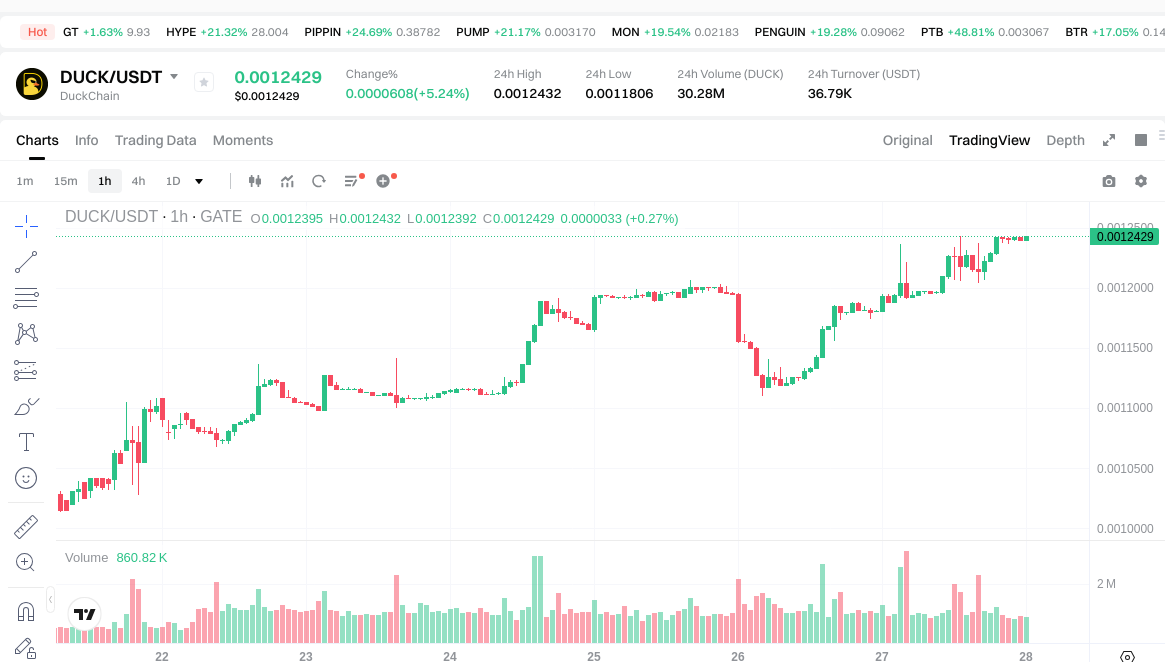
As of January 28, 2026, DUCK is trading at $0.0012418, showing a 24-hour increase of 4.35%, a 7-day gain of 18.24%, and a 30-day increase of 12.55%. However, the token has experienced a 72.97% decline over the past year from its initial trading price of $0.05, indicating significant market volatility and price discovery phase.
These fluctuations reflect the typical volatility of newly launched blockchain projects, market sentiment shifts, and the evolving adoption of DuckChain's infrastructure within the TON and Telegram ecosystems.
Click to view the current DUCK market price
On-Chain Metrics
- Holder Count: Approximately 252,588 addresses hold DUCK tokens, demonstrating growing community participation and distribution across the network.
- 24-Hour Trading Volume: $36,797.51, reflecting active market interest and liquidity.
- Market Capitalization: $7,326,620, with a fully diluted valuation of $11,741,067.91, showing the market cap to FDV ratio of 59%.
- Market Dominance: 0.00037% of the total cryptocurrency market, indicating DuckChain's emerging position in the broader blockchain ecosystem.
DuckChain Ecosystem Applications and Partners
Core Use Cases
DuckChain's ecosystem supports multiple applications:
- Cross-Chain Interoperability: Leveraging Arbitrum Orbit infrastructure, DuckChain enables seamless bridging between TON, Ethereum (EVM), Bitcoin (BTC), and other ecosystems, providing enhanced liquidity flow across blockchain networks.
- Telegram-Native dApps: Integration with Telegram allows developers to build and deploy decentralized applications directly within the messaging platform, offering simplified Web3 experiences for 950 million potential users.
- Unified Gas System: Through Telegram Stars and account abstraction, DuckChain reduces technical barriers, enabling streamlined on-chain operations accessible to Web2 users.
Strategic Partnerships
DuckChain utilizes Arbitrum Orbit's robust infrastructure to enhance its technical capabilities and cross-chain connectivity. This partnership provides DuckChain with proven scaling solutions and development tools, strengthening its position as a consumer-focused blockchain layer on TON.
Challenges and Considerations
DuckChain faces several developmental challenges:
- Market Volatility: Price fluctuations, with the token experiencing movement between $0.000606 and $0.01816, reflect broader cryptocurrency market dynamics
- Competition: Operating in an environment with established blockchain platforms requires continuous innovation in user experience and technical performance
- Adoption Hurdles: Converting Web2 users to Web3 requires sustained educational efforts and seamless user interface design
These factors drive ongoing refinement of DuckChain's technology and user engagement strategies.
DuckChain's community demonstrates active participation, with 252,588 token holders as of January 2026. The project maintains an engaged following through its X platform presence at @Duck_Chain, where updates on technical developments and ecosystem growth generate regular community discussion.
X platform discussions around DuckChain reflect diverse perspectives:
- Supporters emphasize DuckChain's Telegram integration and cross-chain capabilities, viewing it as an accessible entry point for mainstream blockchain adoption
- Observers monitor price performance and ecosystem development progress, tracking the project's evolution from its January 2025 launch
Recent trends indicate growing interest in Telegram-based blockchain solutions, positioning DuckChain within emerging market segments.
Discussion Topics
X users frequently discuss DuckChain's approach to simplifying blockchain interaction, cross-chain bridging functionality, and potential for mainstream adoption through Telegram's user base, highlighting both opportunities and the challenges of achieving widespread Web3 integration.
Additional DuckChain Resources
- Official Website: Visit DuckChain's official site for features, use cases, and latest developments.
- Documentation: DuckChain Diary provides technical details on architecture, objectives, and vision.
- X Platform: DuckChain actively maintains its presence on X using @Duck_Chain, sharing updates on technical upgrades, community initiatives, and ecosystem partnerships.
DuckChain Future Roadmap
- Ongoing Development: Enhancement of cross-chain bridging capabilities to improve transaction efficiency and user experience
- Ecosystem Goals: Expansion of dApp offerings within the Telegram environment to serve diverse user needs
- Long-term Vision: Establish blockchain technology as intuitive as messaging for Telegram's global user base
How to Participate in DuckChain?
- Acquisition: DuckChain (DUCK) is available on Gate.com and other platforms
- Storage: Secure DUCK tokens using compatible TON wallets
- Ecosystem Engagement: Explore dApp development opportunities through DuckChain's developer resources
- Community Involvement: Follow official channels for updates on governance and community initiatives
Summary
DuckChain approaches blockchain technology through Telegram integration, offering simplified access, cross-chain connectivity, and familiar user interfaces. Its active community, comprehensive resources, and market presence contribute to its positioning in the cryptocurrency space. While navigating market dynamics and adoption challenges, DuckChain's focus on user experience and cross-chain interoperability reflects its commitment to making blockchain technology more accessible. Whether you are new to cryptocurrency or an experienced participant, DuckChain represents an interesting approach to blockchain adoption through social platform integration.
FAQ
What is Crypto DUCK and how does it work?
Crypto DUCK is a decentralized digital asset designed for Web3 communities. It operates on blockchain technology, enabling peer-to-peer transactions and smart contract functionality. Users can stake, trade, and participate in governance through the DUCK token ecosystem.
What are the main use cases and features of DUCK token?
DUCK token enables governance participation, staking rewards, gas fee payments, and liquidity provision on DuckChain. It powers the network's decision-making and AI-driven governance features.
How can I buy and store DUCK cryptocurrency?
Create a digital wallet account, purchase stablecoins like USDT, swap USDT for DUCK tokens, and securely store them in your wallet. You can use Web3 wallets or exchange wallets depending on your preference.
What is the total supply and tokenomics of DUCK?
DUCK has a total supply of 75,581,232 tokens with a circulating supply of 45,274,336.31. The maximum supply is capped at 75,581,231.71, ensuring controlled inflation and long-term sustainability.
Is DUCK a safe investment? What are the risks?
DUCK carries inherent volatility and market risks. Security breaches, regulatory changes, and price fluctuations are primary concerns. Conduct thorough research and only invest what you can afford to lose.
How does DUCK compare to other similar cryptocurrencies?
DUCK outperforms similar AI cryptocurrencies and maintains strength while the broader crypto market declines. With superior trading volume and development momentum, DUCK stands out among comparable tokens in the AI sector.
What is the project roadmap and future development plan for DUCK?
DUCK's roadmap focuses on AI-powered, Telegram-native Web3 experiences. In 2025, the project emphasizes execution and ecosystem development. Future plans include expanding DuckChain's capabilities, enhancing user adoption through Telegram integration, and advancing decentralized AI features to drive mainstream Web3 adoption.
* The information is not intended to be and does not constitute financial advice or any other recommendation of any sort offered or endorsed by Gate.