DuckChain (DUCK) is the first consumer layer blockchain on TON, launched in 2025 to democratize blockchain access for Telegram's 950 million users by bridging TON with Ethereum, Bitcoin, and other ecosystems. This article provides a comprehensive analysis of DuckChain's technical architecture powered by Arbitrum Orbit technology, market performance metrics including its current trading dynamics on Gate, and real-world applications through dApp development and Web3 integration. With over 252,000 token holders as of early 2026, DuckChain addresses critical challenges in mainstream Web3 adoption through unified gas systems via Telegram Stars and account abstraction features. The guide explores DuckChain's ecosystem partnerships, community engagement on social platforms, and market position while examining technical hurdles and competition in the consumer blockchain space. Designed for both newcomers and experienced crypto participants, this resource offers insights into DUCK token acquisition, storage solutions,
DuckChain's Positioning and Significance
In 2025, the DuckChain team launched DuckChain (DUCK), aiming to address the complexity barriers preventing mainstream Web2 users from accessing blockchain technology and the fragmentation between TON and other major ecosystems.
As the first consumer layer blockchain on TON, DuckChain plays a critical role in bridging TON with Ethereum, Bitcoin, and other ecosystems while simplifying Web3 interactions for Telegram's vast user base.
As of 2026, DuckChain has established itself as an innovative infrastructure layer, with over 252,000 token holders and an active developer community.
This article will provide an in-depth analysis of its technical architecture, market performance, and future potential.
Origin and Development History
Birth Background
DuckChain was created by the DuckChain team in 2025, aiming to solve the accessibility challenges that prevent Web2 users from adopting blockchain technology and the lack of interoperability between TON and other major ecosystems.
It emerged during the rapid expansion of the Telegram ecosystem and growing demand for seamless blockchain integration, with the goal of making blockchain operations as intuitive as sending messages on Telegram and transforming the platform into a super app.
DuckChain's launch brought new possibilities for Telegram's 950 million global users and developers seeking to build consumer-focused dApps.
Important Milestones
- 2025: Mainnet launch on January 16, establishing infrastructure using Arbitrum Orbit technology.
- 2025: Token listing on Gate.com, expanding accessibility to global traders.
- 2025-2026: Ecosystem expansion with the introduction of unified gas systems via Telegram Stars and account abstraction features.
With support from the DuckChain development team and the broader TON and Arbitrum communities, DuckChain continues to optimize its technology, security, and real-world applications.
How DuckChain Works
No Central Control
DuckChain operates on a decentralized network built upon TON infrastructure, enhanced with Arbitrum Orbit technology, freeing it from control by banks or governments.
These distributed components collaborate to validate transactions, ensuring system transparency and attack resistance, granting users greater autonomy while improving network resilience.
Blockchain Core
DuckChain's blockchain functions as a public, immutable digital ledger recording every transaction.
Transactions are grouped into blocks and linked through cryptographic hashing to form a secure chain.
Anyone can view the records, establishing trust without intermediaries.
The integration with Arbitrum Orbit technology and TON infrastructure enables enhanced cross-chain capabilities and improved transaction processing.
Ensuring Fairness
DuckChain leverages TON's consensus mechanism combined with Arbitrum Orbit's rollup technology to validate transactions and prevent fraudulent activities such as double-spending.
Network participants maintain security through validation processes across both TON and the Arbitrum Orbit layer, with incentive structures designed to encourage honest participation.
Its innovation includes unified gas payment systems using Telegram Stars and account abstraction to simplify user experience.
Secure Transactions
DuckChain uses public-private key cryptography to protect transactions:
- Private keys (like secret passwords) are used to sign transactions
- Public keys (like account numbers) are used to verify ownership
This mechanism ensures fund security while maintaining appropriate privacy levels for blockchain transactions.
The integration with Telegram's ecosystem provides additional layers of user-friendly security features designed for mainstream adoption.
Circulation Overview
As of January 27, 2026, DuckChain (DUCK) has a circulating supply of 5,900,000,000 tokens, with a total supply of 9,454,878,330 tokens and a maximum supply capped at 10,000,000,000 tokens. The current circulation ratio stands at approximately 59% of the maximum supply. The token operates on a fixed supply model with a predetermined maximum cap, which may influence its long-term scarcity dynamics. New tokens enter the market through predetermined distribution mechanisms that support ecosystem development and community engagement.
Price Volatility
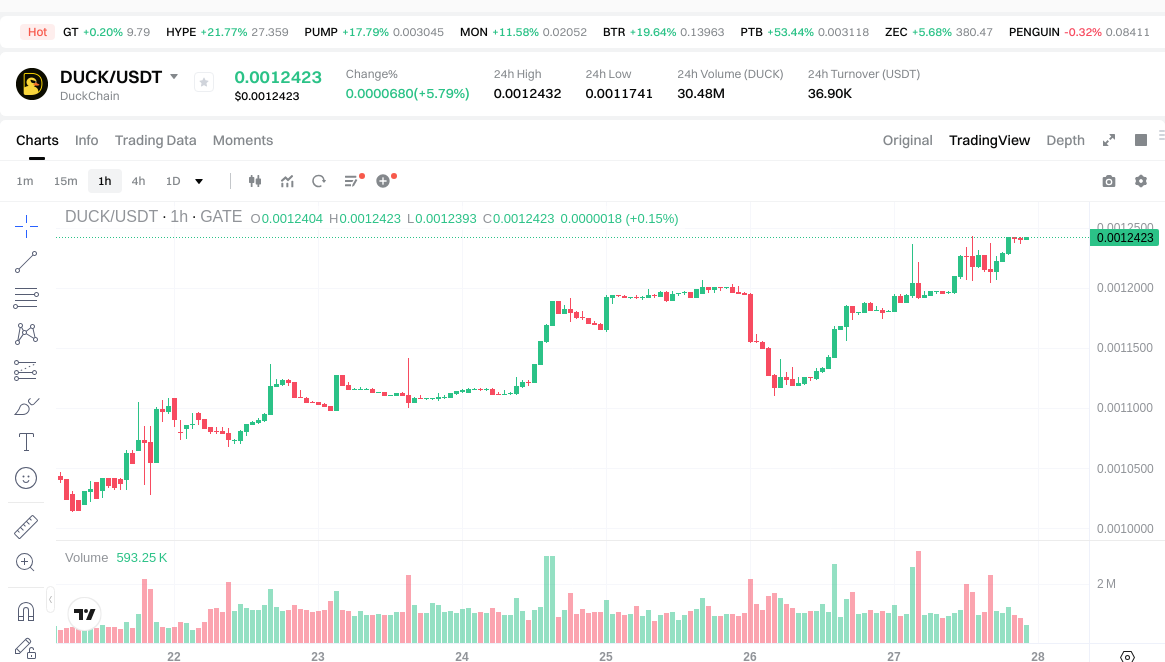
DuckChain (DUCK) reached its all-time high price of $0.01816 on January 16, 2025, driven by initial market enthusiasm and launch momentum. The token's lowest price of $0.000606 occurred on October 10, 2025, reflecting broader market corrections and consolidation phases. As of January 27, 2026, the token is trading at $0.0012423, showing a 24-hour increase of 5.68%, a 7-day gain of 19.54%, and a 30-day increase of 11.33%. However, the token has experienced a significant decline of 73.02% from its launch price of $0.05, indicating substantial volatility influenced by market sentiment, adoption trends, and broader cryptocurrency market dynamics.
Click to view the current DUCK market price
On-Chain Metrics
- Market Capitalization: $7,329,570 (representing approximately 0.00037% market dominance)
- 24-Hour Trading Volume: $36,908.03 (indicating current market activity levels)
- Holder Addresses: 252,588 addresses (reflecting community size and distribution)
- Fully Diluted Valuation: $11,745,795.35 (based on maximum supply)
- Market Cap to FDV Ratio: 59% (indicating current circulation relative to full dilution)
DuckChain Ecosystem Applications and Partnerships
Core Use Cases
DuckChain's ecosystem supports multiple applications:
- dApp Development: Developers can utilize familiar tools to build decentralized applications, migrate existing applications, and attract liquidity to the Telegram ecosystem.
- Web3 Integration: DuckChain enables users to perform on-chain operations and interact with numerous dApps directly within Telegram, offering a Web3 experience as intuitive as using Web2 applications.
Strategic Partnerships
DuckChain leverages Arbitrum Orbit's infrastructure to bridge TON with Ethereum (EVM), Bitcoin (BTC), and other ecosystems.
This partnership provides a solid foundation for DuckChain's ecosystem expansion and technical capabilities.
Controversies and Challenges
DuckChain faces the following challenges:
- Technical Hurdles: Ensuring seamless integration across multiple blockchain ecosystems while maintaining performance and security.
- Adoption Barriers: Transitioning Web2 users to Web3 requires continuous education and user experience optimization.
- Market Competition: Competing with established blockchain platforms in the consumer layer space.
These issues have sparked discussions within the community and market, while also driving DuckChain's continuous innovation.
DuckChain's community demonstrates strong engagement, with over 250,000 holders as of January 27, 2026.
On X platform, related posts and hashtags (such as #DuckChain) frequently trend, with the project's mission to make blockchain as intuitive as sending a message on Telegram resonating with the 950 million global Telegram users.
The launch of the unified gas system via Telegram Stars and account abstraction features has generated significant community interest.
Sentiment on X shows mixed perspectives:
- Supporters praise DuckChain's user-friendly approach and its potential to bridge TON with major ecosystems like Ethereum and Bitcoin, viewing it as a gateway for mainstream blockchain adoption.
- Critics focus on the project's early stage and the challenges of establishing a new consumer layer blockchain in a competitive market.
Recent trends indicate growing interest following the project's launch in mid-January 2026.
Hot Topics
X users actively discuss DuckChain's approach to lowering barriers for Web2 users, its integration with the Telegram ecosystem, and its potential to transform Telegram into a super app for blockchain interactions,
showcasing both its transformative potential and the challenges in achieving mainstream adoption.
- Official Website: Visit DuckChain's official website for features, use cases, and latest updates.
- Documentation: DuckChain Diary provides detailed information about its technical architecture, goals, and vision.
- X Updates: On X platform, DuckChain uses @Duck_Chain to actively engage with the community,
with posts covering topics such as technical developments, community activities, and partnership announcements, generating significant engagement.
DuckChain Future Roadmap
- Ecosystem Goals: Expand dApp ecosystem and attract more developers to build on the platform
- User Growth: Leverage Telegram's user base to onboard Web2 users into Web3
- Long-term Vision: Become the leading consumer layer blockchain connecting TON with multiple blockchain ecosystems
How to Participate in DuckChain?
- Purchase Options: Buy DUCK on Gate.com and other supporting exchanges
- Storage Solutions: Securely store DUCK using compatible TON wallets
- Ecosystem Participation: Explore dApps built on DuckChain directly through Telegram
- Developer Contribution: Visit the official documentation to develop dApps or contribute to the ecosystem
Summary
DuckChain aims to redefine blockchain accessibility by making it as intuitive as sending a Telegram message, offering seamless integration, user-friendly gas payment systems, and cross-chain connectivity.
Its strategic positioning as the first consumer layer blockchain on TON, combined with Arbitrum Orbit infrastructure and Telegram's user base, creates unique opportunities in the decentralized technology landscape.
Despite facing challenges such as market competition and technical integration complexities, DuckChain's innovative approach and clear mission position it as a project worth monitoring in the evolving blockchain space.
Whether you're a newcomer or an experienced participant, DuckChain presents interesting possibilities for blockchain adoption and participation.
FAQ
What is Crypto DUCK and how does it work?
Crypto DUCK is a digital asset designed for the Web3 ecosystem, operating on blockchain technology to enable decentralized transactions and smart contract functionality. It works through a distributed ledger system, allowing users to trade, stake, and participate in governance activities while maintaining security and transparency across the network.
What is the purpose and use case of DUCK token?
DUCK token serves multiple functions: governance participation, staking rewards, gas fee payments, and liquidity provision on DuckChain. It enables users to participate in network decision-making and earn rewards.
How can I buy and store DUCK cryptocurrency?
You can purchase DUCK using your debit/credit card or bank transfer on centralized exchanges. Store your DUCK securely in a crypto wallet for safekeeping and full control of your assets.
What are the risks and security considerations for DUCK?
DUCK token risks include smart contract vulnerabilities, liquidity concerns, market volatility, and regulatory uncertainty. Secure your wallet with strong passwords, enable two-factor authentication, and verify contract addresses before transactions.
What is the market cap and future prospects of DUCK?
DUCK has a market cap of $2.96 trillion with 24-hour trading volume of $127.16 billion. The project shows strong market dominance. Future prospects remain dynamic as the ecosystem continues evolving within the broader crypto landscape.
* The information is not intended to be and does not constitute financial advice or any other recommendation of any sort offered or endorsed by Gate.