Enjin Coin (ENJ) is a utility token powering a comprehensive blockchain gaming platform launched in 2017, addressing virtual asset ownership and interoperability challenges. With over 18.7 million registered users and a market cap of $64 million, ENJ enables developers and players to create, trade, and monetize NFTs with gas-free transactions. This guide explores ENJ's decentralized architecture, Proof-of-Stake consensus mechanism, price history from $0.019 to $4.82, and strategic gaming ecosystem partnerships. The article examines on-chain metrics, community engagement on social platforms, competitive landscape, and practical participation methods through Gate cryptocurrency exchange. Whether you're a crypto enthusiast or gaming developer, this comprehensive overview demonstrates ENJ's position in the blockchain gaming sector and its mechanisms for creating player-driven economies.
Enjin Coin's Positioning and Significance
In 2017, Enjin launched Enjin Coin (ENJ), aiming to address the lack of true ownership and interoperability of virtual assets in the gaming industry.
As a blockchain-based platform for creating and managing virtual goods, Enjin Coin plays a key role in gaming, NFTs, and the metaverse.
As of 2026, Enjin Coin has established itself as a recognized player in the blockchain gaming ecosystem, with over 18.7 million registered users and an active developer community.
This article will provide an in-depth analysis of its technical architecture, market performance, and future potential.
Origin and Development History
Birth Background
Enjin Coin was created by Enjin in 2017, aiming to solve the problem of virtual goods lacking real-world value and portability across gaming platforms.
It emerged during the blockchain technology boom, with the goal of empowering players, content creators, and game publishers with true ownership of digital assets to transform the status quo.
The launch of Enjin Coin brought new possibilities to the gaming industry and virtual goods market.
Important Milestones
- 2017: Enjin Coin was launched, introducing blockchain-based virtual goods creation.
- 2018: The Enjin Platform SDK was released, enabling developers to integrate blockchain assets into games.
- 2020: JumpNet was introduced, providing gasless, instant transactions for NFTs.
- 2021: The Efinity parachain project was announced, focusing on cross-chain NFT interoperability.
With the support of the Enjin community and the Enjin ecosystem, Enjin Coin continues to optimize its technology, security, and real-world applications.
How Enjin Coin Works
No Central Control
Enjin Coin operates on a decentralized network of computers (nodes) distributed globally, free from the control of banks or governments.
These nodes collaborate to verify transactions, ensuring the system is transparent and resistant to attacks, granting users greater autonomy and enhancing network resilience.
Blockchain Core
Enjin Coin's blockchain is a public, immutable digital ledger that records every transaction.
Transactions are grouped into blocks and linked through cryptographic hashes to form a secure chain.
Anyone can view the records, establishing trust without intermediaries.
The platform utilizes Ethereum-based smart contracts and has expanded to its own blockchain infrastructure to further enhance performance.
Ensuring Fairness
Enjin Coin leverages Ethereum's Proof of Stake (PoS) consensus mechanism to validate transactions and prevent fraudulent activities such as double-spending.
Validators maintain network security through staking ETH and running nodes, earning rewards in the process.
Its innovation includes energy efficiency and integration with gaming ecosystems.
Secure Transactions
Enjin Coin uses public-private key cryptography to protect transactions:
- Private keys (like secret passwords) are used to sign transactions
- Public keys (like account numbers) are used to verify ownership
This mechanism ensures fund security while transactions remain pseudonymous.
Additionally, the platform supports multi-signature wallets and ERC-1155 token standard for enhanced security and flexibility in managing virtual assets.
Circulation Overview
As of January 19, 2026, Enjin Coin's circulating supply is 1,923,972,113.099118 tokens, with a total supply of 1,812,211,928 tokens. The maximum supply is unlimited, indicating an inflationary token model.
New tokens enter the market through the platform's ecosystem development and community incentive mechanisms, which influence its supply and demand dynamics.
Price Fluctuations
Enjin Coin reached its all-time high of $4.82 on November 25, 2021, driven by the broader cryptocurrency market bull run and increased interest in blockchain gaming and NFT ecosystems.
Its lowest price of $0.01865964 occurred on November 12, 2017, during the early stages of the project when market awareness and adoption were limited.
These fluctuations reflect changing market sentiment, adoption trends in the gaming industry, and broader cryptocurrency market cycles.
Click to view the current ENJ market price
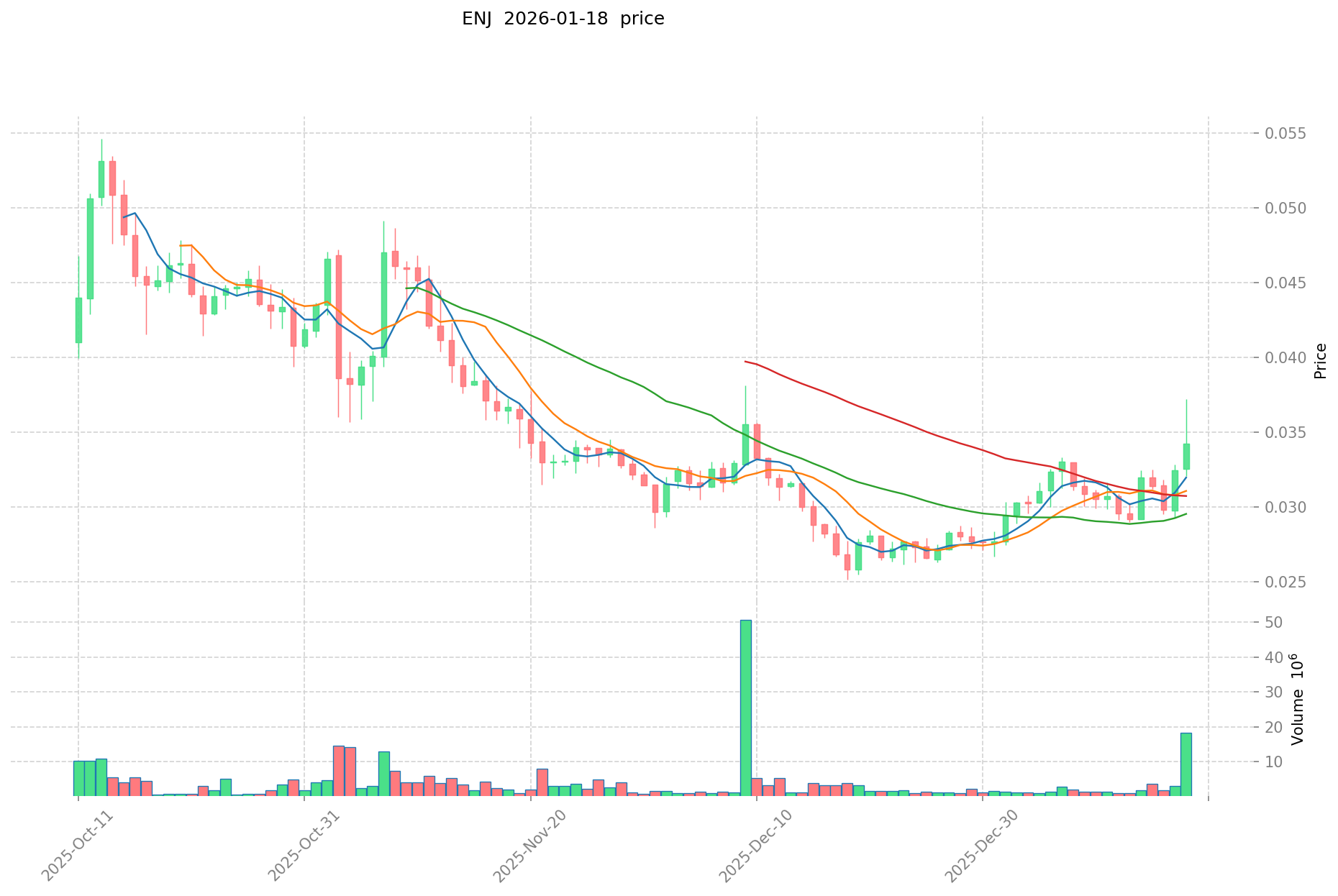
On-chain Metrics
- Holder Count: 153,530 addresses (reflecting user participation and token distribution)
- 24-hour Trading Volume: $351,543.73 (indicating current market activity)
- Market Capitalization: $64,010,552.20 (representing the token's overall market value)
Enjin Coin Ecosystem Applications and Partnerships
Core Use Cases
Enjin Coin's ecosystem supports multiple applications:
- Gaming and Virtual Assets: Enjin platform enables game developers and content creators to integrate blockchain-based virtual items, providing true ownership and interoperability of in-game assets.
- NFT Infrastructure: The platform facilitates creation and management of non-fungible tokens, allowing communities to tokenize digital collectibles and game items.
Strategic Partnerships
Enjin has established its presence through collaboration with various gaming communities and developers, enhancing its technical capabilities within the gaming sector.
These partnerships provide a foundation for Enjin Coin's ecosystem expansion.
Controversies and Challenges
Enjin Coin faces the following challenges:
- Market Competition: The rise of other blockchain gaming platforms and NFT ecosystems
- Regulatory Considerations: Evolving regulatory frameworks for digital assets and NFTs
- Technology Evolution: Adapting to changing blockchain standards and gaming industry requirements
These issues have sparked discussions within the community and market, while driving Enjin Coin's continued innovation.
Enjin Coin's community demonstrates notable activity, with the platform having 18.7 million registered players and approximately 60 million monthly global game player visits.
On X platform, related posts and hashtags (such as #ENJ) generate regular engagement within the gaming and NFT communities.
Factors such as new gaming integrations and NFT marketplace developments have contributed to community enthusiasm.
Sentiment on X presents diverse perspectives:
- Supporters praise Enjin Coin's gaming integration capabilities and NFT functionality, viewing it as a bridge between traditional gaming and blockchain technology.
- Observers discuss market volatility and the evolving gaming NFT landscape.
Recent trends reflect ongoing interest in gaming-focused blockchain applications.
Trending Topics
X users discuss Enjin Coin's role in gaming economies, NFT utility, and virtual item ownership, showcasing both its innovation potential and the challenges in mainstream gaming adoption.
- Official Website: Visit Enjin official website for features, use cases, and latest updates.
- White Paper: Enjin Coin white paper details its technical architecture, objectives, and vision.
- X Updates: On X platform, Enjin uses @enjin for community engagement, with posts covering platform updates, gaming integrations, and ecosystem developments, generating notable community interaction.
Enjin Coin Future Roadmap
- Ongoing Development: Continued enhancement of blockchain gaming infrastructure and NFT capabilities
- Ecosystem Goals: Expanding support for gaming communities and virtual item marketplaces
- Long-term Vision: Establishing itself as a leading platform for blockchain-based gaming assets
How to Participate in Enjin Coin?
- Purchase Channels: ENJ can be acquired on Gate.com and other cryptocurrency exchanges
- Storage Solutions: Secure storage using compatible cryptocurrency wallets
- Community Participation: Engage with the Enjin community through official channels and gaming platforms
- Ecosystem Building: Developers can explore Enjin's documentation to integrate blockchain features into gaming projects
Summary
Enjin Coin leverages blockchain technology to redefine gaming and virtual assets, providing ownership transparency, asset interoperability, and community-driven value.
Its active community, extensive gaming platform background, and market presence establish its position in the cryptocurrency gaming sector.
Despite facing competitive pressures and evolving market dynamics, Enjin Coin's focus on gaming applications and clear development direction position it within the future of blockchain-based gaming.
Whether you are new to crypto gaming or an experienced participant, Enjin Coin represents an interesting project in the intersection of blockchain and gaming industries.
FAQ
What is Enjin (ENJ) and what is its main purpose?
Enjin (ENJ) is a utility token powering a blockchain platform for creating, trading, and monetizing NFTs and in-game items. It enables gas-free transactions, supports gaming ecosystems across multiple platforms, and backs the value of digital assets built on the Enjin network.
How can I buy and store Enjin (ENJ) tokens?
Purchase ENJ tokens using a credit or debit card on cryptocurrency exchanges. Store your ENJ in a secure digital wallet, either a custodial wallet provided by exchanges or a non-custodial wallet for enhanced security and full control over your assets.
What is the difference between Enjin (ENJ) and other gaming cryptocurrencies?
Enjin (ENJ) is a comprehensive blockchain platform for gaming, offering developer tools and infrastructure. Unlike many gaming tokens focused on specific games, ENJ provides broader ecosystem support, stronger community backing, and an established track record in the Web3 gaming space.
What are the risks and benefits of investing in Enjin (ENJ)?
Benefits include reduced payment fraud, lower transaction costs, and gaming ecosystem growth potential. Risks involve market volatility, regulatory uncertainty, and competitive pressures in the blockchain gaming space.
How does Enjin's blockchain technology work for NFTs and gaming?
Enjin Blockchain is a Substrate-based Proof-of-Stake blockchain custom-built for NFTs and digital assets. Developers can embed ENJ tokens within NFTs to ensure base value. The platform provides APIs and SDKs for seamless integration into games, enabling player-driven economies with real-world value digital assets.
* The information is not intended to be and does not constitute financial advice or any other recommendation of any sort offered or endorsed by Gate.