This comprehensive guide explores Ethereum Name Service (ENS), a decentralized naming system launched in 2017 that transforms complex blockchain addresses into human-readable domains. ENS serves as critical Web3 infrastructure, enabling simplified cryptocurrency transactions and decentralized identity management across DeFi platforms and applications. The article examines ENS's technical architecture leveraging Ethereum's blockchain and PoS consensus, analyzes current market performance with 66,947 token holders and $417.7M market cap, and explores ecosystem partnerships. It addresses challenges including scalability and regulatory uncertainties while highlighting community enthusiasm and adoption trends. The guide provides practical insights on registering domains, purchasing ENS tokens on Gate, participating in governance, and understanding ENS's pivotal role in mainstream blockchain adoption and decentralized web infrastructure development.
ENS's Positioning and Significance
In 2017, True Names Limited and Ethereum community contributors launched Ethereum Name Service (ENS) (ENS), aiming to solve the complexity of interacting with blockchain addresses and the poor user experience of remembering long hexadecimal strings.
As the leading decentralized domain name service on Ethereum, ENS plays a critical role in blockchain identity, Web3 infrastructure, and decentralized applications.
As of 2026, ENS has become a key infrastructure component in the Ethereum ecosystem, with 66,947 holders and an active developer community.
This article will provide an in-depth analysis of its technical architecture, market performance, and future potential.
Origin and Development History
Birth Background
ENS was created by True Names Limited and the Ethereum community in 2017, aiming to solve the challenge of mapping human-readable names to machine-readable blockchain identifiers, improving user experience in Web3 interactions.
It emerged during the rapid expansion of Ethereum's ecosystem and growing demand for user-friendly blockchain interfaces, with the goal of providing a decentralized, open, and extensible naming system that replaces complex addresses with memorable domain names.
ENS's launch brought blockchain users, developers, and Web3 applications new possibilities for simplified interaction.
Important Milestones
- 2017: Service launched, enabling users to register .eth domains and map them to Ethereum addresses, content hashes, and metadata.
- 2021: ENS token launched in November, introducing decentralized governance and treasury management through DAO structure.
- 2021: Trading began on multiple platforms including Gate.com, with initial market recognition driving ecosystem expansion.
- 2023: Ecosystem continued to grow with integration across numerous DeFi protocols, NFT platforms, and Web3 applications.
With support from ENS DAO and the global Ethereum community, ENS continues to optimize its protocol, security features, and real-world utility.
How ENS Works
No Central Control
ENS operates on Ethereum's decentralized network of global nodes, independent of centralized authorities or intermediaries.
These nodes collaboratively maintain the naming registry, ensuring the system remains transparent, censorship-resistant, and resilient against attacks, giving users complete ownership of their domain names and enhancing network durability.
Blockchain Foundation
ENS's smart contracts run on Ethereum's blockchain, a public and immutable digital ledger that records all domain registrations and updates.
Registrations and resolver updates are recorded as transactions, grouped into blocks and cryptographically linked to form a secure chain.
Anyone can verify domain ownership records without requiring intermediaries to establish trust.
The system leverages Ethereum's existing infrastructure while implementing hierarchical domain management through specialized smart contracts.
Ensuring Integrity
ENS relies on Ethereum's Proof of Stake (PoS) consensus mechanism to validate transactions and prevent unauthorized domain manipulations or fraudulent registrations.
Ethereum validators maintain network security through staking ETH and validating blocks containing ENS transactions, earning staking rewards.
The protocol's innovation includes permanent domain ownership model with renewable registration periods, allowing users to retain control of their domains as long as renewals are maintained.
Secure Ownership
ENS utilizes Ethereum's public-private key cryptography to protect domain ownership:
- Private keys (similar to secret passwords) control domain management and configuration
- Public keys (similar to account identifiers) verify ownership on the blockchain
This mechanism ensures secure domain control while maintaining pseudonymous ownership records publicly visible on the blockchain.
Additional features include multi-signature wallet support and programmable resolver contracts enabling complex ownership and management structures.
Circulation Overview
As of January 15, 2026, ENS has a circulating supply of 38,194,934.79 tokens, with a total supply of 100,000,000 tokens. The maximum supply is capped at 100,000,000 tokens, representing a fixed supply model.
The current circulating supply accounts for approximately 38.19% of the total supply. ENS tokens serve as the native governance token of the Ethereum Name Service, used for voting on protocol decisions and treasury grant allocations.
Price Fluctuations
ENS reached a peak price of $83.40 on November 11, 2021, driven by strong market demand following its initial token distribution and the broader cryptocurrency market rally during that period.
The token experienced its lowest price of $6.69 on October 19, 2023, coinciding with broader market corrections and reduced trading activity in the decentralized identity sector.
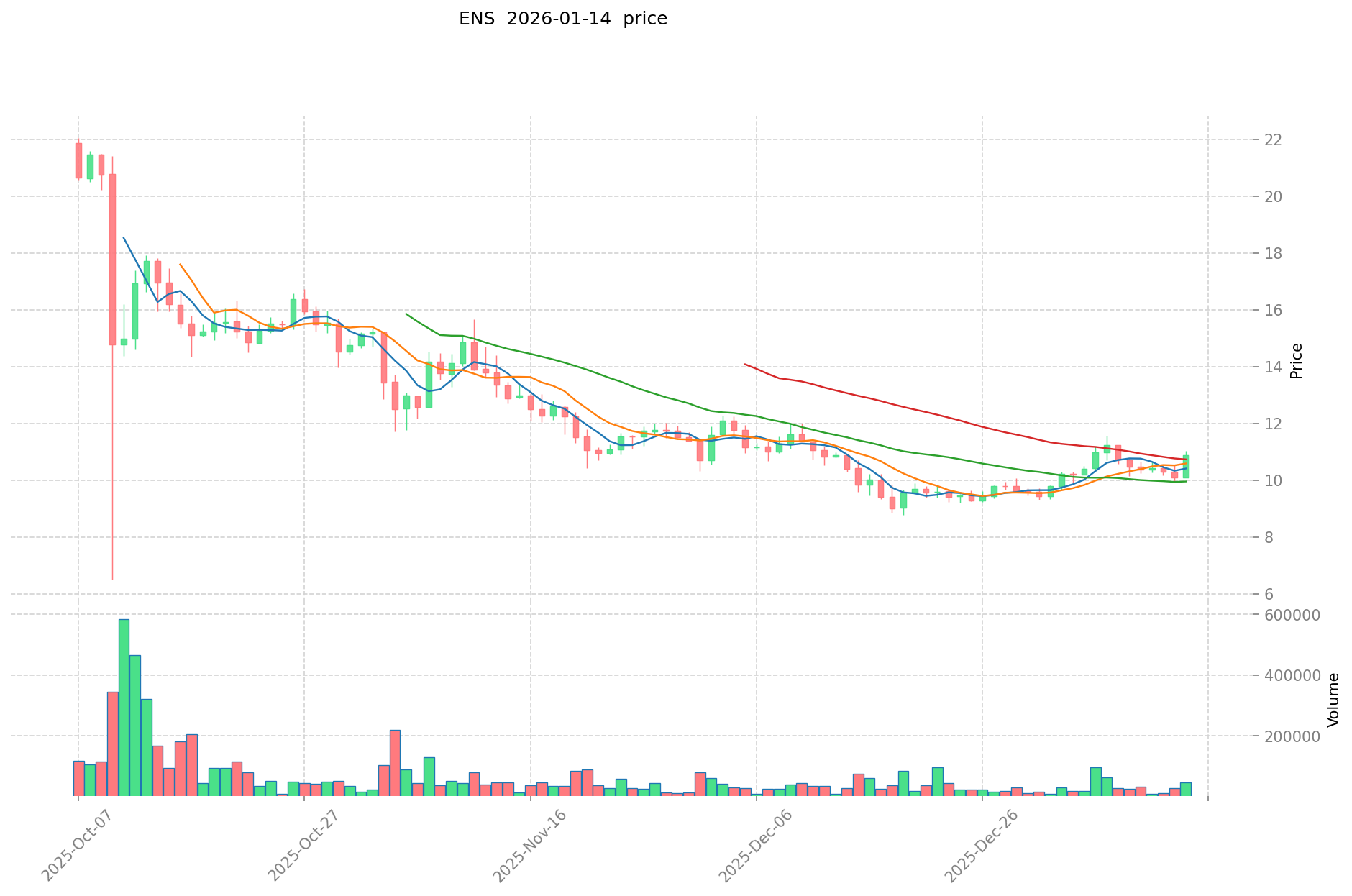
Recent price movements show a -1.15% change over 1 hour, -0.09% over 24 hours, and +2.27% over 7 days. Over the past 30 days, ENS has gained 11.55%, though it remains down -64.64% from its price one year ago. These fluctuations reflect shifting market sentiment, adoption trends, and evolving demand for blockchain-based naming services.
Click to view the current ENS market price
On-Chain Metrics
- Market Capitalization: $417,738,001.81 (reflecting current valuation based on circulating supply)
- 24-Hour Trading Volume: $735,622.01 (indicating market liquidity and trading activity)
- Token Holders: 66,947 addresses (demonstrating community participation and distribution)
- Fully Diluted Valuation: $1,093,700,000.00 (representing potential market cap if all tokens were in circulation)
ENS Ecosystem Applications and Partners
Core Use Cases
ENS's ecosystem supports multiple applications:
- Domain Name Services: ENS domains like "alice.eth" provide human-readable names for Ethereum addresses, simplifying cryptocurrency transactions and decentralized website access.
- DeFi Integration: ENS names are integrated across DeFi platforms, enabling users to send payments and interact with smart contracts using memorable names instead of complex addresses.
- Digital Identity: ENS serves as a decentralized identity system, allowing users to associate their Ethereum addresses with profiles, social media, and other metadata.
Strategic Collaborations
ENS has established partnerships within the Ethereum ecosystem, enhancing its technical capabilities and market influence.
These partnerships provide a solid foundation for ENS's ecosystem expansion.
Controversies and Challenges
ENS faces the following challenges:
- Technical Issues: Scalability concerns related to Ethereum network congestion and gas fees
- Regulatory Risk: Evolving regulations around decentralized naming systems and cryptocurrency governance
- Competition Pressure: Alternative naming services and blockchain identity solutions competing for market share
These issues have sparked discussions within the community and market, also driving ENS's continuous innovation.
Fan Enthusiasm
ENS's community demonstrates strong vitality, with approximately 66,947 token holders.
On X platform, relevant posts and hashtags (such as #ENS) frequently trend, generating significant engagement.
New feature launches and integration announcements have ignited community enthusiasm.
Sentiment on X presents polarization:
- Supporters praise ENS's decentralization features and its role in simplifying blockchain user experience, considering it fundamental infrastructure for Web3.
- Critics focus on issues such as price volatility and dependency on Ethereum's network performance.
Recent trends show mixed sentiment influenced by broader market conditions.
Hot Topics
X users actively discuss ENS's governance model, treasury management, and integration with Web3 applications,
showcasing both its transformative potential and the obstacles toward mainstream adoption.
- Official Website: Visit ENS Official Website to learn about features, use cases, and latest developments.
- X Updates: On X platform, ENS maintains an active presence using @ensdomains,
with posts covering technical upgrades, community events, and partnership announcements, generating substantial likes and retweets.
ENS Future Roadmap
- Ongoing Development: Continued enhancement of domain resolution capabilities and cross-chain compatibility
- Ecosystem Goals: Expand integration with more DApps and Web3 platforms
- Long-term Vision: Become the standard naming service for decentralized identity across blockchains
How to Participate in ENS?
- Purchase Channels: Buy ENS on Gate.com and other supported exchanges
- Storage Solutions: Securely store ENS tokens using compatible Ethereum wallets
- Participate in Governance: Engage in community decisions through the ENS DAO voting system
- Build Ecosystem: Visit ENS documentation to develop applications or contribute to the protocol
Summary
ENS redefines domain name services through blockchain technology, providing transparency, decentralization, and seamless integration with Ethereum addresses.
Its active community, comprehensive resources, and strong market performance distinguish it in the cryptocurrency domain.
Despite facing regulatory uncertainties and technical challenges, ENS's innovative approach and clear development direction position it as important infrastructure in the future of decentralized technology.
Whether you are a newcomer or experienced participant, ENS deserves attention and involvement.
FAQ
What is ENS (Ethereum Name Service) and how does it work?
ENS is a decentralized naming system on Ethereum that converts long wallet addresses into human-readable names, similar to DNS. It uses smart contracts for transparent, censorship-resistant name resolution without central authorities.
How do I register an ENS domain name?
To register an ENS domain, visit the ENS app, select your desired name and registration period, then complete a three-step process: request registration, wait 60 seconds, and finalize the registration transaction in your wallet within one day.
What are the costs and fees associated with registering an ENS name?
ENS registration costs $5 per year for names with 5+ characters, $160 annually for 4-character names, and $640 for 3-character names, plus network gas fees.
How is ENS different from traditional DNS domain names?
ENS uses blockchain technology for decentralized domain management, unlike traditional DNS controlled by central authorities. ENS domains are immutable, owned by users, and directly resolve to crypto addresses without intermediaries.
Can I use ENS to receive cryptocurrency payments?
Yes, you can use ENS to receive cryptocurrency payments. ENS names function as wallet addresses, enabling direct crypto transfers. PayPal and Venmo now support sending crypto via ENS usernames, making payments simpler and more user-friendly.
What are the benefits of owning an ENS domain?
ENS domains enhance brand recognition, simplify cryptocurrency transactions, and provide long-term value. They create memorable web addresses on Ethereum blockchain, improve user trust, and secure your digital identity for future growth.
How long does an ENS domain registration last?
ENS domain registrations last for a minimum of one year and can be renewed for up to 8 years at a time. Once expired, domains enter a grace period before becoming available for re-registration.
Is my ENS domain name secure and permanent?
Yes. Your ENS domain is secure and permanent once registered, as it's stored immutably on the Ethereum blockchain. Ownership remains yours indefinitely unless you choose to release it.
Can I sell or transfer my ENS domain to someone else?
Yes, you can sell or transfer your ENS domain. You have full ownership and can transfer it to another wallet address or sell it on supported platforms. Simply use the transfer function in the ENS manager to send it to a new owner.
What happens if I don't renew my ENS domain?
If you don't renew your ENS domain, it enters a 90-day grace period. After that, your domain expires and becomes available for anyone to register. You lose ownership and control of the domain permanently.
* The information is not intended to be and does not constitute financial advice or any other recommendation of any sort offered or endorsed by Gate.