Eclipse represents an innovative Layer 2 scaling solution launched in 2025, combining Ethereum settlement, Solana Virtual Machine execution, and Celestia data availability to address blockchain scalability challenges. This comprehensive guide explores Eclipse's technical architecture, market performance, and ecosystem applications, demonstrating how it delivers Solana-level execution speed while maintaining Ethereum security guarantees. The ES token trades on Gate.com and multiple platforms, with a circulating supply of 150 million tokens. Backed by leading investors including Placeholder VC and Polychain, Eclipse serves DeFi protocols, NFT platforms, and high-frequency trading applications. The article covers Eclipse's modular design, on-chain metrics, strategic partnerships, and future roadmap, providing readers with essential insights into this emerging hybrid blockchain infrastructure and its role in cross-chain interoperability.
Eclipse's Positioning and Significance
In 2025, the Eclipse Foundation launched Eclipse (ES), aiming to address scalability limitations and high transaction costs on Ethereum while maintaining its security guarantees.
As Ethereum's first Solana Virtual Machine (SVM) Layer 2 solution, Eclipse plays a critical role in blockchain scalability and cross-chain interoperability.
As of 2026, Eclipse has established itself as an innovative Layer 2 infrastructure combining Ethereum settlement, SVM execution, and Celestia data availability, supported by leading venture capital firms including Placeholder VC, Hack VC, Polychain, and industry pioneers from Celestia, Solana, and Flashbots.
This article will provide an in-depth analysis of its technical architecture, market performance, and future potential.
Origin and Development History
Birth Background
Eclipse was created by the Eclipse Foundation in 2025, aiming to solve Ethereum's scalability challenges while preserving its security and decentralization.
It emerged during the maturation of modular blockchain architecture and growing demand for high-performance Layer 2 solutions, with the goal of delivering Solana-level execution speed on Ethereum through innovative architectural design.
Eclipse's launch brought new possibilities for DeFi protocols, NFT platforms, and high-frequency trading applications requiring both speed and security.
Important Milestones
- 2025: Mainnet launch, achieving integration of Ethereum settlement layer, SVM execution environment, and Celestia data availability.
- 2025: Secured backing from leading investors including Placeholder VC, Hack VC, DBA, Polychain, Tribe, and Parafi, along with endorsements from industry leaders such as Mustafa Al-Bassam (Celestia), Anatoly Yakovenko (Solana), and Hasu (Flashbots).
- 2026: ES token trading commenced on Gate.com and multiple platforms, with the token demonstrating significant growth momentum.
With support from its investor consortium and vibrant developer community, Eclipse continues to optimize its technical capabilities, security infrastructure, and real-world applications.
How Eclipse Works
Decentralized Architecture
Eclipse operates across a distributed network of nodes spanning the globe, eliminating reliance on centralized financial institutions or governmental control.
These nodes collaborate to validate transactions, ensuring system transparency and attack resistance, granting users greater autonomy and enhancing network resilience.
Modular Blockchain Core
Eclipse's architecture represents a modular approach combining best-in-class components: Ethereum provides settlement guarantees, the Solana Virtual Machine enables high-performance execution, and Celestia ensures data availability.
Transactions are processed through the SVM execution layer, settled on Ethereum, with data availability secured by Celestia.
This layered approach creates a public, immutable ledger where anyone can verify records without intermediaries.
The modular stack design further enhances performance by optimizing each layer independently.
Consensus and Validation
Eclipse leverages Ethereum's Proof of Stake consensus mechanism for final settlement while utilizing SVM's high-throughput execution environment for transaction processing.
Validators secure the network through staking and node operation across multiple layers, receiving rewards denominated in ES tokens.
Its innovation includes combining Ethereum's security with Solana's execution speed, achieving significantly higher transactions per second compared to traditional Layer 2 solutions.
Secure Transactions
Eclipse employs public-private key cryptography to protect transactions:
- Private keys (similar to secret passwords) are used to sign transactions
- Public keys (similar to account numbers) verify ownership
This mechanism ensures fund security while transactions maintain pseudonymous privacy.
The multi-layer architecture provides additional security through Ethereum settlement guarantees and Celestia's data availability proofs.
Circulation Overview
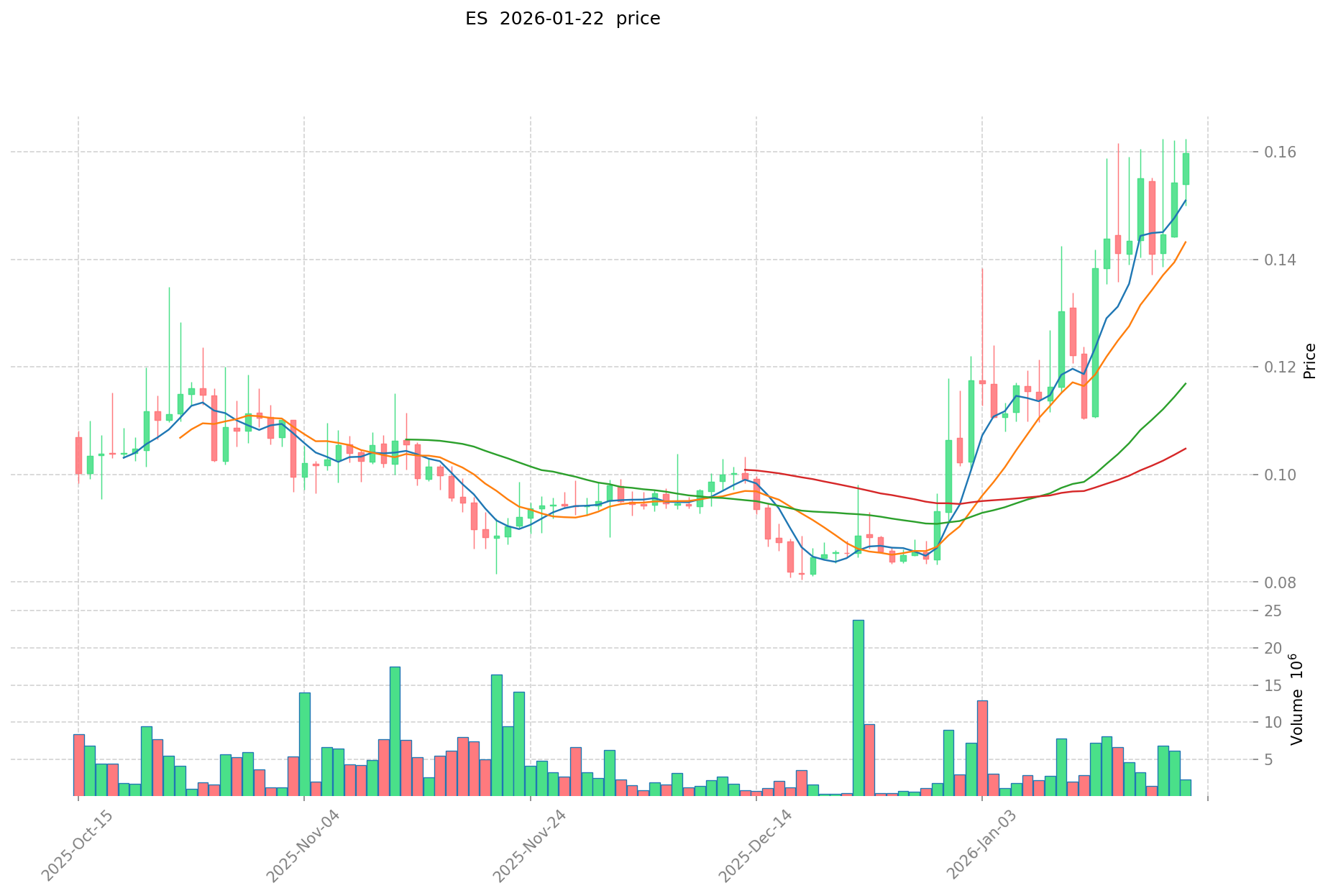
As of January 22, 2026, Eclipse's circulating supply is 150,000,000 ES tokens, with a total supply of 1,000,000,000 tokens. The circulating supply represents approximately 15% of the total supply, indicating a controlled token release strategy. The token operates under a fixed supply model with a maximum cap of 1,000,000,000 tokens.
Price Volatility
Eclipse reached a notable price level of $0.5 on July 16, 2025, driven by market dynamics during the project's early trading phase. The token experienced its lowest price point at $0.0723 on October 10, 2025, reflecting market adjustments following initial launch momentum. These price movements demonstrate the typical volatility patterns associated with emerging blockchain projects, influenced by market sentiment, adoption trends, and broader crypto market conditions.
Click to view current ES market price
On-Chain Metrics
- 24-Hour Trading Volume: $196,345 (indicating active market participation)
- Token Holders: 777 addresses (reflecting growing community engagement)
- Market Capitalization: $23.99 million (demonstrating current market valuation)
Eclipse Ecosystem Applications and Partners
Core Use Cases
Eclipse's ecosystem architecture combines multiple leading technologies to support various applications:
- Layer 2 Scaling: Eclipse serves as Ethereum's first Solana Virtual Machine (SVM) L2 solution, providing enhanced transaction execution efficiency while maintaining Ethereum settlement security.
- Modular Infrastructure: Eclipse leverages Celestia for data availability, delivering optimized performance across execution, settlement, and data layers.
Strategic Partnerships
Eclipse has established collaborations with Celestia, Solana, and Ethereum ecosystems, enhancing its technical capabilities across the modular blockchain stack. These partnerships provide Eclipse with robust infrastructure support for cross-chain interoperability and scalability.
Challenges and Considerations
Eclipse faces several considerations:
- Technical Complexity: Integrating multiple blockchain layers (Ethereum settlement, SVM execution, Celestia data availability) presents architectural coordination challenges
- Market Competition: Operating in a competitive L2 landscape with established solutions
- Ecosystem Development: Building developer adoption and application deployment on a novel architecture
These factors continue to shape Eclipse's development trajectory and community engagement.
Eclipse's community demonstrates active participation, with 777 token holders as of January 2026. The project has garnered support from prominent industry figures including Mustafa Al-Bassam (Celestia), Anatoly Yakovenko (Solana), and representatives from leading investment firms.
On X platform, Eclipse maintains an active presence through @EclipseFND, sharing updates about technical developments and ecosystem growth. Community discussions often center around Eclipse's unique hybrid architecture combining Ethereum and Solana technologies.
Discussion Topics
X users engage with Eclipse's modular L2 approach, SVM execution benefits, and cross-chain capabilities, exploring both the technical innovations and practical applications of the platform.
- Official Website: Visit Eclipse official site for features, use cases, and latest developments.
- White Paper: Eclipse Performance Thesis details its technical architecture, objectives, and vision.
- X Updates: On X platform, Eclipse uses @EclipseFND for community engagement, sharing content about technical upgrades, ecosystem developments, and partnership announcements.
Eclipse Future Roadmap
- Ongoing Development: Continued enhancement of SVM L2 execution capabilities on Ethereum
- Ecosystem Goals: Expanding developer tools and application deployment infrastructure
- Long-term Vision: Establishing Eclipse as a high-performance L2 solution bridging Ethereum security with SVM efficiency
How to Participate in Eclipse?
- Purchase Options: Acquire ES tokens on Gate.com and other supporting exchanges
- Storage Solutions: Use compatible wallets such as MetaMask for ERC20 tokens or Eclipse-compatible wallets for secure storage
- Explore Ecosystem: Visit Eclipse documentation to learn about building on the platform
- Monitor Development: Follow Eclipse's X account and join their Discord community for updates
Summary
Eclipse introduces an innovative approach to blockchain architecture by combining Ethereum settlement, Solana Virtual Machine execution, and Celestia data availability. The project offers enhanced performance, modular design, and cross-chain benefits to developers and users.
With backing from leading investors including Placeholder VC, Polychain, and industry leaders from Celestia, Solana, and Ethereum ecosystems, Eclipse has established credibility in the L2 space. Despite facing technical integration complexity and market competition, Eclipse's unique architecture and strategic positioning in the modular blockchain landscape make it a noteworthy development in Layer 2 scaling solutions.
Whether you are exploring L2 technologies or interested in hybrid blockchain architectures, Eclipse represents an interesting approach to combining multiple leading technologies into a unified platform.
FAQ
What is Crypto ES and what does ES stand for in the cryptocurrency context?
Crypto ES refers to a digital asset in the cryptocurrency ecosystem. ES typically stands for "Exchange Settlement" or represents a specific token symbol. It functions as a blockchain-based token facilitating transactions, trading settlements, and protocol governance within its network ecosystem.
How do I buy, store, and trade Crypto ES tokens?
Purchase Crypto ES tokens through major crypto platforms using fiat or digital assets. Store them securely in hardware or software wallets. Trade via spot or futures markets on supported platforms. Always verify wallet addresses and use reputable trading venues for optimal security and liquidity.
What are the main risks and security considerations when dealing with Crypto ES?
Key risks include smart contract vulnerabilities, private key theft, market volatility, and regulatory changes. Secure your assets with hardware wallets, enable two-factor authentication, verify contract addresses, and only trade on reputable platforms. Stay informed about updates and use strong passwords.
What is the difference between Crypto ES and other similar cryptocurrencies or tokens?
Crypto ES offers superior scalability, faster transaction speeds, and lower fees compared to competitors. Its innovative consensus mechanism and enhanced security features provide users with a more efficient and reliable blockchain experience for digital asset transactions.
What is the use case and real-world application of Crypto ES?
Crypto ES serves as a decentralized utility token enabling smart contract execution, governance participation, and ecosystem incentives. Real-world applications include DeFi protocols, cross-chain bridge operations, and decentralized application payments within the Web3 ecosystem.
Is Crypto ES regulated and what is its legal status in different countries?
Crypto ES operates within evolving regulatory frameworks across jurisdictions. Its legal status varies by country—some nations classify it as a digital asset, others require specific licensing. Always verify local regulations before participating in your region.
* The information is not intended to be and does not constitute financial advice or any other recommendation of any sort offered or endorsed by Gate.