This comprehensive guide explores Filecoin (FIL), the native cryptocurrency powering the decentralized storage network launched by Protocol Labs in 2020. As the incentive layer for IPFS, Filecoin addresses centralized data control by enabling secure, verifiable file storage through innovative proof mechanisms and blockchain technology. The article covers Filecoin's technical architecture, including its decentralized consensus model and cryptographic security layers, while analyzing market performance with current pricing at $1.57 and a $1.16 billion market cap. It examines the thriving ecosystem supporting Web3 applications, the active community of 1.17 million holders, and real-world use cases in data preservation and content delivery. Additionally, the guide discusses challenges including competition from alternative storage solutions, presents strategic partnerships, and outlines participation methods through Gate and other platforms. Whether you're evaluating Filecoin as infrastructure investment or explo
Filecoin(IPFS)'s Positioning and Significance
In 2020, Protocol Labs launched Filecoin(IPFS) (FIL), aiming to solve decentralized storage inefficiency and data control by centralized entities.
As the incentive layer for the InterPlanetary File System (IPFS), Filecoin(IPFS) plays a key role in decentralized storage and Web3 infrastructure.
As of 2026, Filecoin(IPFS) has become a leading decentralized storage network, with over 1.17 million holders and an active developer community.
This article will provide an in-depth analysis of its technical architecture, market performance, and future potential.
Origin and Development History
Birth Background
Filecoin(IPFS) was created by Protocol Labs in 2020, aiming to solve the problem of centralized data storage and incentivize distributed file storage.
It was born during the rise of Web3 and decentralized technologies, with the goal of providing a secure, efficient, and decentralized storage solution to change the status quo.
The launch of Filecoin(IPFS) brought new possibilities for content creators, developers, and organizations seeking data sovereignty.
Important Milestones
- 2020: Mainnet launch on October 15, realizing decentralized storage with cryptographic proofs and blockchain verification.
- 2021: Price surge, with FIL reaching significant market attention as the network expanded its storage capacity.
- 2025: Continued ecosystem growth, with increasing adoption by enterprises and developers building decentralized applications.
- 2026: As of January, trading at approximately $1.57 with a circulating supply of 736 million FIL.
With the support of Protocol Labs, the Filecoin Foundation, and the global community, Filecoin(IPFS) continues to optimize its technology, security, and real-world applications.
How Filecoin(IPFS) Works
No Central Control
Filecoin(IPFS) operates on a decentralized network of computers (nodes) distributed globally, free from control by banks or governments.
These nodes collaborate to verify transactions and storage proofs, ensuring the system is transparent and attack-resistant, granting users greater autonomy and improving network resilience.
Blockchain Core
Filecoin(IPFS)'s blockchain is a public, immutable digital ledger that records every transaction and storage deal.
Transactions are grouped into blocks and linked through cryptographic hashes to form a secure chain.
Anyone can view the records, establishing trust without intermediaries.
The network utilizes unique cryptographic proofs (Proof-of-Replication and Proof-of-Spacetime) to verify that storage providers are correctly storing data over time.
Ensuring Fairness
Filecoin(IPFS) adopts Expected Consensus (EC) combined with Proof-of-Replication (PoRep) and Proof-of-Spacetime (PoSt) to verify storage deals and prevent fraud.
Storage miners maintain network security by providing storage capacity and generating cryptographic proofs and receive FIL rewards.
Its innovation includes verifiable storage proofs and efficient resource allocation through a storage marketplace.
Secure Transactions
Filecoin(IPFS) uses public-private key cryptography to protect transactions:
- Private keys (like secret passwords) are used to sign transactions
- Public keys (like account numbers) are used to verify ownership
This mechanism ensures fund security, and transactions maintain pseudonymous privacy.
The network's cryptographic proof system adds additional security layers by ensuring data integrity and storage provider accountability.
Circulation Overview
As of January 14, 2026, Filecoin(IPFS) has a circulating supply of 736,049,320 FIL tokens, with a total supply of 1,958,531,861 FIL. The token operates under an inflationary model with no maximum supply cap. New tokens enter the market through mining rewards distributed to storage providers who contribute hard disk capacity to the network. This mechanism incentivizes participants to provide decentralized storage solutions, directly impacting the supply-demand dynamics of the ecosystem.
Price Volatility
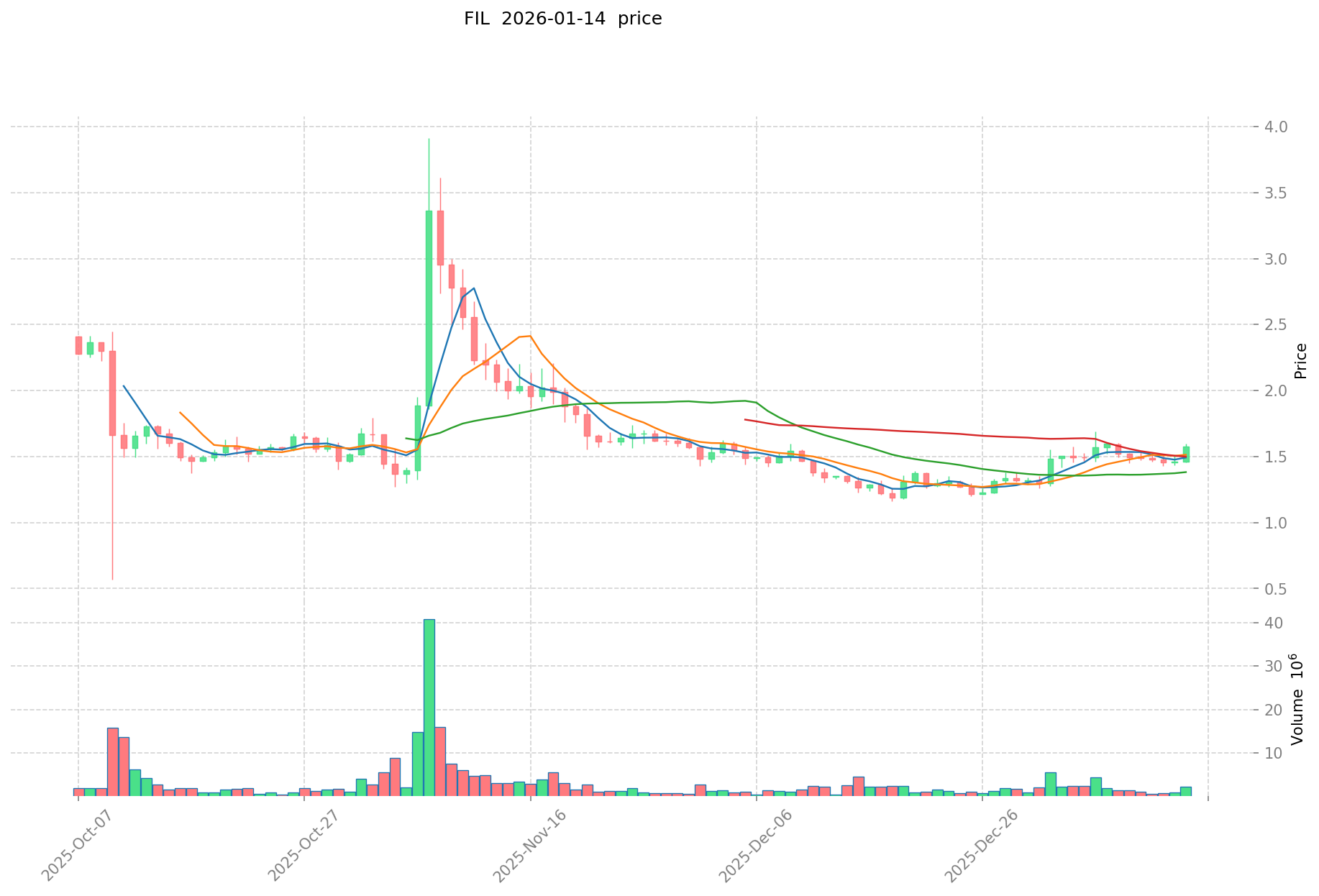
Filecoin(IPFS) reached its all-time high price of $236.84 on April 1, 2021, driven by the broader cryptocurrency market bull run and growing institutional interest in decentralized storage solutions. The token experienced its lowest price of $0.848008 on October 11, 2025, reflecting market-wide downturns and declining network activity during that period. These price fluctuations demonstrate the impact of market sentiment, adoption trends, and external macroeconomic factors on the token's valuation.
Recent price movements show varied performance across different timeframes. Over the past 24 hours, FIL has increased by 6.8%, trading at $1.57. The 7-day performance shows a modest gain of 0.26%, while the 30-day period reflects a more substantial increase of 17.43%. However, the 1-year performance indicates a significant decline of 68.10%, highlighting the challenges faced by the project amid evolving market conditions.
Click to view the current FIL market price
On-chain Metrics
- Holder Addresses: Approximately 1,172,900 addresses hold FIL tokens, indicating a broad distribution among participants in the ecosystem
- Market Capitalization: The current market cap stands at $1.16 billion, representing 0.090% of the total cryptocurrency market share
- Fully Diluted Valuation: The FDV is calculated at $3.07 billion, with the market cap to FDV ratio at 37.56%, reflecting the portion of total supply currently in circulation
- 24-hour Trading Volume: The token recorded a trading volume of $3.64 million over the past 24 hours, demonstrating ongoing market activity and liquidity
Filecoin Ecosystem Applications and Partners
Core Use Cases
Filecoin's ecosystem supports multiple applications:
- Decentralized Storage: Filecoin provides decentralized data storage solutions, offering secure and verifiable file storage.
- Web3 Infrastructure: The network enables distributed content delivery and data preservation for Web3 applications.
Strategic Partnerships
Filecoin has established collaborations to enhance its technical capabilities and market influence.
These partnerships provide a solid foundation for Filecoin's ecosystem expansion.
Controversies and Challenges
Filecoin faces the following challenges:
- Technical Issues: Storage proof mechanisms and network performance optimization remain ongoing concerns
- Competition Pressure: The rise of alternative decentralized storage solutions creates competitive dynamics
These issues have sparked discussions within the community and market, while also driving Filecoin's continuous innovation.
Fan Enthusiasm
Filecoin's community demonstrates significant activity, with over 1.17 million holders participating in the network.
On X platform, related posts and hashtags (such as #Filecoin) frequently trend.
Network developments and technological milestones fuel community enthusiasm.
Sentiment on X shows diverse perspectives:
- Supporters praise Filecoin's decentralized storage capabilities and incentive mechanisms, viewing it as essential infrastructure for Web3.
- Critics focus on network complexity and competition from alternative solutions.
Recent trends indicate varied sentiment depending on market conditions and network developments.
Hot Topics
X users actively discuss Filecoin's storage economics, network upgrades, and adoption metrics,
showcasing both its transformative potential and the challenges toward mainstream adoption.
- Official Website: Visit Filecoin Official Website for features, use cases, and latest updates.
- X Updates: On X platform, Filecoin maintains an active presence using @Filecoin,
with posts covering technical upgrades, community events, and ecosystem developments, generating significant engagement.
Filecoin Future Roadmap
- Ongoing Development: Continuous improvements to storage proof mechanisms and network performance
- Ecosystem Goals: Expanding decentralized storage adoption and developer tooling
- Long-term Vision: Becoming foundational infrastructure for decentralized data storage and Web3 applications
How to Participate in Filecoin?
- Purchase Channels: Buy FIL on Gate.com and other platforms
- Storage Solutions: Securely store FIL using compatible wallets
- Participate in Governance: Engage in community discussions through official forums
- Build the Ecosystem: Visit GitHub repositories to contribute code or develop applications
Summary
Filecoin redefines decentralized storage through blockchain technology, offering transparency, security, and verifiable data preservation.
Its active community, robust resources, and market presence establish its position in the cryptocurrency sector.
Despite facing technical complexity and competitive dynamics, Filecoin's innovation and clear development direction position it as significant infrastructure in the decentralized technology landscape.
Whether you are a newcomer or experienced participant, Filecoin merits attention and engagement.
FAQ
What is Filecoin (FIL) and how does it work?
Filecoin (FIL) is a decentralized storage network where users store data securely and affordably. Storage providers earn FIL tokens by offering storage space. Data is verified through proof-of-storage mechanisms, ensuring reliable storage and retrieval across a global peer-to-peer network.
What are the main use cases and benefits of Filecoin?
Filecoin provides decentralized storage for NFTs, Web3 applications, and permanent data archiving. Key benefits include scalable infrastructure, cost-efficiency, and reliable storage for audio, video, and gaming content across the metaverse ecosystem.
How can I buy and store Filecoin (FIL)?
Purchase FIL on crypto exchanges using fiat or other cryptocurrencies. Store it securely in a hardware wallet, software wallet, or exchange account. Choose based on your security and accessibility needs.
What is the difference between Filecoin and other storage-based cryptocurrencies?
Filecoin offers significantly lower storage costs at approximately $0.19/TB/month compared to competitors like Sia ($2.50/TB/month) and Storj ($4/TB/month). This cost advantage makes Filecoin more economically attractive for storage providers and users seeking affordable decentralized storage solutions.
Is Filecoin a good investment? What are the risks?
Filecoin has strong technical foundations in decentralized storage but faces significant market pressures. It experienced an 80.63% annual decline and 99.47% retreat from its 2021 peak. Long-term potential exists if enterprise adoption accelerates, though current valuations reflect high market skepticism and continuous selling pressure.
How do Filecoin miners earn rewards?
Filecoin miners earn rewards through block rewards proportional to their quality-adjusted power contribution to the network. Miners are compensated based on their storage capacity and service quality, with rewards distributed fairly across the network.
What is the total supply and tokenomics of FIL?
Filecoin (FIL) has a total supply of 1.95 billion tokens with approximately 687 million in circulation. The tokenomics model rewards storage providers through block rewards and retrieval fees, incentivizing network participation and data preservation.
* The information is not intended to be and does not constitute financial advice or any other recommendation of any sort offered or endorsed by Gate.