Fly.trade is a revolutionary multichain liquidity aggregator protocol launched in 2025, designed to solve fragmented liquidity across blockchains and deliver seamless swap experiences. As a key DeFi infrastructure solution, FLY token (circulating supply: 13.08M) enables optimized swap routing across multiple blockchain networks with non-custodial security. The protocol operates through decentralized nodes on the Sonic blockchain, providing traders and protocols with superior execution efficiency. With 2,468 holders and active community engagement, Fly.trade addresses competitive gaps in cross-chain trading. This comprehensive guide covers technical architecture, market performance (reaching $1.77 in June 2025), ecosystem applications, and investment considerations, helping readers understand Fly.trade's role in DeFi infrastructure and cross-chain asset exchange on Gate.
Fly.trade's Position and Significance
In 2025, the Fly.trade team launched Fly.trade (FLY), aiming to address fragmented liquidity across blockchains and inefficient swap experiences for traders.
As a multichain liquidity aggregator, Fly.trade plays a key role in DeFi and cross-chain asset exchange.
As of 2026, Fly.trade has established itself within the crypto ecosystem, with a circulating supply of approximately 13.08 million FLY tokens and an active community of 2,468 holders.
This article will provide an in-depth analysis of its technical architecture, market performance, and future potential.
Origin and Development History
Background of Creation
Fly.trade was created in 2025, aiming to solve the challenge of accessing optimal liquidity across multiple blockchain networks and delivering seamless swap experiences.
It emerged during the expansion of multichain ecosystems and growing demand for efficient DeFi infrastructure, with the goal of providing traders, protocols, and agents with optimized swap routing and superior user experience.
The launch of Fly.trade brought new possibilities for DeFi users and cross-chain traders.
Major Milestones
- 2025: Mainnet launch on the Sonic blockchain, achieving multichain liquidity aggregation functionality.
- June 6, 2025: Token price reached a notable level of $1.77.
- 2025: Ecosystem development with integration across multiple chains and growing adoption by traders.
- 2026: Continued optimization of protocol functionality and user experience enhancements.
With the support of the development team and community, Fly.trade continues to refine its technology, security, and real-world applications.
How Fly.trade Works?
No Central Control
Fly.trade operates on a decentralized network of computers (nodes) distributed globally, free from control by banks or governments.
These nodes collaborate to validate transactions, ensuring system transparency and resistance to attacks, granting users greater autonomy and enhancing network resilience.
Blockchain Core
Fly.trade's blockchain is a public, immutable digital ledger that records every transaction.
Transactions are grouped into blocks and linked through cryptographic hashing to form a secure chain.
Anyone can view the records, establishing trust without intermediaries.
The protocol leverages the Sonic blockchain infrastructure to enhance performance and efficiency.
Ensuring Fairness
Fly.trade relies on the Sonic blockchain's consensus mechanism to validate transactions and prevent fraudulent activities such as double-spending.
Network participants maintain system security through validation and node operation, receiving rewards accordingly.
The innovation includes optimized swap routing across multiple liquidity sources for better execution.
Secure Transactions
Fly.trade uses public-private key cryptography to protect transactions:
- Private keys (similar to secret passwords) are used to sign transactions
- Public keys (similar to account numbers) are used to verify ownership
This mechanism ensures fund security while maintaining transparent on-chain verification.
The protocol emphasizes user control over assets through non-custodial architecture.
Circulation Overview
As of February 08, 2026, FLY has a circulating supply of 13,084,779 tokens, with a total supply of 100,000,000 tokens. The maximum supply is capped at 100,000,000 tokens, establishing a fixed supply model.
The current circulating supply represents approximately 13.02% of the total supply, with the remaining tokens potentially subject to future distribution schedules.
Price Fluctuations
FLY reached a peak price of $1.77 on June 06, 2025, during the early stages of its market introduction. The lowest price of $0.01307 was recorded on November 28, 2025, reflecting subsequent market adjustments and volatility patterns typical of emerging digital assets.
These fluctuations illustrate the dynamic nature of market sentiment, adoption trends, and broader market conditions affecting the asset's valuation.
Click to view the current FLY market price
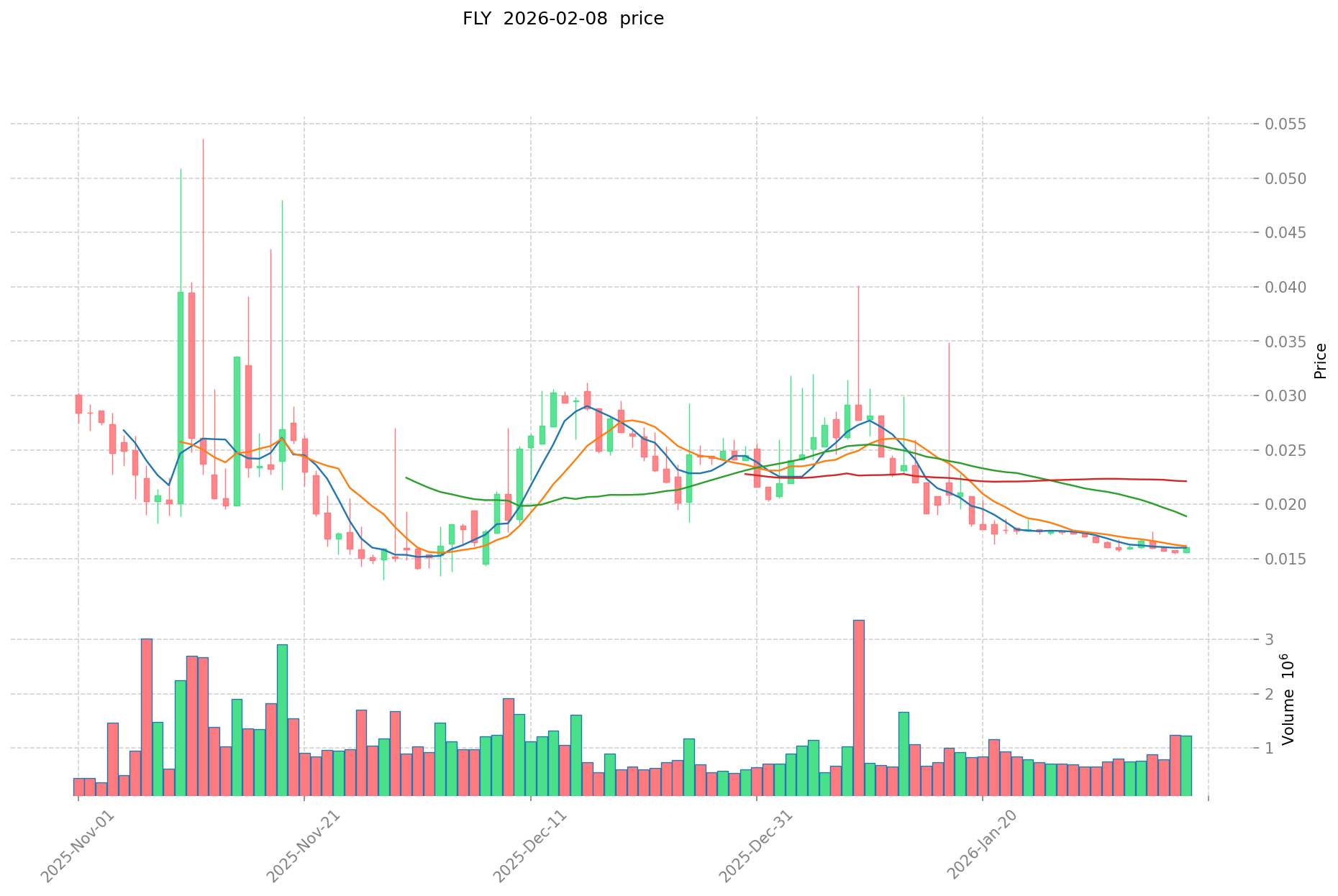
On-Chain Metrics
- Holder Addresses: Approximately 2,468 addresses (reflecting current network participation)
- 24-Hour Trading Volume: $14,398.70 (indicating recent market activity levels)
- Market Capitalization: $206,477.81 (representing current circulating value assessment)
Fly.trade Ecosystem Applications and Strategic Partners
Core Use Cases
Fly.trade's ecosystem supports multiple applications:
- DeFi: As a multichain liquidity aggregator, Fly.trade optimizes swap processes for traders and protocols, delivering seamless user experience across different blockchain networks.
- Protocol Integration: Fly.trade serves as infrastructure for automated trading agents and protocols, enhancing their swap efficiency and liquidity access.
Strategic Partnerships
While specific partnership details are not extensively documented in available materials, Fly.trade's multichain approach positions it to collaborate with various blockchain ecosystems and DeFi protocols.
These potential collaborations provide foundation for Fly.trade's ecosystem expansion.
Challenges and Considerations
Fly.trade faces several considerations:
- Market Competition: Operating in a competitive liquidity aggregator space with established players
- Market Volatility: The token experienced significant price fluctuations, with a 30-day decline of approximately 49.87%
- Adoption Growth: With 2,468 holders as of February 8, 2026, continued user acquisition remains an ongoing focus
These factors shape community discussions and drive the project's continued development.
Fly.trade's community shows active participation, with the project maintaining presence across multiple platforms.
On X platform, users engage with content related to Fly.trade's swap optimization features and multichain capabilities.
Project updates and feature announcements generate interest among traders seeking efficient liquidity solutions.
X platform discussions present varied perspectives:
- Supporters highlight Fly.trade's seamless user experience and multichain liquidity optimization, viewing it as a valuable tool for efficient token swaps.
- Observers monitor the project's price performance and adoption metrics, particularly given recent market movements.
Recent trends reflect the broader market sentiment affecting DeFi protocols and liquidity aggregators.
Discussion Topics
X users discuss Fly.trade's multichain approach, swap optimization technology, and position within the DeFi landscape,
showcasing both its technical innovation and the challenges of establishing presence in a competitive sector.
- Official Website: Visit Fly.trade Official Site for features, use cases, and latest updates.
- X Platform: Fly.trade maintains active presence on X at @flytrade_, sharing updates about technical developments, community activities, and platform enhancements.
- Discord Community: Join discussions at the Fly.trade Discord to engage with the community.
- Blockchain Explorer: View contract details on Sonic Scan.
How to Participate in Fly.trade?
- Purchase Options: FLY token is available for trading on Gate.com and other exchanges
- Storage Solutions: Store FLY tokens securely using compatible Web3 wallets that support the Sonic blockchain
- Use the Platform: Access Fly.trade's multichain liquidity aggregator for optimized token swaps
- Community Engagement: Join the Discord community to stay updated and participate in discussions
Summary
Fly.trade offers a multichain liquidity aggregator solution, providing optimized swap processes, seamless user experience, and protocol integration capabilities.
Its technical approach to liquidity optimization and multichain support positions it within the DeFi infrastructure landscape.
Despite facing market volatility and competitive pressures, Fly.trade's focus on user experience and swap optimization represents its contribution to decentralized trading infrastructure.
Whether you're a trader seeking efficient swaps or interested in DeFi protocols, Fly.trade presents an option worth exploring.
FAQ
What is FLY cryptocurrency? What are its main features and uses?
FLY is a DeFi cross-chain aggregation token providing infrastructure services. It enables users to deposit and trade multiple tokens across chains with a single click, simplifying cross-chain transactions and investments for both retail and institutional traders.
How to buy FLY coin? Which exchanges support FLY trading?
You can purchase FLY through major cryptocurrency exchanges by creating an account, completing verification, and placing buy orders. FLY is also available on decentralized exchanges like Uniswap and PancakeSwap for direct wallet-to-wallet trading. Choose based on your preference for centralized or decentralized trading.
What is the team background and technical features of the FLY project?
FLY project is developed by the Flight Intelligence Technology and Equipment team, focusing on artificial intelligence and big data technologies. The team possesses leading technical capabilities and research strength to drive economic and social progress through innovation.
What are the main risks of investing in FLY coin?
FLY coin investment carries significant risks including extreme price volatility, regulatory uncertainty, potential exchange fraud, and liquidity concerns. Market manipulation by large holders and platform operational failures pose additional threats to investors.
What is the difference between FLY and other cryptocurrencies such as Ethereum and Dogecoin?
FLY differs from Ethereum and Dogecoin in its specific use case and design. Ethereum enables smart contracts and DApps, while Dogecoin functions as a meme-driven currency. FLY serves distinct purposes with unique tokenomics and utility tailored to its ecosystem, offering different value propositions than both.
* The information is not intended to be and does not constitute financial advice or any other recommendation of any sort offered or endorsed by Gate.