FUEL is a decentralized Layer 2 Optimistic Rollup solution built on Ethereum, addressing scalability limitations with parallelized transaction execution exceeding 600 TPS and ultra-low fees under $0.0002 per transaction. Launched by Fuel Labs in 2024, FUEL has achieved over $380 million in TVL with a circulating supply of 7.06 billion tokens. The ecosystem features FuelVM technology, Sway programming language, and native account abstraction, empowering developers and users with faster, cost-effective transaction experiences. This comprehensive guide explores FUEL's technical architecture, market performance, ecosystem applications, and community dynamics. Whether you're a developer, investor, or blockchain enthusiast, this article provides actionable insights into FUEL's innovative approach to Ethereum scaling and its position within the competitive Layer 2 landscape.
Fuel's Position and Significance
In 2024, the Fuel team launched Fuel (FUEL), aiming to address limitations in Ethereum's scalability and transaction throughput.
As the fastest and most cost-effective Optimistic rollup on Ethereum, Fuel plays a critical role in Layer 2 scaling solutions and DeFi applications.
As of 2026, Fuel has established itself as an emerging Layer 2 solution, with over $380 million in total value locked (TVL) and an active developer community.
This article provides an in-depth analysis of its technical architecture, market performance, and future potential.
Origins and Development History
Background
Fuel was created by the Fuel Labs team in 2024, aiming to solve scalability bottlenecks and high transaction costs on Ethereum.
It emerged during the rapid expansion of Layer 2 solutions in the blockchain ecosystem, with the goal of providing developers and users with faster, cheaper transaction experiences to transform the current landscape.
The launch of Fuel brought entirely new possibilities to Ethereum ecosystem developers and DeFi users.
Major Milestones
- 2024: Mainnet launch, achieving parallelized transaction execution exceeding 600 TPS.
- December 2024: Token launched on Gate.com, expanding market accessibility.
- 2025: Fuel Ignition surpassed $380 million in TVL, demonstrating significant ecosystem growth.
- 2026: Continued ecosystem development with native account abstraction and multi-wallet support.
With support from Fuel Labs and its developer community, Fuel continues to optimize its technology, security features, and real-world applications.
How Fuel Works
Decentralized Architecture
Fuel operates on a decentralized network of nodes distributed globally, independent of centralized banking or governmental control.
These nodes collaborate to validate transactions, ensuring system transparency and attack resistance while granting users greater autonomy and enhancing network resilience.
Blockchain Foundation
Fuel's blockchain serves as a public, immutable digital ledger that records every transaction.
Transactions are grouped into blocks and linked through cryptographic hashing to form a secure chain.
Anyone can view these records, establishing trust without intermediaries.
Fuel's Optimistic Rollup architecture further enhances performance by processing transactions off-chain while inheriting Ethereum's security guarantees.
Consensus Mechanism
Fuel utilizes Optimistic Rollup technology with fraud proofs to validate transactions and prevent fraudulent activities such as double-spending.
Validators and sequencers maintain network security through transaction ordering and fraud proof verification, earning rewards in the process.
Its innovation includes parallelized transaction execution and significantly lower transaction costs (under $0.0002 per transaction).
Secure Transactions
Fuel employs public-private key cryptography to protect transactions:
- Private keys (similar to secret passwords) are used to sign transactions
- Public keys (similar to account numbers) are used to verify ownership
This mechanism ensures fund security while transactions maintain pseudonymous privacy.
Additionally, Fuel incorporates native account abstraction to enhance user experience and security, enabling more flexible wallet interactions across different networks.
Circulation Overview
As of January 26, 2026, Fuel's circulating supply stands at 7,056,486,284.96 tokens, with a total supply of 10,220,430,412.82 tokens. The token operates on an inflationary model with no maximum supply cap.
New tokens enter the market through the network's distribution mechanisms, influencing supply and demand dynamics. The current circulating ratio represents approximately 69.04% of the total supply, indicating ongoing token distribution processes.
Price Fluctuations
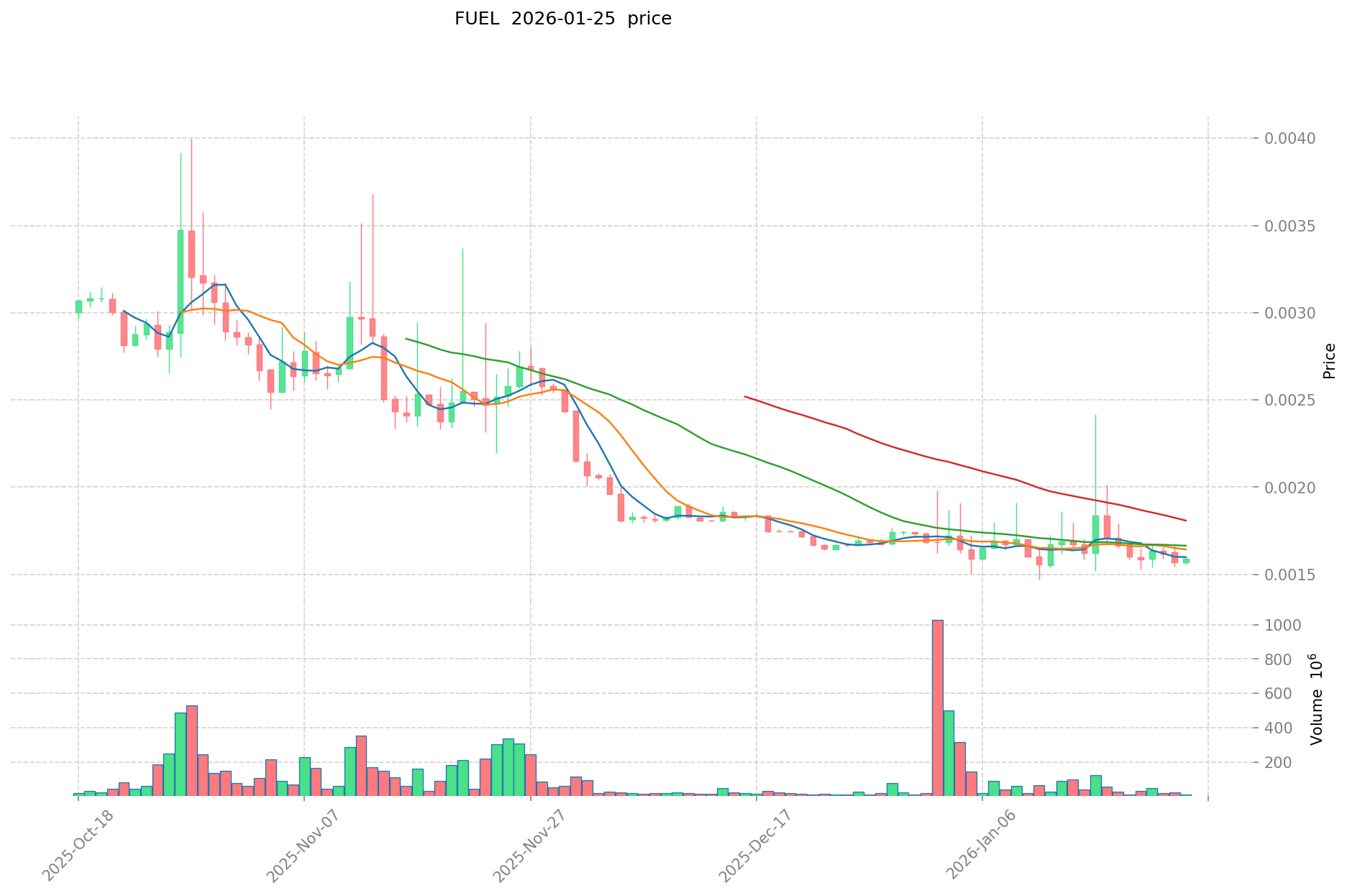
Fuel reached an all-time high of $0.021383 on April 16, 2025, reflecting early market enthusiasm following its mainnet launch. The token's lowest recorded price was $0.001469 on January 11, 2026, amid broader market corrections and profit-taking activities.
As of January 26, 2026, FUEL trades at $0.001569, showing short-term price movements of -0.32% (1H), -0.19% (24H), and -5.31% (7D). These fluctuations reflect ongoing market sentiment adjustments, adoption trends, and external factors affecting the Layer 2 ecosystem.
Click to view current FUEL market price
On-Chain Metrics
- 24-Hour Trading Volume: $18,035.43 (indicating current market activity levels)
- Holder Count: 7,190 addresses (reflecting user participation in the network)
- Market Capitalization: $11,071,626.98 (representing the current valuation of circulating tokens)
Fuel Ecosystem Applications and Partners
Core Use Cases
Fuel's ecosystem supports multiple applications:
- Layer 2 Scaling: Fuel Ignition, providing optimistic rollup solutions with parallelized transaction execution.
- Developer Tools: FuelVM, Sway programming language, and Forc toolchain, enabling innovative development experiences in the Ethereum ecosystem.
Strategic Partnerships
Fuel has established collaborations with various partners to enhance its technical capabilities and market influence.
These partnerships provide a solid foundation for Fuel's ecosystem expansion.
Controversies and Challenges
Fuel faces the following challenges:
- Technical Hurdles: Maintaining transaction efficiency and network stability as the ecosystem scales
- Regulatory Risks: Navigating evolving regulatory frameworks for Layer 2 solutions
- Competition Pressure: Competing with established Layer 2 solutions and emerging blockchain platforms
These issues have sparked discussions within the community and market, while also driving Fuel's continuous innovation.
Fuel's community demonstrates active engagement, with approximately 7,190 holders.
On X platform, related posts and hashtags (such as #Fuel) frequently generate discussions.
Developments such as the mainnet launch and technological innovations have energized community participation.
Sentiment on X shows varied perspectives:
- Supporters praise Fuel's high throughput capabilities, low transaction costs, and native account abstraction, viewing it as an innovative solution for Ethereum scalability.
- Critics focus on price volatility and the competitive landscape in Layer 2 solutions.
Recent trends indicate interest in the project's technological advancements and ecosystem development.
Popular Topics
X users actively discuss Fuel's technical architecture, transaction efficiency, and developer experience,
showcasing both its transformative potential and the challenges in achieving mainstream adoption.
- Official Website: Visit Fuel's Official Website for features, use cases, and latest updates.
- Documentation: Fuel Documentation provides detailed information about its technical architecture, objectives, and vision.
- X Updates: On X platform, Fuel Network uses @fuel_network to engage with the community,
sharing content about technical upgrades, ecosystem developments, and partnership announcements.
Fuel's Future Roadmap
- Ongoing Development: Expanding FuelVM capabilities and Sway language features, enhancing developer experience and network performance
- Ecosystem Goals: Growing the developer community and supporting diverse application development
- Long-term Vision: Establishing itself as a leading Layer 2 solution for Ethereum scalability
How to Participate in Fuel?
- Purchase Channels: Acquire FUEL on Gate.com and other supported exchanges
- Storage Solutions: Use compatible wallets to securely store FUEL tokens
- Ecosystem Development: Visit the developer documentation to explore building applications on Fuel
- Community Engagement: Follow official channels to stay updated on project developments
Summary
Fuel leverages blockchain technology to bring innovative scaling solutions to Ethereum, offering parallelized transaction execution, low costs, and enhanced developer tools.
Its growing community, comprehensive resources, and technological innovations position it as a notable project in the Layer 2 space.
While facing regulatory considerations and competitive pressures, Fuel's innovative approach and clear development direction establish its relevance in decentralized technology's evolution.
Whether you are a newcomer or experienced participant, Fuel presents opportunities worth exploring.
FAQ
What is Crypto FUEL and what problem does it solve?
Crypto FUEL is a blockchain-based fuel token designed to optimize transaction efficiency and reduce network congestion. It solves scalability challenges by enabling faster, cost-effective transactions while providing users with incentive mechanisms for network participation and ecosystem growth.
How do you buy and store FUEL tokens?
Purchase FUEL tokens through decentralized exchanges or peer-to-peer platforms using crypto wallets. Store them securely in hardware wallets, web3 wallets, or self-custody solutions that support the blockchain network FUEL operates on.
What is the use case and utility of FUEL in its blockchain ecosystem?
FUEL serves as the native gas token powering transaction execution and smart contract deployment on the Fuel blockchain. It incentivizes network validators, enables decentralized governance participation, and facilitates rapid transaction processing through the network's optimized architecture.
What are the risks and security considerations when investing in FUEL?
Key risks include market volatility, regulatory changes, and smart contract vulnerabilities. Ensure secure wallet management, enable two-factor authentication, verify contract audits, and only invest capital you can afford to lose. Research the project team and community thoroughly before participating.
How does FUEL compare to other similar cryptocurrency projects?
FUEL stands out with superior transaction speed, lower gas fees, and enhanced scalability. Its innovative consensus mechanism outperforms competitors, offering better energy efficiency and faster finality. FUEL's developer-friendly ecosystem and growing adoption make it a leading choice in the layer-2 solutions space.
* The information is not intended to be and does not constitute financial advice or any other recommendation of any sort offered or endorsed by Gate.