GEODNET (GEOD) is the world's largest decentralized Real-Time Kinematic (RTK) network, launched in 2023 to democratize precision positioning and address limitations of centralized infrastructure providers. Operating as a leading DePIN project with over 16,500 token holders, GEODNET employs a global network of space weather mining stations on the Polygon blockchain to deliver centimeter-level positioning accuracy for autonomous systems, precision agriculture, and surveying applications. The GEOD token incentivizes network participation through Proof of Stake consensus, with a circulating supply of 438.8 million tokens out of 1 billion maximum. With a market cap of $68.70 million and daily trading volume around $56,143 on Gate.com, GEODNET faces both competitive challenges and significant growth opportunities. This comprehensive guide explores GEODNET's technical architecture, market dynamics, ecosystem applications, and participation pathways for investors and developers seeking exposure to decentralized physi
GEODNET's Position and Significance
In 2023, the GEODNET team launched GEODNET (GEOD), aiming to address limitations in global positioning accuracy and the centralization of Real-Time Kinematic (RTK) networks.
As the world's largest decentralized RTK network, GEODNET plays a critical role in precision positioning, autonomous systems, and geospatial applications.
As of 2026, GEODNET has established itself as a leading DePIN (Decentralized Physical Infrastructure Network) project in the positioning sector, supported by over 16,500 token holders and an expanding network of space weather mining stations.
This article will provide an in-depth analysis of its technical architecture, market performance, and future potential.
Origin and Development History
Background
GEODNET was created by its founding team in 2023, aiming to solve the accessibility and cost barriers of high-precision positioning services traditionally controlled by centralized providers.
It emerged during the rapid expansion of DePIN projects and growing demand for autonomous vehicle navigation, precision agriculture, and IoT applications, with the goal of democratizing centimeter-level positioning accuracy through a decentralized network that transforms positioning infrastructure.
GEODNET's launch brought unprecedented possibilities for developers, businesses, and individuals requiring precise location services.
Key Milestones
- 2023: Network launch, establishing a decentralized space weather mining station infrastructure that reports real-time solar wind effects on GNSS signals.
- 2023: Token listing on Gate.com and other exchanges, expanding accessibility for global users and investors.
- 2024-2025: Network expansion phase, with mining stations deployed across multiple continents to enhance global RTK coverage and signal accuracy.
- 2025: Growing adoption in autonomous systems, precision agriculture, and surveying applications, demonstrating real-world utility.
With support from its community of miners, developers, and early adopters, GEODNET continues to enhance its network coverage, positioning accuracy, and ecosystem applications.
How GEODNET Works
Decentralized Infrastructure
GEODNET operates through a global network of space weather mining stations deployed by participants worldwide, eliminating dependence on centralized positioning service providers.
These stations collaborate to monitor solar wind effects on GNSS signals and generate RTK correction data, ensuring the system remains transparent, resilient, and accessible to all users.
Blockchain Foundation
GEODNET's token operates on the Polygon network, leveraging blockchain technology to record transactions and reward contributions in a transparent, immutable manner.
Transactions are grouped into blocks and cryptographically linked, creating a secure chain accessible to anyone.
This infrastructure supports the distribution of GEOD tokens to mining station operators and enables seamless integration with DeFi and other blockchain applications.
Consensus and Rewards
GEODNET utilizes Polygon's Proof of Stake (PoS) consensus mechanism to validate transactions efficiently and sustainably.
Mining station operators earn GEOD tokens by deploying hardware that monitors space weather conditions and contributes RTK correction data to the network.
This incentive structure encourages global participation while maintaining network security and data quality.
Secure Transactions
GEODNET employs public-private key cryptography to protect transactions:
- Private keys (similar to secret passwords) are used to sign transactions
- Public keys (similar to account numbers) verify ownership
This mechanism ensures fund security while maintaining transparent yet pseudonymous transaction records.
The Polygon blockchain's architecture provides additional security through its established validator network and smart contract capabilities.
Circulation Overview
As of January 18, 2026, GEODNET's circulating supply stands at 438,777,944 GEOD tokens, with a total supply of 1,000,000,000 tokens under a fixed supply model.
The current circulating supply represents approximately 43.88% of the maximum supply, with tokens entering the market through the project's distribution mechanism. The token allocation follows the project's emission schedule designed to support network growth and participant incentives.
Price Fluctuation
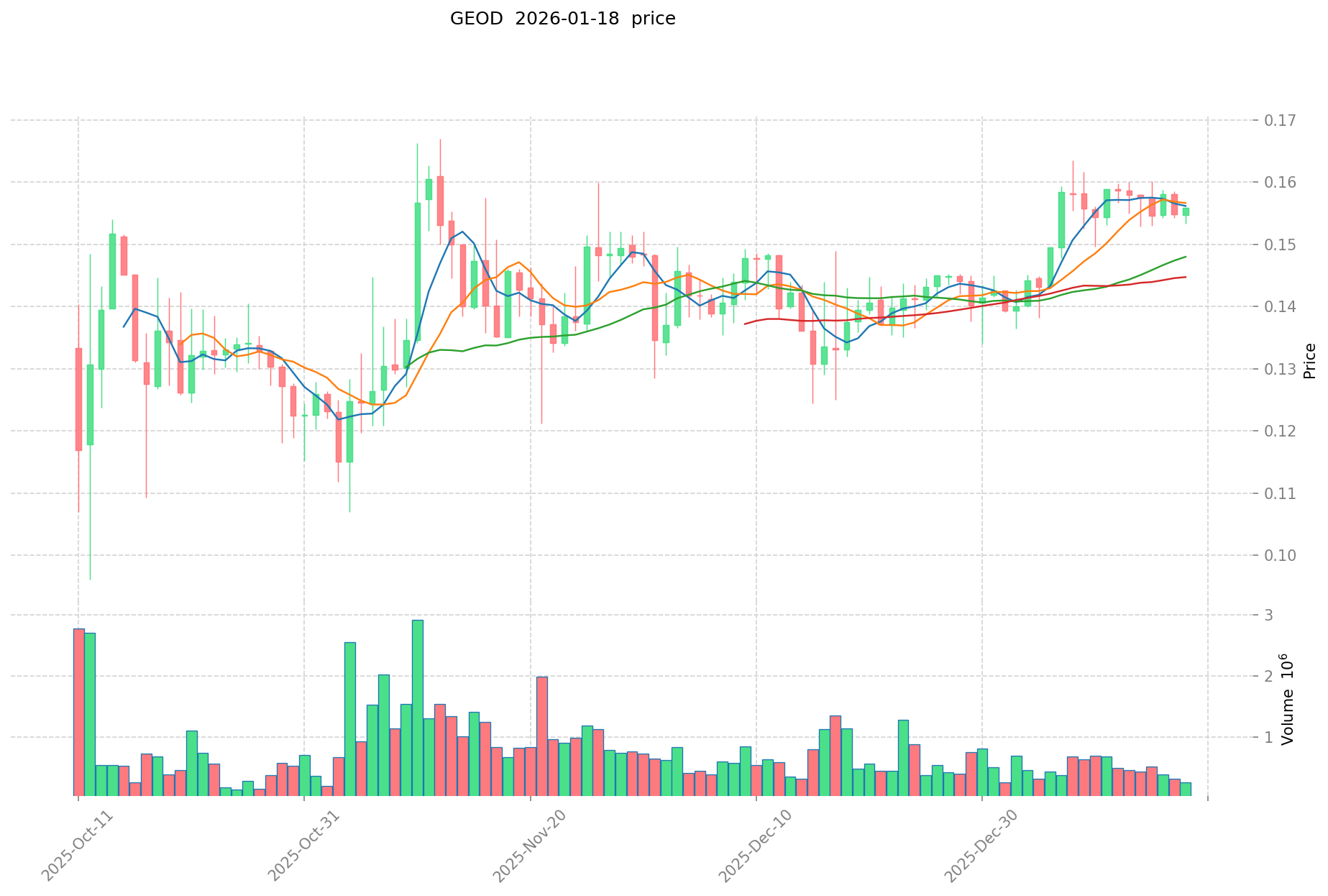
GEODNET reached a notable price level of $0.37899 on January 25, 2025, driven by increased market interest and network expansion activities during that period.
Its lowest recorded price was $0.09605, occurring on October 12, 2025, influenced by broader market corrections and seasonal trading patterns.
These price movements reflect the interplay of market sentiment, adoption trends, and the evolving landscape of decentralized physical infrastructure networks (DePIN).
Click to view the current GEOD market price
On-Chain Metrics
- Daily Trading Volume: Approximately $56,143 (indicating active market participation)
- Token Holders: 16,546 addresses (reflecting growing user engagement)
- Market Capitalization: $68.70 million (demonstrating the project's market position in the DePIN sector)
GEODNET Ecosystem Applications and Partners
Core Use Cases
GEODNET's ecosystem supports multiple applications:
- Precision Navigation: Real-Time Kinematics (RTK) technology provides centimeter-level positioning accuracy, enhancing autonomous vehicle navigation, drone operations, and surveying.
- Space Weather Monitoring: Mining stations report real-time solar wind effects on GNSS signals, supporting scientific research and satellite communication optimization.
- Time Synchronization: Improves absolute time accuracy to nanosecond level, critical for telecommunications and financial trading systems.
Strategic Partnerships
GEODNET has established collaborations with organizations in the positioning and satellite technology sectors, enhancing its technical capabilities and market reach.
These partnerships provide a solid foundation for GEODNET's ecosystem expansion.
Controversies and Challenges
GEODNET faces the following challenges:
- Technical Complexity: Maintaining accuracy across a decentralized network of mining stations requires continuous optimization.
- Regulatory Environment: Emerging regulations around DePIN (Decentralized Physical Infrastructure Networks) projects may impact operations.
- Competitive Landscape: Competition from traditional RTK service providers and other blockchain-based positioning networks.
These issues have sparked discussions within the community and market, while also driving GEODNET's ongoing innovation.
GEODNET's community demonstrates growing activity, with 16,546 token holders as of January 2026.
On X platform, posts and hashtags related to GEODNET (such as #GEODNET and #GEOD) generate regular engagement.
Factors such as network expansion and technological milestones have energized the community.
Sentiment on X shows diverse perspectives:
- Supporters praise GEODNET's innovative DePIN model and practical utility in precision positioning, viewing it as a transformative infrastructure project.
- Critics focus on token price volatility and adoption challenges in competing with established RTK providers.
Recent trends indicate growing interest in real-world blockchain applications.
Hot Topics
X users actively discuss GEODNET's expansion of mining station networks, partnerships with positioning technology companies, and competition with traditional GPS correction services,
showcasing both its revolutionary potential and obstacles to mainstream adoption.
- Official Website: Visit GEODNET Official Site for features, use cases, and latest updates.
- Whitepaper: GEODNET Whitepaper details its technical architecture, goals, and vision.
- X Updates: On X platform, GEODNET maintains an active presence through @GEODNET_, sharing content about network growth, technical developments, and community activities.
GEODNET Future Roadmap
- Network Expansion: Continue deploying mining stations globally to enhance RTK coverage and signal accuracy.
- Ecosystem Goals: Support development of location-based applications and services leveraging centimeter-level positioning.
- Long-term Vision: Become the world's leading decentralized RTK infrastructure, serving autonomous systems and precision industries.
How to Participate in GEODNET?
- Purchase Channels: Acquire GEOD on Gate.com and other supported exchanges.
- Storage Solutions: Use compatible wallets such as MetaMask for secure storage of GEOD tokens.
- Network Participation: Deploy GEODNET mining stations to contribute to RTK network coverage and earn rewards.
- Ecosystem Development: Visit GEODNET's developer resources to build applications utilizing precision positioning data.
Summary
GEODNET redefines positioning technology through blockchain, offering centimeter-level accuracy, decentralized infrastructure, and real-time space weather data.
Its growing network, practical applications, and innovative DePIN model distinguish it in the cryptocurrency sector.
Despite facing adoption challenges and market competition, GEODNET's pioneering approach and clear development path position it as a significant player in decentralized physical infrastructure.
Whether you're new to crypto or an experienced participant, GEODNET merits attention and engagement.
FAQ
What is GEOD cryptocurrency? What are its basic features and uses?
GEOD is a utility token powering GEODNET, a decentralized geolocation data network. It incentivizes miners, pays for data stream fees, and enables governance participation. GEOD operates across multiple chains including Polygon as an ERC-20 token, enhancing accessibility and utility within the ecosystem.
How to acquire GEOD tokens? Which exchanges can I buy them on?
You can acquire GEOD tokens through reputable centralized cryptocurrency exchanges. GEOD is available for purchase on major platforms. Visit the official GEOD website or check real-time listings to find current trading pairs and exchange options for your region.
What is the technical principle of GEOD project? How does it differ from other cryptocurrencies?
GEOD utilizes physical data crowdsourcing, including geolocation and dashcam footage, to generate monetizable value. Unlike traditional cryptocurrencies, GEOD focuses on tokenizing real-world physical data collection and validation through a decentralized network.
What are the risks of investing in GEOD? What security issues should I be aware of?
GEOD prices can fluctuate dramatically, potentially causing capital loss. Ensure platform security to prevent information leakage. You are responsible for your own investment decisions and should conduct thorough due diligence before trading.
GEOD项目的团队背景和发展路线图如何?
GEOD项目由专注于区块链技术的创新团队领导。团队计划在未来三年内实现主要技术突破,已完成初步测试,2026年将推出主要功能模块。
What is the total supply of GEOD? What is the inflation mechanism?
GEOD has a total supply of 136 million tokens. The mechanism is deflationary, with tokens being burned and removed from circulation, reducing the total supply over time.
* The information is not intended to be and does not constitute financial advice or any other recommendation of any sort offered or endorsed by Gate.