GEODNET (GEOD) is the world's largest decentralized RTK network launched in 2023, addressing inefficiencies in global positioning and centralized infrastructure. This comprehensive guide explores GEODNET's technical architecture, powered by Polygon blockchain and Proof-of-Coverage consensus, delivering centimeter-level positioning accuracy and nanosecond-level timing precision. The article covers its origin, development milestones including Gate.com listing at $0.15, and current market metrics: 438.77M circulating tokens, $68.7M market cap, and 16,546 token holders. Discover how distributed space weather mining stations eliminate single points of failure while earning GEOD rewards. Learn core applications in precision agriculture and autonomous vehicles, community sentiment on X platform, and participation methods. Despite regulatory challenges and competition, GEODNET's DePIN innovation and focus on decentralized infrastructure position it uniquely in blockchain-based geospatial data solutions.
GEODNET's Positioning and Significance
In 2023, the GEODNET team launched GEODNET (GEOD), aiming to address inefficiencies in global positioning accuracy and the centralized nature of traditional RTK networks.
As "the world's largest decentralized RTK network", GEODNET plays a crucial role in high-precision positioning, autonomous vehicles, and surveying applications.
As of 2026, GEODNET has become a leading DePIN project in the geospatial data sector, with over 16,546 token holders and an expanding network of space weather mining stations.
This article will provide an in-depth analysis of its technical architecture, market performance, and future potential.
Origin and Development History
Birth Background
GEODNET was created by its founding team in 2023, aiming to solve the limitations of standalone GPS accuracy and the high costs of traditional Real-Time Kinematics (RTK) infrastructure.
It emerged during the rapid expansion of Decentralized Physical Infrastructure Networks (DePIN), with the goal of providing centimeter-level positioning accuracy through a distributed network of space weather stations to transform the landscape.
GEODNET's launch brought entirely new possibilities for precision agriculture, autonomous transportation, and geospatial data applications.
Important Milestones
- 2023: Network launch on Polygon, establishing the foundation for decentralized RTK signal generation.
- 2023: Token listing on Gate.com on September 6, 2023, with a publish price of $0.15.
- 2025: Network expansion milestone, with the deployment of thousands of space weather mining stations globally.
- 2025: Price surge in January, reaching $0.37899 on January 25, 2025.
With the support of its community and network participants, GEODNET continues to optimize its technology, security, and real-world applications.
How GEODNET Works
No Central Control
GEODNET operates on a decentralized network of space weather mining stations distributed globally, eliminating dependence on centralized positioning infrastructure providers.
These stations collaboratively report real-time solar wind influences on Global Navigation Satellite System (GNSS) signals and generate RTK correction data, ensuring system transparency and resistance to single points of failure, granting users greater autonomy and enhancing network resilience.
Blockchain Core
GEODNET's infrastructure leverages blockchain technology to create a public, immutable record of network contributions and data integrity.
Transactions and data submissions are grouped into blocks and linked through cryptographic hashing to form a secure chain.
Anyone can verify the records, establishing trust without intermediaries.
The network utilizes the Polygon blockchain for efficient token distribution and network coordination.
Ensuring Fairness
GEODNET employs a Proof-of-Coverage consensus mechanism to validate contributions from mining stations, preventing data manipulation and ensuring network reliability.
Mining station operators maintain network security by deploying and operating GNSS reference stations that continuously report atmospheric and ionospheric conditions, earning GEOD token rewards.
Its innovation includes leveraging DePIN principles to create economic incentives for distributed infrastructure deployment, achieving greater coverage at lower costs compared to traditional systems.
Secure Transactions
GEODNET uses public-private key cryptography to protect token transactions:
- Private keys (similar to secret passwords) are used to sign transactions
- Public keys (similar to account numbers) are used to verify ownership
This mechanism ensures fund security, with transactions maintaining pseudonymous privacy on the Polygon blockchain.
The network's positioning data accuracy reaches centimeter-level precision and improves absolute time accuracy to nanosecond-level, providing unprecedented reliability for critical applications.
Circulating Supply Overview
As of January 18, 2026, GEODNET's circulating supply stands at 438,777,944 tokens, with a total supply of 1,000,000,000 GEOD tokens, representing a fixed supply model.
The current circulation rate is approximately 43.88%, indicating that a significant portion of tokens remains outside active circulation.
While specific distribution details are not provided in available materials, the tokenomics structure appears designed to support long-term network development and community participation.
Price Fluctuation
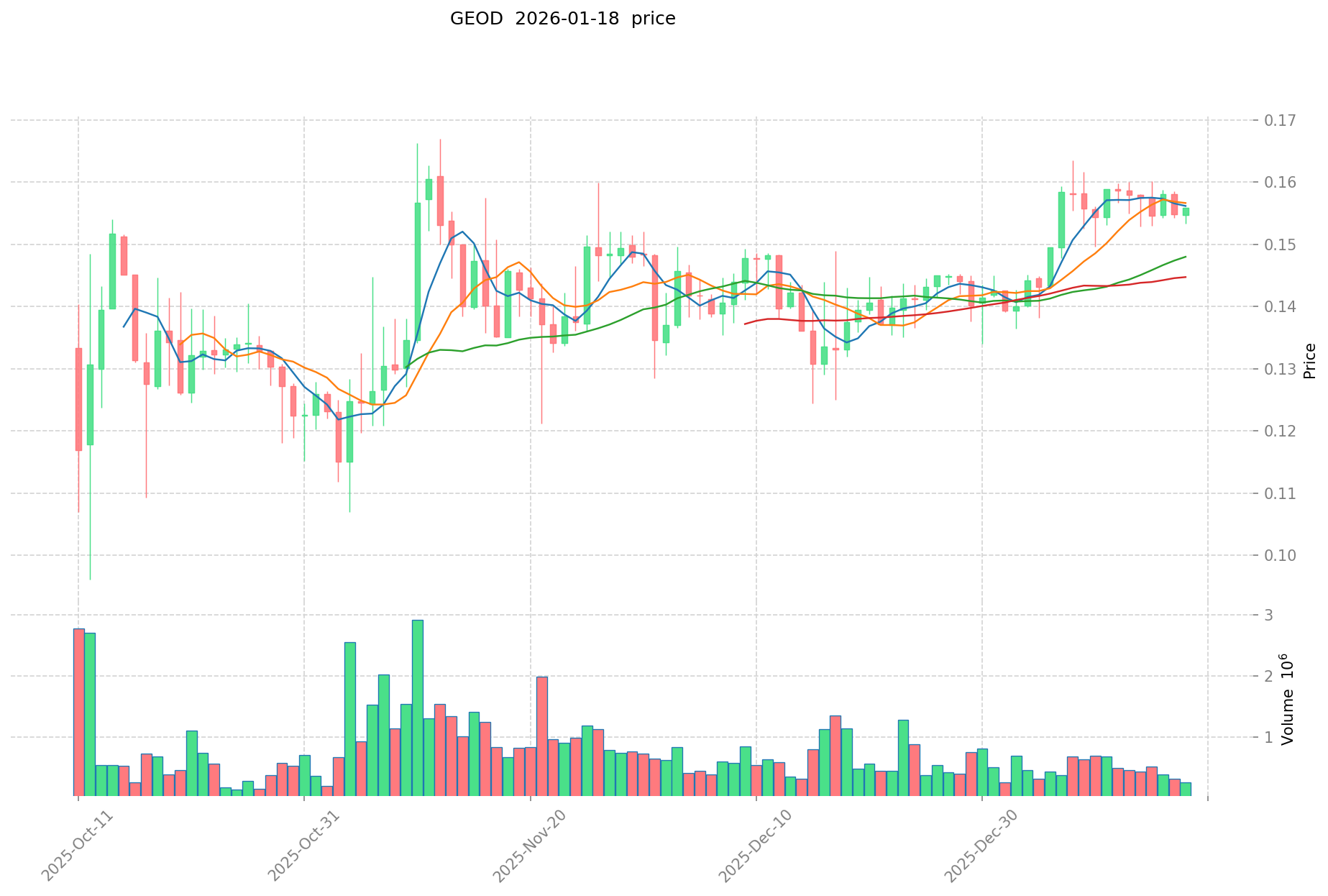
GEODNET reached a notable price level of $0.37899 on January 25, 2025, reflecting increased market interest during that period.
The token experienced its lower price point of $0.09605 on October 12, 2025, which occurred during a period of market adjustment.
As of the current date, GEODNET is trading at $0.1566, showing a 24-hour change of 1.18% and a 30-day increase of 13.4%. However, the token has experienced a decline of 54.40% over the past year, reflecting broader market dynamics and varying adoption patterns.
Click to view current GEOD market price
On-Chain Metrics
- Market Capitalization: $68,712,626 (reflecting current circulating supply valuation)
- Fully Diluted Valuation: $156,600,000 (based on maximum token supply)
- 24-Hour Trading Volume: $54,753.79 (indicating active trading activity)
- Token Holders: 16,546 addresses (demonstrating community participation)
- Market Share: 0.0046% of the overall cryptocurrency market
GEODNET Ecosystem Applications and Partners
Core Use Cases
GEODNET's ecosystem supports multiple applications:
- Positioning Services: Space Weather Mining Stations, providing Real-Time Kinematics (RTK) signals with centimeter-level accuracy.
- GNSS Signal Correction: Data reporting systems, enabling precise correction of Global Navigation Satellite System signals for improved positioning and timing accuracy.
Strategic Partnerships
The reference materials do not provide specific information about GEODNET's strategic partnerships.
Controversies and Challenges
GEODNET faces the following challenges:
- Technical Difficulties: Maintaining network coverage and ensuring consistent signal quality across global stations
- Regulatory Risks: Potential compliance requirements related to space weather data and positioning services
- Competitive Pressure: Competition from traditional RTK networks and emerging positioning technologies
These issues have sparked discussions within the community and market, while also driving GEODNET's continuous innovation.
GEODNET's community demonstrates notable activity, with 16,546 token holders as of January 18, 2026.
On X platform, related posts and hashtags (such as #GEOD) generate engagement, with discussions around network expansion and RTK technology.
Network growth and mining station deployment have fueled community enthusiasm.
Sentiment on X shows diverse perspectives:
- Supporters praise GEODNET's innovative approach to decentralized positioning services and DePIN principles, regarding it as "the future of precision location technology".
- Critics focus on price volatility and competition from established positioning services.
Recent trends indicate cautious optimism around the network's expansion and technological advantages.
Trending Topics
X platform users actively discuss GEODNET's market positioning, mining station economics, and RTK technology adoption,
showcasing both its transformative potential and the barriers to mainstream adoption.
- Official Website: Visit GEODNET Official Site for features, use cases, and latest updates.
- White Paper: GEODNET White Paper details its technical architecture, objectives, and vision.
- X Updates: On X platform, GEODNET actively engages using @GEODNET_,
with posts covering technical updates, community activities, and network expansion news, generating substantial engagement from the community.
GEODNET Future Roadmap
The reference materials do not provide specific roadmap details for future years.
How to Participate in GEODNET?
- Purchase Channels: Buy GEOD on Gate.com and other exchanges
- Storage Solutions: Use compatible wallets to securely store GEOD tokens
- Participate in the Network: Deploy Space Weather mining stations to contribute to the RTK network
- Ecosystem Building: Visit the official website for information on contributing to network expansion
Summary
GEODNET redefines positioning services through blockchain technology, offering decentralized RTK signals, centimeter-level accuracy, and nanosecond-level timing precision.
Its active community, innovative DePIN approach, and market performance position it uniquely in the cryptocurrency space.
Despite facing regulatory considerations and market competition, GEODNET's innovative spirit and focus on precision positioning technology give it a significant role in the future of decentralized infrastructure.
Whether you are a newcomer or experienced participant, GEODNET merits attention and engagement.
FAQ
What is GEOD and what is its purpose in the blockchain ecosystem?
GEOD is a blockchain-based geospatial network providing real-time, high-precision positioning data for IoT and autonomous systems. It incentivizes miners to generate accurate GNSS data through token rewards, ensuring secure and decentralized geospatial data infrastructure for global applications.
How can I buy or acquire GEOD tokens?
You can acquire GEOD tokens through centralized or decentralized exchanges that support it. Use your preferred platform to connect your wallet, deposit funds, and trade for GEOD tokens directly.
What are the risks and benefits of investing in GEOD?
GEOD offers potential high returns as an emerging digital asset, but carries elevated risk due to market volatility and limited trading volume. Investors should conduct thorough research before participating.
Which exchanges support GEOD trading?
GEOD is supported on major cryptocurrency exchanges including MEXC Global, Gate.com, and Coinex. These platforms offer various trading pairs for GEOD tokens with active liquidity and trading volume.
What is the total supply and current market cap of GEOD?
GEOD has a total supply of 438.78 million tokens with a current market cap of $67.09 million, representing less than 0.01% of the total crypto market cap.
How does GEOD differ from other similar cryptocurrency projects?
GEOD distinguishes itself through its unique blockchain niche and specialized functionality. Unlike generalized crypto projects, GEOD offers distinctive tokenomics, governance mechanisms, and use cases tailored to its ecosystem. Its differentiation lies in focused development, community-driven initiatives, and specific value propositions that set it apart from competing projects in the market.
* The information is not intended to be and does not constitute financial advice or any other recommendation of any sort offered or endorsed by Gate.