GHO is Aave's native decentralized stablecoin, launched in 2023 to address liquidity constraints and capital inefficiency in DeFi markets. As an over-collateralized stablecoin pegged 1:1 to USD, GHO operates on Ethereum with full transparency and community governance, distinguishing it from centralized alternatives like USDC and USDT. This comprehensive guide explores GHO's technical architecture, market performance metrics including 352.82 million circulating supply, and operational mechanisms that maintain peg stability through dynamic interest rates and governance-controlled caps. The article covers ecosystem applications, strategic positioning within Aave Protocol, current challenges including regulatory risks and competitive pressures, and community sentiment across social platforms. Whether examining trading opportunities on Gate or participating in governance, readers gain actionable insights into GHO's role in decentralized finance and its future potential for mainstream DeFi adoption.
GHO's Positioning and Significance
In 2023, Aave launched GHO (GHO), aiming to address liquidity constraints and capital efficiency challenges in decentralized finance.
As a decentralized, over-collateralized stablecoin native to the Aave Protocol, GHO plays a key role in DeFi lending and borrowing markets.
As of 2026, GHO has established itself as a significant stablecoin within the Aave ecosystem, with 6,773 holders and an active governance community.
This article will provide an in-depth analysis of its technical architecture, market performance, and future potential.
Origin and Development Timeline
Background
GHO was created by Aave in 2023, aiming to solve capital inefficiency and limited borrowing flexibility in decentralized lending protocols.
It emerged during the maturation phase of DeFi infrastructure, with the goal of providing users with a transparent, fully-backed stablecoin that maintains dollar parity to transform existing limitations.
The launch of GHO brought DeFi users and liquidity providers entirely new possibilities.
Key Milestones
- 2023: Mainnet launch, implementing on-demand minting within governance-controlled supply caps.
- 2025: Market expansion with trading volume reaching significant levels across exchanges.
- 2026: Ecosystem maturity, with circulating supply reaching 352.82 million tokens.
With support from the Aave community and governance framework, GHO continues to optimize its technical foundation, security mechanisms, and real-world applications.
How GHO Operates
Decentralized Control
GHO operates within the Aave Protocol's decentralized infrastructure, independent of traditional banking or governmental oversight.
The protocol's distributed network validates minting and burning operations, ensuring transparency and attack resistance while granting users greater autonomy and enhancing network resilience.
Blockchain Foundation
GHO utilizes Ethereum blockchain as its public, immutable digital ledger, recording every transaction.
Transactions are grouped into blocks and cryptographically linked to form a secure chain.
Anyone can review records without requiring intermediaries to establish trust.
The ERC-20 standard implementation ensures compatibility with existing DeFi infrastructure and wallets.
Maintaining Stability
GHO employs over-collateralization mechanisms within the Aave Protocol to maintain its dollar peg and prevent under-backed issuance.
Users mint GHO by depositing collateral assets that exceed the borrowed value, with the protocol enforcing liquidation mechanisms when collateral ratios fall below required thresholds.
Innovations include dynamic interest rates and governance-managed supply caps to balance stability and capital efficiency.
Secure Transactions
GHO leverages public-private key cryptography to protect transactions:
- Private keys (similar to secret passwords) are used to authorize minting and transfers
- Public keys (similar to account numbers) verify ownership and transaction validity
This mechanism ensures fund security while maintaining transparent on-chain activity.
Additional security features include integration with Aave's audited smart contract infrastructure and multi-signature governance controls.
Circulating Supply Overview
As of 15 January 2026, GHO's circulating supply stands at 352,821,318 tokens, with a total supply of 352,821,318 tokens. The maximum supply is unlimited (∞), indicating a dynamic issuance model.
New tokens enter the market through user-initiated minting within the Aave Protocol, subject to governance-approved mint caps. This mechanism directly influences supply-demand dynamics as users can mint GHO on demand based on their collateralized positions.
The circulating supply represents 100% of the total supply, suggesting full distribution with no locked or reserved allocations mentioned in available materials.
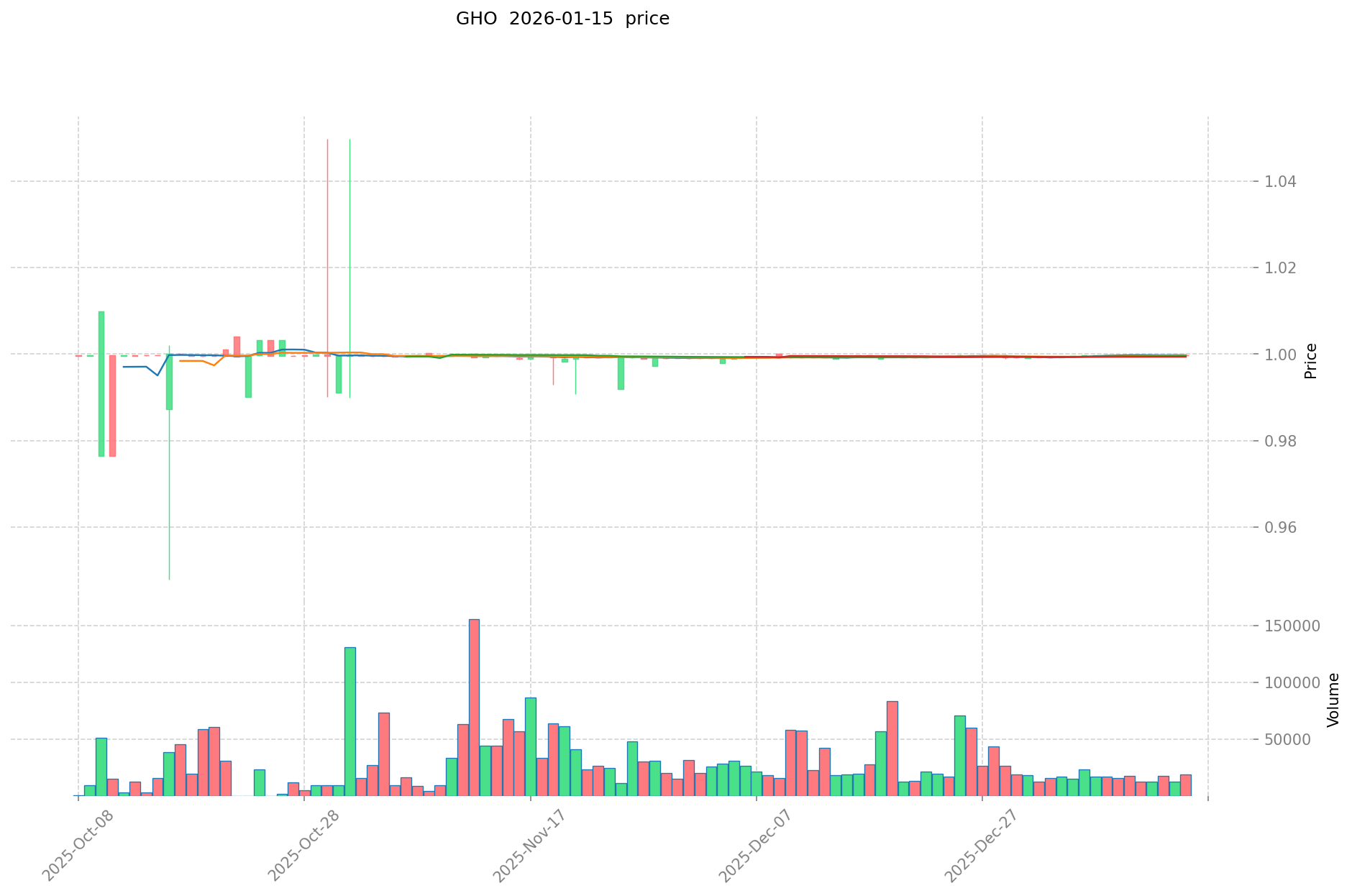
Price Volatility
GHO reached a notable price level of $1.6 on 30 September 2025, driven by market conditions during that period.
Its lowest recorded price was $0.9478, occurring on 16 October 2025, reflecting temporary deviations from its USD peg.
These fluctuations demonstrate the stablecoin's price dynamics influenced by market efficiency mechanisms, collateralization ratios within the Aave Protocol, and broader market sentiment toward decentralized stablecoins.
Click to view current GHO market price
On-Chain Metrics
- Holders: 6,773 addresses (reflecting user adoption and distribution)
- Market Capitalization: $352,750,753.74 (indicating total value locked in circulating supply)
- 24-Hour Trading Volume: $24,378.47 (showing current market activity levels)
GHO Ecosystem Applications and Partners
Core Use Cases
GHO's ecosystem supports multiple applications:
- DeFi: Integrated within the Aave Protocol, providing decentralized lending and borrowing services.
- Stablecoin Infrastructure: Enables users to mint GHO on demand, facilitating liquidity provision and collateralized stablecoin operations.
Strategic Partnerships
GHO is natively built within the Aave Protocol, leveraging its established infrastructure and governance framework.
These partnerships provide a solid foundation for GHO's ecosystem expansion.
Controversies and Challenges
GHO faces the following challenges:
- Technical Issues: Maintaining peg stability during market volatility requires robust over-collateralization mechanisms.
- Regulatory Risks: As a decentralized stablecoin, GHO operates in an evolving regulatory environment that may impact its adoption.
- Competitive Pressure: Other stablecoins such as USDC, DAI, and emerging protocols present ongoing competition in the decentralized finance space.
These issues have sparked discussions within the community and market, while also driving continuous innovation for GHO.
GHO's community demonstrates active engagement, with 6,773 holders as of January 15, 2026.
On X platform, related posts and hashtags (such as #GHO) generate consistent interest.
Price movements and protocol updates have fueled community enthusiasm.
Sentiment on X shows diverse perspectives:
- Supporters praise GHO's transparency, over-collateralization, and integration with Aave Protocol, viewing it as a reliable decentralized stablecoin option.
- Critics focus on peg maintenance challenges and market liquidity concerns.
Recent trends indicate cautious optimism among users tracking stablecoin developments.
Hot Topics
X users actively discuss GHO's peg stability mechanisms, governance by Aave, and its role in DeFi lending markets,
showcasing both its transformative potential and the obstacles toward broader mainstream adoption.
- Official Website: Visit GHO Official Website for features, use cases, and latest updates.
- White Paper: GHO Technical Paper details its technical architecture, objectives, and vision.
- X Updates: On X platform, GHO maintains activity through @aave,
with posts covering technical upgrades, community activities, and partnership news.
GHO Future Roadmap
- Ongoing Development: Continuous optimization of minting mechanisms and peg stability features to enhance protocol efficiency and user experience.
- Ecosystem Goals: Expansion of GHO adoption within DeFi protocols and integration with additional lending markets.
- Long-term Vision: Establish GHO as a trusted decentralized stablecoin infrastructure within the broader cryptocurrency ecosystem.
How to Participate in GHO?
- Purchase Channels: Acquire GHO on Gate.com and other supporting platforms.
- Storage Solutions: Use compatible wallets such as MetaMask for secure storage.
- Participate in Governance: Engage with Aave governance through community voting platforms to influence GHO-related decisions.
- Build the Ecosystem: Access developer documentation to integrate GHO into DeFi applications or contribute to protocol development.
Summary
GHO redefines decentralized stablecoins through blockchain technology, offering transparency, over-collateralization, and seamless integration with lending protocols.
Its active community, comprehensive resources, and solid market presence make it distinctive in the cryptocurrency field.
Despite facing regulatory uncertainties and competitive pressures, GHO's innovative approach and clear development trajectory position it as a significant player in the future of decentralized finance.
Whether you are a newcomer or experienced participant, GHO merits attention and engagement.
FAQ
What is GHO? How does it differ from other stablecoins?
GHO is a decentralized stablecoin pegged 1:1 to USD, built on Ethereum by Aave. Unlike centralized stablecoins such as USDT and USDC, GHO operates in a fully decentralized manner, offering greater transparency and community governance.
Who issues GHO? What role does Aave Protocol play?
GHO is issued by Aave as a decentralized stablecoin. Aave Protocol serves as the core issuer and manager, enabling users to mint GHO by depositing collateral in Aave V3, maintaining a decentralized and over-collateralized stablecoin ecosystem.
How to obtain and use GHO tokens?
Participate in platform activities and challenges to earn free GHO tokens. Trade GHO for other cryptocurrencies through spot trading or swap services. Use GHO within the ecosystem for transactions and liquidity provision.
What are the main application scenarios for GHO?
GHO serves as Aave's native stablecoin, primarily used for decentralized lending and borrowing, collateral management, and ecosystem governance. It enables efficient capital utilization in DeFi protocols and supports cross-chain liquidity solutions.
What are the risks of holding GHO? How is its security guaranteed?
GHO risks include smart contract vulnerabilities and collateral fluctuations. Security is ensured through audited code, decentralized governance, and over-collateralization requirements protecting the protocol's stability and user funds.
What are the advantages of GHO compared to stablecoins like USDC and USDT?
GHO is more decentralized than USDC and USDT, offering more flexible governance and multi-chain scalability. It operates through Aave protocol's smart contract system rather than centralized entities.
* The information is not intended to be and does not constitute financial advice or any other recommendation of any sort offered or endorsed by Gate.