Gitcoin is a decentralized platform revolutionizing open-source development and public goods funding through innovative blockchain technology. This comprehensive guide explores how Gitcoin's quadratic funding mechanism democratizes resource allocation, enabling communities to collectively support projects with genuine grassroots backing rather than concentrated capital. Designed for developers, funders, and Web3 enthusiasts, the article covers Gitcoin's technical architecture, GTC governance token utility, market performance metrics with 91,106 token holders, and ecosystem applications. Discover how to participate in GitcoinDAO governance on Gate exchange, navigate challenges including price volatility and adoption barriers, and understand Gitcoin's strategic roadmap for becoming the leading infrastructure for sustainable public goods funding in the digital economy.
Gitcoin's Positioning and Significance
In 2021, Gitcoin contributors launched Gitcoin (GITCOIN), aiming to address challenges in funding open-source development and public goods sustainment.
As a decentralized platform for open-source software development and community funding, Gitcoin plays a pivotal role in open-source ecosystems, decentralized governance, and public goods funding.
As of 2026, Gitcoin has established itself as a leading platform in the Web3 open-source community, with over 91,000 token holders and an active developer ecosystem.
This article will provide an in-depth analysis of its technical architecture, market performance, and future potential.
Origin and Development History
Birth Background
Gitcoin was created by its founding team in 2021, aiming to solve the persistent challenge of sustainable funding for open-source software and digital public goods.
It emerged during the rapid expansion of blockchain technology and decentralized autonomous organizations, with the goal of enabling developers to monetize open-source contributions while communities collectively fund critical infrastructure through transparent, decentralized mechanisms.
Gitcoin's launch brought new possibilities to open-source developers, Web3 projects, and public goods advocates.
Important Milestones
- 2021: GTC governance token launched, establishing GitcoinDAO to decentralize platform governance.
- 2021: Platform enabled funding through Quadratic Funding mechanisms, democratizing resource allocation for public goods.
- Subsequent years: Ecosystem expanded with grants programs supporting thousands of open-source projects across Python, Rust, Ruby, JavaScript, Solidity, HTML, CSS, and design.
- Ongoing: Continuous evolution in decentralized governance models and funding mechanisms to support the next generation of digital public goods.
With support from the GitcoinDAO community and Web3 ecosystem participants, Gitcoin continues to refine its governance, security, and real-world applications.
How Gitcoin Works?
Decentralized Governance
Gitcoin operates through a decentralized autonomous organization (DAO) where GTC token holders participate in governance decisions without centralized control.
These community members collaboratively determine funding priorities, platform upgrades, and ecosystem development, ensuring transparency and collective ownership while empowering contributors with direct influence over the platform's direction.
Gitcoin's infrastructure comprises an open-source ecosystem connecting developers, projects, and funders through transparent mechanisms.
The platform utilizes blockchain technology to record contributions and funding allocations, creating an immutable record of community support for public goods.
Anyone can participate in funding rounds or contribute to projects, establishing trust through transparent on-chain records.
The platform supports development across multiple programming languages and design disciplines, facilitating comprehensive open-source collaboration.
Quadratic Funding Mechanism
Gitcoin employs Quadratic Funding (QF) to democratically allocate resources to public goods projects.
Community members contribute to projects they support, with matching funds amplified based on the number of individual contributors rather than total amount donated.
This innovative approach prioritizes broad community support over concentrated capital, ensuring more equitable distribution of resources to projects with genuine grassroots backing.
Governance Token Utility
Gitcoin uses GTC as its governance token, enabling holders to:
- Vote on proposals regarding platform development and fund allocation
- Participate in GitcoinDAO governance to shape the future of public goods funding
- Influence ecosystem direction through decentralized decision-making processes
This governance structure ensures the platform remains community-driven, with token holders collectively steering Gitcoin's evolution while maintaining transparency and decentralized control over critical decisions.
Circulation Overview
As of January 26, 2026, Gitcoin's circulating supply stands at 87,491,501.90 GITCOIN, with a total supply of 100,000,000 GITCOIN under a fixed supply model.
The token operates within the GitcoinDAO ecosystem as a governance token, with its distribution mechanism designed to support decentralized funding of public goods.
Price Volatility
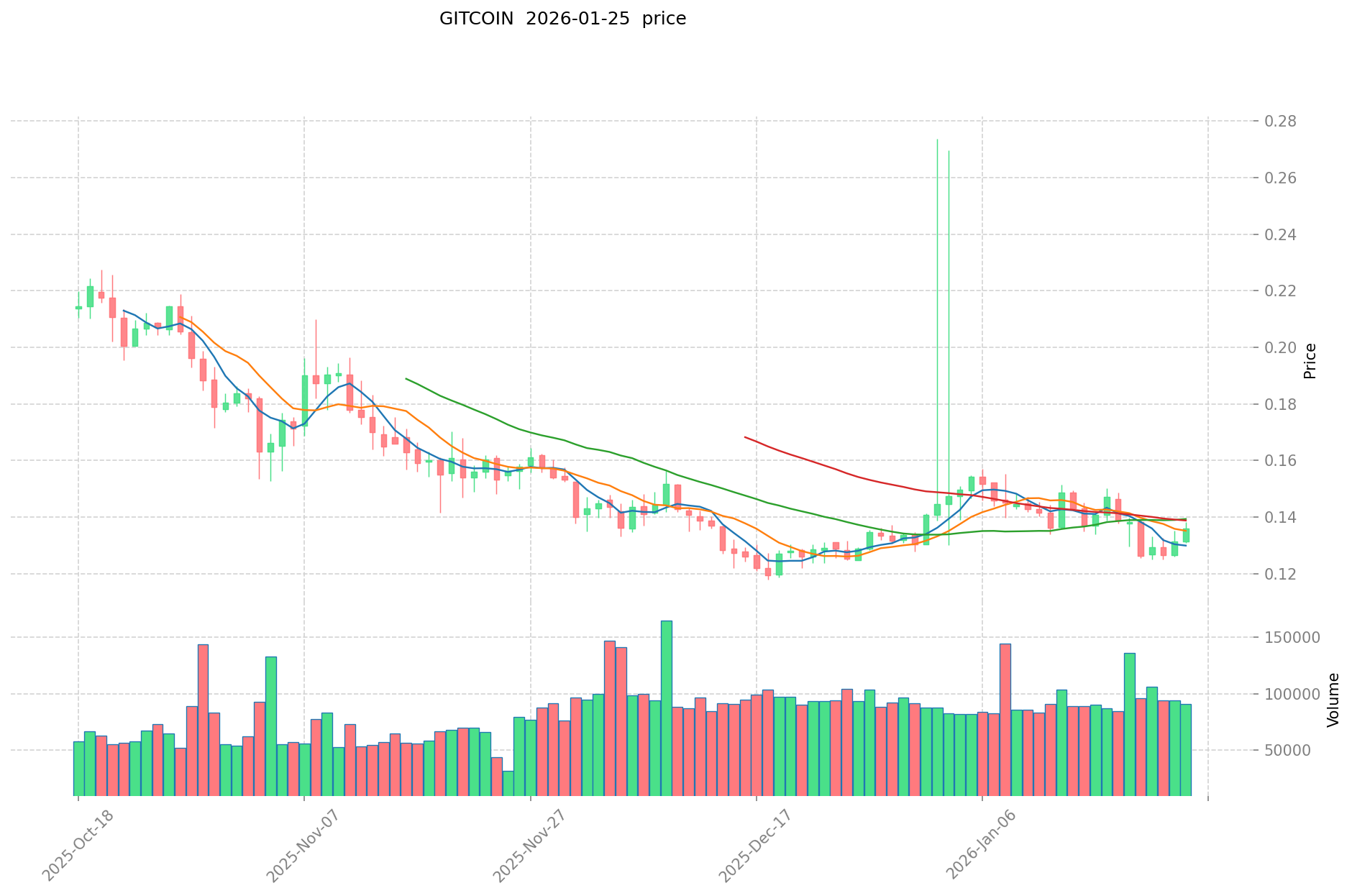
Gitcoin reached its all-time high of $22.37 on November 27, 2021, driven by favorable market conditions during the broader cryptocurrency bull market and increased interest in decentralized autonomous organizations.
Its lowest price of $0.118188 occurred on December 19, 2025, influenced by broader market corrections and shifting sentiment in the digital asset sector.
These fluctuations reflect evolving market dynamics, adoption patterns, and external macroeconomic factors.
Click to view the current GITCOIN market price
On-Chain Metrics
- Holder Count: 91,106 addresses (indicating community distribution and engagement levels)
- Circulating Supply Ratio: 87.49% (demonstrating the proportion of tokens currently in active circulation)
- Market Cap to Fully Diluted Valuation: 87.49% (reflecting the relationship between current market capitalization and potential maximum valuation)
Gitcoin Ecosystem Applications and Partners
Core Use Cases
Gitcoin's ecosystem supports multiple applications:
- Open Source Development: Gitcoin platform enables developers to contribute to open source projects using Python, Rust, Ruby, JavaScript, Solidity, HTML, CSS, and Design, while receiving compensation for their work.
- Public Goods Funding: GitcoinDAO leverages the GTC governance token to facilitate community-driven funding mechanisms for next-generation public goods and open source infrastructure.
Strategic Partnerships
Gitcoin has established collaborations that enhance its technical capabilities and market influence.
These partnerships provide a solid foundation for Gitcoin's ecosystem expansion.
Controversies and Challenges
Gitcoin faces the following challenges:
- Market Volatility: The token has experienced significant price fluctuations, with a year-over-year decline of 78.44%
- Competitive Pressure: The emergence of alternative funding platforms and governance mechanisms in the blockchain space
- Adoption Barriers: Challenges in expanding the user base beyond the existing developer community
These issues have sparked discussions within the community and market, driving Gitcoin's continuous innovation.
Gitcoin's community demonstrates strong vitality, with 91,106 token holders as of January 26, 2026.
On X platform, relevant posts and hashtags (such as #Gitcoin) frequently trend.
New feature releases and funding rounds ignite community enthusiasm.
Sentiment on X presents polarization:
- Supporters praise Gitcoin's commitment to open source development and decentralized governance, considering it a crucial infrastructure for funding public goods.
- Critics focus on price volatility and token utility concerns.
Recent trends indicate mixed sentiment amid market fluctuations.
Hot Topics
X users actively discuss Gitcoin's funding mechanisms, governance model, and role in the open source ecosystem,
demonstrating both its transformative potential and obstacles toward mainstream adoption.
- Official Website: Visit Gitcoin Official Site for features, use cases, and latest updates.
- X Updates: On X platform, Gitcoin actively engages using @gitcoin,
with posts covering platform upgrades, community events, funding rounds, and partnership announcements.
Gitcoin Future Roadmap
- Ecosystem Goal: Expand the platform's reach to support more open source projects and developers
- Long-term Vision: Become a leading infrastructure for funding and sustaining public goods in the digital economy
How to Participate in Gitcoin?
- Purchase Channels: Buy GITCOIN on Gate.com and other supported exchanges
- Storage Solutions: Use compatible Ethereum wallets to securely store GTC tokens
- Participate in Governance: Engage in GitcoinDAO community decisions through governance platforms
- Build Ecosystem: Visit developer documentation to contribute to open source projects or develop on the platform
Summary
Gitcoin redefines open source funding through blockchain technology, providing transparency, community governance, and sustainable compensation mechanisms for developers.
Its active community, rich resources, and clear mission distinguish it in the cryptocurrency field.
Despite facing market volatility and adoption challenges, Gitcoin's innovative approach and commitment to public goods funding position it as an important player in the future of decentralized technology.
Whether you are a newcomer or experienced participant, Gitcoin deserves attention and engagement.
FAQ
What is Gitcoin? What are its main functions and objectives?
Gitcoin is a platform supporting open-source software development through quadratic funding and grants. Its main functions include funding developers, building community, and enabling decentralized collaboration. The objective is to sustain public goods in web3 ecosystem.
What is the purpose of GTC tokens on Gitcoin and how to obtain them?
GTC tokens serve governance and community participation functions on Gitcoin. Holders can vote on protocol decisions and fund allocation. GTC can be obtained through community contributions, participating in quadratic funding rounds, staking rewards, or direct acquisition in the market.
As a developer, how can I obtain funding or participate in projects on Gitcoin?
Create a Gitcoin profile, explore active bounties and grants in your expertise area, submit proposals or solutions to earn funding. Apply for GitcoinDAO grants, participate in hackathons, or build projects addressing community needs to secure financial support and collaboration opportunities.
What is Gitcoin Grants and how does it help open source projects obtain funding?
Gitcoin Grants is a decentralized funding platform enabling communities to support open source projects through quadratic funding mechanisms. It allocates matching pools to projects based on community contributions, amplifying individual donations and democratizing developer funding in the Web3 ecosystem.
Gitcoin uses blockchain technology and quadratic funding mechanisms to democratize open source funding. It enables direct community voting and matching pools, ensuring funds reach projects with genuine community support more fairly than traditional platforms.
What risks should I be aware of when participating in Gitcoin?
Gitcoin participants face smart contract risks, governance token volatility, and funding variability. Grant amounts fluctuate based on matching pools and community voting. Ensure you understand the funding mechanisms and thoroughly review smart contract security before participation.
* The information is not intended to be and does not constitute financial advice or any other recommendation of any sort offered or endorsed by Gate.