GraphLinq Protocol (GLQ) is a decentralized no-code automation platform launched in 2021 to democratize blockchain integration without coding requirements. This comprehensive guide explores its technical architecture, market performance, and real-world applications in DeFi monitoring and cross-chain execution. With over 10,700 token holders and a circulating supply of 340 million GLQ tokens, the protocol operates through decentralized execution engines and blockchain-based validation on Ethereum. The article examines price dynamics, on-chain metrics, ecosystem applications, and community engagement, while addressing market challenges including volatility and competitive pressures. Designed for developers, DeFi users, and enterprises, this guide provides actionable insights on purchasing GLQ tokens on Gate, storage solutions, and participation opportunities in the growing blockchain automation landscape.
GraphLinq Protocol's Position and Significance
In 2021, the GraphLinq team launched GraphLinq Protocol (GLQ), aiming to address the complexity of blockchain integration and the need for accessible automation tools without coding requirements.
As a no-code automation protocol for decentralized DeFi data monitoring and multi-chain execution, GraphLinq Protocol plays a key role in blockchain automation and DeFi infrastructure.
As of 2026, GraphLinq Protocol has established itself within the blockchain automation space, with over 10,700 token holders and an active development community.
This article will provide an in-depth analysis of its technical architecture, market performance, and future potential.
Origin and Development History
Birth Background
GraphLinq Protocol was created by the GraphLinq team in 2021, aiming to solve the technical barriers preventing non-developers from leveraging blockchain automation and connecting decentralized systems efficiently.
It emerged during the rapid expansion of DeFi and multi-chain ecosystems, with the goal of democratizing blockchain automation by eliminating coding requirements and enabling seamless cross-chain connectivity.
GraphLinq Protocol's launch brought new possibilities to developers, DeFi users, and enterprises seeking blockchain integration.
Important Milestones
- 2021: Protocol launch with GLQ token deployment on Ethereum as an ERC-20 token, enabling users to run graph executions through the GraphLinq Engine network.
- GraphLinq established its no-code IDE platform, allowing users to create blockchain automation workflows through visual graph-based interfaces.
- The protocol expanded its multi-chain support, enhancing interoperability across different blockchain networks.
- Community growth reached over 10,700 holders, demonstrating adoption of the automation tools.
With support from the GraphLinq community and development team, GraphLinq Protocol continues to refine its technology, security features, and real-world applications.
How GraphLinq Protocol Works?
Decentralized Automation
GraphLinq Protocol operates through a decentralized network of execution engines that process automation workflows without central control.
These distributed engines collaborate to execute user-defined graphs, ensuring system transparency and resilience while giving users full ownership of their automation logic.
Blockchain Foundation
GraphLinq Protocol utilizes blockchain technology to record and validate automation executions transparently.
The GLQ token, deployed as an ERC-20 standard on Ethereum, serves as the payment mechanism for execution fees within the GraphLinq Engine network.
Users create visual automation workflows (graphs) that interact with blockchain data and external systems, with all execution activity traceable on-chain.
The protocol's architecture enables connection between blockchain networks and conventional systems without requiring coding expertise.
Execution and Fee Structure
GraphLinq Protocol employs a fee-based execution model where users pay GLQ tokens to run their automation graphs on the network.
Graph creators design workflows through the visual IDE, and execution engines process these workflows, monitoring DeFi protocols, triggering actions based on blockchain events, and facilitating cross-chain data flows.
The protocol's innovation includes removing technical barriers through no-code interfaces while maintaining decentralized execution.
Secure Integration
GraphLinq Protocol maintains security through blockchain-based validation and transparent execution records.
Users maintain control over their automation logic and private keys, with the protocol facilitating secure connections between blockchain data sources and execution targets.
The visual graph-based approach reduces implementation errors while enabling complex automation workflows for DeFi monitoring, alert systems, and cross-chain operations.
Circulation Overview
As of February 01, 2026, GraphLinq Protocol (GLQ) has a circulating supply of 340,000,000 tokens, with a total supply of 499,999,961.366287 tokens and a maximum supply capped at 500,000,000 tokens. The circulating supply represents approximately 68% of the total supply, indicating a significant portion of tokens are already in market circulation. GLQ operates as an ERC-20 token on the Ethereum blockchain, with its contract address verified at 0x9f9c8ec3534c3ce16f928381372bfbfbfb9f4d24. The token serves as the primary medium for paying execution fees when running graph executions through the GraphLinq engine network.
Price Fluctuations
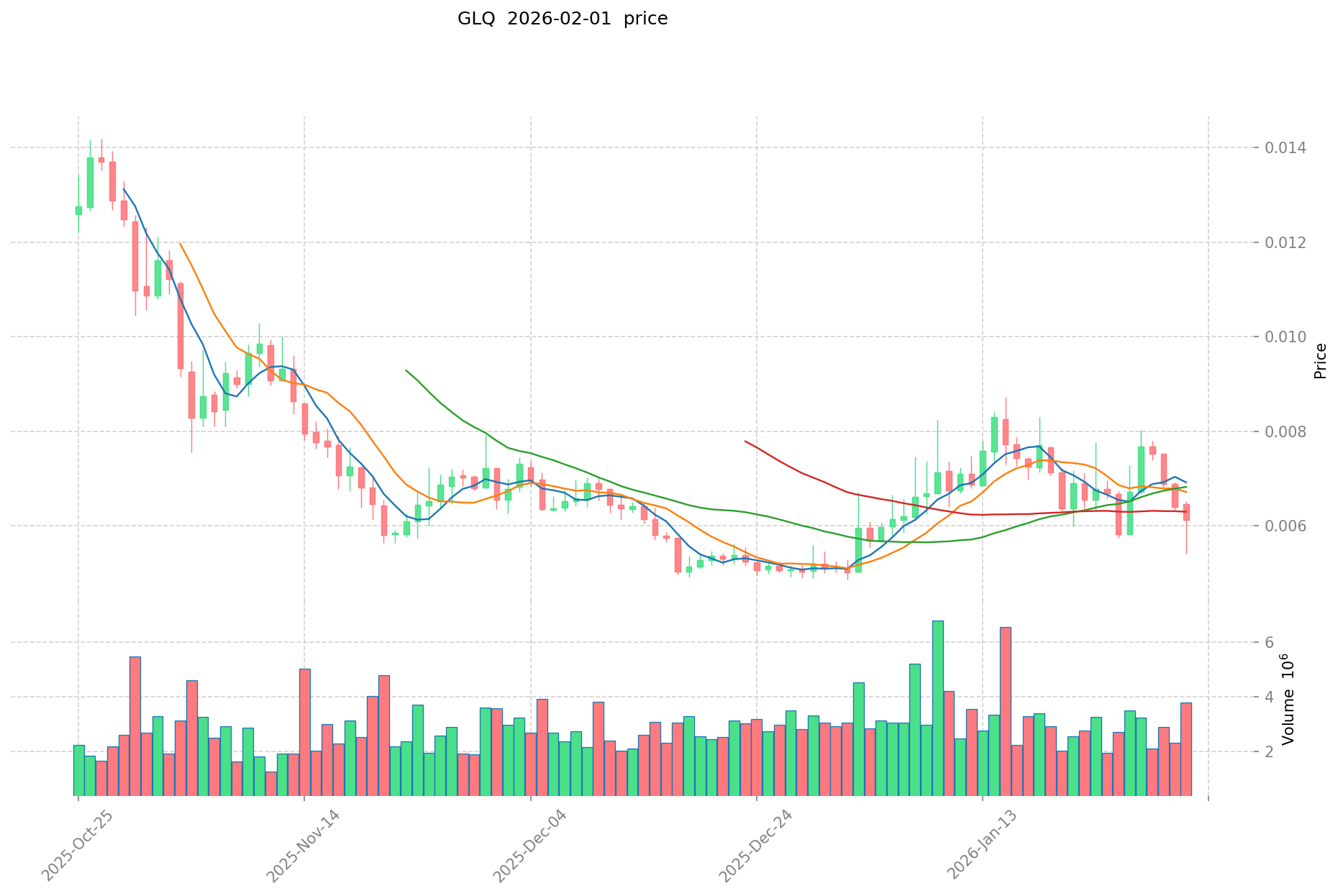
GraphLinq Protocol (GLQ) reached its all-time high price of $0.19361 on March 18, 2024, reflecting strong market interest during that period. The token's lowest recorded price was $0.00118009 on June 19, 2022, representing a significant contrast in valuation. As of the latest update on February 01, 2026, GLQ trades at $0.006329, showing a 1-hour increase of 2.88%, a 24-hour decrease of 1.86%, a 7-day decline of 5.1%, and a 30-day gain of 26%. However, over the past year, the token has experienced an 86.59% decline from previous levels. The 24-hour trading range spans from $0.00541 to $0.006517, demonstrating moderate intraday volatility. These price movements reflect broader market dynamics, project development progress, and shifting investor sentiment within the decentralized automation and DeFi monitoring sector.
Click to view current GLQ market price
On-Chain Metrics
- Token Holders: As of the latest data, GLQ has 10,716 token holders, indicating a growing community of users participating in the GraphLinq ecosystem.
- Market Capitalization: The current market capitalization stands at approximately $2,151,860, with a fully diluted market cap of $3,164,499.76, representing a market cap to FDV ratio of 68%.
- Trading Activity: The 24-hour trading volume reaches $22,812.74, reflecting active market participation and liquidity for the token across 3 exchanges, with trading available on Gate.com.
GraphLinq Protocol Ecosystem Applications and Partners
Core Use Cases
GraphLinq Protocol's ecosystem supports diverse applications:
- DeFi Automation: GraphLinq enables decentralized data monitoring and automated execution across multiple blockchain networks, providing no-code blockchain integration solutions.
- Cross-Chain Connectivity: The protocol facilitates seamless connections between blockchain systems and external platforms, promoting automated workflow execution without programming requirements.
Strategic Collaborations
While specific partnership details are not extensively documented in available materials, GraphLinq Protocol's multi-chain architecture positions it to integrate with various blockchain ecosystems, enhancing its technical capabilities and market reach.
These collaborative potentials provide a foundation for GraphLinq Protocol's ecosystem expansion.
Challenges and Controversies
GraphLinq Protocol faces several challenges:
- Market Competition: Competing with established blockchain automation platforms and smart contract ecosystems
- Price Volatility: Significant fluctuations with GLQ experiencing an 86.59% decline over the past year
- Adoption Barriers: Building awareness and user base in a crowded DeFi infrastructure market
These issues have sparked discussions within the community and continue to drive the protocol's evolution.
GraphLinq Protocol maintains an active community with 10,716 token holders as of February 2026.
On X platform, discussions around GraphLinq Protocol and its GLQ token generate regular engagement, particularly during protocol updates and market movements.
Factors such as price changes and platform feature announcements contribute to community activity levels.
X platform sentiment shows varied perspectives:
- Supporters highlight GraphLinq Protocol's no-code automation capabilities and multi-chain compatibility, viewing it as an accessible solution for blockchain integration.
- Critics focus on price performance concerns and adoption challenges in a competitive market.
Recent trends reflect mixed sentiment influenced by broader market conditions and the token's price trajectory.
Trending Topics
X users discuss GraphLinq Protocol's automation technology, tokenomics, and market positioning,
showcasing both its innovative potential and the obstacles toward mainstream adoption.
- Official Website: Visit GraphLinq Protocol official site for features, use cases, and latest developments.
- Blockchain Explorer: Track GLQ token activity through GraphLinq Explorer and Etherscan.
- X Platform: GraphLinq Protocol maintains presence on X through @graphlinq_proto, sharing updates on technical developments, community initiatives, and ecosystem news.
GraphLinq Protocol Future Roadmap
While specific dated milestones are not detailed in available materials, GraphLinq Protocol's development direction focuses on:
- Enhancing multi-chain automation capabilities and expanding blockchain connectivity options
- Ecosystem Growth: Increasing adoption among developers and enterprises seeking no-code blockchain solutions
- Long-term Vision: Establishing itself as a standard platform for automated blockchain interactions
How to Participate in GraphLinq Protocol?
- Purchase Channels: GLQ tokens are available on Gate.com and select cryptocurrency exchanges
- Storage Solutions: Use compatible ERC-20 wallets such as MetaMask or hardware wallets for secure storage
- Network Participation: Run graph executions through the GraphLinq Engine network using GLQ tokens for execution fees
- Ecosystem Building: Access developer resources at the official website to create automated blockchain workflows
Summary
GraphLinq Protocol redefines blockchain automation through its no-code approach, offering accessibility, multi-chain compatibility, and automated execution capabilities.
Its community of over 10,000 holders, technical resources, and specialized focus position it as a notable project in the blockchain automation space.
Despite facing market volatility and competitive pressures, GraphLinq Protocol's innovative approach and clear technical direction establish its relevance in decentralized technology's future.
Whether you're a newcomer or experienced participant, GraphLinq Protocol presents opportunities for engagement in blockchain automation.
FAQ
What is GLQ? How does it work?
GLQ is the native token of GraphLinq Chain used for paying transaction fees and governance voting. It serves as the validation method for confirming blocks on the GraphLinq Chain network.
What are the practical uses and application scenarios of GLQ?
GLQ serves as a utility token within the Gala ecosystem, enabling governance participation, staking rewards, and access to gaming and entertainment services. It facilitates transactions across the Gala network and provides holders with voting rights on platform development decisions.
How to Buy and Store GLQ Tokens?
Register a CoinEx account and deposit funds to purchase GLQ tokens. Transfer your GLQ to a secure cold storage wallet for long-term protection and security of your assets.
What is the difference between GLQ and other mainstream cryptocurrencies such as BTC and ETH?
GLQ focuses on liquidity provision and DeFi efficiency rather than being a store of value or medium of exchange like BTC and ETH. While BTC prioritizes value preservation and ETH supports smart contracts and decentralized applications, GLQ aims to enhance DeFi ecosystem functionality and transaction volume.
What are the risks to note when investing in GLQ?
GLQ investment carries market volatility and technology risks with significant price fluctuations. Investors should understand market trends and personal risk tolerance. Conduct thorough market research before investing.
* The information is not intended to be and does not constitute financial advice or any other recommendation of any sort offered or endorsed by Gate.