GraphLinq Protocol (GLQ) is a comprehensive no-code automation platform revolutionizing blockchain integration and DeFi operations across multiple chains. Launched in 2021, GLQ addresses the technical barriers preventing non-developers from automating decentralized finance activities. This guide explores GLQ's decentralized infrastructure built on Ethereum as an ERC-20 token, examining its blockchain foundation, secure transaction mechanisms, and fair consensus validation. The article analyzes GLQ's market performance, including circulating supply of 340 million tokens and current trading data on Gate, alongside on-chain metrics revealing 10,714 token holders. It covers practical ecosystem applications in DeFi automation and blockchain connectivity, community engagement on social platforms, and development roadmap priorities. Whether exploring GLQ's innovative no-code approach, understanding tokenomics, or learning participation methods through Gate and compatible wallets, this guide provides essential insigh
GraphLinq Protocol's Positioning and Significance
In 2021, the GraphLinq team launched GraphLinq Protocol (GLQ), aiming to address the complexity of blockchain integration and the technical barriers preventing non-developers from automating DeFi operations.
As a no-code automation platform for decentralized finance data monitoring and execution across multiple chains, GraphLinq Protocol plays a key role in DeFi automation, blockchain integration, and data analytics.
As of 2026, GraphLinq Protocol has established itself as an innovative infrastructure solution in the blockchain automation space, with over 10,700 token holders and an active development community.
This article will provide an in-depth analysis of its technical architecture, market performance, and future potential.
Origin and Development History
Birth Background
GraphLinq Protocol was created by its founding team in 2021, aiming to solve the challenge of connecting blockchain networks with external systems without requiring coding expertise.
It emerged during the DeFi boom and growing demand for blockchain automation tools, with the goal of democratizing access to blockchain automation and enabling seamless multi-chain operations to transform the current landscape.
The launch of GraphLinq Protocol brought new possibilities for DeFi users, developers, and blockchain projects seeking efficient automation solutions.
Major Milestones
- 2021: Token launch at an initial price of approximately 0.041 USD, establishing the foundation for the protocol's ecosystem.
- 2024: Significant price movement reaching near 0.19 USD in March, reflecting growing market interest in automation solutions.
- 2026: The protocol maintains an active ecosystem with over 10,700 holders and operates on Ethereum as an ERC-20 token.
With community support and continuous protocol development, GraphLinq Protocol continues to optimize its technical capabilities, security features, and real-world applications in blockchain automation.
How GraphLinq Protocol Works?
No Central Control
GraphLinq Protocol operates on a decentralized network of nodes distributed globally, independent of centralized institutions or single points of control.
These nodes collaborate to process and validate automation executions, ensuring system transparency and resistance to attacks, granting users greater autonomy while enhancing network resilience.
Blockchain Foundation
GraphLinq Protocol's infrastructure leverages blockchain technology as a transparent, immutable foundation for recording automation executions and token transactions.
Operations are recorded on the Ethereum blockchain as an ERC-20 token, with transactions grouped into blocks and linked through cryptographic hashing to form a secure chain.
Anyone can verify records without intermediaries, establishing trustless automation.
The protocol's multi-chain application approach enables cross-chain data monitoring and execution capabilities.
Ensuring Fairness
GraphLinq Protocol operates on Ethereum's Proof of Stake (PoS) consensus mechanism to validate transactions and prevent fraudulent activities such as double-spending.
Network validators maintain network security through staking ETH and validating blocks, receiving rewards for their participation.
The protocol's innovation includes enabling automated graph executions without coding requirements and supporting multi-chain operations.
Secure Transactions
GraphLinq Protocol utilizes public-private key cryptography to protect transactions:
- Private keys (similar to secret passwords) are used to authorize automation executions and token transfers
- Public keys (similar to account numbers) are used to verify ownership and transaction authenticity
This mechanism ensures fund security while transactions maintain pseudonymous privacy typical of Ethereum-based tokens.
Users pay execution fees in GLQ tokens to run their graph-based automations through the GraphLinq Engine network, creating a self-sustaining economic model.
Circulation Overview
As of February 01, 2026, GraphLinq Protocol's circulating supply stands at 340,000,000 GLQ tokens, with a total supply of 499,999,961.366287 tokens and a maximum supply capped at 500,000,000 GLQ. The circulating supply represents approximately 68% of the maximum supply, indicating a relatively high token circulation ratio.
GLQ is an ERC-20 token that circulates within the protocol and community ecosystem. Token holders utilize GLQ to run graph executions through the GraphLinq engine network and pay for execution fees, which forms the core economic model of the protocol.
Price Volatility
GraphLinq Protocol reached its historical high of $0.19361 on March 18, 2024, driven by market dynamics and adoption trends during that period.
The token experienced its lowest price point at $0.00118009 on June 19, 2022, reflecting broader market conditions and cyclical downturns in the cryptocurrency sector.
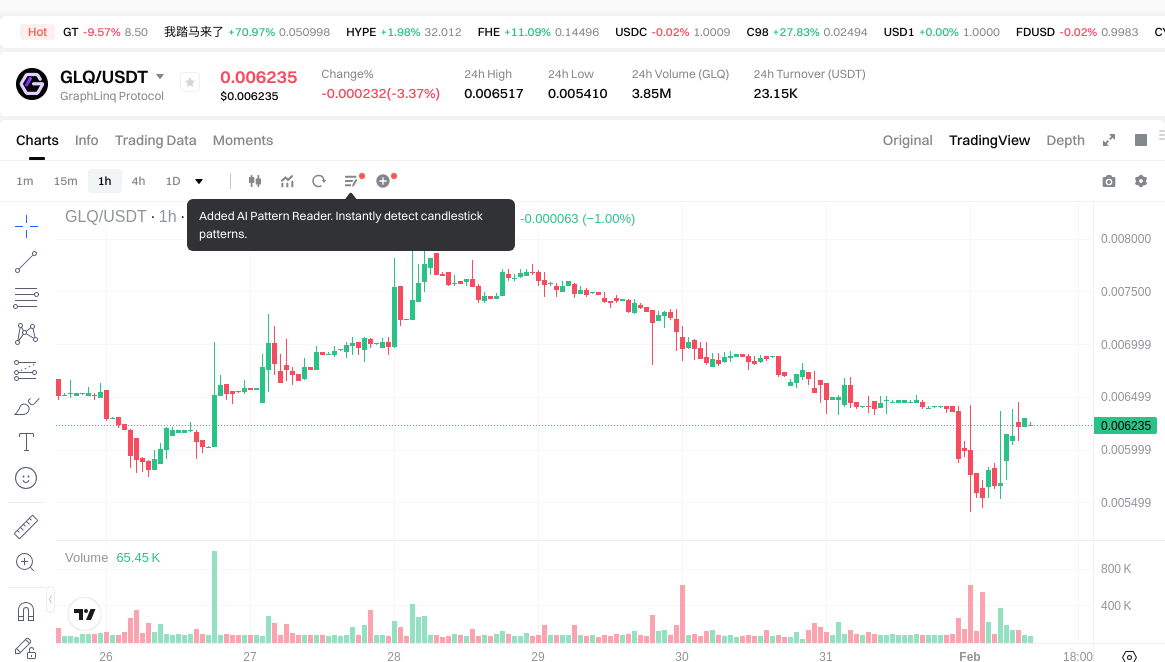
As of the latest data update on February 01, 2026, GLQ is trading at $0.006235, with a 24-hour trading volume of $23,168.797204. Recent price movements show a 0.33% increase over the past hour, while experiencing a -4% decline over 24 hours and a -5.75% decrease over the past week. However, the token has demonstrated resilience with a 24.09% gain over the past 30 days, despite an -86.76% decline over the one-year period.
These fluctuations reflect various factors including market sentiment, adoption trends, and external market conditions affecting the broader cryptocurrency ecosystem.
Click to view current GLQ market price
On-Chain Metrics
- Token Holders: The protocol currently has 10,714 token holders, indicating a diverse distribution of GLQ tokens across the community.
- Market Capitalization: GraphLinq Protocol maintains a market cap of $2,119,900, with a fully diluted valuation of $3,117,499.759118799445.
- Market Dominance: The token represents 0.00011% of the total cryptocurrency market, positioning it within the emerging project category.
GraphLinq Protocol Ecosystem Applications and Partners
Core Use Cases
GraphLinq Protocol's ecosystem supports multiple applications:
- DeFi Automation: The protocol enables decentralized monitoring and execution of DeFi operations, providing automated data tracking and transaction execution across multiple chains.
- Blockchain Integration: GraphLinq facilitates no-code blockchain connectivity, allowing users to link blockchain systems with external applications without technical expertise.
Strategic Partnerships
GraphLinq Protocol continues to expand its technical capabilities and market presence through ecosystem development.
These partnerships provide a solid foundation for GraphLinq's ecosystem expansion.
Challenges and Discussions
GraphLinq Protocol faces the following challenges:
- Technical Considerations: As an automation protocol operating across multiple chains, ensuring seamless cross-chain execution requires continuous optimization.
- Market Competition: The growing landscape of blockchain automation and integration solutions presents competitive dynamics.
- Adoption Barriers: Encouraging broader adoption of no-code blockchain tools remains an ongoing effort.
These issues have sparked discussions within the community and market, driving GraphLinq's continuous innovation.
GraphLinq Protocol's community demonstrates active participation, with the token held by 10,714 addresses as of February 2026.
On X platform, related posts and hashtags (such as #GLQ and #GraphLinq) generate regular engagement.
New feature releases and protocol developments continue to energize community discussions.
Sentiment on X presents varied perspectives:
- Supporters praise GraphLinq Protocol's no-code approach and multi-chain automation capabilities, viewing it as an accessible solution for blockchain integration.
- Observers focus on market performance and ecosystem development progress.
Recent trends reflect typical market dynamics with mixed sentiment patterns.
Popular Topics
X users discuss GraphLinq Protocol's automation features, DeFi applications, and ease of use,
showcasing both its innovative potential and areas for continued development.
- Official Website: Visit GraphLinq Protocol Official Website for features, use cases, and latest updates.
- Blockchain Explorer: GraphLinq Explorer and Etherscan Contract provide transaction and contract verification data.
- X Updates: On X platform, GraphLinq Protocol maintains active presence through @graphlinq_proto,
with posts covering technical updates, community events, and ecosystem developments.
GraphLinq Protocol Future Roadmap
- Ongoing Development: Continued enhancement of automation capabilities and multi-chain support, improving execution efficiency and reliability.
- Ecosystem Goals: Expanding the range of supported applications and use cases across blockchain platforms.
- Long-term Vision: Establishing GraphLinq as a leading no-code blockchain automation solution for DeFi and beyond.
How to Participate in GraphLinq Protocol?
- Purchase Options: Acquire GLQ through supported platforms including Gate.com.
- Storage Solutions: Securely store GLQ using compatible Ethereum wallets such as MetaMask or hardware wallets.
- Ecosystem Participation: Explore GraphLinq's automation tools to build custom blockchain workflows without coding.
- Community Involvement: Engage with the GraphLinq community through official channels and contribute to ecosystem growth.
Summary
GraphLinq Protocol redefines blockchain automation through its no-code approach, offering accessibility, multi-chain compatibility, and DeFi monitoring capabilities.
Its active community, comprehensive resources, and market presence position it distinctively in the cryptocurrency space.
Despite facing competitive and adoption challenges, GraphLinq Protocol's innovative approach and clear development direction establish its relevance in decentralized technology's future.
Whether you are a newcomer or experienced participant, GraphLinq Protocol represents an interesting automation solution worth exploring.
FAQ
What is GLQ cryptocurrency and what does it do?
GLQ is the native token of Graphlinq Protocol, an Ethereum-based platform. It powers the graph network, enabling users to run graphs on both testnet and mainnet for decentralized data processing and automation.
How can I buy and store GLQ tokens?
Purchase GLQ tokens through cryptocurrency platforms using credit card, bank transfer, or other payment methods. After buying, transfer them to a secure wallet for storage. Hardware wallets offer the highest security level for long-term holding.
What is the total supply and tokenomics of GLQ?
GLQ has a total supply of 650,000,000 tokens with a circulating supply of 339,999,900. There is no maximum supply cap. The tokenomics feature no ongoing minting mechanism for new GLQ tokens.
Which blockchain network does GLQ run on?
GLQ runs on the Ethereum blockchain as an ERC20 token. It is used within the Graphlinq ecosystem for executing graphs on the platform's network.
What is the project behind GLQ and what problems does it solve?
GLQ is a no-code automation platform enabling users to create complex blockchain and non-blockchain workflows without coding skills. It solves service integration challenges and simplifies task automation for developers and enterprises.
Is GLQ a safe investment and what are the risks?
GLQ offers potential growth opportunities within the decentralized ecosystem. While all crypto investments carry volatility, GLQ's utility-driven model and growing adoption reduce speculative risk. Key risks include market fluctuations and regulatory changes. Conduct thorough research before investing.
How does GLQ compare to other similar cryptocurrencies?
GLQ offers higher growth potential with greater volatility due to its lower market cap and trading volume compared to established alternatives like ENJ. GLQ provides unique exposure to gaming and metaverse opportunities with more dynamic price movements.
* The information is not intended to be and does not constitute financial advice or any other recommendation of any sort offered or endorsed by Gate.