GMX is a decentralized perpetual exchange protocol launched in 2021 to address inefficiencies in on-chain derivatives trading. Built on Arbitrum with multi-chain expansion to Avalanche, GMX operates without central control while ensuring transaction security through blockchain technology and smart contract audits. This comprehensive guide explores GMX's technical architecture, innovative GLP liquidity pool mechanism, market performance with 300,976+ holders, and core use cases in leveraged trading and DeFi infrastructure. The article examines GMX's ecosystem partnerships, current challenges including competitive pressure, and the active community sentiment across social platforms. Whether you're a trader seeking low-slippage perpetual trading or interested in decentralized finance innovation, this guide covers participation methods on Gate and governance opportunities through GMX token holders.
GMX's Positioning and Significance
In 2021, the GMX team launched GMX (GMX), aiming to address inefficiencies and high costs in decentralized perpetual trading.
As a decentralized perpetual exchange platform, GMX plays a key role in the DeFi derivatives trading sector.
As of 2026, GMX has become a prominent player in the decentralized derivatives space, with over 300,976 holders and an active developer community.
This article will provide an in-depth analysis of its technical architecture, market performance, and future potential.
Origin and Development History
Background of Creation
GMX was created by the GMX development team in 2021, aiming to solve challenges such as limited liquidity, high slippage, and centralization risks in decentralized perpetual trading.
It emerged during the DeFi boom and growing demand for decentralized derivatives, with the goal of providing low-slippage, capital-efficient perpetual trading through innovative liquidity pool mechanisms.
The launch of GMX brought new possibilities to traders seeking decentralized leverage trading alternatives.
Major Milestones
- 2021: Mainnet launch on Arbitrum, implementing zero-price-impact trades through the GLP liquidity pool mechanism.
- 2022: Expansion to Avalanche network, broadening multi-chain ecosystem reach.
- 2023: Platform trading volume and fees reached significant levels, with GMX reaching an all-time high price of $91.07 on April 18, 2023.
- 2024-2025: Continued ecosystem development with ongoing protocol improvements and community governance initiatives.
With support from the decentralized community and active governance participants, GMX continues to optimize its technology, security, and real-world applications.
How Does GMX Work?
No Central Control
GMX operates on a decentralized network of computers (nodes) distributed globally, free from control by banks or governments.
These nodes collaborate to validate transactions, ensuring the system remains transparent and attack-resistant, granting users greater autonomy and enhancing network resilience.
Blockchain Foundation
GMX's infrastructure is built on the Arbitrum blockchain (with additional deployment on Avalanche), leveraging a public, immutable digital ledger that records all protocol interactions.
Transactions are grouped into blocks and linked through cryptographic hashes to form a secure chain.
Anyone can view the records, establishing trust without intermediaries.
The use of Layer 2 scaling solutions like Arbitrum further enhances performance and reduces transaction costs.
Ensuring Fairness
GMX operates on blockchains that use Proof of Stake (PoS) mechanisms to validate transactions and prevent fraudulent activities such as double-spending.
Network validators maintain security through staking and running validation nodes, earning rewards in the respective blockchain's native tokens.
GMX's innovation includes a unique liquidity pool model (GLP) that allows liquidity providers to earn fees while traders benefit from low slippage.
Secure Transactions
GMX leverages public-private key cryptography to protect transactions:
- Private keys (like secret passwords) are used to sign transactions
- Public keys (like account numbers) are used to verify ownership
This mechanism ensures fund security while maintaining transactions at a pseudonymous privacy level.
The protocol incorporates smart contract security audits and multi-signature governance controls for additional protection.
Circulation Overview
As of January 18, 2026, GMX's circulating supply stands at 10,376,043.24 tokens, with a total supply of 10,376,043.24 tokens and a maximum supply capped at 13,250,000 tokens, representing a fixed supply model. The current circulating supply accounts for approximately 78.31% of the maximum supply.
New tokens enter the market through platform fee distributions, where GMX token holders receive 30% of the fees generated by the platform, influencing supply-demand dynamics.
Price Fluctuation
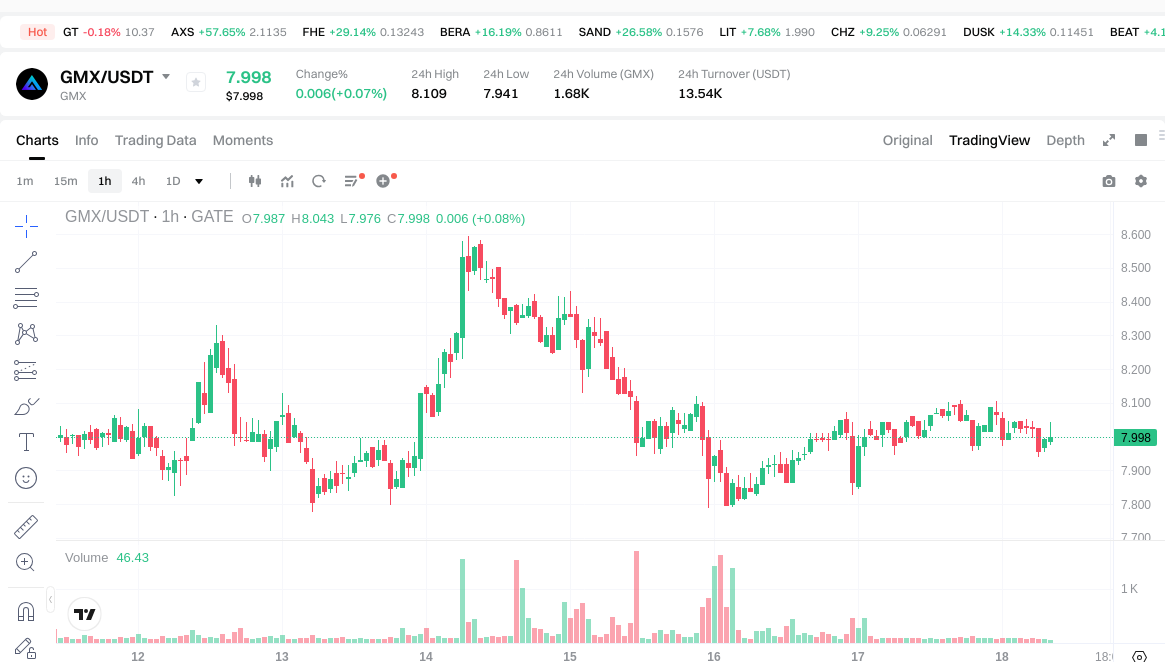
GMX reached its historical high price of $91.07 on April 18, 2023, driven by favorable market conditions during the period. Its lowest price of $6.92 occurred on October 11, 2025, reflecting market volatility and broader industry trends.
These fluctuations demonstrate the impact of market sentiment, adoption trends, and external factors on the token's valuation.
Click to view the current GMX market price
On-chain Metrics
- Holders: 300,976 addresses (reflecting user participation)
- 24-hour Trading Volume: $13,584.27 (indicating network activity)
- Market Capitalization: $83,330,003.29 (representing current market valuation)
GMX Ecosystem Applications and Partners
Core Use Cases
GMX's ecosystem supports multiple applications:
- Decentralized Trading: GMX provides perpetual swap trading with low fees and minimal slippage.
- DeFi Infrastructure: The platform enables leveraged trading and liquidity provision, driving innovation in decentralized finance.
Strategic Partnerships
GMX has established collaborations to enhance its technical capabilities and market presence.
These partnerships provide a solid foundation for GMX's ecosystem expansion.
Controversies and Challenges
GMX faces the following challenges:
- Technical Issues: Scaling solutions and network optimization remain ongoing priorities
- Competitive Pressure: Competition from other decentralized exchanges and DeFi protocols
These issues have sparked discussions within the community and market, while also driving GMX's continuous innovation.
GMX's community demonstrates significant activity, with over 300,000 token holders.
On X platform, related posts and hashtags (such as #GMX) frequently trend.
Factors such as platform updates and trading volume growth have ignited community enthusiasm.
Sentiment on X shows varied perspectives:
- Supporters praise GMX's decentralized trading capabilities and fee distribution model, considering it an innovative DeFi protocol.
- Critics focus on price volatility and market competition.
Trending Topics
X users actively discuss GMX's decentralized exchange model, tokenomics, and platform development,
showcasing both its transformative potential and challenges in achieving broader adoption.
- Official Website: Visit GMX Official Site for features, use cases, and latest updates.
- X Updates: On X platform, GMX maintains an active presence at @GMX_IO,
with posts covering technical upgrades, community events, and platform developments, generating significant engagement.
GMX Future Roadmap
- Ecosystem Goals: Expanding platform capabilities and supporting diverse trading pairs
- Long-term Vision: Becoming a leading decentralized perpetual exchange infrastructure
How to Participate in GMX?
- Purchase Channels: Buy GMX on Gate.com and other exchanges
- Storage Solutions: Securely store GMX using compatible wallets
- Participate in Governance: GMX token holders can participate in platform governance decisions
- Build Ecosystem: Visit developer documentation to contribute to the platform
Summary
GMX redefines decentralized trading through blockchain technology, offering transparent, secure, and efficient perpetual swap trading.
Its active community, comprehensive resources, and strong market performance distinguish it in the cryptocurrency space.
Despite facing regulatory uncertainties and competitive pressures, GMX's innovative approach and clear development trajectory position it prominently in the future of decentralized finance.
Whether you are a newcomer or experienced trader, GMX deserves attention and participation.
FAQ
What is GMX and how does it work as a decentralized exchange?
GMX is a decentralized exchange enabling trading across multiple blockchains using liquidity pools instead of order books. It supports direct trades from Arbitrum, Avalanche, Solana, and other networks, executing trades against dynamically balanced pools with Chainlink data feeds for reliable pricing.
How can I trade on GMX and what are the main features?
GMX is a decentralized futures and spot trading platform. Connect your wallet, deposit collateral, and trade leveraged positions with low fees. Key features include perpetual futures, spot trading, stop-loss orders, and multi-chain support on Arbitrum and Avalanche networks.
What is the GMX token and what are its use cases?
GMX token powers a decentralized perpetual exchange across multiple blockchains including Arbitrum, Avalanche, and Solana. It provides liquidity for the protocol, enables permissionless on-chain trading, and serves as the foundational liquidity layer for multichain DeFi.
What are the risks and benefits of using GMX for trading?
Benefits include advanced trading tools, deep liquidity, and low slippage. Risks involve market volatility, leverage exposure, and potential liquidation. GMX offers decentralized trading with flexible leverage but requires careful risk management.
How does GMX compare to other decentralized exchanges like Uniswap or dYdX?
GMX stands out with superior total locked value of $627 million, significantly outpacing dYdX's $356 million. GMX offers specialized perpetual trading with efficient capital utilization and lower slippage, making it a stronger competitor in the decentralized exchange ecosystem.
How do I stake GMX tokens and what rewards can I earn?
Stake GMX tokens in your wallet to earn GMX rewards and escrowed GMX. Rewards vest over one year. Each staked token generates the same rewards as regular GMX tokens.
What is the difference between GMX spot trading and perpetual futures trading?
Spot trading involves buying and owning assets outright for immediate settlement. Perpetual futures trading uses leveraged contracts with no expiration, allowing you to profit from price movements without owning the underlying asset.
* The information is not intended to be and does not constitute financial advice or any other recommendation of any sort offered or endorsed by Gate.