GMX is a comprehensive guide to the decentralized perpetual exchange platform that addresses inefficiencies in centralized trading through transparent, low-cost alternatives on the Arbitrum network. The article examines GMX's technical architecture, including multi-asset liquidity pools and autonomous smart contracts, alongside its utility and governance token model where holders earn 30% of platform fees. Currently trading at $7.998 with over 300,000 holders, GMX demonstrates significant market presence despite 67.58% decline over the past year. The guide covers core use cases including decentralized perpetual trading with up to 50x leverage and liquidity provision opportunities, while addressing challenges like regulatory risks and competitive pressures. Readers will discover how to purchase GMX on Gate.com, participate in governance, and engage with the growing DeFi derivatives ecosystem through practical integration pathways and risk management strategies.
GMX's Positioning and Significance
In the era of decentralized finance evolution, GMX (GMX) was launched to address inefficiencies in perpetual futures trading, high centralized exchange risks, and lack of transparency in fee structures.
As a decentralized spot and perpetual exchange platform, GMX plays a critical role in the DeFi derivatives trading sector.
As of 2026, GMX has established itself as a prominent player in the decentralized derivatives market, with over 300,000 holders and an active community of traders and liquidity providers.
This article will provide an in-depth analysis of its technical architecture, market performance, and future potential.
Origin and Development History
Birth Background
GMX emerged to solve the challenges of centralized perpetual exchanges, including counterparty risk, opaque fee structures, and limited user control over funds.
It was born during the rapid expansion of DeFi protocols, with the goal of providing transparent, low-cost, and decentralized perpetual trading to empower users.
The launch of GMX brought new possibilities for traders seeking alternatives to centralized platforms.
Key Milestones
- The platform launched its decentralized exchange model, implementing zero-price-impact trading and multi-asset pool liquidity.
- GMX expanded its ecosystem with significant trading volume growth and community-driven governance initiatives.
- The token achieved distribution across 28 exchanges, enhancing accessibility for global users.
- The platform's fee-sharing mechanism allocated 30% of platform-generated fees to GMX token holders, strengthening token utility.
With community support and continuous protocol development, GMX continues to refine its technology, security features, and real-world applications.
How GMX Operates
Decentralized Architecture
GMX operates on a decentralized infrastructure deployed on the Arbitrum network, eliminating reliance on centralized intermediaries.
The protocol's smart contracts handle trade execution, position management, and fee distribution autonomously, ensuring transparency and reducing counterparty risk.
This architecture provides users with greater control over their assets while enhancing network resilience.
Blockchain Foundation
GMX leverages the Arbitrum blockchain for its operations, benefiting from Layer 2 scaling solutions that provide faster transaction speeds and lower costs.
All trading activities and fee distributions are recorded on an immutable, transparent ledger.
The use of multi-asset liquidity pools (GLP) allows for efficient capital utilization and reduced slippage for traders.
Anyone can verify transactions and protocol mechanics without requiring intermediaries.
Governance and Sustainability
GMX implements a utility and governance token model where GMX holders participate in protocol decisions and receive fee rewards.
Token holders earn 30% of platform-generated fees, creating aligned incentives between users and protocol success.
The circulating supply of approximately 10.38 million GMX tokens represents about 78.31% of the maximum supply of 13.25 million tokens.
This mechanism ensures sustainable protocol development while rewarding active participants.
Secure Trading Environment
GMX employs smart contract-based security measures to protect user funds and trading operations.
Users maintain custody of their assets through:
- Wallet integration that keeps funds under user control until execution
- Transparent on-chain settlement that eliminates counterparty risk
The protocol undergoes regular security audits to maintain system integrity.
Trading on GMX maintains pseudonymous privacy while ensuring transaction transparency through blockchain verification.
Circulation Overview
As of January 18, 2026, GMX has a circulating supply of 10,376,042.61 tokens, with a total supply of 10,376,042.61 tokens and a maximum supply of 13,250,000 tokens. The current circulating supply represents approximately 78.31% of the maximum supply. GMX operates as a utility and governance token within its decentralized perpetual exchange ecosystem, where token holders can participate in platform governance and receive 30% of the fees generated by the platform.
Price Volatility
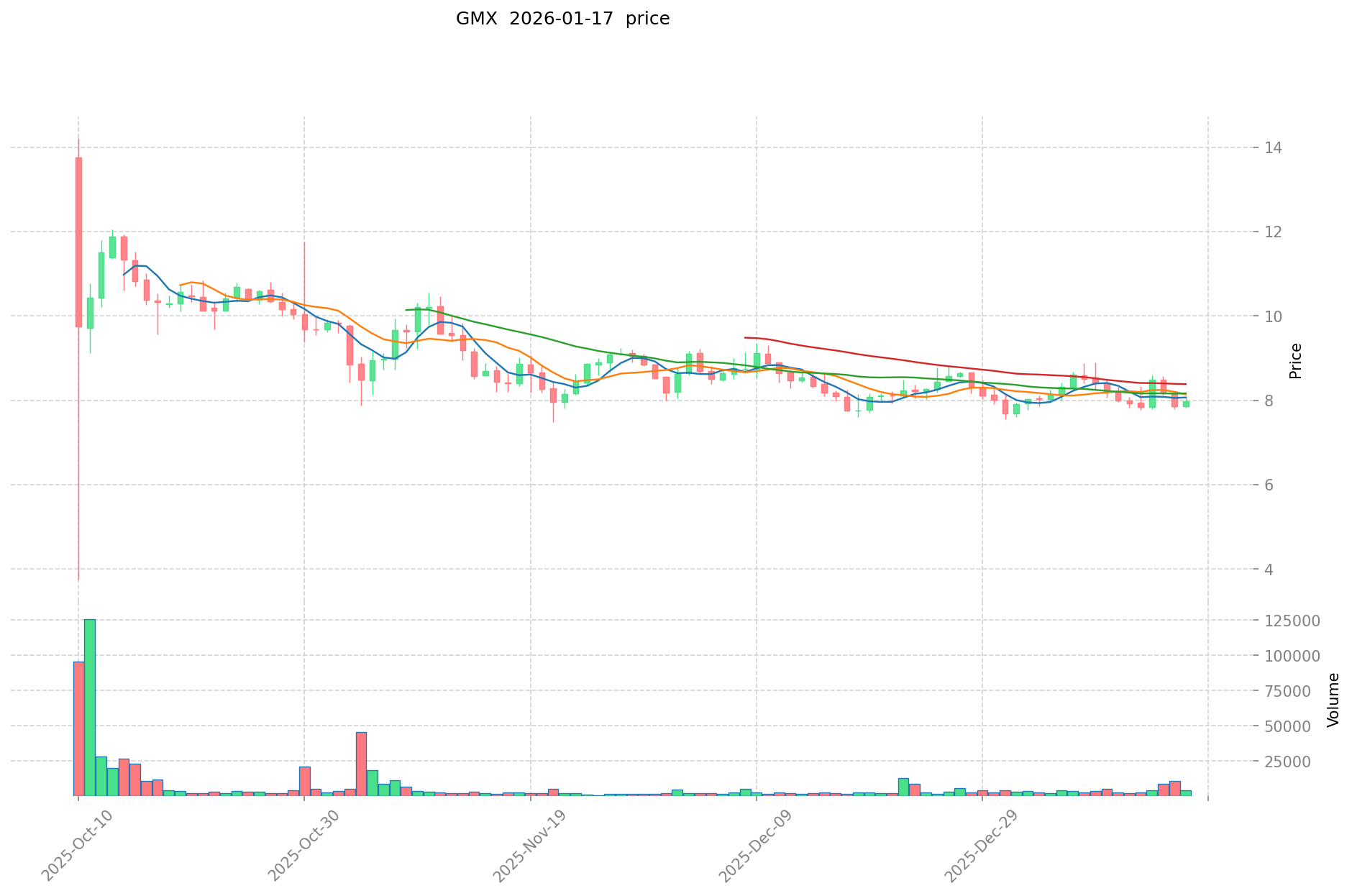
GMX reached its all-time high of $91.07 on April 18, 2023, during a period of increased interest in decentralized perpetual exchanges and broader market conditions favoring DeFi protocols. The token's lowest price was $6.92, recorded on October 11, 2025, reflecting market-wide corrections and shifts in trading sentiment. These fluctuations demonstrate the impact of market dynamics, adoption patterns, and external factors on the token's valuation. Currently trading at $7.998, GMX has experienced a decline of approximately 67.58% over the past year.
Click to view current GMX market price
On-Chain Metrics
- 24-Hour Trading Volume: $13,730.73 (indicating active market participation)
- Token Holders: 300,976 addresses (reflecting widespread distribution and community engagement)
- Market Capitalization: $82,987,588.80 (representing its current market valuation)
- Market Cap to FDV Ratio: 78.31% (showing the proportion of circulating supply relative to maximum supply)
GMX Ecosystem Applications and Partners
Core Use Cases
GMX's ecosystem supports multiple applications:
- Decentralized Trading: GMX provides decentralized perpetual trading with up to 50x leverage, enabling users to trade major cryptocurrencies directly from their wallets.
- Liquidity Provision: The GLP (GMX Liquidity Provider) pool allows users to provide liquidity and earn a share of platform fees, supporting the platform's trading infrastructure.
Strategic Partnerships
GMX operates on the Arbitrum network, leveraging its Layer 2 scaling solutions to provide fast and cost-efficient trading experiences.
These partnerships provide a solid foundation for GMX's ecosystem expansion.
Controversies and Challenges
GMX faces the following challenges:
- Technical Issues: As a decentralized perpetual exchange, GMX needs to continuously optimize its oracle system and liquidity mechanisms to ensure price accuracy and trading efficiency
- Regulatory Risks: The evolving regulatory landscape for decentralized derivatives platforms may present compliance challenges in different jurisdictions
- Competitive Pressure: The rise of other decentralized exchanges and perpetual trading platforms creates an increasingly competitive market environment
These issues have sparked discussions within the community and market, while also driving GMX's continuous innovation.
GMX's community demonstrates notable activity, with the protocol having accumulated over 300,976 holders as of the latest data.
On X platform, relevant posts and hashtags (such as #GMX) frequently gain attention.
The platform's fee-sharing mechanism and governance token utility have contributed to community enthusiasm.
Sentiment on X shows varied perspectives:
- Supporters praise GMX's decentralized nature, fee-sharing mechanism, and innovative trading model, viewing it as a significant advancement in decentralized derivatives trading.
- Critics focus on price volatility, market risks associated with leveraged trading, and challenges in user adoption.
Recent trends indicate ongoing community discussions around platform development and market conditions.
Popular Topics
X users actively discuss GMX's fee distribution model, liquidity pool performance, and protocol upgrades,
showcasing both its innovative potential and the challenges in achieving broader mainstream adoption.
- Official Website: Visit GMX Official Website for features, use cases, and latest updates.
- X Updates: On X platform, GMX maintains an active presence through @GMX_IO,
with posts covering protocol updates, trading features, community developments, and platform metrics, generating significant engagement.
GMX Future Roadmap
- GMX continues to develop its decentralized perpetual trading infrastructure with focus on enhancing user experience and expanding supported assets
- Ecosystem Goals: Strengthen liquidity mechanisms and expand the range of tradable assets
- Long-term Vision: Establish itself as a leading decentralized perpetual trading platform in the DeFi ecosystem
How to Participate in GMX?
- Purchase Channels: Buy GMX on Gate.com and other major cryptocurrency exchanges
- Storage Solutions: Store GMX securely using compatible wallets that support Arbitrum network tokens
- Participate in Governance: GMX token holders can participate in protocol governance decisions
- Ecosystem Building: Developers can explore integration opportunities with GMX's trading infrastructure
Summary
GMX has redefined decentralized derivatives trading through blockchain technology, offering transparent fee structures, decentralized governance, and efficient perpetual trading.
Its engaged community, innovative tokenomics, and market performance position it distinctively in the cryptocurrency sector.
Despite facing regulatory uncertainties and competitive pressures, GMX's innovative approach and clear development focus give it an important role in the future of decentralized finance.
Whether you are a newcomer or an experienced participant, GMX presents opportunities worth exploring and engaging with.
FAQ
What is GMX and how does it work as a decentralized exchange?
GMX is a decentralized exchange offering leveraged perpetual futures and spot trading with low fees. It uses multi-asset liquidity pools and operates without central authority, enabling secure and transparent peer-to-peer trading.
What are the main features and advantages of trading on GMX?
GMX offers zero price impact trades, minimal slippage, and competitive trading fees. It provides efficient execution, allowing traders to trade large amounts without significant price movement, enhancing overall trading experience and profitability.
How do I buy and hold GMX tokens?
You can buy GMX tokens through decentralized exchanges or DEXs, then transfer them to a secure wallet like Klever Wallet for long-term holding. Store your private keys safely to maintain full control of your assets.
What is the GMX token used for and what are its benefits?
GMX tokens enable governance and accrue 70% of protocol fees. Token holders can vote on platform changes, influence decisions, and earn continuous fee rewards from trading activity.
What are the risks and security considerations when using GMX?
GMX carries risks including smart contract vulnerabilities, market volatility, liquidation risk on leveraged positions, and counterparty risk. Use hardware wallets, enable two-factor authentication, and only invest capital you can afford to lose.
GMX excels in leveraged trading with superior liquidity, dYdX offers traditional orderbook models with competitive fees, while Uniswap specializes in spot trading. Many traders use all three platforms to maximize their distinct advantages.
* The information is not intended to be and does not constitute financial advice or any other recommendation of any sort offered or endorsed by Gate.