This comprehensive guide explores The Graph (GRT), a decentralized indexing protocol launched in 2017 to solve blockchain data accessibility challenges. The article covers The Graph's foundational role in Web3 infrastructure, technical architecture utilizing staking mechanisms, and market performance with 173,059 holders. It examines core use cases in DeFi and NFT sectors through partnerships with Uniswap and Aave, while addressing challenges like network decentralization and competitive pressures. The guide details how to participate in The Graph's ecosystem, including purchasing GRT on Gate.com, and explores community sentiment surrounding decentralization progress. With clear development roadmaps and active developer engagement, The Graph positions itself as the essential data querying layer for decentralized applications.
The Graph's Positioning and Significance
In 2017, Yaniv Tal, Brandon Ramirez, and Jannis Pohlmann launched The Graph (GRT), aiming to address the inefficiency and complexity of querying blockchain data.
As a decentralized protocol for indexing and querying blockchain data, The Graph plays a critical role in Web3 infrastructure, DeFi applications, and blockchain data accessibility.
As of 2026, The Graph has become a foundational infrastructure layer within the blockchain ecosystem, with over 173,000 token holders and an active developer community.
This article will provide an in-depth analysis of its technical architecture, market performance, and future potential.
Origin and Development History
Background of Creation
The Graph was created by Yaniv Tal, Brandon Ramirez, and Jannis Pohlmann in 2017, aiming to solve the challenges of efficiently accessing and querying blockchain data.
It emerged during the rapid expansion of blockchain technology and the growing complexity of decentralized applications, with the goal of making blockchain data easily accessible and queryable through open APIs called subgraphs.
The Graph's launch brought new possibilities for developers and applications requiring reliable blockchain data access.
Key Milestones
- 2017: Project initiated to develop decentralized indexing protocol.
- 2020: Mainnet launched on December 17, enabling decentralized data indexing and querying services.
- 2021: Token reached significant valuation milestone, reflecting growing adoption in the DeFi and Web3 sectors.
- Ongoing: Ecosystem expansion with thousands of subgraphs deployed across multiple blockchain networks.
With support from The Graph Foundation and a global community of developers, The Graph continues to enhance its protocol, security features, and real-world applications.
How The Graph Works
No Central Control
The Graph operates on a decentralized network of nodes distributed globally, eliminating dependence on centralized entities.
These nodes collaborate to index and serve blockchain data queries, ensuring the system remains transparent and resistant to single points of failure, granting users greater autonomy and improving network resilience.
Blockchain Foundation
The Graph functions as an indexing protocol layer that organizes blockchain data into subgraphs - open APIs that make data easily accessible.
Data is indexed from various blockchains, structured efficiently, and made queryable through GraphQL.
Anyone can view indexed data and build applications without requiring intermediaries to establish trust.
The protocol supports multiple blockchain networks, enabling cross-chain data accessibility.
Ensuring Fairness
The Graph employs a curation and staking mechanism to validate data quality and prevent malicious behavior.
Indexers stake GRT tokens to provide indexing and query services, while Curators signal which subgraphs are valuable to the network, and both receive rewards for their contributions.
Its innovation includes a market-driven approach to data indexing where economic incentives align network participants' interests.
Secure Transactions
The Graph uses cryptographic methods to protect network operations:
- Private keys are used by network participants to authorize their activities
- Public addresses verify ownership and participation rights
This mechanism ensures network security while maintaining transparency in the indexing and querying process.
Additionally, the protocol incorporates economic security through token staking requirements for Indexers.
Circulation Overview
As of January 15, 2026, The Graph's circulating supply is 10,674,556,288.09 GRT, with a total supply of 10,800,262,816.05 GRT. The circulating supply represents approximately 98.84% of the total supply, indicating a high proportion of tokens already in circulation. The token distribution follows a model that supports network operations through indexer staking and curator participation mechanisms.
Price Volatility
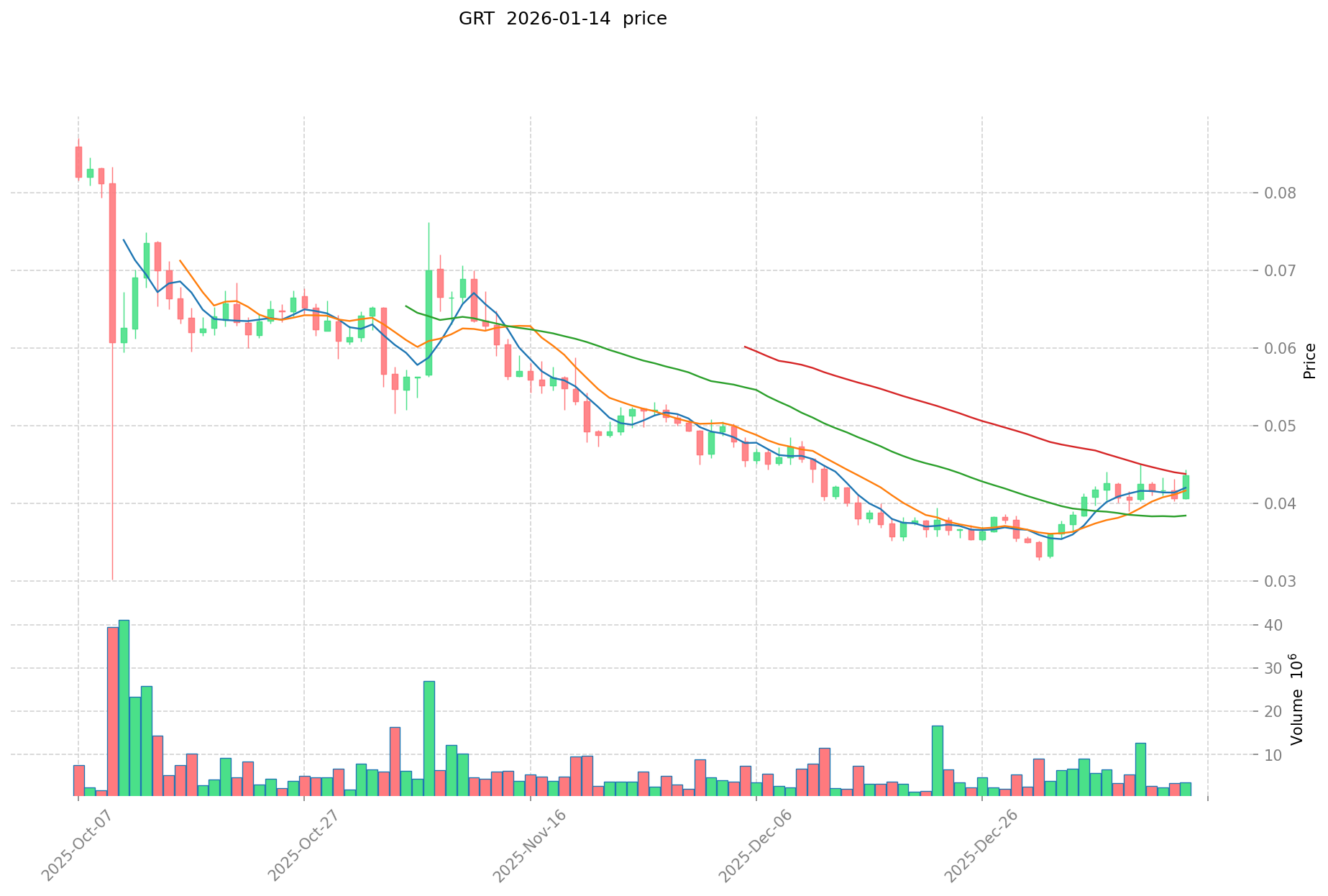
The Graph reached its historical high price of $2.84 on February 12, 2021, during a period of strong market momentum in the broader cryptocurrency sector. Its lowest price was $0.03272768, recorded on January 1, 2026. These fluctuations reflect shifts in market sentiment, network adoption patterns, and broader macroeconomic factors affecting the cryptocurrency industry.
Over different time horizons, GRT has shown varied performance: a -0.88% change over 1 hour, -0.09% over 24 hours, +5.62% over 7 days, +13.55% over 30 days, and -77.81% over 1 year. These metrics illustrate the token's responsiveness to both short-term market dynamics and longer-term trend shifts.
Click to view the current GRT market price
On-Chain Metrics
- 24-Hour Trading Volume: $274,527.38 (indicating active market participation)
- Holders: 173,059 addresses (reflecting user distribution across the network)
- Market Capitalization: $457,404,736.94 (representing the token's current market valuation)
- Fully Diluted Valuation: $462,791,261.67 (showing potential market cap at maximum supply)
The Graph Ecosystem Applications and Partners
Core Use Cases
The Graph's ecosystem supports multiple applications:
- DeFi: Projects like Uniswap, Aave, and Synthetix utilize The Graph's indexing protocol to provide decentralized data querying and access for their platforms.
- NFT and Metaverse: NFT marketplaces and blockchain gaming projects leverage The Graph's subgraphs to enable efficient querying of on-chain asset data and transaction histories.
Strategic Partnerships
The Graph has established collaborations with various blockchain networks and Web3 projects, enhancing its technical capabilities and market presence.
These partnerships provide a solid foundation for The Graph's ecosystem expansion across multiple blockchain networks.
Controversies and Challenges
The Graph faces the following challenges:
- Technical hurdles: Maintaining indexing quality and data accuracy across multiple blockchain networks
- Competition pressure: Emerging indexing solutions and query protocols in the blockchain space
- Network decentralization: Balancing the transition from hosted service to fully decentralized network operations
These issues have sparked discussions within the community and market, while also driving The Graph's continuous innovation.
The Graph's community demonstrates strong activity, with developers actively building subgraphs and contributing to the protocol's growth.
On X platform, relevant posts and hashtags (such as #TheGraph and #GRT) appear regularly in discussions about Web3 infrastructure.
New protocol upgrades and ecosystem developments generate enthusiasm among community members.
Sentiment on X shows varied perspectives:
- Supporters praise The Graph's decentralized indexing capabilities and essential role in Web3 infrastructure, viewing it as "the Google of blockchain data".
- Critics focus on token price volatility and the ongoing transition from centralized to decentralized operations.
Recent trends reflect mixed sentiment influenced by broader market conditions.
Hot Topics
X platform users actively discuss The Graph's decentralization progress, subgraph development, and role in the Web3 ecosystem,
showcasing both its transformative potential and the challenges in achieving full decentralization.
- Official Website: Visit The Graph Official Website for features, use cases, and latest updates.
- X Updates: On X platform, The Graph maintains an active presence through @graphprotocol,
with posts covering protocol upgrades, community activities, ecosystem developments, and technical announcements.
The Graph Future Roadmap
- Ongoing Development: Advancing decentralized network infrastructure and improving query performance
- Ecosystem Goals: Expanding subgraph development across multiple blockchain networks and supporting growing data indexing needs
- Long-term Vision: Becoming the standard indexing and querying layer for Web3 and decentralized applications
How to Participate in The Graph?
- Purchase Channels: Buy GRT on Gate.com and other cryptocurrency exchanges
- Storage Solutions: Use compatible wallets to securely store GRT tokens
- Participate in Governance: Engage in protocol governance through community proposals and discussions
- Build Ecosystem: Visit The Graph's developer documentation to create subgraphs or contribute to protocol development
Summary
The Graph redefines blockchain data accessibility through its decentralized indexing protocol, providing transparency, reliability, and efficient data querying capabilities.
Its active developer community, comprehensive resources, and essential role in Web3 infrastructure distinguish it in the cryptocurrency space.
Despite facing challenges such as network decentralization transition and market competition, The Graph's innovation spirit and clear development roadmap position it importantly in the future of decentralized technology.
Whether you are a newcomer or experienced participant, The Graph deserves attention and involvement.
FAQ
What is GRT (The Graph) and what is its purpose?
The Graph (GRT) is a decentralized protocol enabling efficient access and querying of blockchain data. It functions as a search engine for blockchains, allowing developers and users to organize and retrieve blockchain information securely and efficiently.
What are the main functions and use cases of GRT tokens?
GRT tokens incentivize and reward The Graph network participants while enabling network governance. They are staked by indexers, curators, and delegators to provide indexing services, earn fees, and participate in decentralized data querying across blockchain networks.
How to buy and store GRT tokens?
Purchase GRT on crypto platforms by selecting GRT trading pairs and confirming your order. Store tokens in exchange wallets or transfer to personal crypto wallets for enhanced security and control.
What is the difference between GRT and other cryptocurrencies or blockchain projects?
GRT is a decentralized protocol for indexing and querying blockchain data, distinguishing it from other projects. It offers superior market capitalization and trading volume, serving as essential infrastructure for Web3 data access and discovery.
What are the risks to pay attention to when investing in GRT?
GRT investment risks include market volatility, technology development uncertainties, and network adoption challenges. As an indexing protocol, GRT faces competition and regulatory changes. Price fluctuations can be significant, and technical implementation may encounter unforeseen obstacles.
* The information is not intended to be and does not constitute financial advice or any other recommendation of any sort offered or endorsed by Gate.