This comprehensive guide explores Hedera (HBAR), a high-performance distributed ledger network utilizing hashgraph consensus technology to address scalability, security, and fairness in blockchain systems. Hedera achieves transaction throughput exceeding 10,000 TPS through asynchronous Byzantine Fault Tolerance (aBFT) and fair transaction ordering, making it ideal for enterprises, DeFi applications, and tokenization use cases. With a market capitalization of approximately $4.98 billion and 42.79 billion HBAR in circulation, the platform maintains a globally distributed node network supporting diverse applications in supply chain, identity verification, and decentralized finance. The article covers Hedera's technical architecture, market performance metrics, ecosystem partnerships, and real-world adoption potential. For investors and developers, this guide provides pathways to purchase HBAR on Gate and participate in the growing Hedera ecosystem while addressing key considerations regarding market volatility a
Hedera's Positioning and Significance
In 2019, the Hedera team launched Hedera (HBAR), aiming to address issues related to scalability, security, and fairness in distributed ledger technology.
As a high-performance public ledger network utilizing hashgraph consensus, Hedera plays a key role in decentralized applications, payment systems, and enterprise blockchain solutions.
As of 2026, Hedera has established itself in the cryptocurrency market with a market capitalization ranking around 30th globally, supporting an active developer community and diverse use cases.
This article will analyze its technical architecture, market performance, and future potential.
Origin and Development History
Background
Hedera was developed by its founding team in 2019 to solve challenges in traditional blockchain systems, including limited throughput, unpredictable transaction ordering, and vulnerability to certain attack vectors.
It emerged during a period of growing interest in distributed ledger technology, with the goal of providing fast, secure, and fair consensus through innovative hashgraph technology.
Hedera's launch offered enterprises and developers new possibilities for building scalable decentralized solutions.
Key Milestones
- 2019: Mainnet launch, achieving processing capabilities exceeding 10,000 transactions per second.
- Subsequent years: Network expansion with growing adoption across various sectors including supply chain, identity verification, and tokenization.
- Ongoing: Ecosystem development with increasing numbers of decentralized applications and use cases being deployed on the network.
With support from its governing council and developer community, Hedera continues to enhance its technology, security features, and real-world applications.
How Hedera Works
No Central Control
Hedera operates on a decentralized network of computers (nodes) distributed globally, independent of traditional banking or governmental oversight.
These nodes collaborate to validate transactions, ensuring system transparency and resistance to attacks, granting users greater autonomy while enhancing network resilience.
Distributed Ledger Core
Hedera's distributed ledger is a public, immutable digital record documenting every transaction.
Transactions are processed and timestamped, forming a secure and transparent history.
Anyone can access the records, establishing trust without intermediaries.
The hashgraph consensus mechanism provides unique advantages in terms of speed and fairness compared to traditional blockchain architectures.
Ensuring Fairness
Hedera employs asynchronous Byzantine Fault Tolerance (aBFT) consensus through its hashgraph algorithm to validate transactions and prevent fraudulent activities like double-spending.
Network nodes participate in gossip-about-gossip protocol and virtual voting to maintain network security and reach consensus.
Its innovations include high throughput, low latency, and fair transaction ordering based on consensus timestamps.
Secure Transactions
Hedera uses public-private key cryptography to protect transactions:
- Private keys (similar to secret passwords) are used to authorize transactions
- Public keys (similar to account numbers) are used to verify ownership
This mechanism ensures fund security while maintaining transaction transparency with pseudonymous characteristics.
The network's security is further enhanced by its governance model and the diverse composition of council members operating nodes.
Circulation Overview
As of 13 January 2026, Hedera's circulating supply stands at 42,793,137,593.04 HBAR tokens, with a total supply of 50,000,000,000 HBAR. The maximum supply is capped at 50 billion tokens, establishing a fixed supply model.
The current circulation ratio represents approximately 85.59% of the total supply, with new tokens entering the market according to Hedera's predetermined release schedule. This gradual release mechanism influences the supply-demand dynamics of HBAR in the marketplace.
Price Movements
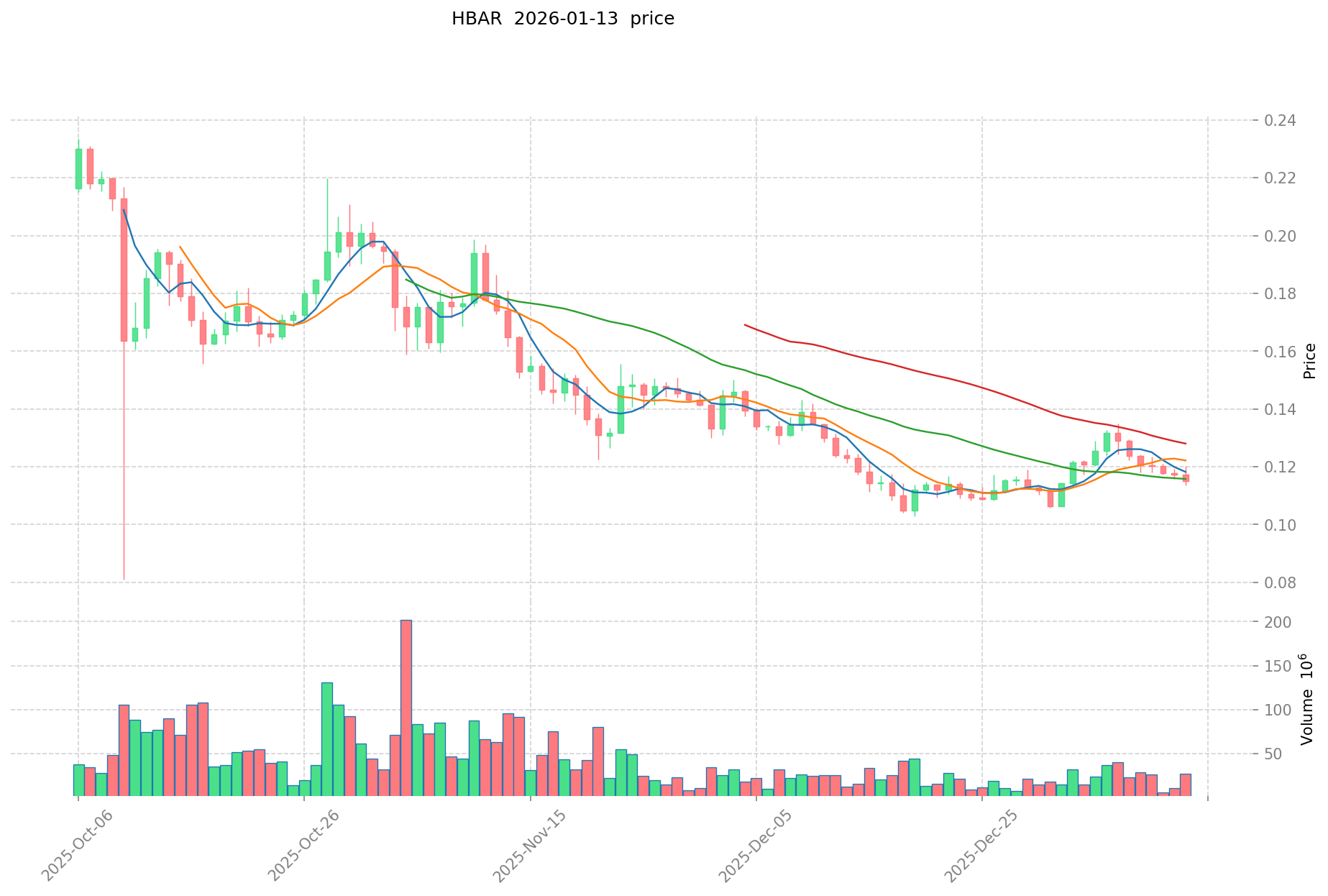
Hedera reached a notable price level of $0.569229 on 15 September 2021, during a period of broader market expansion and increased interest in distributed ledger technology solutions.
The lowest recorded price was $0.00986111 on 3 January 2020, reflecting early-stage market conditions and adoption levels.
As of the current data, HBAR trades at $0.11635, showing various price movements across different timeframes: a decline of 0.06% over 1 hour, an increase of 0.95% over 24 hours, a decrease of 11.63% over 7 days, a decline of 4.65% over 30 days, and a decrease of 58.26% over 1 year. These fluctuations reflect evolving market sentiment, adoption patterns, and broader cryptocurrency market conditions.
Click to view current HBAR market price
Market Metrics
- Market Capitalization: Hedera maintains a market capitalization of approximately $4.98 billion, ranking it at position 30 among cryptocurrencies
- 24-Hour Trading Volume: The network recorded a trading volume of approximately $2.72 million over the past 24 hours
- Fully Diluted Valuation: The fully diluted market cap stands at $5.82 billion, with a market cap to FDV ratio of 85.59%
- Market Dominance: HBAR represents approximately 0.17% of the total cryptocurrency market capitalization
Hedera Ecosystem Applications and Partners
Core Use Cases
Hedera's ecosystem supports multiple applications:
- Decentralized Finance (DeFi): Projects leverage Hedera's high-speed network to provide efficient financial services such as tokenization and asset management.
- Enterprise Solutions: Hedera enables supply chain tracking, digital identity verification, and secure data sharing for businesses.
- Tokenization: The network supports creating and managing digital tokens for various asset classes.
Strategic Partnerships
Hedera has established collaborations with various partners to enhance its technical capabilities and market influence. These partnerships provide a solid foundation for Hedera's ecosystem expansion.
Controversies and Challenges
Hedera faces the following challenges:
- Technical Questions: Discussions around network scalability and transaction optimization continue within the community.
- Regulatory Environment: Like many blockchain projects, Hedera operates in an evolving regulatory landscape that requires ongoing adaptation.
- Market Competition: The presence of other blockchain platforms creates a competitive environment for adoption and development.
These issues have sparked discussions within the community and market, while also driving Hedera's continuous innovation.
Hedera's community remains active with a circulating supply of 42.79 billion HBAR tokens representing 85.59% of the total supply. The network demonstrates consistent on-chain activity and user participation.
Sentiment on social platforms shows varied perspectives:
- Supporters praise Hedera's high throughput (>10,000+ TPS), aBFT consensus security, and fair transaction ordering, viewing it as a robust platform for enterprise and decentralized applications.
- Observers monitor price fluctuations and market performance, with recent data showing price movements of -0.06% (1H), +0.95% (24H), -11.63% (7D), and -4.65% (30D).
Recent trends reflect the broader market conditions affecting digital assets.
Popular Topics
Users discuss Hedera's consensus mechanism, network performance, and enterprise adoption potential, highlighting both its innovative technology and the challenges of achieving widespread adoption.
- Official Website: Visit Hedera's official website for features, use cases, and latest developments.
- X (Twitter): Follow Hedera on X platform at @hedera for updates on technical developments, community activities, and ecosystem news.
- Explorer: Check Hedera Explorer for real-time network data and transaction information.
- GitHub: Access Hedera's GitHub for technical documentation and open-source contributions.
Hedera Future Roadmap
Hedera continues to focus on ecosystem development and network optimization. The project aims to expand its application base and enhance network capabilities to support diverse use cases across various industries.
How to Participate in Hedera?
- Purchase Options: Buy HBAR on Gate.com and other supported platforms.
- Storage Solutions: Use compatible wallets to securely store your HBAR tokens.
- Ecosystem Participation: Explore opportunities to build on Hedera by visiting their developer resources and documentation.
- Community Engagement: Join Hedera's community channels including their subreddit and Facebook page to stay informed and connected.
Summary
Hedera leverages hashgraph consensus technology to offer a fast, secure, and fair public ledger network with throughput exceeding 10,000 TPS. The platform provides transparency, asynchronous Byzantine Fault Tolerance (aBFT) security, and efficient transaction processing.
With a current market capitalization of approximately $4.98 billion and trading at $0.11635 as of January 13, 2026, Hedera maintains its position as a notable player in the distributed ledger technology space. The network has 42.79 billion HBAR in circulation out of a maximum supply of 50 billion tokens.
Despite facing market volatility and competitive pressures, Hedera's unique consensus mechanism and focus on enterprise applications position it as a distinctive platform in the blockchain ecosystem. Whether you're new to cryptocurrency or an experienced participant, Hedera offers opportunities for exploration and engagement in distributed ledger technology.
FAQ
What is Hedera (HBAR) and what is its purpose?
Hedera (HBAR) is a cryptocurrency on the Hedera Hashgraph platform using proof-of-stake consensus. HBAR tokens enable staking and network participation, supporting decentralized applications and ensuring transaction security and network decentralization.
Hedera uses hashgraph consensus instead of blockchain, delivering superior speed and energy efficiency. It processes transactions faster with lower costs than Ethereum and Bitcoin, making it ideal for enterprise applications.
What are the main use cases and applications of HBAR?
HBAR powers the Hedera network, serving as transaction fees for fast settlements. Main applications include DeFi protocols, NFT platforms, supply chain tracking, and enterprise solutions requiring high throughput and low latency.
How can I buy and store HBAR tokens?
Purchase HBAR from reputable cryptocurrency exchanges using fiat or other cryptocurrencies. Transfer tokens to a secure wallet like Hedera-compatible wallets or hardware wallets for long-term storage and enhanced security.
What is the tokenomics and supply of HBAR?
HBAR has a fixed total supply of 50 billion tokens with no inflation. It serves as a utility and governance token within the Hedera ecosystem, ensuring long-term sustainability and decentralized network participation.
Is Hedera secure and what are the potential risks of investing in HBAR?
Hedera employs advanced cryptographic protocols and Byzantine Fault Tolerance, making it highly secure. However, investing in HBAR carries risks including market volatility, regulatory uncertainties, and competition from other distributed ledger technologies.
* The information is not intended to be and does not constitute financial advice or any other recommendation of any sort offered or endorsed by Gate.