This comprehensive guide explores Hashflow (HFT), a leading DeFi protocol launched in 2022 to revolutionize decentralized trading. Hashflow addresses critical challenges including MEV exploitation, price slippage, and lack of guaranteed pricing through its innovative RFQ (Request for Quote) model powered by professional market makers. The platform operates on a decentralized blockchain architecture supporting multi-chain deployment across Ethereum and BSC networks. Hashflow's breakthrough innovation, the xOS universal zk-settlement layer, establishes provable trust across exchange ecosystems using zero-knowledge proof technology. As of 2026, Hashflow has facilitated over $20 billion in trading volume with 16,056 active token holders. This article details Hashflow's technical infrastructure, market performance metrics, ecosystem applications, current challenges, and future roadmap. Whether you're a DeFi trader, liquidity provider, or blockchain enthusiast, this guide provides essential insights into how Hashfl
Hashflow's Positioning and Significance
In 2022, the Hashflow team launched Hashflow (HFT), aiming to address inefficiencies in decentralized trading, MEV exploitation, and the lack of guaranteed pricing in DeFi.
As one of DeFi's largest RFQ (Request for Quote) liquidity sources and a universal zk-settlement layer, Hashflow plays a critical role in decentralized finance and cross-exchange trading.
As of 2026, Hashflow has evolved beyond a decentralized exchange into a benchmark for trust across the exchange ecosystem, facilitating over $20 billion in trading volume through professional market makers. It has an active community with approximately 16,000 token holders and continues to expand its technological capabilities.
This article will provide an in-depth analysis of its technical architecture, market performance, and future potential.
Origin and Development History
Genesis Background
Hashflow was created by its founding team in 2022, aiming to solve challenges in decentralized trading including MEV vulnerabilities, price slippage, and lack of transparent pricing mechanisms.
It emerged during the rapid growth phase of DeFi ecosystems, with the goal of providing guaranteed pricing, MEV protection, and seamless cross-chain trading experiences to reshape the trading landscape.
The launch of Hashflow brought new possibilities to DeFi traders, liquidity providers, and the broader decentralized exchange ecosystem.
Key Milestones
- 2022: Mainnet launch with HFT token listing on Gate.com, implementing RFQ-based trading model to provide guaranteed pricing.
- 2022-2024: Ecosystem expansion with professional market makers onboarded, facilitating billions in trading volume.
- 2025-2026: Introduction of Hashflow xOS, a universal zk-settlement layer setting new standards for provable trust across exchanges.
With support from its community, professional market makers, and the DeFi ecosystem, Hashflow continues to optimize its technology, security features, and real-world applications.
How Does Hashflow Work?
Decentralized Architecture
Hashflow operates on a decentralized network infrastructure, eliminating reliance on traditional centralized exchange intermediaries.
This distributed architecture collaborates to facilitate trading activities, ensuring system transparency and resilience while granting users greater control over their assets and enhancing network security.
Blockchain Foundation
Hashflow leverages blockchain technology as its public, immutable digital ledger to record all trading activities.
Transactions are grouped into blocks and cryptographically linked to form a secure chain.
Anyone can verify records without requiring intermediaries, establishing trust through transparency.
The platform supports multi-chain deployment, with smart contracts on Ethereum and BSC networks, enabling cross-chain liquidity and trading capabilities.
RFQ and xOS Innovation
Hashflow employs a Request for Quote (RFQ) model where professional market makers provide guaranteed pricing, preventing issues like slippage and MEV exploitation.
Market makers maintain network liquidity by providing competitive quotes and facilitating trades, receiving compensation through trading spreads.
The platform's innovation includes Hashflow xOS, a universal zk-settlement layer that enables provable trust across different exchanges and enhances trading security through zero-knowledge proof technology.
Secure Transactions
Hashflow utilizes public-private key cryptography to protect trading activities:
- Private keys (similar to secret passwords) are used to authorize transactions
- Public keys (similar to account numbers) are used to verify ownership
This mechanism ensures fund security while maintaining transaction transparency and auditability on the blockchain.
Additional security features include smart contract audits and professional market maker risk management protocols.
Circulation Overview
As of January 24, 2026, Hashflow's circulating supply stands at 687,292,258.83 HFT, with a total supply of 1,000,000,000 HFT operating under a fixed supply model.
The circulating supply represents approximately 68.73% of the total supply, with tokens distributed through various allocation mechanisms that support the project's ecosystem development.
The token distribution supports the platform's mission to provide professional market-making services and build trust across the decentralized exchange ecosystem.
Price Fluctuations
Hashflow reached a notable price point of $3.61 on November 7, 2022, during a period of increased interest in decentralized exchange infrastructure and RFQ (Request for Quote) liquidity solutions.
The token experienced its lower price range at $0.02468737 on October 11, 2025, influenced by broader market conditions affecting the DeFi sector.
These price movements reflect market sentiment shifts, adoption patterns of the platform's xOS settlement layer, and evolving dynamics within the decentralized trading landscape.
Click to view current HFT market price
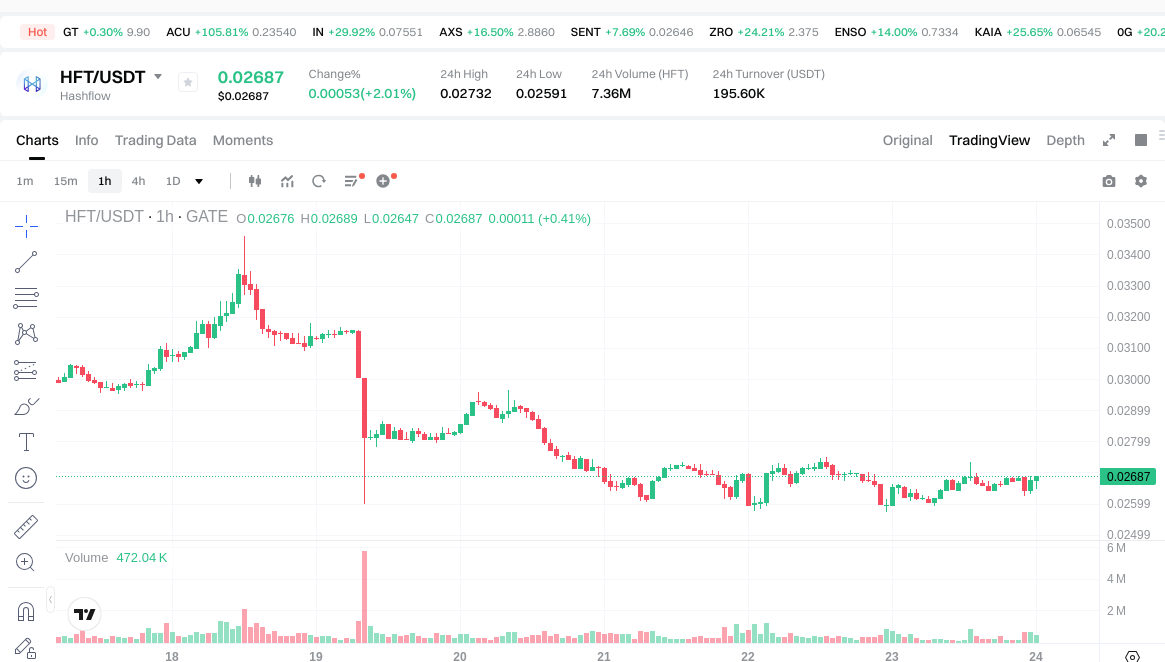
On-chain Metrics
- Holder Count: 16,056 addresses (indicating community distribution)
- 24-hour Trading Volume: $196,074.10 (reflecting current market activity)
- Market Capitalization: $18,247,609.47 (representing the circulating value in the market)
Hashflow Ecosystem Applications and Strategic Partners
Core Use Cases
Hashflow's ecosystem supports multiple application scenarios:
- DeFi Trading: Hashflow powers one of DeFi's largest RFQ (Request for Quote) liquidity sources, providing decentralized trading with guaranteed pricing protection.
- Cross-Exchange Settlement: Hashflow xOS serves as a universal zk-settlement layer, driving provable trust infrastructure across the exchange ecosystem.
Strategic Collaborations
Hashflow has facilitated over $20 billion in trading volume through professional market makers, enhancing its technical capabilities and market presence.
These partnerships provide a solid foundation for Hashflow's ecosystem expansion.
Controversies and Challenges
Hashflow faces the following challenges:
- Technical Hurdles: Continuous optimization of RFQ mechanisms and settlement efficiency
- Regulatory Risks: Compliance requirements in evolving DeFi regulatory landscapes
- Competitive Pressure: Competition from other DEX protocols and trading platforms
These issues have sparked discussions within the community and market, while also driving Hashflow's continuous innovation.
Hashflow's community demonstrates active participation, with 16,056 token holders supporting the ecosystem.
On X platform, related posts and hashtags (such as #HFT and #Hashflow) frequently appear in discussions.
New feature launches and protocol upgrades have ignited community enthusiasm.
Sentiment on X shows diverse perspectives:
- Supporters praise Hashflow's MEV protection, guaranteed pricing, and professional market-making infrastructure, viewing it as a benchmark for trust in decentralized trading.
- Critics focus on price volatility and competitive dynamics in the DEX space.
Recent trends reflect evolving market conditions and trading activity.
Trending Topics
X users actively discuss Hashflow's zk-settlement technology, RFQ liquidity mechanisms, and cross-exchange trust infrastructure,
showcasing both its transformative potential and the challenges in achieving mainstream adoption.
- Official Website: Visit Hashflow official website for features, use cases, and latest developments.
- Application Platform: Access Hashflow app to explore trading functionalities.
- X Updates: On X platform, Hashflow maintains active engagement through its official handle @hashflow,
sharing content about protocol upgrades, community events, and ecosystem developments.
- Blockchain Explorers: Track HFT token activities on Ethereum and BSC networks.
Hashflow Future Roadmap
- Ongoing Development: Expansion of xOS zk-settlement layer capabilities, enhancing cross-exchange trust and settlement efficiency
- Ecosystem Goals: Growing RFQ liquidity sources and professional market maker partnerships
- Long-term Vision: Establishing industry standards for provable trust across the exchange ecosystem
How to Participate in Hashflow?
- Purchase Channels: Acquire HFT on Gate.com and other supported exchanges
- Storage Solutions: Securely store tokens using compatible wallets for ERC-20 and BEP-20 standards
- Engage with Protocol: Utilize Hashflow's trading platform to experience guaranteed pricing and MEV protection
- Build Ecosystem: Visit official documentation to explore integration opportunities and contribute to development
Summary
Hashflow redefines decentralized trading through innovative blockchain technology, offering guaranteed pricing, MEV protection, and professional market-making infrastructure.
Its active community, comprehensive resources, and significant trading volume position it distinctively in the cryptocurrency space.
Despite facing regulatory considerations and competitive dynamics, Hashflow's innovative approach and clear development trajectory secure its important role in the future of decentralized finance.
Whether you are a newcomer or an experienced participant, Hashflow merits attention and engagement.
FAQ
What is Crypto HFT (High-Frequency Trading)? How does it differ from traditional HFT?
Crypto HFT uses automated algorithms to execute trades in milliseconds on blockchain-based markets. Unlike traditional HFT limited by stock exchange infrastructure, crypto HFT leverages 24/7 decentralized markets, lower latency networks, and direct blockchain interaction for faster execution and higher transaction volumes.
How does crypto high-frequency trading work? What technical infrastructure is required?
Crypto HFT uses algorithmic trading bots to execute thousands of trades per second, exploiting micro price differences. It requires low-latency servers, direct API connections to blockchain networks, sophisticated algorithms, real-time data feeds, and robust risk management systems to capitalize on fleeting market opportunities.
What are the main risks of engaging in crypto HFT?
Main risks include market volatility causing rapid losses, technical glitches or system failures, liquidity constraints, regulatory uncertainty, and intense competition. Flash crashes and slippage can amplify drawdowns quickly in high-frequency trading environments.
What impact does crypto HFT have on market liquidity and price discovery?
Crypto HFT enhances market liquidity by increasing trading volume and tightening bid-ask spreads, enabling faster price discovery. It improves market efficiency through rapid information processing and arbitrage opportunities, benefiting all market participants through reduced transaction costs.
Can individual investors participate in crypto HFT? How much capital and technical threshold are needed?
Yes, individuals can participate in crypto HFT with lower barriers than traditional markets. You need moderate capital (starting from thousands of dollars) and technical skills in programming and algorithms. Access to fast APIs and low-latency infrastructure is essential. Success requires continuous optimization and market analysis.
Crypto HFT performance varies by exchange due to differences in trading volume, liquidity depth, latency infrastructure, order matching speed, and fee structures. Exchanges with higher trading activity generally offer better execution for HFT strategies, while lower-latency connections and advanced API support enhance competitive advantages.
* The information is not intended to be and does not constitute financial advice or any other recommendation of any sort offered or endorsed by Gate.