Hyperliquid (HYPE) is a high-performance Layer 1 blockchain revolutionizing decentralized finance through sub-1-second block latency and fully on-chain perpetual trading. Ranking #27 by market cap with $5.76B valuation, this article explores HYPE's technical architecture, market dynamics, and ecosystem potential. It covers Hyperliquid's origin as a solution to blockchain scalability challenges, its decentralized infrastructure ensuring transparency without intermediaries, and real-world applications in DeFi. With HYPE trading at $24.16 on Gate.com and active community engagement, the guide examines market performance metrics, competitive challenges, and future roadmap. Whether you're a trader seeking high-performance infrastructure, a developer building permissionless applications, or an investor evaluating digital assets, this comprehensive overview reveals how Hyperliquid is reshaping on-chain financial systems and creating opportunities in next-generation DeFi infrastructure.
Hyperliquid's Positioning and Significance
In the context of evolving blockchain infrastructure, Hyperliquid (HYPE) was launched to address the persistent challenges of scalability, latency, and transparency in decentralized finance systems.
As a high-performance Layer 1 blockchain optimized for financial applications, Hyperliquid plays a critical role in on-chain perpetual trading and DeFi ecosystems.
As of 2026, Hyperliquid has established itself as a prominent project within the crypto space, ranking 27th by market capitalization with an active development community and growing user base.
This article provides an in-depth analysis of its technical architecture, market performance, and future potential.
Origin and Development History
Birth Background
Hyperliquid was created to solve the limitations of existing blockchain networks in supporting high-frequency financial applications with sub-second latency and full on-chain transparency.
It emerged during the maturation phase of blockchain technology, aiming to provide a fully on-chain open financial system where user-built applications interface with performant native components without compromising user experience.
Hyperliquid's launch opened new possibilities for traders, developers, and DeFi users seeking transparent, high-performance infrastructure.
Important Milestones
- The mainnet launched, achieving block latency of less than 1 second and supporting a fully on-chain order book perpetual exchange.
- The flagship application, Hyperliquid DEX, became operational, demonstrating transparent on-chain execution for every order, cancellation, trade, and liquidation.
- The token HYPE was listed on Gate.com in November 2024, expanding accessibility to global traders.
- The ecosystem continued to evolve with growing trading volumes and expanding user adoption.
With support from its foundation and community, Hyperliquid continues to refine its technology, security measures, and real-world applications.
How Hyperliquid Works
No Central Control
Hyperliquid operates on a decentralized network of computers (nodes) distributed globally, independent of banks or government control.
These nodes collaborate to validate transactions, ensuring the system remains transparent and resistant to attacks, granting users greater autonomy and enhancing network resilience.
Blockchain Foundation
Hyperliquid's blockchain is a public, immutable digital ledger recording every transaction.
Transactions are grouped into blocks and linked through cryptographic hashes to form a secure chain.
Anyone can view the records, establishing trust without intermediaries.
The architecture is optimized for financial applications, enabling the entire ecosystem of permissionless financial applications to operate with minimal latency.
Ensuring Fairness
Hyperliquid employs a consensus mechanism to validate transactions and prevent fraudulent activities such as double-spending.
Network participants maintain security through their operations and receive HYPE rewards.
The system's innovations include optimization for high-performance financial operations with block latency under 1 second.
Secure Transactions
Hyperliquid uses public-private key cryptography to protect transactions:
- Private keys (similar to secret passwords) are used to sign transactions
- Public keys (similar to account numbers) are used to verify ownership
This mechanism ensures fund security while maintaining transaction transparency on-chain.
The fully on-chain nature of all operations provides unprecedented visibility into the state of the financial system.
Circulation Overview
As of 13 January 2026, Hyperliquid's circulating supply stands at 238,385,315.95 HYPE, with a total supply of 962,274,028.95 HYPE and a maximum supply capped at 1,000,000,000 HYPE. The current circulation represents approximately 23.84% of the total supply, indicating a controlled distribution model.
New tokens enter the market through the project's native issuance mechanism on the Hyperliquid L1 blockchain, which influences supply-demand dynamics as the ecosystem continues to expand.
Price Fluctuations
Hyperliquid reached a notable price level of $59.4 on 18 September 2025, driven by strong market momentum and growing adoption of its fully onchain order book perpetuals exchange.
The lowest recorded price was $0.011812 on 26 October 2024, during the early stages of market discovery following its initial deployment.
As of 13 January 2026, HYPE is trading at $24.161, reflecting a -1.29% change over the past hour, +0.77% over 24 hours, and -8.64% over the past 7 days. The 30-day performance shows a -16.66% decline, while the 1-year performance demonstrates a +14.48% increase. These fluctuations reflect evolving market sentiment, adoption trends, and external factors affecting the broader cryptocurrency sector.
Click to view current HYPE market price
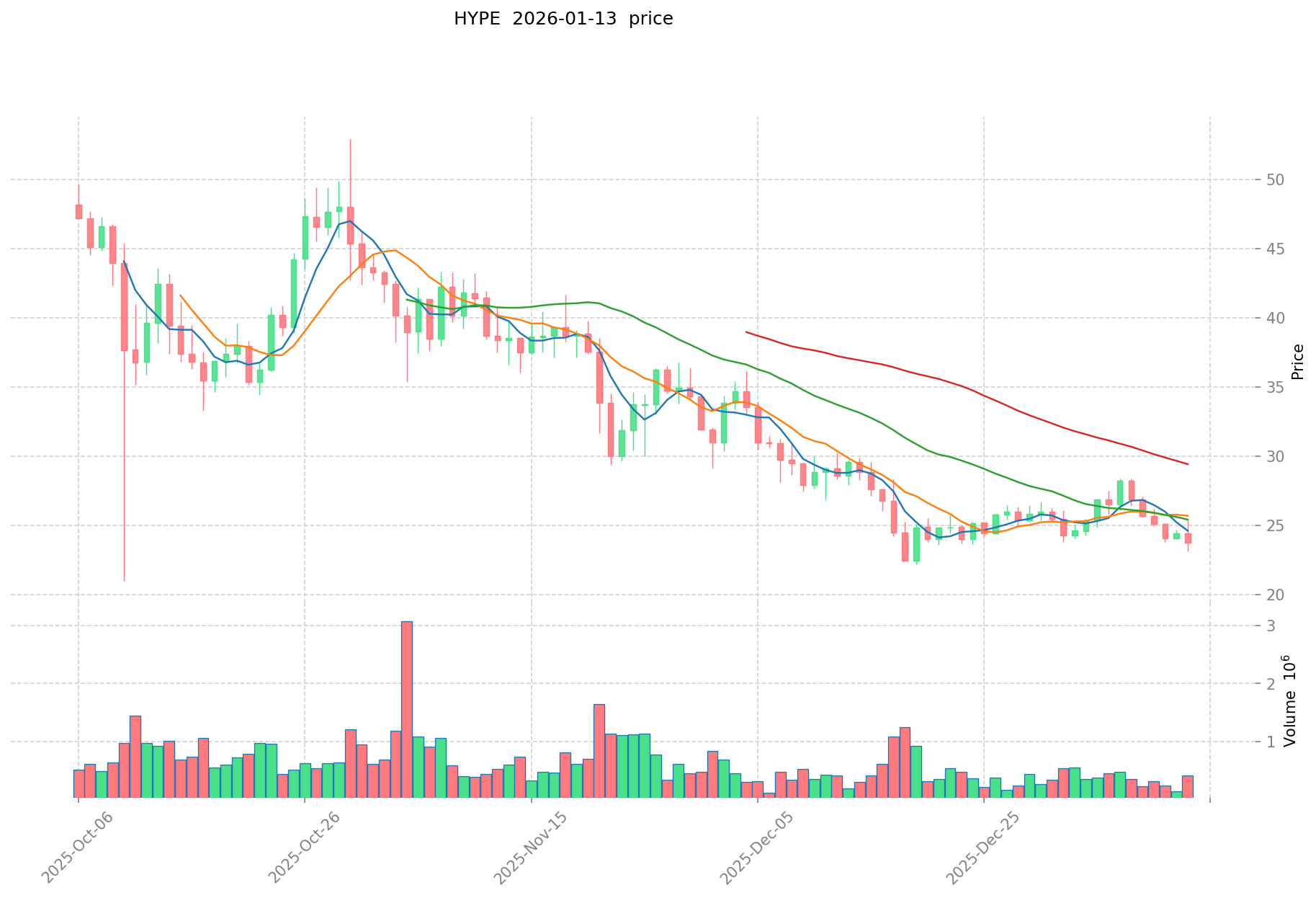
Onchain Metrics
- 24-Hour Trading Volume: $10,054,591.68 (demonstrating active market participation)
- Market Capitalization: $5,759,627,618.77 (ranking #27 among cryptocurrencies)
- Fully Diluted Valuation: $23,249,502,813.56 (reflecting potential market value at maximum supply)
- Market Dominance: 0.70% (indicating Hyperliquid's share of the total cryptocurrency market)
Hyperliquid Ecosystem Applications and Partners
Core Use Cases
Hyperliquid's ecosystem supports multiple applications:
- DeFi: Hyperliquid DEX, providing fully onchain order book perpetual trading.
- Financial Infrastructure: Permissionless financial applications with transparent onchain execution for orders, cancellations, trades, and liquidations.
Strategic Partnerships
Specific partnership information is not available in the provided materials. However, Hyperliquid's open financial system architecture allows user-built applications to interface with its native components, establishing a foundation for ecosystem expansion.
Controversies and Challenges
Hyperliquid faces the following challenges:
- Technical Challenges: Maintaining sub-1-second block latency while scaling the ecosystem
- Regulatory Risks: Operating as a decentralized perpetual exchange in an evolving regulatory environment
- Competitive Pressure: Competition from established blockchain platforms and decentralized exchanges
These issues have sparked discussions within the community and market, driving Hyperliquid's continuous innovation.
Hyperliquid's community demonstrates activity through its transparent onchain operations. The platform supports a fully permissionless financial application ecosystem.
On X platform, related posts and hashtags (such as #HYPE) generate engagement. Factors such as the platform's performance optimization and native component integration have contributed to community interest.
Sentiment on X shows polarization:
- Supporters praise Hyperliquid's high performance, transparency, and fully onchain architecture, viewing it as "next-generation DeFi infrastructure".
- Critics focus on price volatility, competition from established platforms, and adoption challenges.
Recent trends reflect mixed sentiment as the market evaluates the platform's long-term potential.
Popular Topics
X users discuss Hyperliquid's performance capabilities, decentralization model, and competition with traditional exchanges, highlighting both its transformative potential and barriers to mainstream adoption.
- Official Website: Visit Hyperliquid Official Website for features, use cases, and latest updates.
- Documentation: Hyperliquid Documentation details its technical architecture, goals, and vision.
- X Updates: On X platform, Hyperliquid uses @HyperliquidX, with posts covering technical developments, ecosystem updates, and community activities, generating engagement through likes and shares.
Hyperliquid Future Roadmap
- Ongoing Development: Continued optimization of the L1 infrastructure to maintain sub-1-second block latency
- Ecosystem Goals: Expansion of permissionless financial applications on the platform
- Long-term Vision: Establish a fully onchain open financial system with seamless user experience
How to Participate in Hyperliquid?
- Purchase Options: Buy HYPE on exchanges including Gate.com
- Storage Solutions: Securely store using compatible wallets that support the Hyperliquid mainnet
- Ecosystem Participation: Access developer documentation to build applications or contribute to the ecosystem
- Trading: Utilize the Hyperliquid DEX for fully onchain perpetual trading
Summary
Hyperliquid redefines decentralized finance through blockchain technology, offering transparency, performance, and fully onchain execution.
Its active community, comprehensive resources, and market presence position it distinctively in the cryptocurrency space.
Despite facing regulatory uncertainties and competitive pressures, Hyperliquid's innovative approach and clear development direction secure its position in the future of decentralized technology.
Whether you are a newcomer or experienced participant, Hyperliquid merits attention and engagement.
FAQ
What is HYPE(Hype)in cryptocurrency and how is it generated?
Cryptocurrency HYPE refers to sudden market excitement and investment frenzy around digital assets, typically driven by social media and influencers. This phenomenon causes rapid price spikes followed by potential sharp declines as investor sentiment shifts dramatically.
How to identify if a cryptocurrency project is in the HYPE stage?
Identify HYPE stage projects by rapid price surges, explosive social media buzz, massive trading volume spikes, and intense media coverage. High retail investor inflow and FOMO-driven sentiment are key indicators of a project entering its hype phase.
What is the difference between crypto HYPE and real value?
HYPE reflects market sentiment and speculation, while real value derives from technology fundamentals, adoption, and ecosystem utility. Quality projects often get undervalued amid market noise, creating genuine opportunities for discerning investors.
What are some famous cryptocurrency HYPE bubble cases in history?
Notable bubbles include the 2017 Bitcoin bull market and 2018 crash, 2021 NFT craze, and 2022 FTX collapse. These events demonstrate speculation-driven price volatility and market cycles in crypto.
HYPE阶段的加密货币投资风险有哪些?
HYPE阶段加密货币的主要风险包括市场波动剧烈、价格操纵风险、监管政策不确定性和技术安全隐患。投资者需谨慎评估这些因素。
Social media and influencers drive cryptocurrency HYPE through viral content, community engagement, and trend amplification. They generate massive trading volume, increase token awareness, and create FOMO among investors, directly impacting market momentum and asset adoption.
* The information is not intended to be and does not constitute financial advice or any other recommendation of any sort offered or endorsed by Gate.