IMPT is a blockchain-based carbon credit ecosystem launched in 2022 that enables users to offset their carbon footprint through everyday purchases on partner retail platforms. As an ERC-20 token operating on Ethereum's energy-efficient Proof of Stake network, IMPT tokenizes carbon credits and rewards sustainable consumer behavior with transparent, verifiable environmental impact tracking. The article comprehensively covers IMPT's technical architecture, market performance metrics, strategic retail partnerships, and ecosystem applications. It examines current challenges including market volatility, adoption barriers, and competitive dynamics within the sustainability blockchain sector. Additionally, it provides practical guidance on purchasing IMPT tokens on Gate, storage solutions, and community participation strategies. This guide serves environmentally conscious investors and users exploring accessible carbon offsetting mechanisms through blockchain technology.
IMPT's Position and Significance
In 2022, the IMPT.io team launched IMPT (IMPT), aiming to address the lack of accessible mechanisms for individuals to offset their carbon footprint through everyday consumption.
As a blockchain-based carbon credit ecosystem integrated with e-commerce, IMPT plays a key role in environmental sustainability and green finance.
As of 2026, IMPT has established partnerships with various retailers and carbon offset projects, with 16,680 holders and an active community focused on environmental impact.
This article will provide an in-depth analysis of its technical architecture, market performance, and future potential.
Origin and Development History
Birth Background
IMPT was created by the IMPT.io team in 2022, aiming to solve the disconnect between consumer spending and environmental responsibility.
It was born during growing global awareness of climate change and carbon neutrality goals, with the objective of enabling users to earn carbon credits through everyday purchases and reduce their carbon footprint.
The launch of IMPT brought new possibilities to environmentally conscious consumers and the carbon credit market.
Key Milestones
- 2022: Token launch, establishing a product ecosystem connecting retailers with carbon offset projects.
- 2022-2024: Expansion of partner network, integrating multiple e-commerce platforms to enable users to earn IMPT tokens from purchases.
- 2024-2026: Continued development of the platform's carbon credit conversion mechanism and NFT-based environmental impact tracking.
With support from the IMPT.io team and its environmental partners, IMPT continues to optimize its platform, partnerships, and real-world applications.
How IMPT Works?
No Central Control
IMPT operates on the Ethereum blockchain, a decentralized network of computers (nodes) distributed globally, free from control by banks or governments.
These nodes collaborate to validate transactions, ensuring system transparency and attack resistance, granting users greater autonomy and enhancing network resilience.
Blockchain Core
IMPT's underlying blockchain is a public, immutable digital ledger that records every transaction.
Transactions are grouped into blocks and linked through cryptographic hashes to form a secure chain.
Anyone can view the records, establishing trust without intermediaries.
As an ERC-20 token, IMPT benefits from Ethereum's established security and interoperability.
Ensuring Fairness
IMPT relies on Ethereum's Proof of Stake (PoS) consensus mechanism to validate transactions and prevent fraud such as double-spending.
Validators maintain network security through staking ETH and running validator nodes, earning rewards in the process.
The innovation includes leveraging Ethereum's energy-efficient PoS mechanism to align with IMPT's environmental mission.
Secure Transactions
IMPT uses public-private key cryptography to protect transactions:
- Private keys (similar to secret passwords) are used to sign transactions
- Public keys (similar to account numbers) are used to verify ownership
This mechanism ensures fund security, with transactions maintaining pseudonymity typical of Ethereum-based tokens.
Additionally, the platform incorporates NFT technology to represent carbon credits, providing transparent and verifiable proof of environmental impact reduction.
Circulation Overview
As of February 1, 2026, IMPT's circulating supply stands at 1,242,300,524.65 tokens, with a total supply of 1,646,194,201.96 tokens and a maximum supply cap of 2,759,522,759 tokens. The circulating supply represents approximately 45.02% of the total supply, indicating a controlled token release strategy. New tokens enter the market through the project's predetermined distribution mechanism, which influences the supply-demand dynamics within the IMPT ecosystem.
Price Fluctuations
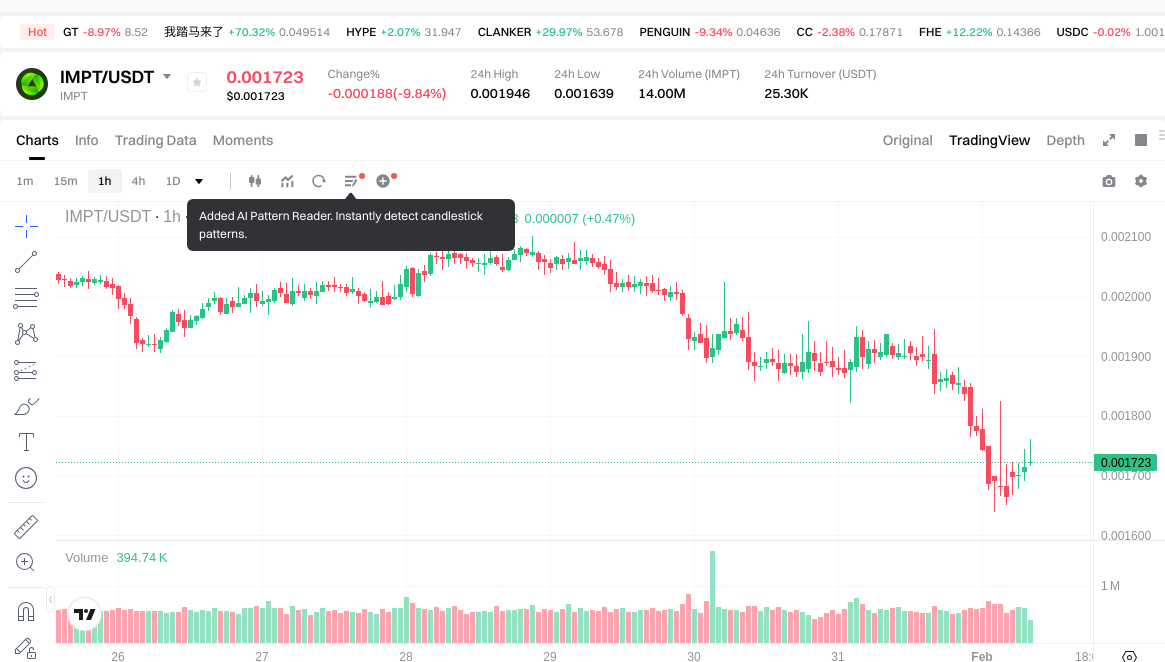
IMPT reached its peak price of $0.02042864 on December 15, 2022, driven by initial market enthusiasm and strong community interest during its early launch phase. The token experienced its lowest price point of $0.00150302 on September 7, 2024, reflecting broader market corrections and shifting investor sentiment in the carbon credit tokenization space. As of February 1, 2026, IMPT trades at $0.001734, showing price movements of -0.29% (1H), -9.21% (24H), -14.82% (7D), -31.03% (30D), and -66.34% (1Y). These fluctuations illustrate the token's responsiveness to market conditions, adoption trends, and evolving dynamics in the sustainability-focused blockchain sector.
Click to view the current IMPT market price
On-Chain Metrics
- Holder Count: 16,680 addresses (indicating community size and token distribution)
- 24-Hour Trading Volume: $25,323.19 (reflecting current market activity)
- Market Capitalization: $2,154,149.11 (representing the token's current market valuation)
- Fully Diluted Valuation: $2,854,500.75 (projecting potential market cap at maximum supply)
IMPT Ecosystem Applications and Strategic Partners
Core Use Cases
IMPT's ecosystem is designed around sustainability and environmental impact:
- Carbon Credit Trading: The platform enables users to convert IMPT tokens into carbon credits, facilitating direct carbon footprint reduction through blockchain technology.
- Retail Integration: IMPT partners with various merchants, allowing consumers to earn IMPT tokens from everyday purchases while supporting environmental initiatives.
Strategic Collaborations
IMPT has established partnerships with retail brands and environmental organizations to enhance its sustainability mission.
These partnerships provide a foundation for IMPT's ecosystem expansion and real-world impact in carbon offsetting.
Challenges and Considerations
IMPT faces several challenges in its development:
- Market Volatility: The token has experienced significant price fluctuations, with a 66.34% decline over the past year
- Adoption Barriers: Integrating blockchain-based carbon credits into mainstream retail requires ongoing education and infrastructure development
- Competitive Landscape: The emergence of various sustainability-focused blockchain projects creates a competitive environment
These issues have sparked discussions within the community and continue to drive IMPT's evolution.
IMPT maintains an active community with 16,680 token holders as of February 2026.
The project engages users through social platforms, with discussions around sustainable shopping and carbon offsetting regularly trending.
Factors such as new merchant partnerships and environmental initiatives have generated community enthusiasm.
Sentiment on X displays varied perspectives:
- Supporters highlight IMPT's innovative approach to combining e-commerce with environmental responsibility, viewing it as a practical solution for sustainable consumption.
- Critics focus on price performance concerns and questions about long-term viability in the carbon credit market.
Recent trends indicate mixed sentiment, with environmental advocates showing interest while traders express caution regarding market performance.
Trending Topics
X users discuss IMPT's integration of retail rewards with carbon offsetting, token utility, and environmental impact verification,
revealing both the project's innovative potential and questions about mainstream adoption.
- Official Website: Visit IMPT.io for features, use cases, and latest developments.
- Blockchain Explorer: Track IMPT transactions and smart contract activity on Etherscan.
- X Updates: IMPT maintains an active presence on X through @IMPT_token,
sharing updates on merchant partnerships, carbon credit initiatives, and community activities.
IMPT Future Roadmap
- Ecosystem Expansion: Onboarding additional retail partners and expanding the product marketplace
- Carbon Credit Integration: Enhancing the mechanism for converting tokens to verified carbon credits
- Long-term Vision: Establishing a comprehensive platform connecting consumers, retailers, and environmental projects through blockchain technology
How to Participate in IMPT?
- Purchase Options: IMPT is available on Gate.com and other exchanges
- Storage Solutions: Use compatible Ethereum wallets such as MetaMask for secure storage
- Ecosystem Participation: Engage with the platform by shopping through partner merchants and converting tokens to carbon credits
- Community Involvement: Follow official channels on X, Facebook, and Discord for updates and discussions
Summary
IMPT leverages blockchain technology to create a sustainability-focused ecosystem, offering transparent carbon offsetting and reward mechanisms for conscious consumers.
Its innovative approach to combining retail purchases with environmental impact, along with active community engagement, positions it as a noteworthy project in the sustainability sector.
Despite facing market volatility and adoption challenges, IMPT's mission to make carbon offsetting accessible through everyday shopping demonstrates a unique application of blockchain technology.
Whether you're interested in environmental initiatives or exploring utility tokens, IMPT presents an interesting case study in sustainable blockchain applications.
FAQ
What is IMPT crypto token and what is its main purpose?
IMPT is a blockchain-based token that enables buying and selling of carbon credits on a decentralized marketplace. Its main purpose is to make carbon credit trading more accessible, transparent, and efficient for individuals and organizations worldwide.
How does IMPT work and what problems does it solve?
IMPT is a blockchain platform enabling carbon offsetting through tokenized credits. Users earn IMPT tokens by making sustainable purchases, which can be converted into verified carbon credits. It solves carbon footprint tracking transparency and accessibility issues in the voluntary carbon market.
Where can I buy IMPT tokens and how do I store them securely?
IMPT tokens can be purchased on major cryptocurrency platforms. For secure storage, use a reputable Web3 wallet or hardware wallet. Always enable two-factor authentication and keep your private keys confidential for maximum security.
What is the tokenomics of IMPT and what is the total supply?
IMPT has a total supply of 1 billion tokens with a capped maximum limit. The circulating supply varies based on market conditions and token distribution schedules.
Is IMPT a safe investment and what are the risks involved?
IMPT offers carbon credit tokenization opportunities with growth potential. Like all crypto assets, it carries market volatility and regulatory risks. Research thoroughly before investing to align with your risk tolerance.
How is IMPT different from other environmental or sustainability-focused crypto projects?
IMPT incentivizes real-world sustainable behaviors and carbon footprint reduction through blockchain tracking and rewards. Unlike projects focused solely on financial gains, IMPT directly drives environmental impact by rewarding eco-friendly actions, making tangible climate change contributions.
* The information is not intended to be and does not constitute financial advice or any other recommendation of any sort offered or endorsed by Gate.