IOTA is a distributed ledger technology designed specifically for Internet of Things (IoT) applications, utilizing innovative Tangle architecture instead of traditional blockchain. Launched in 2016 by a team of developers, IOTA enables feeless machine-to-machine transactions and real-time data transfer, addressing inefficiencies in IoT device communication. The platform uses Directed Acyclic Graph (DAG) technology where each new transaction validates previous transactions, eliminating mining requirements and transaction fees while enabling parallel processing. With over 42,000 holders and a market capitalization of approximately $433 million, IOTA has established itself as a specialized cryptocurrency for supply chain management and IoT ecosystems. This comprehensive guide explores IOTA's technical architecture, market performance, partnerships, and real-world applications. Whether you're interested in blockchain technology, IoT solutions, or cryptocurrency trading on Gate, this guide provides essential insig
IOTA's Position and Significance
In 2016, David Sønstebø, Sergey Ivancheglo, Dominik Schiener, and Serguei Popov launched IOTA (IOTA), aiming to address transaction inefficiency and high costs in machine-to-machine (M2M) communication for the Internet of Things (IoT).
As the first distributed ledger utilizing Tangle technology instead of traditional blockchain, IOTA plays a key role in IoT ecosystems, enabling feeless microtransactions and real-time data transfer.
As of 2026, IOTA has established itself as a specialized cryptocurrency designed for IoT applications, with over 42,000 holders and an active development community.
This article will provide an in-depth analysis of its technical architecture, market performance, and future potential.
Origins and Development History
Birth Background
IOTA was created by David Sønstebø, Sergey Ivancheglo, Dominik Schiener, and Serguei Popov in 2016, aiming to solve the limitations of traditional blockchain technology in handling the massive transaction volumes required for IoT device communication.
It emerged during the expansion of IoT technology and the search for scalable blockchain solutions, with the goal of providing a feeless, lightweight, and scalable infrastructure for machine-to-machine payments and data transfer.
The launch of IOTA brought new possibilities to IoT device manufacturers, smart city developers, and enterprises seeking efficient M2M transaction solutions.
Key Milestones
- 2016: IOTA token sale completed, introducing the Tangle architecture as an alternative to blockchain.
- 2017: Mainnet launched, achieving feeless transactions and establishing partnerships with major technology companies.
- 2017: Price reached an all-time high of $5.25 in December during the cryptocurrency market surge.
- 2018-2020: Development focused on network stability and security improvements.
- 2021-2023: Continued ecosystem expansion with development tools and partnerships in industrial IoT applications.
- 2026: As of January, IOTA maintains a market capitalization of approximately $433 million with ongoing development efforts.
With support from the IOTA Foundation and its global community, IOTA continues to refine its technology, security protocols, and real-world applications.
How IOTA Works
No Central Control
IOTA operates on a decentralized network of nodes distributed globally, independent of control by banks or governments.
These nodes collaborate to validate transactions, ensuring system transparency and attack resistance, granting users greater autonomy and enhancing network resilience.
Tangle Core Technology
IOTA's Tangle is a public, immutable distributed ledger that records every transaction, but differs fundamentally from traditional blockchain architecture.
Instead of grouping transactions into blocks, the Tangle uses a Directed Acyclic Graph (DAG) structure where each new transaction validates two previous transactions.
This approach eliminates the need for miners and transaction fees while enabling parallel processing.
Anyone can view transaction records without intermediaries, establishing trust through mathematical verification.
The Tangle architecture is specifically designed to scale efficiently as network activity increases, making it suitable for high-volume IoT applications.
Ensuring Fairness
IOTA utilizes a consensus mechanism where transaction validators confirm previous transactions to add their own to the network, preventing double-spending and other fraudulent activities.
Participants maintain network security by running nodes and validating transactions, with the system designed to become more secure as transaction volume increases.
Its innovation includes eliminating mining requirements and transaction fees, making microtransactions economically viable.
Secure Transactions
IOTA uses public-private key cryptography to protect transactions:
- Private keys (similar to secret passwords) are used to sign transactions
- Public keys (similar to account numbers) are used to verify ownership
This mechanism ensures fund security, with transactions maintaining pseudonymous privacy.
The lightweight cryptographic design makes IOTA suitable for resource-constrained IoT devices while maintaining robust security standards.
Circulation Overview
As of January 15, 2026, IOTA's circulating supply stands at 4,238,074,002 tokens, with a total supply of 4,794,742,498 tokens. The circulating supply represents approximately 88.39% of the total supply, indicating a relatively mature distribution phase. The token features an infinite maximum supply model, which allows for potential future expansion based on network requirements.
Price Fluctuations
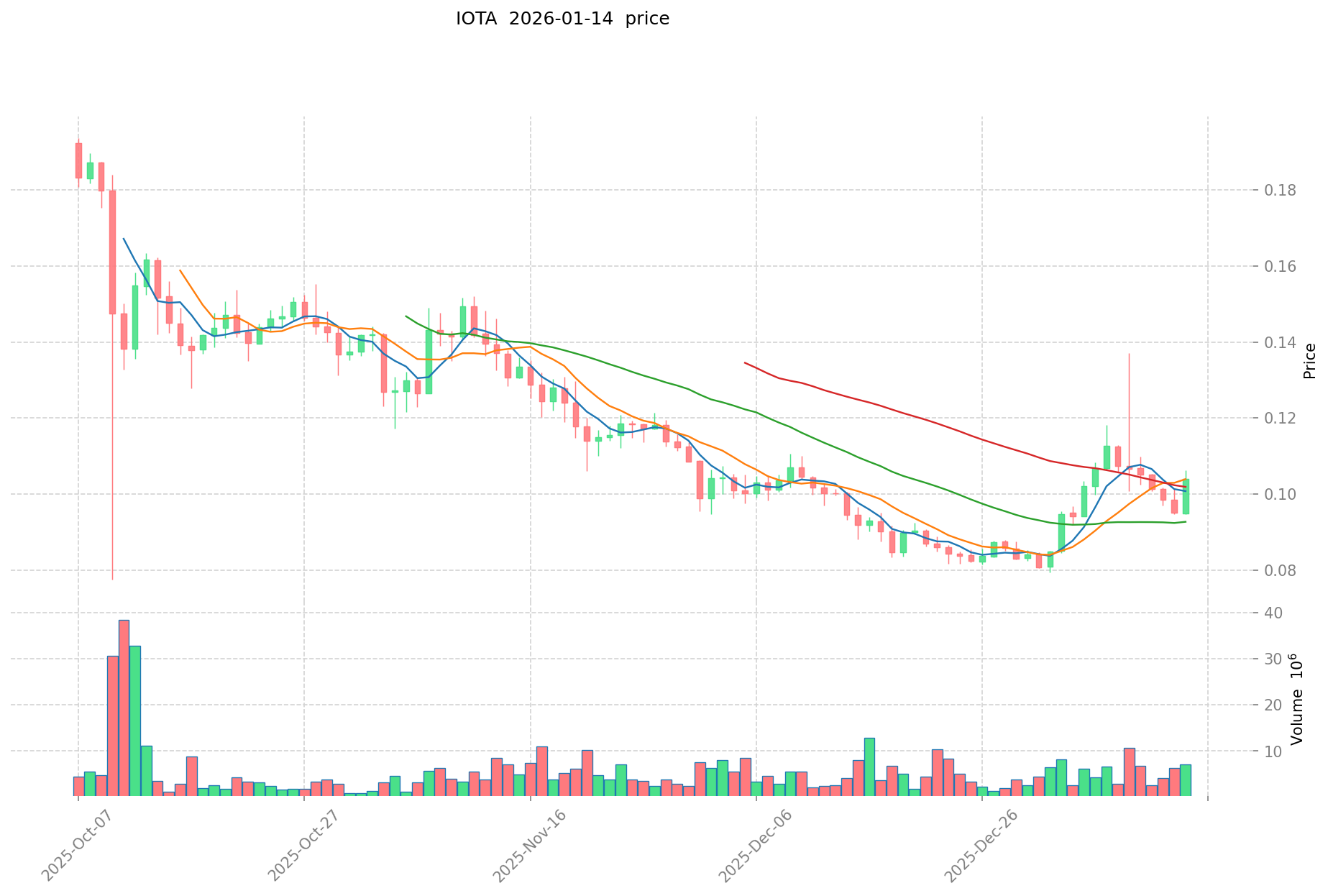
IOTA reached its historical high price of $5.25 on December 19, 2017, during a period of heightened market enthusiasm for cryptocurrency projects and distributed ledger technologies. The lowest recorded price was $0.079428, occurring on January 1, 2026, reflecting broader market corrections and evolving sector dynamics.
As of the current trading period, IOTA is priced at $0.1022, showing varied performance across different timeframes. The token experienced a 0.97% increase over the past 24 hours, while demonstrating a -5.18% change over the 7-day period and a 12.34% gain over the past 30 days. The annual performance shows a -67.71% change, reflecting the challenging market conditions that have affected the broader cryptocurrency ecosystem.
The 24-hour trading range extended from a low of $0.10088 to a high of $0.10761, with a 24-hour trading volume of $803,798.53.
Click to view current IOTA market price
On-Chain Metrics
- Holder Distribution: The network maintains 42,669 token holders, indicating a distributed ownership structure across the ecosystem.
- Market Capitalization: With a circulating market cap of $433,131,163, IOTA represents 0.014% of the total cryptocurrency market share.
- Fully Diluted Valuation: The fully diluted market cap stands at $490,022,683, with the market cap to FDV ratio at 92.13%, suggesting limited dilution risk from unreleased supply.
IOTA Ecosystem Applications and Partnerships
Core Use Cases
IOTA's ecosystem supports multiple applications:
- Internet of Things (IoT): IOTA specializes in machine-to-machine (M2M) transactions, providing feeless micropayments for connected devices.
- Supply Chain Management: Projects leverage IOTA's Tangle technology to enable transparent tracking and verification of goods.
Strategic Collaborations
IOTA continues to build partnerships that strengthen its technological capabilities and market presence.
These collaborations provide a solid foundation for IOTA's ecosystem expansion.
Controversies and Challenges
IOTA faces the following challenges:
- Technical hurdles: Scalability and network optimization remain ongoing focus areas
- Regulatory risks: Evolving global regulations on digital assets create uncertainty
- Competitive pressure: Other blockchain platforms competing for IoT and M2M market share
These issues have sparked discussions within the community and market, while also driving IOTA's continuous innovation.
Fan Enthusiasm
IOTA's community demonstrates considerable activity, with over 42,000 holders participating in the ecosystem.
On X platform, related posts and hashtags (such as #IOTA) frequently appear in trending topics.
Community enthusiasm remains driven by technological developments and ecosystem growth.
Sentiment on X presents diverse perspectives:
- Supporters praise IOTA's feeless transactions, Tangle technology, and IoT focus, considering it an innovative approach to distributed ledger technology.
- Critics focus on price volatility and ongoing technical development.
Recent trends show varied sentiment depending on market conditions and development milestones.
Trending Topics
X users actively discuss IOTA's regulatory environment, technological advancements, and real-world adoption potential,
showcasing both its transformative possibilities and challenges toward mainstream acceptance.
- Official Website: Visit IOTA official website to learn about features, use cases, and latest updates.
- X Updates: On X platform, IOTA maintains an active presence using @iota,
with posts covering technological upgrades, community activities, and ecosystem developments.
IOTA Future Roadmap
- Ongoing Development: Continued enhancement of Tangle technology and network performance
- Ecosystem Goals: Expanding partnerships and real-world implementations in IoT sectors
- Long-term Vision: Establishing IOTA as a foundational protocol for the machine economy
How to Participate in IOTA?
- Purchase Channels: Buy IOTA on Gate.com and other cryptocurrency exchanges
- Storage Solutions: Use hardware wallets or compatible software wallets for secure storage
- Participate in Governance: Engage with the community through official channels and contribute to discussions
- Build Ecosystem: Access developer resources to create applications or contribute to the project
Summary
IOTA redefines digital currency through distributed ledger technology, offering feeless transactions, scalability, and specialized IoT solutions.
Its active community, comprehensive resources, and market presence distinguish it within the cryptocurrency space.
Despite facing regulatory uncertainties and ongoing technical development, IOTA's innovative approach and clear development direction position it as a significant player in decentralized technology's future.
Whether you are a newcomer or experienced participant, IOTA merits attention and engagement.
FAQ
What is IOTA (IOTA)? How does it work?
IOTA is a decentralized blockchain technology designed for Internet of Things (IoT) applications. It uses Directed Acyclic Graph (DAG) instead of traditional blockchain, enabling low-cost transactions at scale. IOTA 2.0 enhances decentralization and introduces smart contract functionality for the ecosystem.
What is the difference between IOTA, Bitcoin, and Ethereum?
IOTA uses Tangle technology instead of blockchain, designed for low-cost IoT transactions. Bitcoin functions as digital currency, while Ethereum enables smart contracts. IOTA focuses on decentralized data transmission with feeless transactions.
What is IOTA's Tangle technology and what advantages does it have compared to blockchain?
Tangle is a directed acyclic graph (DAG) structure eliminating blocks and miners, enabling zero transaction fees and superior scalability. Unlike blockchain's sequential block validation, Tangle allows each new transaction to verify two previous unconfirmed transactions in parallel, delivering faster throughput and greater network efficiency.
What are the main application fields and scenarios for IOTA?
IOTA is primarily used in IoT applications, enabling feeless machine-to-machine transactions via Tangle technology. Key applications include supply chain tracking, smart device coordination, digital identity management, and decentralized machine economies. Its zero-fee structure supports large-scale microtransactions across billions of connected devices.
How to buy and store IOTA tokens?
Purchase IOTA on a reputable cryptocurrency exchange using supported currencies like USDT or ETH. Transfer funds to your wallet, then swap for IOTA. Store IOTA in a secure non-custodial wallet for complete control, ensuring strong passwords and backup security measures.
How is IOTA's security? What are the risks of investing in IOTA?
IOTA uses DAG technology for security, offering fast and scalable transactions. Main risks include centralization concerns from the Coordinator, smart contract vulnerabilities, and market volatility. Investors should conduct thorough research before investing.
* The information is not intended to be and does not constitute financial advice or any other recommendation of any sort offered or endorsed by Gate.