Jupiter (JUP) is Solana's dominant liquidity aggregator, addressing fragmentation across decentralized exchanges since its 2024 launch. As the primary DeFi infrastructure on Solana, Jupiter drives over 80% of retail liquidity movement with 852,684 token holders and $729 million market capitalization. The platform utilizes Solana's high-performance blockchain with Proof of History consensus to enable efficient token swaps through intelligent routing algorithms. JUP tokens serve governance functions within the Jupiter DAO, enabling community participation in protocol decisions. This comprehensive guide explores Jupiter's technical architecture, market performance metrics, strategic partnerships, and ecosystem applications. Whether acquiring JUP on Gate or other exchanges, participating in governance, or building within the ecosystem, Jupiter represents a critical infrastructure component for optimizing decentralized finance on Solana.
Jupiter's Positioning and Significance
In 2024, the Jupiter team launched Jupiter (JUP), aiming to address liquidity fragmentation and inefficient token swaps across decentralized exchanges on Solana.
As Solana's leading liquidity aggregator and primary DeFi infrastructure, Jupiter plays a critical role in DeFi trading and liquidity optimization.
As of 2026, Jupiter has become the dominant liquidity hub on Solana, driving over 80% of retail liquidity movement, with 852,684 holders and an active developer community.
This article will provide an in-depth analysis of its technical architecture, market performance, and future potential.
Origin and Development History
Background of Creation
Jupiter was created by its development team in 2024, aiming to solve fragmented liquidity across multiple DEXs and the complexity of finding optimal swap routes on Solana.
It emerged during the rapid expansion of the Solana DeFi ecosystem, with the goal of providing users with the best token swap prices through intelligent routing aggregation.
The launch of Jupiter brought significantly improved trading efficiency and user experience to Solana DeFi users.
Key Milestones
- January 2024: Token launched and listed on major exchanges, establishing itself as Solana's primary liquidity infrastructure.
- 2024-2025: Achieved seamless integration with the majority of protocols within the Solana network, consolidating its market position.
- 2025: Ecosystem expansion with continuous platform upgrades and feature enhancements.
- 2026: Maintains strong market presence with market capitalization exceeding $729 million and trading volume surpassing $807 million in 24 hours.
With the support of its community and development team, Jupiter continues to optimize its technology, security, and real-world applications.
How Jupiter Works
Decentralized Infrastructure
Jupiter operates on Solana's decentralized blockchain network, eliminating reliance on centralized intermediaries.
The distributed network of validators collaborates to verify transactions, ensuring system transparency and resistance to attacks, granting users greater autonomy and enhancing network resilience.
Blockchain Foundation
Jupiter leverages Solana's blockchain, a public and immutable digital ledger that records every transaction.
Transactions are grouped into blocks and linked through cryptographic hashes to form a secure chain.
Anyone can view the records, establishing trust without intermediaries.
Solana's high-performance architecture with parallel transaction processing further enhances efficiency.
Consensus Mechanism
Jupiter operates on Solana's Proof of History (PoH) combined with Proof of Stake (PoS) to validate transactions and prevent fraud such as double-spending.
Validators maintain network security through staking SOL and processing transactions, earning rewards for their participation.
This mechanism offers high throughput with thousands of transactions per second and energy efficiency.
Secure Transactions
Jupiter utilizes public-private key cryptography to protect transactions:
- Private keys (like secret passwords) are used to sign transactions
- Public keys (like account numbers) are used to verify ownership
This mechanism ensures fund security while maintaining transparency on the Solana blockchain.
Jupiter's smart contract infrastructure adds additional security layers through audited protocols and risk management features.
Circulation Overview
As of 14 January 2026, Jupiter's circulating supply stands at 3,190,419,072.66 tokens, with a total supply of 6,863,983,041.68 tokens and a maximum supply capped at 10,000,000,000 tokens. The current circulating supply represents approximately 31.9% of the total supply. New tokens enter the market through established distribution mechanisms, influencing supply and demand dynamics within the ecosystem.
Price Fluctuations
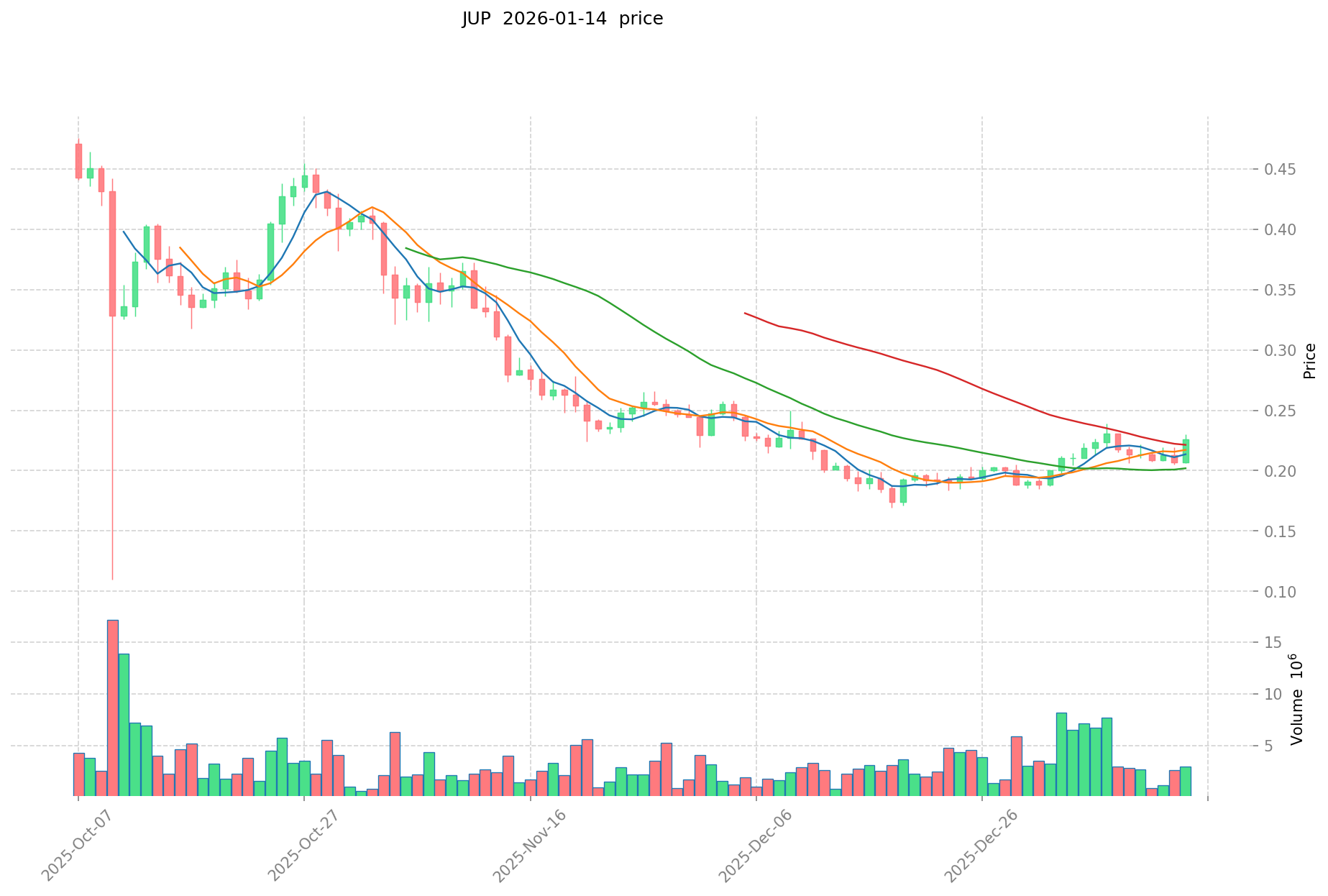
Jupiter reached a notable price level of $2.2 on 31 January 2024, driven by favorable market conditions during its initial launch period and strong community interest in Solana-based DeFi infrastructure. The token experienced its lowest price point of $0.1097 on 10 October 2025, reflecting broader market corrections and volatility in the cryptocurrency sector. These price movements demonstrate the influence of market sentiment, ecosystem adoption trends, and external factors on the token's valuation.
Click to view current JUP market price
On-Chain Metrics
- Holder Addresses: 852,684 addresses (indicating significant user participation and token distribution across the ecosystem)
- 24-Hour Trading Volume: $807,014.87 (demonstrating active market engagement)
- Market Capitalization: $729,521,225.15 (reflecting current market valuation based on circulating supply)
Jupiter Ecosystem Applications and Strategic Partners
Core Use Cases
Jupiter's ecosystem supports multiple applications:
- DeFi: As Solana's primary liquidity infrastructure, Jupiter provides decentralized token swapping and liquidity aggregation, driving more than 80% of the total retail liquidity movement on Solana.
- Protocol Integration: Jupiter seamlessly integrates with the majority of protocols within the Solana network, enabling efficient cross-protocol liquidity routing.
Strategic Partnerships
Jupiter has established integrations with numerous protocols on the Solana network, enhancing its technical capabilities and market influence.
These partnerships provide a solid foundation for Jupiter's ecosystem expansion.
Controversies and Challenges
Jupiter faces the following challenges:
- Technical Issues: Dependency on Solana network performance and potential scalability constraints
- Regulatory Risks: Evolving regulatory frameworks for DeFi protocols and decentralized exchanges
- Competitive Pressure: Competition from other DEX aggregators and liquidity solutions across various blockchain networks
These issues have sparked discussions within the community and market, while also driving Jupiter's continuous innovation.
Jupiter's community demonstrates strong vitality, with the token holder count reaching 852,684.
On X platform, related posts and hashtags (such as #JUP) frequently trend, generating significant engagement.
Factors such as product updates and liquidity milestones have energized the community.
Sentiment on X shows diverse perspectives:
- Supporters praise Jupiter's efficiency as a liquidity aggregator and seamless integration capabilities, considering it a fundamental infrastructure for Solana DeFi.
- Critics focus on price volatility and broader market conditions.
Recent trends indicate varied sentiment patterns influenced by market cycles.
Hot Topics
X users actively discuss Jupiter's role in Solana's DeFi ecosystem, liquidity optimization, and protocol partnerships,
showcasing both its transformative potential and the challenges in achieving broader adoption.
- Official Website: Visit Jupiter Official Website for features, use cases, and latest updates.
- X Updates: On X platform, Jupiter actively engages using its official account, with posts covering technical upgrades, community activities, and partnership announcements, generating significant engagement metrics.
Jupiter Future Roadmap
- Ongoing Development: Continuous enhancement of liquidity aggregation algorithms and routing efficiency, improving transaction execution and user experience
- Ecosystem Goals: Expanding protocol integrations and supporting the growth of Solana's DeFi landscape
- Long-term Vision: Establishing itself as the leading liquidity infrastructure for decentralized finance on Solana
How to Participate in Jupiter?
- Purchase Channels: Acquire JUP on Gate.com and other supported exchanges
- Storage Solutions: Securely store using Solana-compatible wallets such as Phantom or Solflare
- Participate in Governance: Engage in community decisions through governance mechanisms
- Build Ecosystem: Visit developer documentation to contribute to the Jupiter ecosystem
Summary
Jupiter redefines decentralized trading through blockchain technology, providing efficient liquidity aggregation, seamless protocol integration, and optimized trading execution.
Its active community, comprehensive resources, and strong market performance distinguish it in the cryptocurrency field.
Despite facing regulatory uncertainties and competitive pressures, Jupiter's innovative approach and clear development trajectory position it prominently in the future of decentralized finance.
Whether you are a newcomer or an experienced participant, Jupiter merits attention and engagement.
FAQ
What is JUP (Jupiter)? How does it work?
Jupiter is a decentralized exchange aggregator built on Solana blockchain. It enables users to trade multiple cryptocurrencies efficiently by routing orders through various liquidity sources, optimizing prices and minimizing slippage through smart routing algorithms.
What are the uses of JUP tokens? What are the benefits of holding JUP?
JUP tokens are used for governance of the Jupiter DAO. Holders can participate in decision-making processes and receive potential rewards from the ecosystem.
How to buy and trade JUP tokens?
Register an account on a centralized exchange, complete identity verification, deposit fiat currency or crypto, then purchase JUP tokens. You can trade JUP pairs against stablecoins like USDT or other cryptocurrencies on supported trading platforms.
What advantages does JUP have compared to other Solana ecosystem projects?
JUP excels in trading efficiency and user experience within the Solana ecosystem. Its fast transaction speeds, intuitive interface, and superior liquidity aggregation set it apart from competitors like Raydium and Orca.
What risks should I pay attention to when investing in JUP?
JUP investment carries market volatility and price uncertainty risks. Crypto markets fluctuate significantly, requiring thorough research and risk assessment before investing based on your risk tolerance and financial capacity.
What is Jupiter's liquidity aggregator functionality and why is it important?
Jupiter aggregates liquidity from multiple DEX protocols to offer users optimal trading prices and minimal slippage. The JUP token aligns long-term incentives between protocol and community. Its importance lies in enhancing trading efficiency, transparency, and execution quality across Solana.
What is the total supply and allocation mechanism of JUP tokens?
JUP has a total supply of 10 billion tokens. 40% is allocated for community growth and airdrop incentives, with remaining portions distributed to team, early investors, and other incentive mechanisms.
* The information is not intended to be and does not constitute financial advice or any other recommendation of any sort offered or endorsed by Gate.