Kaspa (KAS) is a Layer-1 blockchain implementing the innovative GHOSTDAG protocol to revolutionize blockchain scalability and transaction confirmation speed. Launched in 2021 by an anonymous development team, Kaspa operates as a decentralized network with over 541,000 holders and demonstrates strong community engagement. This comprehensive guide examines Kaspa's technical architecture combining proof-of-work consensus with blockDAG technology, analyzes its market performance including current pricing and on-chain metrics, and explores its ecosystem applications and mining infrastructure. Readers will discover how to participate through Gate.com exchanges, understand the competitive advantages and challenges facing Kaspa, and gain insights into its long-term roadmap for establishing scalable decentralized infrastructure for high-performance transactions.
Kaspa's Positioning and Significance
In 2021, an anonymous development team launched Kaspa (KAS), aiming to address blockchain scalability limitations and transaction confirmation delays.
As one of the fastest Layer-1 blockchains implementing the GHOSTDAG protocol, Kaspa plays a key role in decentralized payment systems and high-throughput blockchain applications.
As of 2026, Kaspa has established itself as a top-tier cryptocurrency by market capitalization, with over 541,000 holders and an active developer community.
This article will provide an in-depth analysis of its technical architecture, market performance, and future potential.
Origin and Development History
Birth Background
Kaspa was created by an anonymous development team in 2021, aiming to solve blockchain scalability limitations and the inability of traditional blockchains to process parallel blocks efficiently.
It emerged during the blockchain technology boom, with the goal of providing secure, fast, and fully scalable transactions to transform the status quo.
Kaspa's launch brought entirely new possibilities for blockchain networks requiring high throughput and instant confirmation.
Important Milestones
- 2021: Mainnet launch, achieving unprecedented block processing speed through the GHOSTDAG protocol.
- 2024: Price reached an all-time high of $0.207411, reflecting growing market recognition.
- 2025: Listing on Gate.com and other major exchanges, expanding trading accessibility to global users.
- 2026: Network continues to grow with over 541,000 holders and sustained community development.
With support from its decentralized community and open-source contributors, Kaspa continues to optimize its technology, security, and real-world applications.
How Does Kaspa Work?
No Central Control
Kaspa operates on a decentralized network of computers (nodes) distributed globally, free from control by banks or governments.
These nodes collaborate to validate transactions, ensuring system transparency and attack resistance, granting users greater autonomy and enhancing network resilience.
Blockchain Core
Kaspa's blockchain is a public, immutable digital ledger that records every transaction.
Transactions are grouped into blocks and linked through cryptographic hashes to form a secure chain.
Anyone can view the records, establishing trust without intermediaries.
Kaspa's implementation of blockDAG (Directed Acyclic Graph) architecture allows parallel block creation and ordering, significantly improving performance beyond traditional linear blockchains.
Ensuring Fairness
Kaspa employs Proof of Work (PoW) consensus with the GHOSTDAG protocol to validate transactions and prevent fraud such as double-spending.
Miners maintain network security by performing computational work to solve cryptographic puzzles, earning KAS rewards.
Its innovation includes allowing parallel blocks to coexist and be ordered in consensus, achieving higher transaction throughput and faster confirmation times.
Secure Transactions
Kaspa uses public-private key cryptography to protect transactions:
- Private keys (similar to secret passwords) are used to sign transactions
- Public keys (similar to account numbers) are used to verify ownership
This mechanism ensures fund security while transactions remain pseudonymous.
The GHOSTDAG protocol adds an additional layer of security by preventing block orphaning and ensuring all honest blocks contribute to the consensus.
Circulation Overview
As of January 14, 2026, Kaspa has a circulating supply of 26,777,148,610.51 KAS, with a total supply of 27,109,909,730.30 KAS and a maximum supply cap of 28,704,026,601 KAS. The circulating supply represents approximately 93.29% of the total supply, indicating a relatively high circulation ratio. New coins enter the market through Kaspa's proof-of-work mining mechanism utilizing the GHOSTDAG protocol, which influences its supply-demand dynamics.
Price Fluctuation
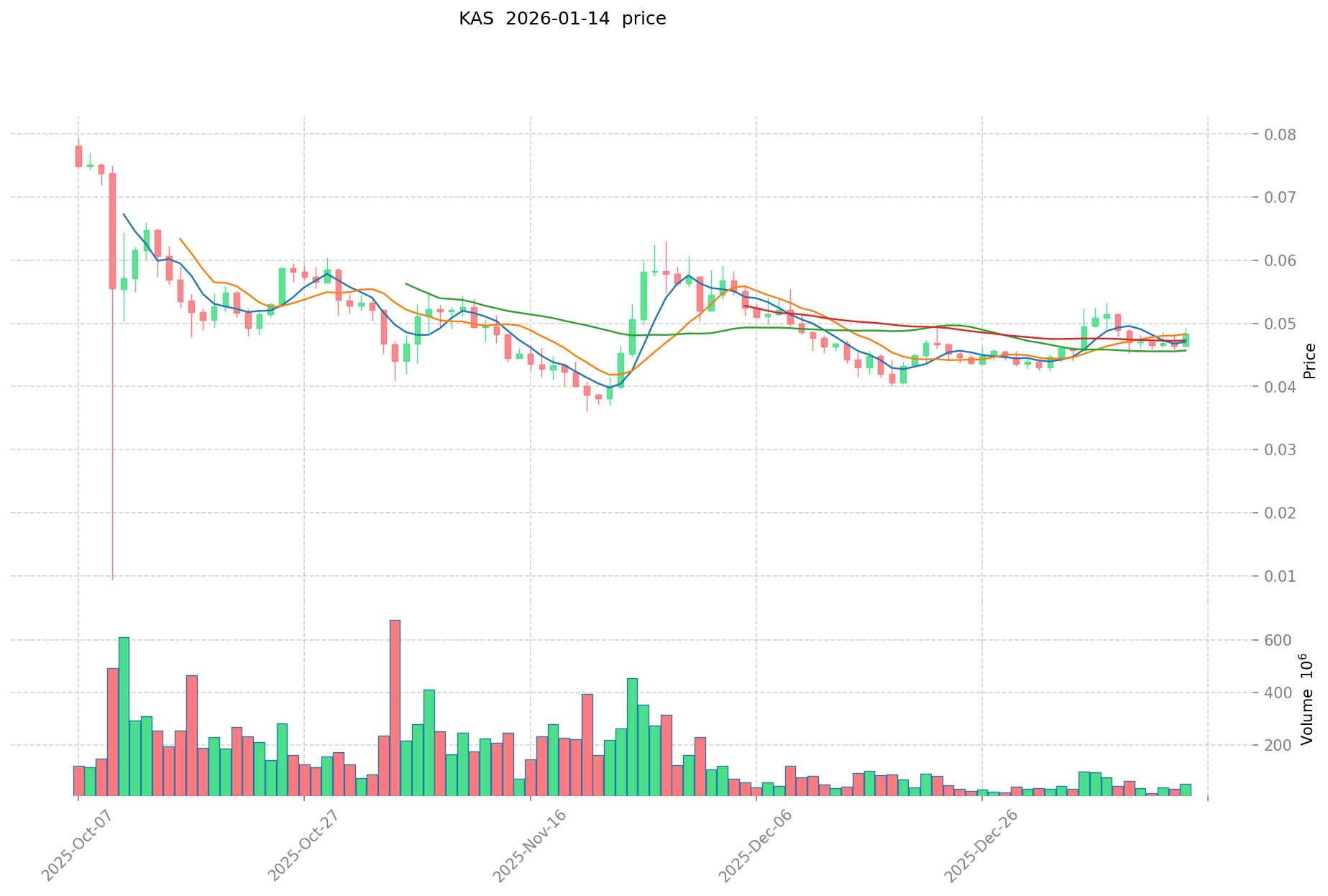
Kaspa reached an all-time high of $0.207411 on August 1, 2024, driven by increased market interest and adoption momentum during that period. Its lowest recorded price was $0.00017105 on May 26, 2022, reflecting early-stage market conditions and limited awareness. As of January 14, 2026, KAS is trading at $0.04836, representing a 58.63% decline from its peak over the past year. Recent price movements show a 4.3% increase over the past 24 hours, though the token has experienced a 5.66% decline over the past 7 days and a 9.53% gain over the past 30 days. These fluctuations reflect ongoing market sentiment, adoption trends, and broader cryptocurrency market dynamics.
Click to view current KAS market price
On-chain Metrics
- Holder Count: Approximately 541,003 addresses hold KAS (demonstrating growing community participation)
- Market Capitalization: $1,294,942,906.80 (reflecting current market valuation)
- 24-Hour Trading Volume: $2,509,027.84 (indicating active trading activity)
Kaspa Ecosystem Applications and Partners
Core Use Cases
Kaspa's ecosystem supports multiple applications:
- Payment Infrastructure: Kaspa provides fast and scalable transaction processing through its GHOSTDAG protocol implementation.
- Decentralized Mining: The proof-of-work consensus mechanism enables distributed network security and fair token distribution.
Strategic Partnerships
Kaspa continues to build its technological foundation through community-driven development and open-source collaboration.
These partnerships and community contributions provide a solid foundation for Kaspa's ecosystem expansion.
Controversies and Challenges
Kaspa faces the following challenges:
- Technical Issues: Scalability optimization and network efficiency improvements remain ongoing focus areas
- Regulatory Risks: The evolving global regulatory landscape for proof-of-work cryptocurrencies
- Competitive Pressure: Competition from other Layer-1 blockchains with alternative consensus mechanisms
These issues have sparked discussions within the community and market, while also driving Kaspa's continuous innovation.
Fan Enthusiasm
Kaspa's community demonstrates strong vitality, with over 541,003 holders actively participating in the network.
On X platform, related posts and hashtags (such as #Kaspa) frequently trend, generating significant engagement.
Technical developments and protocol updates have ignited community enthusiasm.
Sentiment on X shows diverse perspectives:
- Supporters praise Kaspa's GHOSTDAG protocol innovation, decentralization characteristics, and fast block generation, viewing it as "an evolution in blockchain architecture".
- Critics focus on price volatility and market competition from established blockchains.
Recent trends indicate mixed sentiment with technical progress driving positive discussions.
Hot Topics
X users actively discuss Kaspa's DAG-based architecture, mining ecosystem, and scalability potential,
showcasing both its transformative potential and the obstacles toward mainstream adoption.
- Official Website: Visit Kaspa Official Website for features, use cases, and latest updates.
- Whitepaper: Kaspa Whitepaper details its technical architecture, objectives, and vision based on GHOSTDAG protocol research.
- X Updates: On X platform, Kaspa operates under @KaspaCurrency, with active engagement covering protocol development, community initiatives, and ecosystem growth.
Kaspa Future Roadmap
- Ongoing Development: Continuous optimization of GHOSTDAG protocol implementation, enhancing network throughput and efficiency
- Ecosystem Goals: Expanding developer tools and supporting diverse applications on the network
- Long-term Vision: Establishing a scalable, decentralized infrastructure for high-performance transactions
How to Participate in Kaspa?
- Purchase Channels: Buy KAS on Gate.com and other cryptocurrency exchanges
- Storage Solutions: Use secure wallet solutions compatible with Kaspa's native protocol
- Network Participation: Engage in mining operations or run network nodes to support decentralization
- Ecosystem Building: Visit Kaspa GitHub to contribute code or develop applications
Summary
Kaspa redefines blockchain architecture through its innovative GHOSTDAG protocol, offering high throughput, decentralization, and security.
Its active community, open-source resources, and technical performance distinguish it within the cryptocurrency landscape.
Despite facing regulatory uncertainties and competitive challenges, Kaspa's innovative approach and development trajectory position it as a significant player in decentralized technology's future.
Whether you're a newcomer or experienced participant, Kaspa merits attention and engagement.
FAQ
What is Kaspa (KAS) and how does it work?
Kaspa (KAS) is a decentralized Layer 1 blockchain using BlockDAG technology for high scalability and low fees. It combines Bitcoin's security with fast transaction speeds, enabling decentralized applications. Miners earn rewards while users pay minimal fees for transactions.
What are the key features and advantages of KAS compared to other cryptocurrencies?
KAS excels in energy efficiency, consuming significantly less power than traditional PoW cryptocurrencies. Its eco-friendly blockchain architecture appeals to environmentally conscious investors while maintaining strong security and scalability features.
How can I buy and store Kaspa (KAS) tokens?
You can buy KAS through various platforms and payment methods. For secure storage, use dedicated wallets like Klever Wallet or hardware wallets. Choose based on your security needs and convenience preferences.
What is the use case and real-world application of Kaspa?
Kaspa serves as a high-throughput blockchain layer enabling fast transaction verification and settlement. Real-world applications include secondary verification layers, payment processing, and scalable settlement infrastructure for various decentralized applications requiring rapid confirmation speeds.
What are the risks and security considerations when investing in KAS?
Smart contract vulnerabilities and custody risks are primary concerns. Always verify platform security measures, use secure wallets, enable two-factor authentication, and conduct thorough due diligence before investing in KAS.
* The information is not intended to be and does not constitute financial advice or any other recommendation of any sort offered or endorsed by Gate.