Kadena (KDA) is a scalable blockchain platform built by former JPMorgan developers, featuring an innovative braided, parallel chain architecture that combines Proof-of-Work security with enterprise-grade throughput. This comprehensive guide explores Kadena's core technology including its decentralized consensus mechanism, human-readable Pact smart contract language, and hybrid public-private blockchain solutions designed for both DeFi and enterprise applications. The article analyzes KDA's market performance, ecosystem partnerships like Kaddex, and current trading metrics on Gate, while addressing key challenges including market competition and adoption hurdles. Readers will discover Kadena's active community engagement, strategic roadmap for scalability enhancement, and practical steps to participate through token acquisition and DApp development. Whether you seek understanding of next-generation blockchain infrastructure or investment insights, this guide provides essential context for evaluating Kadena's r
Kadena's Position and Significance
In 2018, the team behind Kadena launched Kadena (KDA), aiming to address scalability limitations and security concerns in existing blockchain platforms.
As the first platform to integrate a sharded, braided Proof-of-Work consensus mechanism with a human-readable smart contract language, Kadena plays a key role in enterprise blockchain solutions and decentralized applications.
As of 2026, Kadena has established itself as a platform serving both public and private blockchain needs, with an active developer community focused on building secure and scalable applications.
This article will provide an in-depth analysis of its technical architecture, market performance, and future potential.
Origin and Development History
Background of Creation
Kadena was created by former JPMorgan blockchain team members in 2018, aiming to solve the blockchain trilemma of achieving security, scalability, and decentralization simultaneously.
It emerged during the period when enterprise interest in blockchain technology was growing, with the goal of providing a platform that combines the security of Bitcoin with the throughput needed for enterprise applications.
The launch of Kadena brought new possibilities for enterprises seeking to leverage blockchain technology without compromising on performance or security.
Key Milestones
- 2020: Mainnet launch, implementing a unique braided chain architecture that enables parallel processing across multiple chains.
- Secured funding of USD 15 million from investors including SVAngel and CoinFund.
- Developed both public chain and consortium chain solutions that can be integrated to create new market use cases.
How Does Kadena Work?
No Central Control
Kadena operates on a decentralized network of computers (nodes) distributed globally, free from control by banks or governments.
These nodes collaborate to validate transactions, ensuring the system remains transparent and resistant to attacks, giving users greater autonomy and enhancing network resilience.
Blockchain Core
Kadena's blockchain is a public, immutable digital ledger that records every transaction.
Transactions are grouped into blocks and linked through cryptographic hashing to form a secure chain.
Anyone can view the records, establishing trust without intermediaries.
Kadena employs a braided chain architecture where multiple chains run in parallel, significantly enhancing transaction throughput and performance.
Ensuring Fairness
Kadena uses Proof-of-Work (PoW) consensus with a unique braided, sharded architecture to validate transactions and prevent fraud such as double-spending.
Miners maintain network security through computational work across multiple chains simultaneously and receive KDA rewards.
Its innovation includes achieving higher scalability while maintaining PoW security through parallel chain processing.
Secure Transactions
Kadena uses public-private key cryptography to protect transactions:
- Private keys (like secret passwords) are used to sign transactions
- Public keys (like account numbers) are used to verify ownership
This mechanism ensures fund security while transactions maintain pseudonymous characteristics.
Kadena also features Pact, a human-readable smart contract language with built-in formal verification capabilities, enhancing contract security and reducing vulnerabilities.
Circulation Overview
As of January 31, 2026, Kadena's circulating supply stands at 338,586,083.52 KDA tokens, with a total supply of 338,586,083.52 tokens and a maximum supply cap of 1,000,000,000 KDA. The current circulation represents approximately 33.86% of the maximum supply, indicating a controlled token distribution model. New tokens enter the market through the network's mining mechanism, which influences the supply-demand dynamics of the ecosystem.
Price Volatility
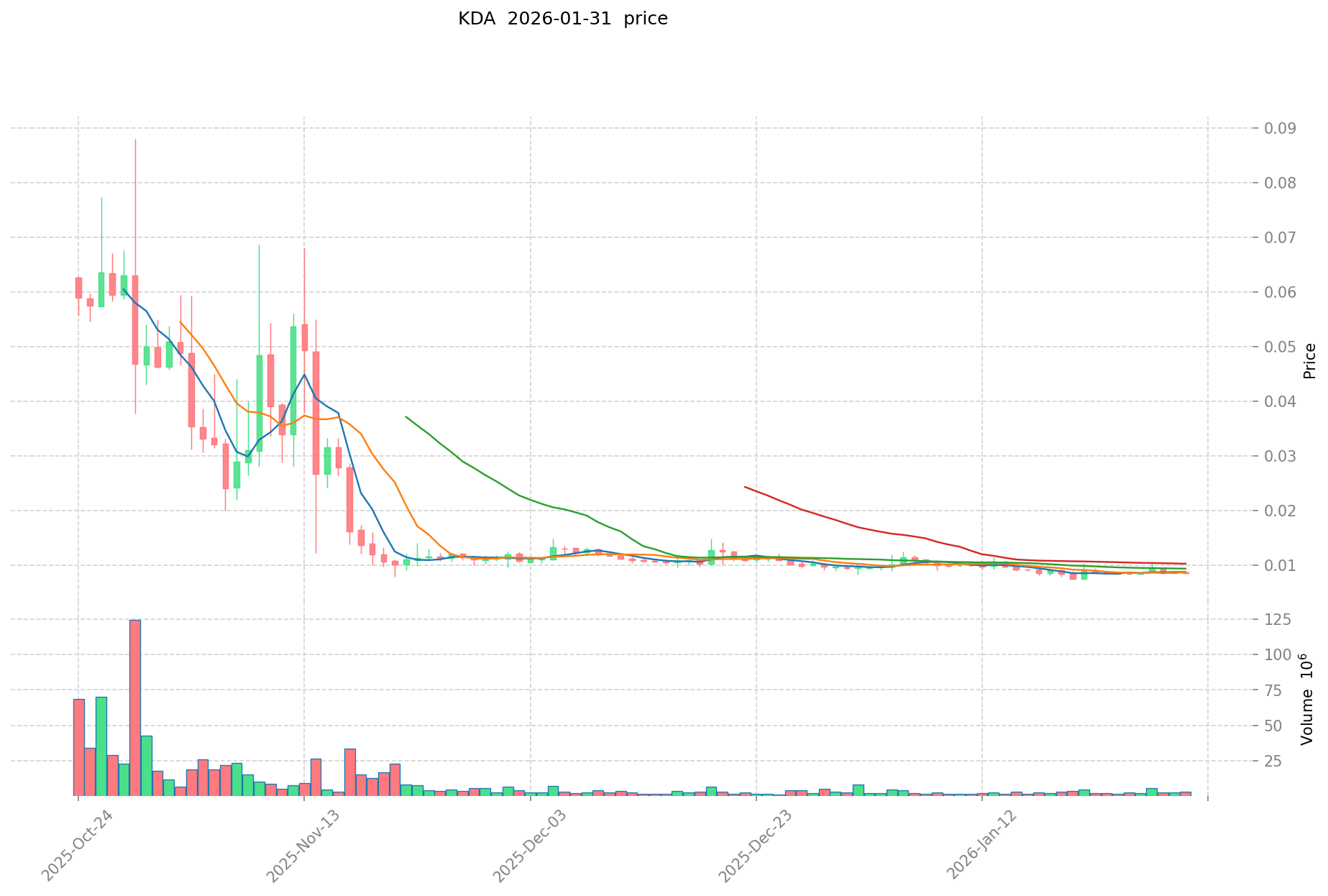
Kadena reached its historical high price of $27.64 on November 11, 2021, during a period of heightened market activity and growing interest in scalable blockchain solutions. The token experienced its lowest price of $0.0074283 on January 21, 2026, reflecting broader market adjustments and changing sentiment in the cryptocurrency sector. As of the latest update, KDA is trading at $0.008532, showing recent price movements of -0.038% over 1 hour, -1.56% over 24 hours, and -0.83% over 7 days. These fluctuations demonstrate the dynamic nature of market sentiment, adoption trends, and external factors affecting the cryptocurrency landscape.
Click to view the current KDA market price
On-Chain Metrics
- 24-Hour Trading Volume: $25,876.02 (indicating current market activity levels)
- Market Capitalization: $2,888,816.46 (reflecting the current valuation of circulating tokens)
- Market Dominance: 0.000097% (representing Kadena's share in the overall cryptocurrency market)
Kadena Ecosystem Applications and Partners
Core Use Cases
Kadena's ecosystem supports multiple applications:
- DeFi: Projects like Kaddex provide decentralized trading capabilities, enabling users to swap tokens and provide liquidity in a trustless environment.
- Enterprise Solutions: Kadena's hybrid blockchain architecture facilitates secure and scalable enterprise applications, allowing businesses to leverage both public and private chain benefits.
Strategic Partnerships
Kadena has established collaborations with various partners to enhance its technical capabilities and market presence.
These partnerships provide a solid foundation for Kadena's ecosystem expansion.
Controversies and Challenges
Kadena faces the following challenges:
- Technical Hurdles: Achieving widespread adoption while maintaining the complexity of its unique multi-chain architecture.
- Market Competition: Competition from established blockchain platforms with larger ecosystems and developer communities.
- Market Volatility: Price fluctuations affecting investor confidence and project development momentum.
These issues have sparked discussions within the community and market, while also driving Kadena's continuous innovation.
Kadena's community demonstrates active participation across various platforms.
On X platform, related posts and hashtags (such as #Kadena and #KDA) generate regular engagement from supporters and developers.
Factors such as technological developments and ecosystem growth contribute to community enthusiasm.
Sentiment on X shows diverse perspectives:
- Supporters praise Kadena's scalability solutions and Pact smart contract language, viewing it as an innovative approach to blockchain technology.
- Critics focus on market performance concerns and adoption challenges in a competitive landscape.
Recent trends indicate mixed sentiment as the market navigates broader crypto cycles.
Popular Topics
X users actively discuss Kadena's technical innovations, scalability features, and ecosystem development,
showcasing both its transformative potential and the challenges it faces in achieving mainstream adoption.
- Official Website: Visit Kadena Official Website for features, use cases, and latest updates.
- White Paper: Kadena White Paper details its technical architecture, objectives, and vision.
- X Updates: On X platform, Kadena maintains an active presence through @kadena_io,
with posts covering technical upgrades, community events, and ecosystem news, generating engagement from the community.
Kadena Future Roadmap
- Ongoing Development: Continuous enhancement of multi-chain architecture and Pact language capabilities, improving scalability and developer experience
- Ecosystem Goals: Expanding DApp development and fostering enterprise adoption
- Long-term Vision: Establishing itself as a scalable and secure blockchain infrastructure for diverse applications
How to Participate in Kadena?
- Purchase Options: Buy KDA on Gate.com and other supported exchanges
- Storage Solutions: Use compatible wallets like Chainweaver or X-Wallet for secure storage
- Build on Kadena: Visit developer documentation to create DApps using Pact smart contract language
- Community Involvement: Engage with the community through official channels and contribute to ecosystem growth
Summary
Kadena redefines blockchain technology through its innovative approach, offering scalability, security, and a unique multi-chain architecture.
Its active community, comprehensive resources, and technological innovations position it distinctively in the cryptocurrency landscape.
Despite facing market competition and adoption challenges, Kadena's innovative spirit and clear development direction give it an important place in the future of decentralized technology.
Whether you are a newcomer or an experienced participant, Kadena is worth watching and engaging with.
FAQ
What is Kadena (KDA) and what are its main features?
Kadena (KDA) is a scalable blockchain platform using innovative consensus mechanisms to overcome traditional PoW limitations. Main features include high transaction throughput, smart contract capabilities, enhanced security, and network governance through KDA token staking.
How does Kadena's blockchain technology differ from other cryptocurrencies?
Kadena uses multiple parallel blockchains instead of a single chain, enabling higher scalability and transaction throughput while maintaining proof-of-work consensus across all chains simultaneously.
What is the use case and purpose of the KDA token?
KDA tokens are used for paying transaction fees, participating in network governance, and incentivizing validators on the Kadena blockchain. They are essential for network operations and community engagement.
How can I buy and store Kadena (KDA) tokens?
Purchase KDA on crypto platforms using fiat or stablecoins. Transfer tokens to a secure wallet supporting Kadena network. Store in hardware wallets or official wallet applications for enhanced security and full asset control.
What are the risks and security considerations for investing in KDA?
KDA investment involves regulatory compliance risks and security threats like exchange hacks. Verify platform security measures, ensure local regulatory adherence, and stay informed on policy changes. Conduct thorough due diligence before investing.
What is Kadena's consensus mechanism and how does it work?
Kadena uses a proof-of-work consensus mechanism called Pact. It employs a braided, parallel chain architecture where multiple chains run simultaneously, validated by nodes through computational work, ensuring security and high throughput for decentralized transactions.
What are the future prospects and roadmap for Kadena (KDA)?
Kadena focuses on scaling blockchain technology to meet global demand. The roadmap emphasizes advanced, scalable solutions and cutting-edge innovation. Kadena aims to lead the industry in next-generation blockchain technology without compromising performance or security.
* The information is not intended to be and does not constitute financial advice or any other recommendation of any sort offered or endorsed by Gate.