Kyber Network Crystal (KNC) is the governance token powering Kyber Network, a decentralized liquidity protocol launched in 2017 to solve token swap inefficiency in DeFi. As a critical infrastructure provider on Ethereum, Kyber enables instant token exchanges through decentralized liquidity aggregation without intermediaries. KNC token holders participate in governance, earn rewards from protocol fees, and stake tokens to support network operations. With a current market cap of $38 million and 17,806 active holders, KNC trades at $0.2235 as of January 2026, reflecting both DeFi's evolving landscape and competitive pressures. This guide explores Kyber's technical architecture, market performance on Gate exchange, ecosystem applications, and how users can participate in decentralized exchange infrastructure. Whether you're new to DeFi or seeking governance participation opportunities, Kyber offers seamless token conversion and community-driven protocol development.
Kyber's Position and Significance
In 2017, the Kyber team launched Kyber (KNC), aiming to solve liquidity fragmentation and inefficient token swaps in decentralized finance.
As a decentralized liquidity protocol, Kyber plays a critical role in DeFi and on-chain trading.
As of 2026, Kyber has established itself as a key infrastructure provider in the Ethereum DeFi ecosystem, with an active developer community and integration across multiple platforms.
This article will provide an in-depth analysis of its technical architecture, market performance, and future potential.
Origin and Development Timeline
Birth Background
Kyber was created by the Kyber team in 2017, aiming to solve liquidity challenges and inefficient token exchange in decentralized environments.
It emerged during the blockchain technology boom and early DeFi exploration, with the goal of providing instant, high-liquidity digital asset trading without intermediaries.
Kyber's launch brought DeFi users and protocols entirely new possibilities for seamless token swaps.
Important Milestones
- 2017: Mainnet launched, implementing on-chain liquidity aggregation and instant token swaps.
- 2021: Major upgrade introduced KyberDMM (Dynamic Market Maker) with capital-efficient liquidity provision.
- 2022: Price reached historical peak at $5.7 amid DeFi expansion.
- 2024: Ecosystem growth continued with enhanced protocol integrations and cross-chain capabilities.
With support from the Kyber community and foundation, Kyber continues to optimize its technology, security, and real-world applications.
How Does Kyber Work?
No Central Control
Kyber operates on a decentralized network of computers (nodes) distributed globally, eliminating control by banks or governments.
These nodes collaborate to verify transactions, ensuring system transparency and attack resistance, granting users greater autonomy and enhancing network resilience.
Blockchain Core
Kyber's blockchain infrastructure leverages Ethereum, a public, immutable digital ledger that records every transaction.
Transactions are grouped into blocks and linked through cryptographic hashes to form a secure chain.
Anyone can view the records, establishing trust without intermediaries.
Kyber's liquidity aggregation protocol further enhances trading efficiency by sourcing liquidity from multiple reserves.
Ensuring Fairness
Kyber leverages Ethereum's Proof of Stake (PoS) consensus mechanism to validate transactions and prevent fraud such as double-spending.
Validators maintain network security through staking ETH and validating blocks, earning rewards in the process.
Kyber's innovation includes dynamic fee adjustment and optimized routing algorithms for better capital efficiency.
Secure Transactions
Kyber utilizes public-private key cryptography to protect transactions:
- Private keys (like secret passwords) are used to sign transactions
- Public keys (like account numbers) are used to verify ownership
This mechanism ensures fund security while transactions remain pseudonymous on the Ethereum blockchain.
Additional security features include smart contract audits and multi-signature governance mechanisms.
Circulation Overview
As of January 20, 2026, Kyber (KNC) has a circulating supply of 170,152,851.23 tokens, with a total supply of 240,863,075.99 tokens and a maximum supply cap of 252,301,550 tokens. The circulating supply represents approximately 67.44% of the total supply, indicating a controlled release model. The token distribution follows KyberNetwork's ecosystem allocation framework, supporting network operations, liquidity provision, and community development initiatives.
Price Fluctuations
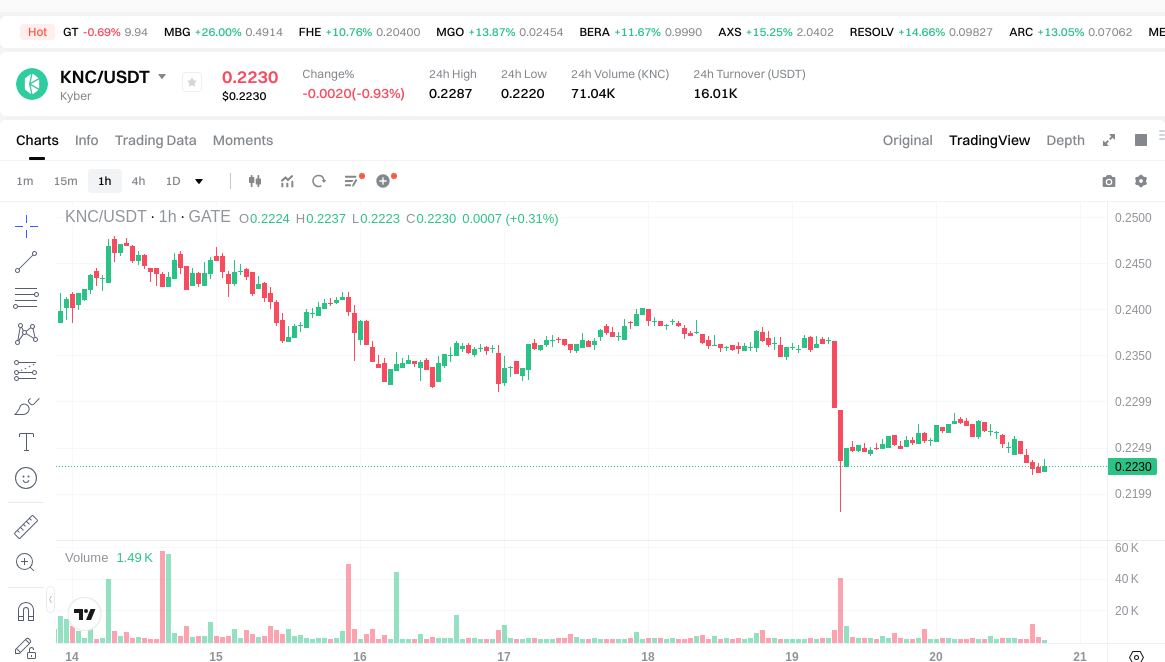
KNC reached its peak price of $5.70 on April 29, 2022, during a period of heightened DeFi activity and increased adoption of decentralized exchange protocols. The token experienced its lowest recorded price of $0.211149 on December 19, 2025, reflecting broader market corrections and shifts in DeFi liquidity patterns. As of January 20, 2026, KNC trades at $0.2235, showing a -0.71% change over 24 hours. Recent price movements indicate:
- 1-hour change: +0.4%
- 7-day change: -5.77%
- 30-day change: -2.02%
- 1-year change: -57.86%
These fluctuations reflect evolving market sentiment, competitive dynamics in the DEX aggregator space, and broader cryptocurrency market trends.
Click to view current KNC market price
On-Chain Metrics
- 24-hour Trading Volume: $16,014.23 (indicating active market participation)
- Token Holder Count: 17,806 addresses (reflecting community distribution)
- Market Capitalization: $38,029,162.25 (representing current network valuation)
- Market Cap to FDV Ratio: 67.44% (showing the relationship between circulating and fully diluted valuation)
Kyber Ecosystem Applications and Partners
Core Use Cases
Kyber's ecosystem supports multiple applications:
- DeFi: KyberNetwork serves as a decentralized trading platform, providing instant exchange and trading of digital assets including various crypto tokens such as Ethereum and its ERC20 tokens, Bitcoin, and ZCash.
- Payment Integration: Through rich payment APIs and next-generation contract wallets, KyberNetwork enables seamless payment capabilities across different tokens for all users.
Strategic Collaborations
While specific partnership details are not extensively documented in available materials, Kyber's open development approach is evident through its active GitHub presence at https://github.com/kybernetwork/KyberWallet.
These technical foundations provide infrastructure for ecosystem expansion.
Controversies and Challenges
Kyber faces several challenges:
- Market Competition: Operating in a competitive landscape with other decentralized exchange protocols and liquidity solutions
- Price Volatility: The token has experienced considerable fluctuation, with a 1-year change of -57.86%
- Market Share: Currently holds 0.0016% market dominance, indicating competitive pressure in the broader cryptocurrency market
These factors continue to influence community discussions and drive ongoing platform development.
Fan Enthusiasm
Kyber maintains an active community with 17,806 token holders.
On X platform, the community engages through the official account at https://twitter.com/kybernetwork.
Community discussions on Reddit at https://www.reddit.com/r/kybernetwork/ and governance forum at https://gov.kyber.org/ demonstrate sustained engagement.
Sentiment on X shows mixed perspectives:
- Supporters value Kyber's decentralized exchange capabilities and liquidity provision, viewing it as an important infrastructure component for DeFi.
- Critics focus on recent price performance and market volatility, with the token trading at $0.2235 as of January 20, 2026.
Recent trends reflect cautious sentiment given the -5.77% weekly decline.
Hot Topics
X users discuss Kyber's market performance, liquidity mechanisms, and position within the evolving DeFi landscape,
reflecting both its technological potential and challenges in maintaining competitive advantage.
- Official Website: Visit Kyber Official Site for features, use cases, and latest updates.
- X Updates: On X platform, Kyber maintains an active presence through @kybernetwork,
with posts covering platform updates, liquidity enhancements, and community developments.
- Developer Resources: Access the GitHub repository at https://github.com/kybernetwork/KyberWallet for technical documentation and code contributions.
- Governance: Participate in community discussions at https://gov.kyber.org/.
Future Roadmap for Kyber
While specific roadmap details are not provided in available materials, Kyber continues to focus on:
- Enhancing liquidity provision mechanisms
- Expanding payment API capabilities
- Strengthening decentralized exchange infrastructure
How to Participate in Kyber?
- Purchase Channels: Buy KNC on Gate.com and 29 other exchanges
- Storage Solutions: Use compatible Ethereum wallets such as MetaMask to securely store KNC tokens (Contract Address: 0xdeFA4e8a7bcBA345F687a2f1456F5Edd9CE97202)
- Participate in Governance: Join discussions and contribute through https://gov.kyber.org/
- Build Ecosystem: Visit https://github.com/kybernetwork/KyberWallet to develop applications or contribute code
Summary
Kyber redefines digital asset exchange through blockchain technology, providing decentralized trading, high liquidity, and seamless token conversion.
Its active community of 17,806 holders, open-source development approach, and established market presence position it as a significant player in the DeFi space.
Despite facing market volatility and competitive pressure, with the token currently priced at $0.2235 and a market cap of approximately $38 million, Kyber's continued focus on liquidity solutions and payment infrastructure keeps it relevant in the decentralized finance ecosystem.
Whether you are new to DeFi or an experienced participant, Kyber offers opportunities for engagement in decentralized exchange technology.
FAQ
What is KNC (Kyber Network Crystal)?
KNC is the governance token of Kyber Network, a decentralized exchange protocol. It enables liquidity provision, fee collection, and voting rights for protocol improvements. KNC holders stake tokens to earn rewards from trading volume and participate in ecosystem decisions.
What are the uses and functions of KNC tokens?
KNC tokens serve as governance tokens for the Kyber Network protocol, enabling holders to participate in decentralized governance decisions. KNC is used for protocol fees, validator rewards, and incentivizing liquidity providers. Holders can stake KNC to earn rewards and influence network parameters and upgrades.
How to buy and store KNC tokens?
Purchase KNC on major cryptocurrency exchanges using fiat or other cryptocurrencies. Store tokens in a secure wallet such as hardware wallets (Ledger, Trezor) or reputable software wallets for enhanced security and full control over your assets.
What is Kyber Network and what role does KNC play in it?
Kyber Network is a decentralized liquidity protocol enabling instant token swaps. KNC is its governance token, used for voting on protocol decisions, earning rewards from transaction fees, and participating in network governance to shape Kyber's future development.
What is the difference between KNC and other DeFi tokens like UNI and SUSHI?
KNC powers Kyber Network's decentralized exchange and liquidity protocol. Unlike UNI(Uniswap)and SUSHI(SushiSwap)focused on AMM trading, KNC emphasizes dynamic market-making and capital efficiency. KNC holders gain governance rights and fee-sharing benefits from protocol revenue, offering unique value capture mechanisms distinct from competing DeFi tokens.
What are the risks of investing in KNC and what should I pay attention to?
KNC price volatility is significant due to market conditions and sentiment shifts. Monitor project developments, liquidity depth, and your risk tolerance. Diversify your portfolio and invest only what you can afford to lose. Stay informed on governance changes and ecosystem updates.
What is KNC's development prospects and roadmap?
KNC is advancing toward enhanced DEX aggregation and layer-2 scaling. The roadmap focuses on expanding liquidity provision, improving trading efficiency, and integrating emerging blockchain networks. KNC aims to strengthen its market position through protocol upgrades and ecosystem partnerships.
* The information is not intended to be and does not constitute financial advice or any other recommendation of any sort offered or endorsed by Gate.