Kusama (KSM) serves as Polkadot's experimental canary network, launched in 2019 to address real-world testing challenges for blockchain innovations before mainnet deployment. This comprehensive guide explores Kusama's technical architecture, market performance, and ecosystem role. The platform operates through a decentralized consensus mechanism using Nominated Proof-of-Stake (NPoS), enabling faster governance cycles and parachain-based scalability. With over 266,873 token holders and a circulating supply of 17.6 million KSM, Kusama has established itself as a critical testing ground for blockchain developers and projects. The article covers Kusama's origins, development milestones, on-chain metrics, DeFi applications, community dynamics, and practical participation methods including purchasing on Gate and staking participation. Whether you seek to understand blockchain innovation or explore ecosystem opportunities, this guide provides essential insights into Kusama's positioning and future potential.
Kusama's Positioning and Significance
In 2019, the Web3 Foundation and Parity Technologies launched Kusama (KSM), aiming to address the challenges of testing and deploying blockchain innovations in real-world environments before implementation on production networks.
As an experimental blockchain platform serving as Polkadot's canary network, Kusama plays a critical role in blockchain development, multi-chain ecosystems, and decentralized governance.
As of 2026, Kusama has established itself as a testing ground for blockchain innovation with over 266,873 token holders, possessing an active validator community and developer ecosystem.
This article will provide an in-depth analysis of its technical architecture, market performance, and future potential.
Origins and Development History
Birth Background
Kusama was created by the Web3 Foundation and Parity Technologies in 2019, aiming to solve the need for a real-environment testing platform to ensure the security and stability of the Polkadot network.
It emerged during the expansion of multi-chain blockchain architectures, with the goal of providing a faster-paced experimental environment where validators, parachain teams, and ecosystem builders could rehearse and test innovations before deploying them to Polkadot.
Kusama's launch brought new possibilities for blockchain developers and projects seeking rapid iteration capabilities.
Important Milestones
- 2019: Mainnet launch, implementing a relay chain architecture with parachain support and accelerated governance parameters.
- Ongoing: Continuous parachain auctions enabling diverse blockchain projects to connect and operate within the Kusama ecosystem.
- Various periods: Governance upgrades introducing faster voting periods (7 days) and implementation periods (8 days after voting) to enable rapid network evolution.
- Recent years: Ecosystem expansion with multiple parachains, bridges, and decentralized applications joining the network.
With support from the Web3 Foundation, Parity Technologies, and the global Kusama community, Kusama continues to optimize its technology, security, and real-world applications.
How Kusama Works
Decentralized Control
Kusama operates on a decentralized network of computers (nodes) distributed globally, independent of banks or government control.
These nodes collaborate to validate transactions, ensuring system transparency and attack resistance, granting users greater autonomy and enhancing network resilience.
Blockchain Foundation
Kusama's blockchain is a public, immutable digital ledger recording every transaction.
Transactions are grouped into blocks and linked through cryptographic hashes to form a secure chain.
Anyone can view the records, establishing trust without intermediaries.
Its relay chain architecture with connected parachains further enhances scalability and specialization.
Ensuring Fairness
Kusama employs Nominated Proof-of-Stake (NPoS) consensus mechanism to validate transactions and prevent fraud such as double-spending.
Validators and nominators maintain network security by staking KSM tokens and validating blocks, earning KSM rewards for their participation.
Its innovations include faster governance cycles and parallel processing through multiple parachains.
Secure Transactions
Kusama uses public-private key cryptography to protect transactions:
- Private keys (similar to secret passwords) are used to sign transactions
- Public keys (similar to account numbers) are used to verify ownership
This mechanism ensures fund security while transactions maintain pseudonymous privacy.
Additional security features include multi-signature capabilities and validator accountability mechanisms built into the protocol.
Circulation Overview
As of January 17, 2026, Kusama's circulating supply is 17,628,225.92 KSM, with a total supply of 17,628,225.92 KSM. The network operates with an inflationary model designed to support ongoing network security and governance.
New tokens enter the market through staking rewards and network inflation mechanisms, influencing supply and demand dynamics. The distribution model supports network validators, parachain participants, and governance activities.
Price Volatility
Kusama reached a notable price level of $621.71 on May 18, 2021, driven by increased market interest in Polkadot ecosystem projects and broader cryptocurrency market momentum during that period.
The lowest recorded price was $0.876572, occurring on January 15, 2020, during the early stages of network development when adoption and market recognition were still building.
These price movements reflect evolving market sentiment, ecosystem adoption trends, and external market conditions affecting the broader cryptocurrency sector.
Check the current KSM market price
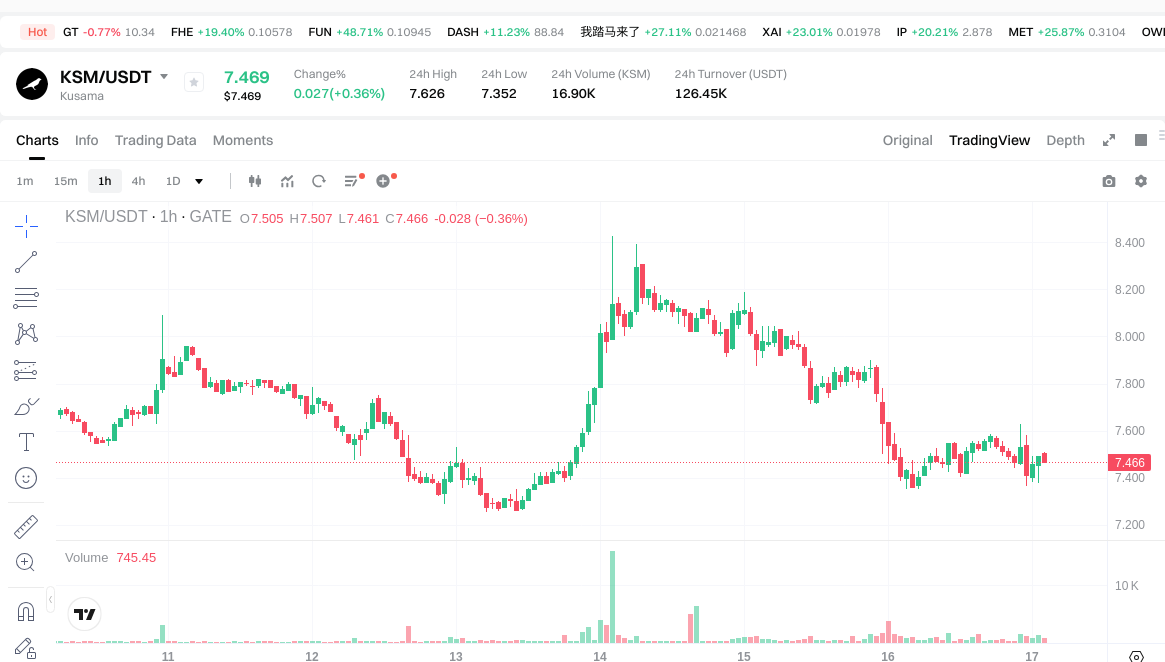
On-Chain Metrics
- Holder Addresses: 266,873 addresses (indicating community participation levels)
- 24-Hour Trading Volume: $124,810.53 (reflecting current market activity)
- Market Capitalization: $132,088,296.85 (representing network valuation)
Kusama Ecosystem Applications and Partners
Core Use Cases
Kusama's ecosystem supports multiple applications:
- Parachain Development: Various projects leverage Kusama's parachain slots to test and deploy blockchain solutions, providing experimental environments for cross-chain interoperability.
- DeFi Applications: Projects within the ecosystem enable decentralized financial services including staking and liquidity provision.
Strategic Partnerships
Kusama serves as an experimental network for Polkadot, allowing developers and validators to test network features in a real-world environment.
These collaborative relationships provide a solid foundation for Kusama's ecosystem expansion.
Controversies and Challenges
Kusama faces the following challenges:
- Technical Challenges: Network governance parameters are adjusted for faster evolution, which may introduce stability considerations
- Competition Pressure: Other blockchain platforms continue to emerge with alternative scaling solutions
These issues have sparked discussions within the community and market, while also driving Kusama's continuous innovation.
Fan Enthusiasm
Kusama's community demonstrates significant activity, with 266,873 holders participating in the network.
On X platform, related posts and hashtags (such as #KSM and #Kusama) appear regularly.
Network upgrades and parachain auctions have generated community enthusiasm.
Sentiment on X shows varied perspectives:
- Supporters praise Kusama's experimental nature and faster governance evolution, viewing it as "Polkadot's canary network".
- Critics focus on price volatility and experimental risks.
Recent trends show mixed sentiment among community members.
Hot Topics
X users actively discuss Kusama's role in testing Polkadot features, parachain slot auctions, and governance participation,
demonstrating both its innovative potential and the challenges of experimental network operations.
- Official Website: Visit Kusama Official Website to learn about features, use cases, and latest developments.
- X Updates: On X platform, Kusama actively engages through @kusamanetwork,
with posts covering technical upgrades, community events, and ecosystem developments.
Kusama Future Roadmap
- Ongoing Development: Continue supporting parachain experiments and network evolution
- Ecosystem Goals: Facilitate testing environments for Polkadot ecosystem projects
- Long-term Vision: Maintain position as experimental network for blockchain innovation
How to Participate in Kusama?
- Purchase Channels: Purchase KSM on Gate.com and other exchanges
- Storage Solutions: Securely store using compatible wallets
- Participate in Governance: Engage in network governance through KSM token voting with 7-day voting periods
- Build the Ecosystem: Access developer resources to contribute to parachain development
Summary
Kusama redefines experimental blockchain networks through its innovative approach, providing faster governance evolution, parachain testing capabilities, and community-driven development.
Its active community, diverse resources, and market presence make it distinctive in the cryptocurrency space.
Despite facing technical considerations and market volatility, Kusama's experimental spirit and clear positioning make it important in the future of decentralized technology.
Whether you are a newcomer or experienced participant, Kusama offers opportunities for engagement and contribution.
FAQ
What is KSM (Kusama)? What are its main functions?
KSM is the native token of Kusama network, primarily used for governance and staking consensus. KSM holders can vote on network decisions and participate in relay chain validation through staking to secure the network.
What is the difference and connection between KSM and Polkadot?
KSM is Kusama, Polkadot's canary network for testing new features before mainnet deployment. Polkadot is the main blockchain, while KSM serves as an experimental testbed. They are closely linked—KSM helps validate and improve Polkadot.
How to buy and store KSM tokens?
Purchase KSM through KSM/USDT or KSM/BTC trading pairs on crypto exchanges. Store your tokens in a secure hardware wallet like Ledger or Polkadot.js for maximum security and full control over your assets.
What is the mining or staking mechanism of KSM?
KSM uses a staking mechanism where holders lock their tokens to participate in Kusama network validation and governance. Stakers earn rewards by securing the network and can vote on protocol decisions to influence network development.
What is the role of KSM in the Kusama network?
KSM serves as Kusama's native token, used to incentivize validators securing the network, pay transaction fees, and participate in network governance decisions.
What are the risks to pay attention to when investing in KSM?
KSM investment carries high risks including significant price volatility, market instability, and liquidity concerns. As an emerging cryptocurrency, KSM prices can fluctuate dramatically. Investors should carefully assess their risk tolerance and investment capacity before participating in KSM trading.
* The information is not intended to be and does not constitute financial advice or any other recommendation of any sort offered or endorsed by Gate.