Lava Network is a decentralized infrastructure protocol that coordinates data providers across multiple blockchain ecosystems to address data access inefficiencies and reliability challenges for AI agents, applications, and wallets. Launched in 2024, it has grown into a revenue-generating protocol with over $3.5 million in secured revenue and $1 million distributed to stakers and providers. The protocol operates through distributed coordination, performance-based routing, and cryptographic verification, ensuring trustless high-speed data access without intermediaries. Strategic partnerships with NEAR, Starknet, Filecoin, and Axelar have accelerated adoption across major blockchain ecosystems. With approximately 4,266 token holders and expanding real-world applications, Lava Network demonstrates strong market traction while navigating technical scaling and regulatory challenges. This comprehensive guide explores its technical architecture, market performance, community sentiment, and investment potential on Ga
Lava Network's Positioning and Significance
In 2024, the Lava Network team launched Lava Network (LAVA), aiming to address inefficiencies in blockchain data access and reliability issues for AI agents, applications, and wallets across multiple chains.
As a protocol that coordinates traffic and aggregates data providers across blockchain ecosystems, Lava Network plays a crucial role in blockchain infrastructure and data services.
As of 2026, Lava Network has established itself as a revenue-generating infrastructure protocol serving major blockchain ecosystems, with over $3.5 million in secured revenue and an active community of stakeholders. The protocol has paid out over $1 million to LAVA stakers and providers, demonstrating tangible utility and adoption.
This article will provide an in-depth analysis of its technical architecture, market performance, and future potential.
Origin and Development History
Birth Background
Lava Network was created by its founding team in 2024, aiming to solve the challenge of coordinating reliable, high-speed data access across fragmented blockchain ecosystems.
It emerged during the expansion of multi-chain environments and the rise of AI-driven blockchain applications, with the goal of providing ultra-reliable data services by aggregating providers and routing traffic based on speed and reliability.
Lava Network's launch brought new possibilities for blockchain developers, AI agents, wallets, and decentralized applications requiring dependable data infrastructure.
Important Milestones
- July 2024: Token launched with an initial offering price of $0.1, establishing its presence in the market.
- December 2025: Price reached a notable level of $0.26114, reflecting growing market interest and adoption.
- 2025: Secured partnerships with major blockchain ecosystems including NEAR, Starknet, Filecoin, and Axelar, which began compensating LAVA stakers and providers for data services.
- Early 2026: The protocol's revenue model matured, with over $3.5 million in secured revenue and more than $1 million distributed to network participants.
With support from its ecosystem partners and a growing community of over 4,200 token holders, Lava Network continues to enhance its technical capabilities, security features, and real-world applications.
How Lava Network Operates
Decentralized Coordination
Lava Network operates through a distributed network of data providers spanning multiple blockchain ecosystems, eliminating dependence on centralized infrastructure providers.
These providers collaborate to deliver data services, with the protocol routing requests based on performance metrics, ensuring system transparency and resilience while giving users greater control over data access quality.
Protocol Architecture
Lava Network's protocol functions as a coordination layer that connects data consumers (AI agents, applications, wallets) with aggregated data providers across blockchain networks.
The protocol evaluates provider performance based on speed and reliability metrics, directing transactions and queries such as wallet balance requests to optimal providers.
This transparent routing mechanism enables trustless data access without intermediaries, while the protocol's multi-chain approach enhances overall network efficiency and coverage.
Incentive Mechanism
Lava Network employs a staking and reward distribution model to maintain service quality and network security.
LAVA stakers and data providers earn compensation by staking tokens and delivering reliable data services to applications and chains within the ecosystem.
The protocol's innovation includes a performance-based payment system where providers are compensated based on their speed and reliability, creating economic incentives for high-quality service delivery.
Security Framework
Lava Network utilizes cryptographic verification to ensure data integrity and secure service delivery:
- Provider credentials are verified through the protocol's authentication system
- Service metrics are transparently recorded and validated on-chain
This framework ensures that data routing decisions are based on verifiable performance data, maintaining service quality while preserving the transparent and auditable nature of provider performance records.
Circulation Overview
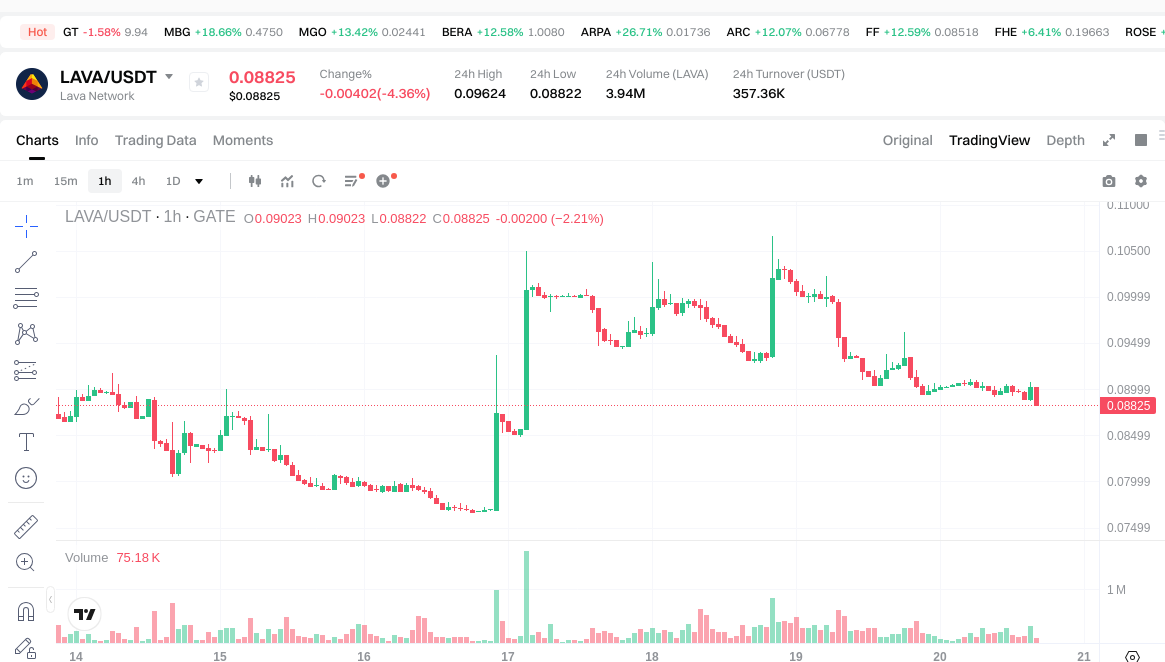
As of January 20, 2026, Lava Network (LAVA) has a circulating supply of 437,356,116 tokens, with a total supply of 1,000,000,000 tokens, representing a circulation ratio of approximately 43.74%. The token operates under a fixed supply model with a maximum cap of 1 billion tokens.
Price Volatility
LAVA reached its peak price of $0.26114 on December 7, 2025, driven by increased market activity and broader adoption of its protocol services. The token's lowest recorded price was $0.008 on January 9, 2025, reflecting early-stage market uncertainty and limited liquidity conditions. These price movements illustrate the impact of market sentiment, protocol development milestones, and the evolving demand for blockchain data infrastructure services.
Click to view current LAVA market price
On-Chain Metrics
- Holder Count: Approximately 4,266 addresses hold LAVA tokens, indicating a growing community base participating in the network ecosystem.
Lava Network Ecosystem Applications and Partners
Core Use Cases
Lava Network's ecosystem supports multiple applications:
- Data Access & Infrastructure: Aggregating data providers to route transactions and queries (such as wallet balances) based on provider speed and reliability.
- AI Agent & dApp Support: Coordinating traffic from AI agents, applications, and wallets across multiple blockchains, enabling seamless cross-chain data access.
Strategic Partnerships
Lava Network has established collaborations with NEAR, Starknet, Filecoin, and Axelar, enhancing its technical capabilities and market influence. These chains and applications have paid LAVA stakers and providers to deliver ultra-reliable services.
These partnerships provide a solid foundation for Lava Network's ecosystem expansion.
Controversies and Challenges
Lava Network faces the following challenges:
- Technical Hurdles: Ensuring consistent speed and reliability across aggregated data providers
- Regulatory Risks: Potential regulatory scrutiny as the protocol grows and handles more transaction volume
- Competitive Pressure: Competition from other blockchain infrastructure solutions and data access protocols
These issues have sparked discussion within the community and market, while also driving continuous innovation at Lava Network.
Lava Network's community demonstrates notable activity, with 4,266 holders and growing engagement. The protocol has secured over $3.5 million in revenue, with chains and applications already paying over $1 million to LAVA stakers and providers.
On X platform, related posts and hashtags (such as #LAVA) generate regular engagement.
Protocol milestones and partnership announcements have ignited community enthusiasm.
Sentiment on X shows diverse perspectives:
- Supporters praise Lava Network's infrastructure approach, revenue generation, and multi-chain compatibility, viewing it as essential blockchain infrastructure.
- Critics focus on price volatility and market cap relative to fully diluted valuation.
Recent trends indicate cautious optimism as the protocol demonstrates revenue growth and partnership expansion.
Hot Topics
X users actively discuss Lava Network's data provider coordination mechanisms, staking rewards, and cross-chain infrastructure potential,
showcasing both its transformative capabilities and the challenges in scaling blockchain data access.
- Official Website: Visit Lava Network Official Site for features, use cases, and latest developments.
- White Paper: Lava Network White Paper details its technical architecture, objectives, and vision.
- X Updates: On X platform, Lava Network maintains an active presence at @lavanetxyz,
with posts covering technical upgrades, community activities, and partnership news, generating engagement from the blockchain infrastructure community.
Lava Network Future Roadmap
- Ongoing Development: Enhancing data provider aggregation and routing algorithms, improving transaction speed and reliability
- Ecosystem Goals: Expanding support for additional blockchains and increasing the number of data providers
- Long-term Vision: Becoming the standard infrastructure for blockchain data access and AI agent coordination
How to Participate in Lava Network?
- Purchase Channels: Buy LAVA on Gate.com and other supported exchanges
- Storage Solutions: Use compatible wallets to securely store LAVA tokens
- Participate in Governance: Engage through staking to earn rewards while supporting network reliability
- Build the Ecosystem: Visit developer documentation to integrate Lava Network's infrastructure into your applications
Summary
Lava Network redefines blockchain data access through its innovative protocol, providing aggregated provider services, reliable data routing, and cross-chain compatibility.
Its active community, comprehensive resources, and revenue-generating model distinguish it in the cryptocurrency infrastructure space.
Despite facing regulatory uncertainties and technical scaling challenges, Lava Network's innovative approach and clear development trajectory position it as an important player in the future of decentralized technology.
Whether you're a newcomer or experienced participant, Lava Network merits attention and engagement.
FAQ
What is Crypto LAVA and what problem does it solve?
Crypto LAVA is a decentralized protocol designed to optimize liquidity provision and reduce transaction costs in DeFi. It solves slippage issues and improves capital efficiency for traders and liquidity providers through innovative automated market-making mechanisms.
How can I buy and store LAVA tokens?
Purchase LAVA tokens through major cryptocurrency platforms using fiat or crypto. Store them securely in a non-custodial wallet like MetaMask or hardware wallets for maximum security and control.
What is the tokenomics and total supply of LAVA?
LAVA has a total supply of 1 billion tokens. The tokenomics include allocation for community rewards, development, and ecosystem growth. Token distribution is designed to incentivize network participation and long-term sustainability of the protocol.
Is LAVA safe to invest in and what are the main risks?
LAVA demonstrates strong security with audited smart contracts and transparent tokenomics. Main risks include market volatility, regulatory changes, and liquidity fluctuations. As with all crypto assets, invest only what you can afford to lose.
What blockchain network does LAVA operate on?
LAVA operates on multiple blockchain networks including Ethereum, Polygon, and Arbitrum, enabling cross-chain compatibility and broader accessibility for users across different blockchain ecosystems.
What are the use cases and real-world applications of LAVA?
LAVA powers decentralized RPC infrastructure, enabling developers to access blockchain networks reliably. It facilitates Web3 applications, DeFi protocols, and NFT platforms by providing scalable node services. LAVA also supports cross-chain communication and serves as infrastructure for emerging metaverse applications.
* The information is not intended to be and does not constitute financial advice or any other recommendation of any sort offered or endorsed by Gate.