This comprehensive guide explores LEVER and LeverFi, a decentralized finance platform addressing DeFi accessibility and leveraged trading efficiency since 2022. The article covers LeverFi's blockchain-based architecture, security mechanisms, and technical infrastructure across EVM Layer 1 networks including Avalanche and Arbitrum. It examines LEVER's market performance, circulating supply of 34.99 billion tokens, and recent price volatility, alongside on-chain metrics and trading data. The guide details core use cases in leveraged yield farming and asset management, community engagement with over 8,647 token holders, and strategic partnerships. Additionally, it addresses leverage trading fundamentals, risk management strategies, liquidation mechanisms, and how to participate through Gate exchanges. Whether you're exploring DeFi opportunities or understanding leveraged strategies, this resource provides essential insights for navigating the LEVER ecosystem.
LeverFi's Position and Significance
In 2022, the LeverFi team launched LeverFi (LEVER), aiming to address challenges in DeFi accessibility and leveraged trading efficiency.
As a DeFi lending and leveraged trading platform, LeverFi plays a key role in decentralized finance and asset management.
As of 2026, LeverFi continues to develop within the DeFi ecosystem, maintaining presence on multiple exchanges and serving a community of holders.
This article will provide an in-depth analysis of its technical architecture, market performance, and future potential.
Origin and Development History
Birth Background
LeverFi was created by the LeverFi team in 2022, aiming to solve inefficiencies in DeFi lending and the complexity of leveraged trading platforms.
It emerged during the expansion of DeFi infrastructure and the need for more intuitive asset management tools, with the goal of providing seamless integration with basic DeFi protocols through a powerful and user-friendly platform.
LeverFi's launch brought new possibilities for DeFi users seeking leveraged exposure and efficient asset management.
Important Milestones
- 2022: Platform launched following the rebranding from RAMP DeFi to LeverFi, with token conversion at a ratio of 1 RAMP = 35 LEVER.
- 2022: Listed on Gate.com and other exchanges, establishing initial market presence.
- Development phase: Focused on deployment across high-speed, low-fee EVM Layer 1 networks including Avalanche and Arbitrum.
- Ongoing: Building community engagement and expanding the DeFi integration ecosystem.
With the support of its community and development team, LeverFi continues to refine its technology, security features, and real-world applications.
How LeverFi Works?
No Central Control
LeverFi operates on decentralized blockchain networks distributed globally, independent of traditional banking or governmental control.
These networks collaboratively process transactions, ensuring system transparency and attack resistance, granting users greater autonomy and enhancing network resilience.
Blockchain Core
LeverFi's platform leverages blockchain technology as a public, immutable digital ledger that records all transactions.
Transactions are grouped into blocks and linked through cryptographic hashes to form a secure chain.
Anyone can view the records, establishing trust without intermediaries.
The platform is designed to operate on high-speed, low-fee EVM-compatible Layer 1 blockchains, enhancing performance and reducing transaction costs.
Ensuring Security
LeverFi relies on the underlying consensus mechanisms of its host blockchains, such as Proof of Stake (PoS), to validate transactions and prevent fraudulent activities like double-spending.
Validators maintain network security through staking and running nodes, receiving rewards for their participation.
The platform's architecture emphasizes efficiency and seamless integration with existing DeFi protocols.
Secure Transactions
LeverFi utilizes public-private key cryptography to protect transactions:
- Private keys (similar to secret passwords) are used to sign transactions
- Public keys (similar to account numbers) are used to verify ownership
This mechanism ensures fund security while maintaining transaction pseudonymity.
The platform integrates with secure wallet infrastructure to protect user assets during leveraged trading and lending activities.
Circulation Overview
As of February 6, 2026, LEVER has a circulating supply of 34,999,246,619 tokens, with a total supply of 42,000,000,000 tokens and a maximum supply of 55,786,500,000 tokens. The circulating supply represents approximately 62.74% of the total supply.
LEVER tokens entered the market through a brand upgrade and conversion mechanism, where RAMP (Ramp DeFi) tokens were exchanged at a ratio of 1 RAMP = 35 LEVER for eligible users. This conversion process significantly influenced the initial supply dynamics of the token.
Price Fluctuations
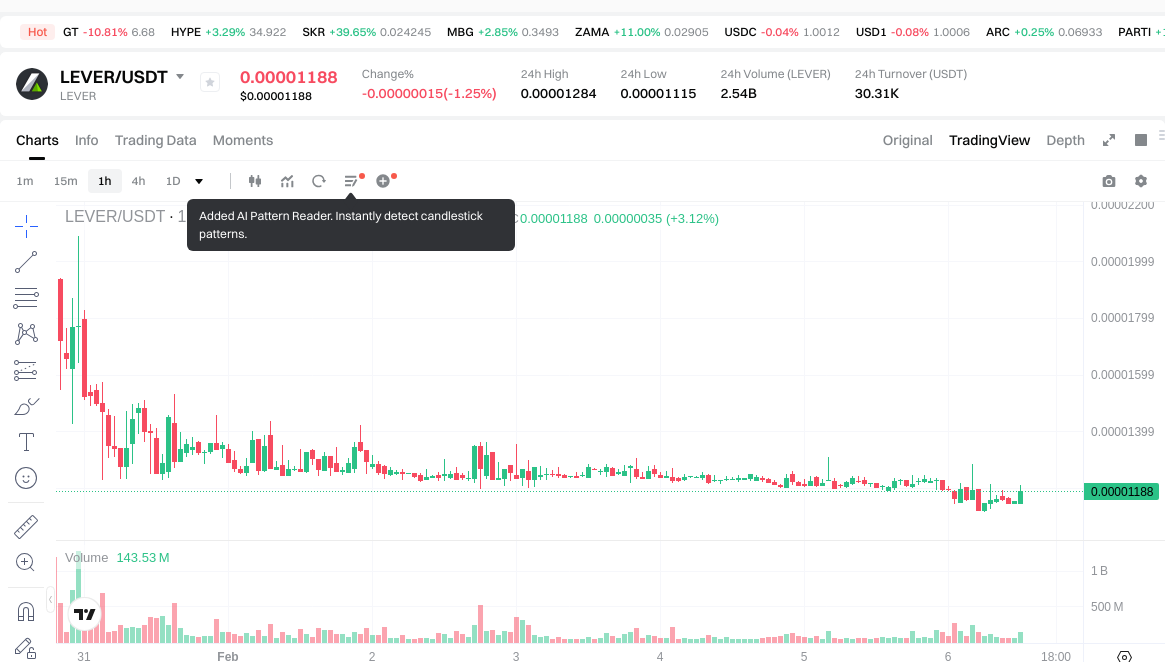
LEVER reached an all-time high of $0.00521513 on July 16, 2022, during a period of heightened interest in DeFi platforms and leveraged yield farming solutions.
The token recorded its lowest price of $0.00001124 on February 6, 2026, reflecting broader market conditions and potential shifts in investor sentiment toward DeFi protocols.
Recent price movements show:
- 1-hour change: -0.045%
- 24-hour change: -5.59%
- 7-day change: -4.97%
- 30-day change: -37.3%
- 1-year change: -99.039%
These fluctuations demonstrate the volatile nature of the token's price action, influenced by market sentiment, adoption trends, and broader cryptocurrency market dynamics.
Click to view the current LEVER market price
On-Chain Metrics
- Token Holders: 8,647 addresses (indicating the distribution of token ownership across the network)
- 24-hour Trading Volume: $29,340.45 (reflecting current market activity and liquidity)
- Market Capitalization: $401,791.35 (representing the total value of circulating tokens)
- Fully Diluted Market Cap: $482,160.00 (projecting the market cap if all tokens were in circulation)
LEVER Ecosystem Applications and Partners
Core Use Cases
LEVER's ecosystem supports multiple applications:
- DeFi: LeverFi platform provides leveraged yield farming and liquidity provision, enabling users to maximize returns through capital-efficient strategies.
- Asset Management: The platform integrates with basic DeFi protocols, offering seamless cross-protocol interactions for portfolio optimization.
Strategic Partnerships
LEVER operates on high-speed, low-fee EVM Layer 1 networks including Avalanche and Arbitrum, leveraging their robust communities and technical infrastructure.
These partnerships provide a solid foundation for LEVER's ecosystem expansion.
Controversies and Challenges
LEVER faces the following challenges:
- Technical Issues: Transitioning from the RAMP DeFi brand and token migration (1 RAMP = 35 LEVER conversion) required extensive coordination
- Market Volatility: The token has experienced notable price fluctuations, with significant decline from historical peaks
- Competitive Pressure: Other leveraged DeFi platforms continue to emerge, intensifying competition in the sector
These issues have sparked community and market discussions, also driving LEVER's continuous innovation.
Fan Enthusiasm
LEVER's community shows active engagement, with over 8,647 token holders participating in the ecosystem.
On X platform, related posts and hashtags (such as #LEVER) generate regular discussions within the DeFi community.
Platform developments and protocol updates ignite community enthusiasm.
Sentiment on X presents diverse perspectives:
- Supporters praise LEVER's capital efficiency and DeFi integration capabilities, recognizing it as a valuable tool for yield optimization.
- Critics focus on price volatility and market performance challenges.
Recent trends reflect mixed sentiment as the project navigates market conditions.
Hot Topics
X users actively discuss LEVER's brand transformation from RAMP DeFi, tokenomics changes, and platform utility,
showcasing both its innovative potential and the challenges in achieving broader adoption.
- Official Website: Visit LEVER Official Website to learn about features, use cases, and latest developments.
- Documentation: LEVER Documentation details its technical architecture, objectives, and vision.
- X Updates: On X platform, LEVER maintains an active presence through @LeverFi,
with posts covering technical upgrades, community activities, and ecosystem developments, generating engagement from the DeFi community.
LEVER Future Roadmap
- Ongoing Development: Enhancement of platform features and cross-chain capabilities, improving transaction efficiency and user experience
- Ecosystem Goals: Expand integration with additional DeFi protocols and Layer 1 networks
- Long-term Vision: Establish LEVER as a leading platform for leveraged DeFi strategies
How to Participate in LEVER?
- Purchase Channels: Buy LEVER on Gate.com and other supported exchanges
- Storage Solutions: Securely store LEVER using compatible wallets such as MetaMask for Ethereum-based assets
- Participate in Ecosystem: Engage with LeverFi platform to access leveraged yield farming opportunities
- Build Ecosystem: Visit developer documentation to contribute to platform development
Summary
LEVER, through its DeFi-focused platform, redefines leveraged yield strategies, offering capital efficiency, protocol integration, and flexible farming options.
Its engaged community, comprehensive resources, and platform capabilities position it within the DeFi landscape.
Despite facing market volatility and competitive challenges, LEVER's focus on asset management innovation and clear development direction establish its role in decentralized finance.
Whether you're new to DeFi or an experienced participant, LEVER presents opportunities worth exploring.
FAQ
What is Crypto Leverage Trading?
Crypto leverage trading allows you to borrow funds to trade cryptocurrencies, amplifying both potential profits and losses. By using leverage (e.g., 10x), you control larger positions with smaller initial capital. However, adverse price movements can trigger forced liquidation if your margin falls below required thresholds.
What is the basic principle and mechanism of leverage trading?
Leverage trading amplifies investment returns by borrowing funds. Traders deposit margin to control larger contract amounts. For example, 10x leverage lets you control $10,000 with $1,000 capital. While this magnifies potential profits, it equally amplifies losses, risking principal beyond initial investment.
How to use leverage function on crypto exchanges?
Deposit collateral to your account, select your desired leverage ratio, and execute trades. Leverage amplifies potential profits but also increases risks proportionally to the multiplier chosen.
What are the risks of leverage trading and how to manage them?
Leverage trading risks include amplified losses from market volatility. Manage risk by setting stop-loss and limit orders, following a strict trading plan, monitoring open positions, and understanding market conditions thoroughly.
What does liquidation mean in leverage trading, and how to avoid liquidation?
Liquidation occurs when market fluctuations reduce account margin below maintenance levels, forcing automatic position closure. To avoid it: use lower leverage ratios (2-3x for beginners), set stop-loss orders, control position sizes, and maintain rational trading discipline. Diversify investments and monitor market risks consistently.
What is the difference between leveraged trading and spot trading?
Spot trading involves buying and selling crypto assets directly with your own funds. Leveraged trading allows you to borrow funds to amplify your trading position, increasing potential profits but also amplifying losses and liquidation risks significantly.
What is the impact of different leverage multiples (2x, 5x, 10x, etc.) on returns and risks?
Higher leverage multiples amplify both profits and losses significantly. A 2x leverage doubles gains but also doubles losses, while 10x leverage magnifies returns tenfold but increases liquidation risk substantially. Greater leverage means smaller price movements can trigger larger account fluctuations and potential margin calls.
* The information is not intended to be and does not constitute financial advice or any other recommendation of any sort offered or endorsed by Gate.