Chainlink (LINK) is a decentralized oracle network solving blockchain's inability to access real-world data and external systems. Launched in 2017 by Sergey Nazarov and Steve Ellis, Chainlink serves as a critical infrastructure layer for DeFi, insurance, gaming, and enterprise applications. This comprehensive guide explores Chainlink's technical architecture utilizing globally distributed node operators, market performance with a $9.36 billion market cap, and its ecosystem partnerships with protocols like Aave and Synthetix. The article covers LINK token economics, security mechanisms including reputation-based consensus and cryptographic verification, current market dynamics, and future roadmap including Cross-Chain Interoperability Protocol (CCIP). Whether you're a developer, investor, or blockchain enthusiast, this guide provides essential insights into Chainlink's role as the standard oracle infrastructure connecting decentralized networks to external data sources securely and transparently.
Chainlink's Positioning and Significance
In 2017, Sergey Nazarov and Steve Ellis launched Chainlink (LINK), aiming to address the inability of smart contracts to access real-world data and connect with external systems.
As the pioneering decentralized oracle network, Chainlink plays a critical role in DeFi, insurance, gaming, and enterprise blockchain applications.
As of 2026, Chainlink has established itself as a top-20 cryptocurrency by market capitalization, with over 120,000 holders and an active developer ecosystem.
This article will provide an in-depth analysis of its technical architecture, market performance, and future potential.
Origin and Development History
Birth Background
Chainlink was created by Sergey Nazarov and Steve Ellis in 2017, aiming to solve the oracle problem—the inability of blockchain smart contracts to securely access off-chain data.
It emerged during the smart contract and DeFi innovation wave, with the goal of enabling smart contracts to interact with real-world data, APIs, and payment systems to transform the blockchain ecosystem.
Chainlink's launch brought entirely new possibilities for developers building decentralized applications and enterprises seeking blockchain integration.
Major Milestones
- 2017: Mainnet launch with initial implementation of decentralized oracle functionality for data retrieval.
- 2019: Introduction of verifiable randomness (VRF) enabling provably fair outcomes for gaming and NFT applications.
- 2020: Adoption accelerated across DeFi protocols, driving ecosystem expansion with hundreds of integrations.
- 2021: Price breakthrough reaching historical levels as institutional adoption and cross-chain expansion gained momentum.
- 2023-2024: Launch of Cross-Chain Interoperability Protocol (CCIP) and Chainlink Functions, expanding capabilities beyond oracle services.
With support from the Chainlink Foundation, developer community, and enterprise partners, Chainlink continues to enhance its technology, security, and real-world applications.
How Chainlink Works
No Central Control
Chainlink operates on a decentralized network of independent node operators distributed globally, eliminating reliance on centralized data providers or single points of failure.
These nodes collaboratively retrieve, validate, and deliver data to smart contracts, ensuring transparency and attack resistance while granting users greater autonomy and enhancing network resilience.
Blockchain Core
Chainlink functions as a decentralized middleware layer connecting blockchains to external data sources, APIs, and payment systems.
It utilizes a network of oracle nodes that fetch off-chain information and deliver it on-chain through cryptographically secured mechanisms.
All data transmissions are recorded and verifiable, establishing trust without intermediaries.
Its architecture includes reputation systems and economic incentives to ensure data accuracy and node reliability.
Ensuring Fairness
Chainlink employs a reputation-based consensus mechanism combined with economic incentives to validate data accuracy and prevent manipulation.
Node operators stake LINK tokens and earn rewards for providing accurate data and maintaining uptime, while facing penalties for malicious behavior or poor performance.
Its innovations include cryptographic proof systems and decentralized computation to enhance data integrity.
Secure Transactions
Chainlink uses cryptographic signatures and on-chain verification to protect data delivery:
- Node operators sign data with private keys before transmission
- Smart contracts verify authenticity using cryptographic proofs and aggregated responses
This mechanism ensures data reliability while maintaining transparency and auditability throughout the oracle process.
Additional security features include multi-layered aggregation from multiple independent sources and threshold signatures to prevent single points of compromise.
Circulating Supply Overview
As of January 13, 2026, ChainLink's circulating supply stands at 708,099,970.45 LINK tokens, with a total supply of 1,000,000,000 tokens. The token follows a fixed supply model with a maximum cap of 1 billion tokens. LINK tokens are ERC20 standardized tokens based on the Ethereum blockchain, used to compensate Chainlink node operators for retrieving off-chain data, formatting data into blockchain-readable formats, performing off-chain computations, and ensuring network uptime. The circulating supply represents approximately 70.81% of the total supply, indicating a substantial portion of tokens are already in circulation.
Price Fluctuations
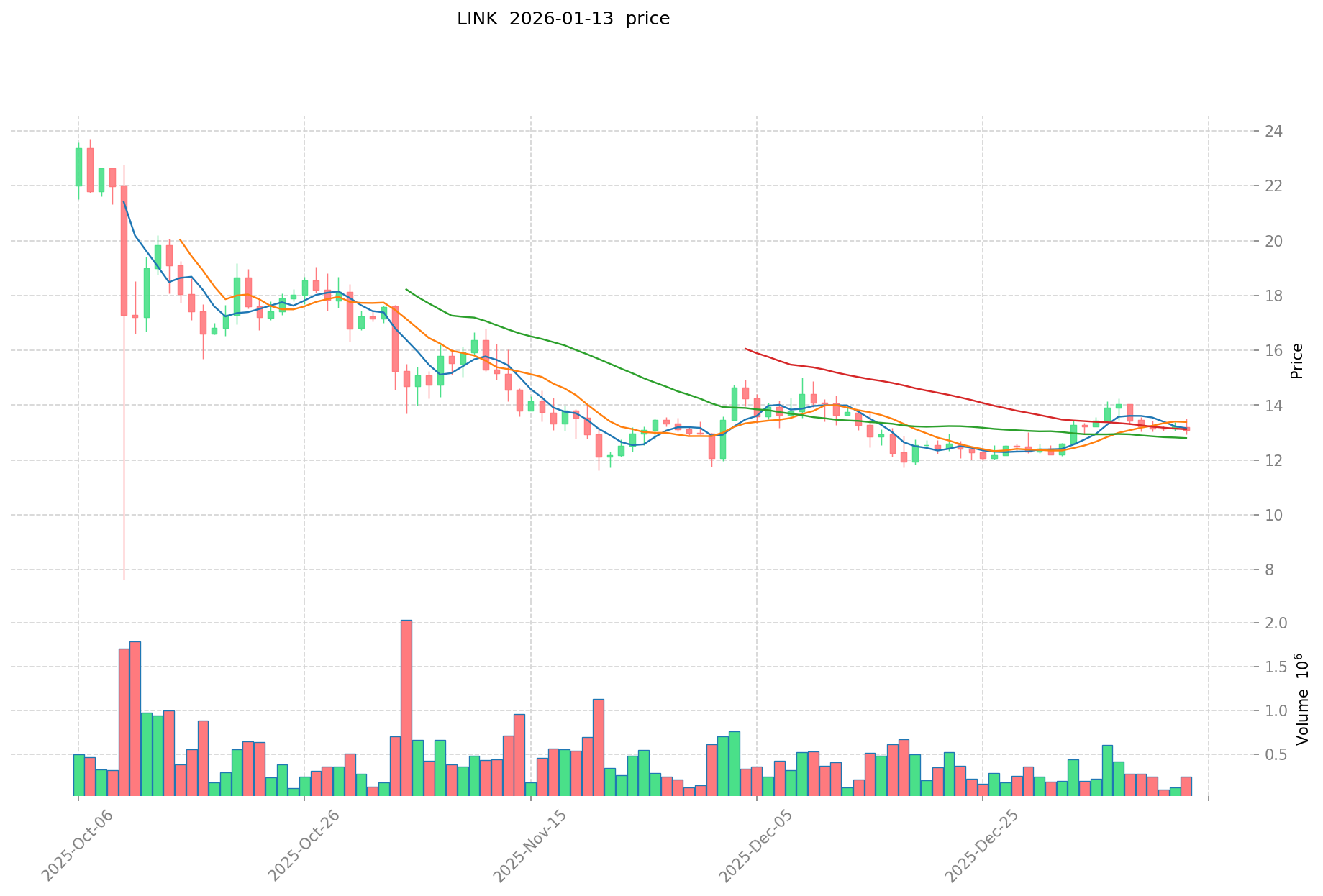
ChainLink reached its historical peak price of $52.70 on May 10, 2021, during a period of significant market momentum in the broader cryptocurrency ecosystem. The token's lowest recorded price was $0.148183 on November 29, 2017, during its early market phase. As of January 13, 2026, LINK is trading at $13.219, reflecting various market dynamics and adoption trends.
Recent price movements show:
- 1-hour change: -0.01% (-$0.0013)
- 24-hour change: -0.6% (-$0.08)
- 7-day change: -3.73% (-$0.51)
- 30-day change: -3.67% (-$0.50)
- 1-year change: -33.47% (-$6.65)
The 24-hour trading range spans from a low of $12.927 to a high of $13.33, demonstrating ongoing price volatility influenced by market sentiment and trading activity.
Click to view current LINK market price
On-Chain Metrics
- Market Capitalization: $9.36 billion, ranking 17th among cryptocurrencies
- Fully Diluted Valuation: $13.22 billion
- 24-hour Trading Volume: Approximately $2.59 million
- Token Holders: 120,837 addresses (reflecting user participation and network adoption)
- Market Dominance: 0.40% of the total cryptocurrency market
- Market Cap to FDV Ratio: 70.81% (indicating the relationship between current market cap and fully diluted valuation)
- Exchange Availability: Listed on 72 cryptocurrency exchanges
ChainLink Ecosystem Applications and Partners
Core Use Cases
ChainLink's ecosystem supports multiple applications:
- DeFi: Projects like Aave and Synthetix utilize Chainlink's oracle services to provide reliable price feeds and secure data delivery for decentralized financial protocols.
- Smart Contract Enhancement: Various blockchain platforms integrate Chainlink oracles, enabling smart contracts to access off-chain data and execute complex automated agreements.
Strategic Partnerships
ChainLink has established collaborations with partners in the blockchain industry, enhancing its technical capabilities and market influence.
These partnerships provide a solid foundation for ChainLink's ecosystem expansion.
Challenges and Controversies
ChainLink faces the following challenges:
- Technical Hurdles: Ensuring data accuracy and oracle reliability across diverse blockchain networks
- Competition Pressure: Other oracle solutions and blockchain platforms continue to emerge in the decentralized data space
These issues have sparked discussions within the community and markets, while also driving ChainLink's continuous innovation.
ChainLink's community demonstrates considerable activity, with over 120,000 token holders as of January 2026.
On X platform, related posts and hashtags (such as #Chainlink and #LINK) frequently trend, generating substantial engagement.
Technical developments and partnership announcements consistently energize the community.
Sentiment on X shows diverse perspectives:
- Supporters praise ChainLink's oracle infrastructure, decentralization features, and real-world integration capabilities, considering it essential for connecting blockchain networks with external data sources.
- Critics focus on price volatility and market performance concerns.
Recent trends indicate mixed sentiment as the token experiences price fluctuations.
Hot Topics
X users actively discuss ChainLink's oracle technology advancements, cross-chain integration, and market positioning,
showcasing both its transformative potential and the challenges in widespread adoption.
- Official Website: Visit ChainLink Official Site for features, use cases, and latest developments.
- X Activity: On X platform, ChainLink maintains an active presence through @chainlink,
with posts covering technical upgrades, community events, and partnership announcements, generating significant engagement.
ChainLink Future Roadmap
- Ongoing Development: Continuous enhancement of oracle network capabilities and cross-chain interoperability
- Ecosystem Goals: Expanding integration with blockchain platforms and DApps requiring reliable external data
- Long-term Vision: Becoming the standard oracle infrastructure for smart contract ecosystems
How to Participate in ChainLink?
- Purchase Channels: Acquire LINK on Gate.com and other platforms
- Storage Solutions: Use compatible wallets like MetaMask or hardware wallets for secure storage
- Ecosystem Building: Visit developer documentation to integrate Chainlink oracles into your projects
Summary
ChainLink redefines how blockchain networks access external data through its decentralized oracle technology, providing transparency, security, and reliable data delivery.
Its active community, rich resources, and solid market position make it distinctive in the cryptocurrency field.
Despite facing competition and technical challenges, ChainLink's innovative approach and clear development direction position it as an important component in the future of decentralized technology.
Whether you are a newcomer or experienced participant, ChainLink merits attention and engagement.
FAQ
What is Chainlink (LINK) and how does it work?
Chainlink (LINK) is a decentralized oracle network connecting smart contracts to real-world data. It bridges blockchain and external information sources securely. LINK tokens reward oracle operators and secure the network through staking mechanisms.
What are the main use cases of LINK tokens?
LINK tokens serve as collateral for Chainlink node operators and incentivize data provision in oracle networks. They secure smart contracts by ensuring accurate, tamper-proof data feeds across blockchains.
How can I buy and store LINK tokens?
Purchase LINK tokens on cryptocurrency exchanges, then transfer them to a secure wallet like MetaMask or hardware wallets for long-term storage. Always enable strong security measures and never share your private keys.
What is the difference between Chainlink and other oracle solutions?
Chainlink is a decentralized oracle network offering broad real-world data sources with strong reliability and security. Unlike centralized alternatives, Chainlink uses a decentralized network to ensure data integrity and prevent single points of failure.
Is Chainlink secure and what are the potential risks?
Chainlink employs robust cryptographic security and decentralized oracle networks to ensure data integrity. Main risks include oracle manipulation, network centralization, and smart contract vulnerabilities. However, continuous security audits and community oversight mitigate these concerns significantly.
What is the future potential and roadmap of Chainlink?
Chainlink's decentralized oracle network has strong long-term potential. LINK could reach $35-$50 by 2025 and potentially $100 by 2030, driven by expanding DeFi adoption, growing partnerships, and increased demand for secure real-world data integration in blockchain applications.
* The information is not intended to be and does not constitute financial advice or any other recommendation of any sort offered or endorsed by Gate.