This comprehensive guide explores Livepeer (LPT), a decentralized video transcoding protocol built on Ethereum that revolutionizes video streaming infrastructure. Launched in 2018, Livepeer eliminates inefficiencies and high costs of traditional centralized platforms by leveraging blockchain technology and Proof-of-Stake mechanisms. The article covers LPT's technical architecture, including how orchestrators and transcoders secure the network through token staking, market performance metrics, and ecosystem applications. With over 2.17 million token holders and a circulating supply of 48.7 million LPT, the protocol demonstrates significant adoption in decentralized media. Discover how to purchase LPT on Gate.com, participate in network governance, and understand the opportunities and challenges facing this innovative decentralized video infrastructure solution.
Livepeer's Position and Significance
In 2018, the Livepeer team launched Livepeer (LPT), aiming to address inefficiencies and high costs in traditional video streaming infrastructure.
As a decentralized video transcoding network built on Ethereum, Livepeer plays a key role in the Web3 media and content streaming sector.
As of 2026, Livepeer has established itself as a leading decentralized video infrastructure protocol, with over 2.17 million token holders and an active developer community.
This article provides an in-depth analysis of its technical architecture, market performance, and future potential.
Origin and Development History
Birth Background
Livepeer was created by its founding team in 2018, aiming to solve the centralized control, high costs, and scalability limitations of traditional video streaming platforms.
It emerged during the blockchain technology expansion period, with the goal of providing affordable, censorship-resistant video transcoding services through decentralized infrastructure.
Livepeer's launch brought new possibilities to content creators, developers, and streaming service providers.
Key Milestones
- 2018: Mainnet launch on Ethereum, implementing decentralized video transcoding protocol.
- Recent years: Ecosystem expansion with integration into various video streaming applications and platforms.
- Ongoing: Continuous protocol upgrades improving transcoding efficiency and network participation mechanisms.
With support from the Livepeer community and ecosystem contributors, Livepeer continues to optimize its technology, security, and real-world applications.
How Livepeer Works
Decentralized Control
Livepeer operates on a decentralized network of computers (nodes) distributed globally, eliminating reliance on centralized video platforms or corporations.
These nodes collaborate to process video transcoding tasks, ensuring the system remains transparent and resistant to single points of failure, granting users greater autonomy and enhancing network resilience.
Blockchain Foundation
Livepeer's protocol is built on the Ethereum blockchain, utilizing a public, immutable digital ledger to record network activities and token transactions.
Transactions are grouped into blocks and linked through cryptographic hashing to form a secure chain.
Anyone can verify records without intermediaries, establishing trust through transparency.
The protocol leverages Ethereum's smart contract capabilities to coordinate transcoding work and reward distribution.
Ensuring Fairness
Livepeer employs a delegated Proof-of-Stake (DPoS) mechanism to validate work and maintain network integrity.
Orchestrators and transcoders secure the network by staking LPT tokens and performing video transcoding tasks, earning LPT rewards and fees from users.
The system's innovation includes efficient work verification and proportional reward distribution based on stake and performance.
Secure Participation
Livepeer uses cryptographic mechanisms to protect the network:
- Private keys (like secret passwords) are used by orchestrators to sign work claims
- Public addresses (like account numbers) are used to verify stake ownership and receive rewards
This structure ensures network security while maintaining transparency in work verification and reward distribution.
Token holders can delegate their LPT to orchestrators, participating in network security without running infrastructure themselves.
Circulation Overview
As of January 16, 2026, Livepeer (LPT) has a circulating supply of 48,777,745.23 tokens, with a total supply of 48,777,745.23 tokens, following an inflationary model with no maximum supply cap. New tokens enter the market through daily issuance rewards distributed to token holders who bond their LPT to transcoders performing video transcoding work on the network, influencing its supply and demand dynamics.
Price Fluctuations
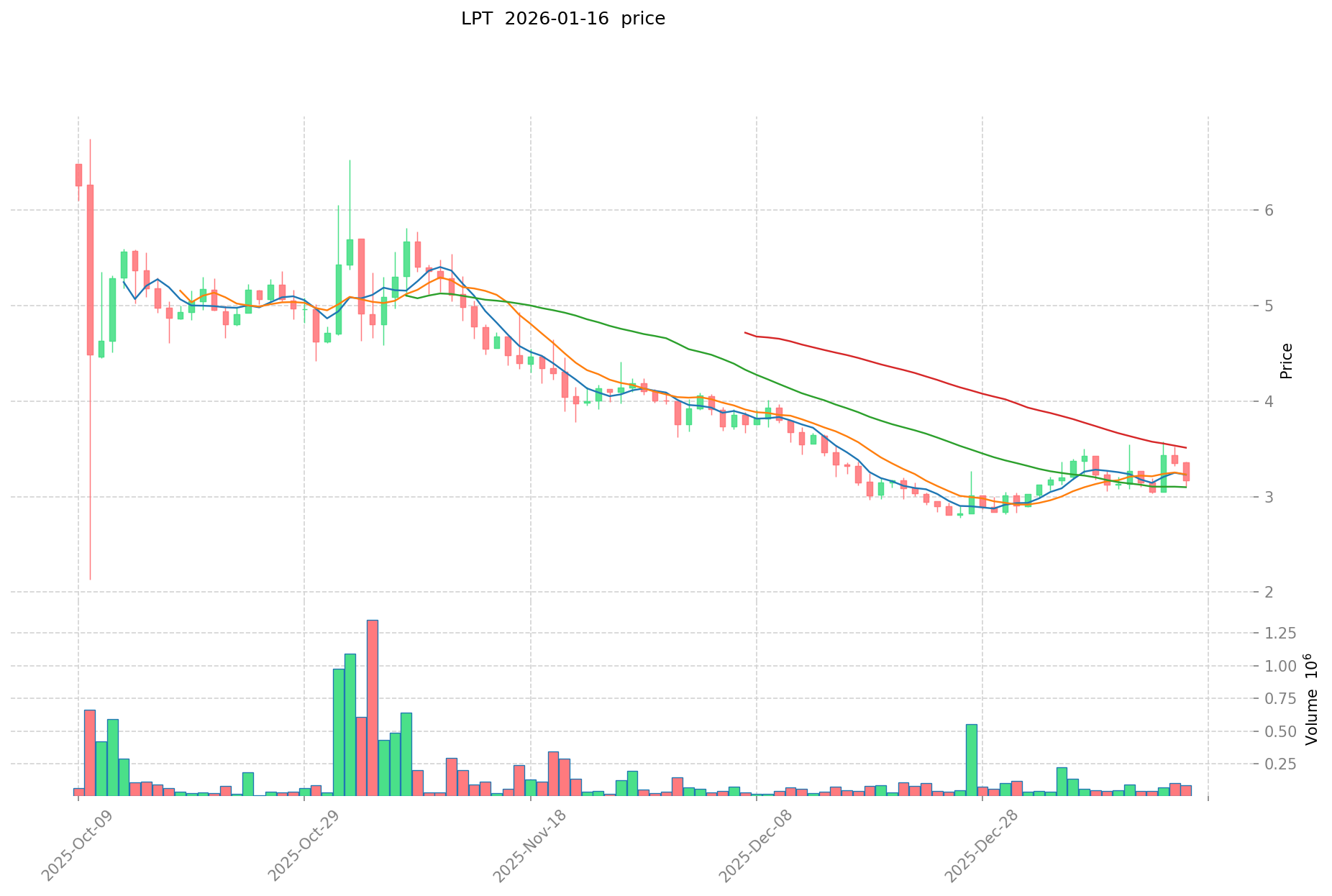
Livepeer (LPT) reached its peak price of $99.03 on November 10, 2021, driven by broader cryptocurrency market momentum and increased adoption of decentralized video streaming solutions. Its lowest recorded price was $0.354051 on October 27, 2019, during the early stages of the project's development and lower market awareness. As of the latest data, LPT trades at $3.257, showing recent price movements of +0.65% (1H), -1.48% (24H), +4.39% (7D), +0.12% (30D), and -78.59% (1Y). These fluctuations reflect market sentiment shifts, adoption trends, and external factors affecting the broader digital asset ecosystem.
Click to view current LPT market price
On-Chain Metrics
- 24-Hour Trading Volume: $221,520.40 (indicating current market activity levels)
- Token Holders: Approximately 2,171,171 addresses (reflecting widespread distribution and user participation)
- Market Capitalization: $158,869,116.23 (representing the project's overall market valuation)
Livepeer Ecosystem Applications and Partners
Core Use Cases
Livepeer's ecosystem supports various applications:
- Video Streaming: Livepeer network enables decentralized video transcoding, providing cost-effective live streaming infrastructure for content creators and platforms.
- Developer Tools: The protocol offers open-source tools for developers to build video applications, promoting innovation in decentralized media services.
Strategic Partnerships
Livepeer operates as an open-source protocol with a focus on community-driven development.
These collaborative efforts provide a solid foundation for Livepeer's ecosystem expansion.
Challenges and Considerations
Livepeer faces the following considerations:
- Technical Evolution: Ongoing optimization of transcoding efficiency and network scalability
- Market Competition: The presence of established centralized video infrastructure providers
- Adoption Barriers: Education and onboarding requirements for decentralized video solutions
These aspects generate discussions within the community and drive continuous innovation for Livepeer.
Livepeer's community shows consistent activity, with the token held across multiple wallets.
On X platform, related posts and hashtags (such as #Livepeer and #LPT) generate regular engagement.
Network developments and protocol updates often spark community interest.
Sentiment on X presents diverse perspectives:
- Supporters highlight Livepeer's decentralized infrastructure and open-source nature, recognizing it as an innovative solution for video streaming.
- Analysts discuss market performance, tokenomics, and competitive landscape.
Recent trends show community focus on protocol developments and ecosystem growth.
Trending Topics
X users discuss Livepeer's decentralized transcoding model, token utility, and infrastructure scalability,
showcasing both its technological potential and the path toward broader adoption.
- Official Website: Visit Livepeer Official Site for features, use cases, and latest updates.
- White Paper: Livepeer White Paper details its technical architecture, objectives, and vision.
- X Updates: On X platform, Livepeer maintains an active presence using @Livepeer,
with posts covering protocol updates, community activities, and ecosystem news, generating community engagement.
Livepeer Future Roadmap
- Ongoing Development: Enhancement of network efficiency and transcoding capabilities, improving performance and reliability
- Ecosystem Goals: Expanding adoption among content creators and streaming platforms
- Long-term Vision: Becoming a foundational infrastructure for decentralized video services
How to Participate in Livepeer?
- Purchase Channels: Acquire LPT on Gate.com and other supported exchanges
- Storage Solutions: Store securely using Ethereum-compatible wallets such as MetaMask or hardware wallets
- Network Participation: Explore bonding tokens to transcoders to earn rewards
- Ecosystem Building: Visit Livepeer GitHub repositories to contribute to development or build applications
Summary
Livepeer redefines video streaming infrastructure through blockchain technology, offering decentralized transcoding, cost efficiency, and open-source accessibility.
Its community-driven approach, technical resources, and market presence distinguish it in the cryptocurrency landscape.
While facing considerations such as adoption challenges and market competition, Livepeer's innovative protocol and development trajectory position it as a notable player in decentralized media technology.
Whether you are a newcomer or an experienced participant, Livepeer presents opportunities for engagement and observation.
FAQ
What is LPT (Livepeer Token)? What are its main functions?
LPT is the native protocol token of the Livepeer network. It serves three primary functions: network governance allowing token holders to participate in decision-making, incentivizing network participants to provide video transcoding services, and securing the network through delegated proof-of-stake consensus mechanisms.
What role does LPT token play in the Livepeer network? How is it different from other cryptocurrencies?
LPT incentivizes network participants to provide video transcoding and distribution services on Livepeer. Unlike general cryptocurrencies, LPT specifically coordinates and rewards infrastructure providers, ensuring cost-effective and reliable video streaming rather than serving as a general-purpose digital currency.
How to buy and trade LPT? Where can I purchase it?
You can buy and trade LPT on major centralized exchanges with user-friendly interfaces and multiple payment methods. LPT is widely available on leading platforms, offering convenient trading pairs and liquidity for both beginners and experienced traders.
What are the application scenarios of Livepeer? Why is LPT token needed?
Livepeer enables decentralized video streaming processing. Enterprises pay video miners with LPT tokens to handle video transcoding and delivery. LPT incentivizes network participants and reduces video processing costs significantly.
What are the risks of investing in LPT? How is its price volatility and market outlook?
LPT faces market volatility and regulatory risks. However, as video streaming demand grows, Livepeer's transcoding infrastructure shows strong potential. Long-term adoption trends suggest positive market prospects for token holders.
How to store and secure LPT tokens? Which wallets are supported?
LPT is an ERC-20 token compatible with Ethereum wallets like MetaMask and MyEtherWallet. For enhanced security, hardware wallets are recommended to protect your tokens.
* The information is not intended to be and does not constitute financial advice or any other recommendation of any sort offered or endorsed by Gate.