This comprehensive guide explores Liquity (LQTY), the governance token powering a revolutionary decentralized lending protocol that eliminates borrowing interest fees. As of 2026, Liquity has grown into a significant DeFi player with over 14,304 token holders, offering interest-free loans against ETH collateral through its LUSD stablecoin. The article addresses key questions for DeFi participants: how Liquity's blockchain-based architecture ensures security and fairness, LQTY's market performance with circulating supply of 98,029,649.28 tokens, and practical participation methods. Covering technical infrastructure, on-chain metrics, ecosystem integrations with Uniswap on Gate exchange, and community dynamics, this guide equips both newcomers and experienced DeFi users with essential knowledge. Explore LQTY's tokenomics, governance mechanisms, stability pool dynamics, and discover how to purchase, store, and engage with this innovative decentralized finance solution.
Liquity (LQTY)'s Positioning and Significance
In 2021, the Liquity team launched Liquity (LQTY), aiming to address inefficiencies in decentralized borrowing and high interest costs in traditional DeFi lending protocols.
As a decentralized borrowing protocol offering zero-interest loans, Liquity plays a key role in the DeFi lending sector.
As of 2026, Liquity has established itself as an innovative player in the decentralized finance ecosystem, with over 14,304 token holders and an active community of developers and users.
This article will provide an in-depth analysis of its technical architecture, market performance, and future potential.
Origin and Development History
Birth Background
Liquity was created by its founding team in 2021, aiming to solve high interest rates and capital inefficiency in existing DeFi lending platforms.
It emerged during the DeFi boom and growing demand for transparent, efficient lending solutions, with the goal of enabling users to borrow against ETH collateral without paying interest fees.
The launch of Liquity brought DeFi users and ETH holders entirely new possibilities for capital utilization.
Important Milestones
- 2021: Mainnet launch on April 5th, introducing zero-interest borrowing and the LUSD stablecoin.
- 2021: Protocol achieved significant adoption with LQTY token distribution to early stability providers and liquidity miners.
- 2021: Price reached an all-time high of $146.94 in April, reflecting strong market interest.
- 2025: The protocol continued to operate with sustained liquidity provision and ongoing community governance.
With support from the decentralized community and Liquity protocol contributors, LQTY continues to optimize its technical infrastructure, security, and real-world applications.
How Does Liquity Work?
No Central Control
Liquity operates on a decentralized network of computers (nodes) distributed globally, free from control by banks or governments.
These nodes collaborate to validate transactions, ensuring the system remains transparent and attack-resistant, granting users greater autonomy and enhancing network resilience.
Blockchain Core
Liquity's blockchain is built on Ethereum, utilizing a public, immutable digital ledger that records every transaction.
Transactions are grouped into blocks and linked through cryptographic hashes to form a secure chain.
Anyone can view the records, establishing trust without intermediaries.
The protocol leverages Ethereum's smart contract capabilities to automate borrowing and liquidation processes.
Ensuring Fairness
Liquity relies on Ethereum's Proof of Stake (PoS) consensus mechanism to validate transactions and prevent fraudulent activities such as double-spending.
Ethereum validators secure the network through staking ETH and validating blocks, earning rewards in the process.
Liquity's innovation includes eliminating interest rates through one-time borrowing fees and algorithmic stability mechanisms.
Secure Transactions
Liquity uses public-private key cryptography to protect transactions:
- Private keys (like secret passwords) are used to sign transactions
- Public keys (like account numbers) are used to verify ownership
This mechanism ensures fund security while maintaining pseudonymous transaction privacy.
The protocol incorporates additional security features such as minimum collateral ratios and automatic liquidation mechanisms to maintain system stability.
Circulation Overview
As of January 21, 2026, Liquity (LQTY) has a circulating supply of 98,029,649.28 tokens, with a total supply of 100,000,000 tokens operating under a fixed supply model.
New tokens entered the market through the protocol's initial distribution mechanism, which impacts its supply-demand dynamics.
LQTY rewards are distributed to stability providers - users who deposit LUSD into the stability pool, front-end operators who facilitate these deposits, and liquidity providers of the LUSD:ETH Uniswap pool.
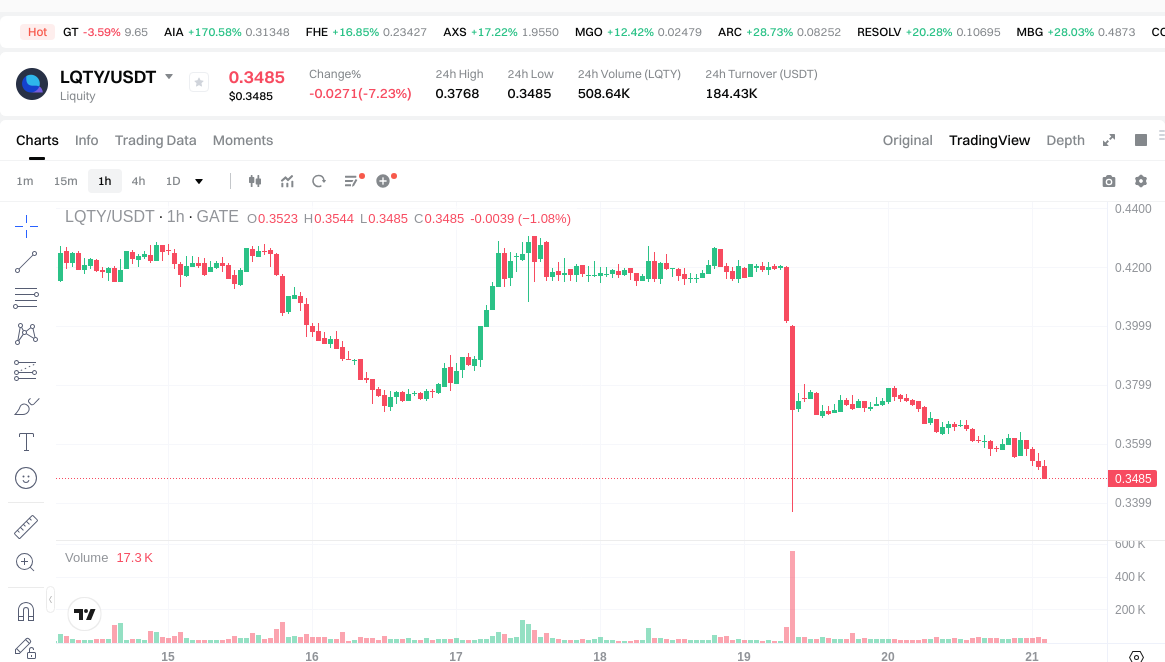
Price Fluctuations
LQTY reached an all-time high of $146.94 on April 6, 2021, driven by strong market momentum during the early adoption phase of the protocol.
Its lowest price was $0.298378, occurring on October 11, 2025, reflecting broader market conditions and sector-specific pressures.
These fluctuations reflect market sentiment, adoption trends, and external factors.
Click to view the current LQTY market price
On-chain Metrics
- Holder Count: 14,304 addresses (indicating network distribution)
- Circulating Supply Ratio: 98.03% (demonstrating high token circulation)
- Market Cap to FDV Ratio: 98.03% (showing minimal unlocked token overhang)
Liquity Ecosystem Applications and Partners
Core Use Cases
Liquity's ecosystem supports multiple applications:
- DeFi: Uniswap, providing decentralized trading functionality for LQTY tokens and LUSD stablecoin pairs.
- Decentralized Lending: Liquity protocol itself enables users to obtain interest-free loans using ETH as collateral, revolutionizing borrowing mechanisms in DeFi.
Strategic Partnerships
Liquity operates as a decentralized protocol with community-driven development. The protocol's integration with Uniswap pools demonstrates its commitment to fostering liquidity and accessibility within the broader Ethereum ecosystem.
Controversies and Challenges
Liquity faces several challenges:
- Technical Challenges: Scalability constraints inherent to the Ethereum network may impact transaction speeds during high network congestion periods.
- Regulatory Risks: The evolving regulatory landscape for DeFi protocols presents ongoing uncertainties that could affect protocol operations.
- Competitive Pressure: Competition from other lending protocols and stablecoin projects on multiple blockchain platforms continues to intensify.
These issues have sparked discussions within the community and driven continuous protocol optimization efforts.
Liquity's community demonstrates strong engagement, with the protocol serving approximately 14,304 token holders as of January 21, 2026. The LQTY token maintains active trading across 32 exchanges, reflecting broad market participation.
Sentiment on X platform shows mixed perspectives:
- Supporters praise Liquity's interest-free borrowing model, decentralization, and capital efficiency, viewing it as an innovative solution in DeFi lending.
- Critics focus on token price volatility and market dynamics, with LQTY experiencing a 6.33% decline in the past 24 hours and a 17.03% decrease over the past week.
Recent trends indicate heightened attention to the protocol's stability mechanism and LQTY token utility.
Popular Topics
X platform users actively discuss Liquity's tokenomics, governance mechanisms, and stability pool dynamics, highlighting both the protocol's technical innovations and areas for potential improvement.
- Official Website: Visit Liquity Official Website for features, use cases, and latest developments.
- X Updates: On X platform, Liquity maintains an active presence through @LiquityProtocol, sharing updates on protocol improvements, community initiatives, and ecosystem developments.
- GitHub Repository: Liquity GitHub provides access to the protocol's open-source code and technical documentation.
- Blockchain Explorer: Track LQTY token transactions on Etherscan.
Liquity Future Roadmap
- Protocol Evolution: Continued optimization of the stability pool mechanism and frontend operator incentives to enhance user experience.
- Ecosystem Goals: Expanding integrations with additional DeFi protocols and strengthening the LUSD stablecoin utility across the Ethereum ecosystem.
- Long-term Vision: Establishing Liquity as a foundational infrastructure for decentralized, interest-free lending solutions.
How to Participate in Liquity?
- Purchase Channels: Acquire LQTY tokens on Gate.com and other major cryptocurrency exchanges.
- Storage Solutions: Securely store LQTY using Ethereum-compatible wallets such as MetaMask or hardware wallets.
- Participate in the Protocol: Deposit LUSD into the Stability Pool to earn LQTY rewards and contribute to protocol stability.
- Build the Ecosystem: Visit the Liquity GitHub repository to explore development opportunities and contribute to the protocol's evolution.
Summary
Liquity has redefined decentralized lending through blockchain technology, offering interest-free borrowing, capital efficiency, and true decentralization. Its engaged community, transparent governance, and innovative stability mechanisms distinguish it within the DeFi space. Despite facing market volatility and competitive pressures, Liquity's commitment to protocol integrity and user-centric design positions it as a valuable component of decentralized finance infrastructure. Whether you are new to DeFi or an experienced participant, Liquity presents compelling opportunities for engagement and exploration.
FAQ
What is LQTY token and what is its main purpose in the Liquity protocol?
LQTY is the governance token of Liquity protocol. It enables holders to participate in protocol governance, earn stability fees, and have voting rights on key decisions. LQTY also incentivizes liquidity provision and protocol participation through rewards distribution.
How does LQTY work and what are the benefits of holding LQTY?
LQTY is the governance token of Liquity protocol. Holders earn protocol fees from stability operations and participate in decentralized governance decisions. Benefits include fee sharing, voting rights on protocol upgrades, and staking rewards from liquidation gains and borrowing interests.
Where can I buy LQTY and how do I store it securely?
LQTY can be purchased on major cryptocurrency exchanges through trading pairs. For secure storage, use hardware wallets like Ledger or Trezor, or reputable custodial wallets. Enable two-factor authentication and keep private keys offline for maximum security.
What are the risks associated with LQTY and DeFi protocols?
LQTY and DeFi protocols face smart contract vulnerabilities, liquidation risks, market volatility, and operational risks. Users may experience slippage, impermanent loss, and potential protocol exploits. Carefully assess your risk tolerance before participating.
How does LQTY compare to other DeFi governance tokens like MKR or COMP?
LQTY powers Liquity protocol governance with lower collateralization requirements than MKR's Maker. Unlike COMP's broad lending focus, LQTY specializes in stablecoin issuance, offering unique value in DeFi governance.
What is the tokenomics and supply of LQTY?
LQTY has a maximum supply of 100 million tokens. The tokenomics include community issuance, stability pool rewards, and protocol governance incentives. Token distribution is designed to decentralize governance over time.
* The information is not intended to be and does not constitute financial advice or any other recommendation of any sort offered or endorsed by Gate.