Litecoin (LTC) is a leading cryptocurrency launched in 2011 by Charlie Lee as a faster alternative to Bitcoin, offering peer-to-peer payments with 2.5-minute block times and Scrypt mining. As of 2026, Litecoin ranks in the top 30 cryptocurrencies by market cap with over 8.8 million holders, demonstrating sustained adoption. This comprehensive guide explores Litecoin's decentralized blockchain architecture, Proof of Work security mechanism, and technical innovations including SegWit and Lightning Network integration. The article examines market performance metrics, including circulating supply of 76.7 million coins and market capitalization of $5.795 billion, alongside price volatility trends. You'll discover Litecoin's ecosystem applications as a payment solution and digital silver store of value, community engagement insights, and practical participation methods via Gate exchange. Whether analyzing regulatory challenges, competitive pressures, or long-term relevance, this guide provides investors and cryptoc
Litecoin's Positioning and Significance
In 2011, Charlie Lee launched Litecoin (LTC), aiming to address slow transaction confirmation times and scalability limitations in early cryptocurrency networks.
As one of the earliest altcoins and a faster alternative to Bitcoin, Litecoin plays a key role in peer-to-peer payments and value transfer.
As of 2026, Litecoin has become a top 30 cryptocurrency by market capitalization, with over 8.8 million holders and an active development community.
This article will provide an in-depth analysis of its technical architecture, market performance, and future potential.
Origin and Development History
Birth Background
Litecoin was created by Charlie Lee in 2011, aiming to solve Bitcoin's slower transaction confirmation times and limited network capacity.
It emerged during the early expansion of cryptocurrency adoption, with the goal of providing faster, more efficient payment processing to improve the user experience.
Litecoin's launch brought new possibilities for individuals and merchants seeking quicker settlement times.
Important Milestones
- 2011: Mainnet launch, implementing 2.5-minute block time and Scrypt mining algorithm.
- 2017: SegWit activation introduced transaction malleability fixes and increased capacity.
- 2017: Lightning Network integration enabled faster micropayments and reduced transaction costs.
- 2021: Price reached historical levels during broader cryptocurrency market growth.
With support from the Litecoin Foundation and global community, Litecoin continues to optimize its technology, security, and real-world applications.
How Litecoin Works
No Central Control
Litecoin operates on a decentralized network of computers (nodes) distributed worldwide, free from bank or government control.
These nodes collaborate to verify transactions, ensuring system transparency and attack resistance, granting users greater autonomy and enhancing network resilience.
Blockchain Foundation
Litecoin's blockchain is a public, immutable digital ledger that records every transaction.
Transactions are grouped into blocks and linked through cryptographic hashes to form a secure chain.
Anyone can view the records, establishing trust without intermediaries.
The Scrypt algorithm provides an alternative mining approach compared to SHA-256-based systems.
Ensuring Fairness
Litecoin employs Proof of Work (PoW) to validate transactions and prevent fraud such as double-spending.
Miners maintain network security through computational work solving cryptographic puzzles and receive LTC rewards.
Its innovation includes faster block generation time (2.5 minutes vs. 10 minutes) and different hashing algorithm.
Secure Transactions
Litecoin uses public-private key cryptography to protect transactions:
- Private keys (like secret passwords) are used to sign transactions
- Public keys (like account numbers) are used to verify ownership
This mechanism ensures fund security while maintaining pseudonymous transactions.
The network's UTXO model and mature codebase provide additional transaction reliability.
Circulation Overview
As of January 13, 2026, Litecoin's circulating supply stands at 76,730,214.48 coins, with a total supply of 76,732,458.23 and a maximum supply capped at 84,000,000 coins, representing a fixed supply model.
New coins enter the market through mining rewards via the Scrypt algorithm, influencing its supply and demand dynamics.
The current circulation represents approximately 91.35% of the maximum supply.
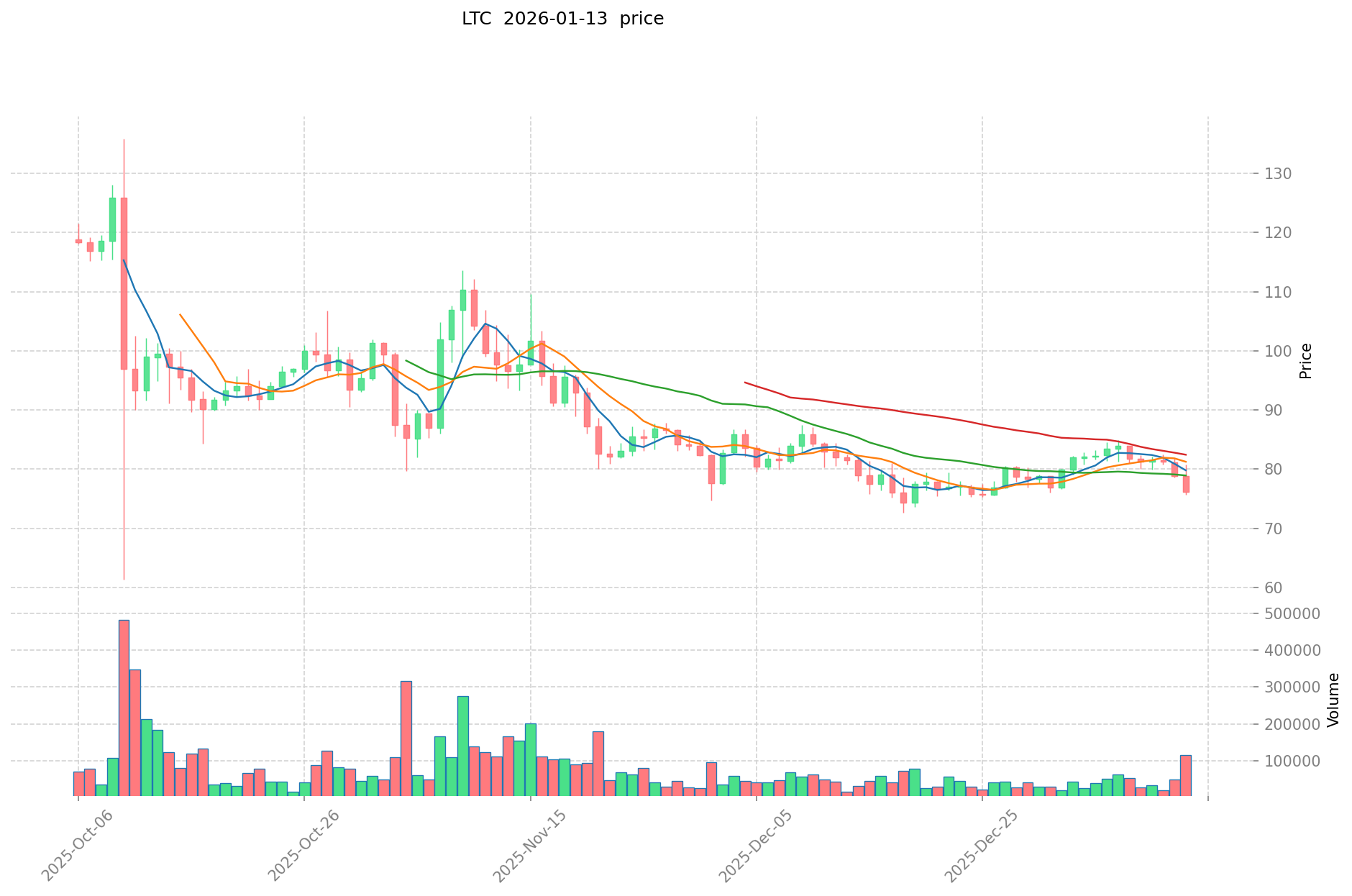
Price Volatility
Litecoin reached a notable price level of $410.26 on May 10, 2021, driven by favorable market conditions during that period.
Its lowest recorded price was $1.15, occurring on January 14, 2015, during early market development phases.
These fluctuations reflect market sentiment, adoption trends, and external factors.
Click to view the current LTC market price
On-Chain Metrics
- Holder Addresses: Approximately 8,873,796 addresses (indicating network distribution)
- 24-Hour Trading Volume: $8,922,648.02 (reflecting market activity)
- Market Capitalization: $5.795 billion (demonstrating market presence)
Litecoin Ecosystem Applications and Partnerships
Core Use Cases
Litecoin's ecosystem supports multiple applications:
- Payment Solutions: Litecoin serves as a fast and efficient payment method, offering peer-to-peer transactions with reduced confirmation times compared to traditional cryptocurrencies.
- Store of Value: As one of the earliest cryptocurrencies, Litecoin functions as digital silver, providing an alternative store of value alongside other digital assets.
Strategic Collaborations
Litecoin has established partnerships within the cryptocurrency industry to enhance its utility and adoption. These collaborations focus on expanding payment acceptance, technical development, and ecosystem growth.
Controversies and Challenges
Litecoin faces the following challenges:
- Technical Issues: As blockchain technology evolves, maintaining competitive transaction speeds and network efficiency remains an ongoing focus.
- Regulatory Uncertainty: Like many cryptocurrencies, Litecoin navigates an evolving regulatory landscape across different jurisdictions.
- Market Competition: The emergence of newer blockchain platforms with advanced features creates competitive pressure in the digital currency space.
These challenges have sparked discussions within the community and continue to drive Litecoin's development efforts.
Litecoin's community demonstrates sustained engagement, with a network supporting over 8.8 million holders. The daily trading volume reaches approximately $8.9 million, reflecting active market participation. Community discussions frequently center around Litecoin's role as an established cryptocurrency and its technological foundations.
Sentiment on social platforms presents varied perspectives:
- Supporters highlight Litecoin's proven track record, network stability, and fast transaction confirmation times, viewing it as a reliable digital currency for payments and transfers.
- Critics focus on price volatility, competition from newer projects, and questions about long-term differentiation in an increasingly crowded market.
Recent trends indicate a cautious optimism, with the cryptocurrency experiencing standard market fluctuations.
Trending Topics
Social media users discuss Litecoin's position in the evolving cryptocurrency landscape, its utility for payments, and comparisons with other established digital assets, reflecting both its historical significance and the challenges of maintaining relevance amid rapid industry innovation.
- Official Website: Visit Litecoin's official website for features, use cases, and latest updates.
- Social Media: On X platform, the Litecoin Foundation operates @LTCFoundation, providing updates on technical developments, community initiatives, and ecosystem news.
- Community Forums: Engage with the community at Litecointalk.org for discussions and support.
- Technical Resources: Explore the Litecoin GitHub repository for code contributions and development insights.
Litecoin Future Roadmap
Litecoin continues to focus on maintaining network security, improving transaction efficiency, and expanding adoption as a payment solution. The project emphasizes its role as a tested and reliable cryptocurrency infrastructure.
How to Participate in Litecoin?
- Purchase Options: Buy LTC on Gate.com and other major cryptocurrency exchanges
- Storage Solutions: Securely store your Litecoin using compatible hardware or software wallets
- Community Engagement: Join discussions on Reddit and Litecointalk forums
- Network Exploration: Use Litecoin block explorer to track transactions and network activity
Summary
Litecoin leverages blockchain technology as an established digital currency, offering fast transaction confirmation, proven security, and efficient peer-to-peer transfers. Its sustained community, comprehensive resources, and market presence position it as one of the foundational cryptocurrencies in the digital asset space.
Despite facing regulatory considerations, market competition, and the need for continued innovation, Litecoin's stability and operational history maintain its relevance in the decentralized technology landscape. Whether you're new to cryptocurrencies or an experienced participant, Litecoin represents an established option worth understanding and monitoring.
FAQ
What is LTC (Litecoin) and how does it work?
Litecoin (LTC) is a decentralized cryptocurrency designed for fast, secure, and low-cost transactions. It uses Scrypt algorithm and has faster block generation than Bitcoin, enabling quicker payments and lower fees for peer-to-peer transfers.
What are the main differences between LTC and Bitcoin?
Litecoin offers faster transaction speeds and lower fees than Bitcoin. It uses Scrypt hashing instead of SHA-256, processes blocks every 2.5 minutes versus Bitcoin's 10, and has 84 million coin supply versus Bitcoin's 21 million. Bitcoin maintains larger market cap and network dominance.
How can I buy and store Litecoin (LTC)?
Open an account on a crypto platform, choose your payment method, and purchase LTC. After buying, transfer your LTC to a secure wallet such as a hardware wallet or software wallet for safekeeping.
What are the advantages and disadvantages of investing in LTC?
Advantages: LTC offers strong liquidity, established market presence, and reliable technology as a proven blockchain. Disadvantages: faces intense competition from Bitcoin and Ethereum, limiting growth potential and market dominance in the crypto space.
Is LTC safe and what are the risks involved?
LTC (Litecoin) utilizes proven blockchain technology with strong security. Main risks include market volatility, regulatory changes, and exchange vulnerabilities. Its decentralized network provides robust protection against attacks and censorship.
* The information is not intended to be and does not constitute financial advice or any other recommendation of any sort offered or endorsed by Gate.