This comprehensive guide explores Luna Classic (LUNC), an algorithmic stablecoin platform launched by Terraform Labs in 2018 on Proof of Stake consensus. The article examines LUNC's technical architecture including DPoS validation, decentralized governance, and secure cryptographic transactions. It analyzes current market performance with 229,951 holders and circulating supply of 5.47 trillion tokens trading at $0.00004216. The guide covers Terra Classic's core DeFi applications, stablecoin mechanisms, and payment network solutions. Additionally, it addresses community sentiment, ecosystem challenges, participation methods via Gate exchange, and long-term recovery roadmap. Whether you're exploring digital currency investments or DeFi opportunities, this resource provides essential insights into LUNC's role in the evolving cryptocurrency landscape.
Terra Classic's Positioning and Significance
In 2018, Terraform Labs launched Terra Classic (LUNC), aiming to address inefficiencies in digital payment systems and the lack of price-stable cryptocurrencies for real-world commerce.
As an algorithmic stablecoin platform built on Proof of Stake consensus, Terra Classic plays a key role in decentralized finance and e-commerce payment solutions.
As of 2026, Terra Classic has evolved into a legacy blockchain ecosystem with an active community, maintaining 229,951 holders and ongoing development efforts.
This article will provide an in-depth analysis of its technical architecture, market performance, and future potential.
Origin and Development History
Birth Background
Terra Classic was created by Terraform Labs in 2018, aiming to solve the challenge of connecting blockchain technology with real-world commerce through price-stable digital currencies.
It emerged during the blockchain technology boom, with the goal of providing merchants and consumers with low-cost transaction advantages through a globally expanding e-commerce alliance.
Terra Classic's launch brought new possibilities for businesses seeking blockchain-based payment solutions and users interested in stable digital assets.
Important Milestones
- 2018: Mainnet launched, implementing algorithmic stablecoin mechanisms and DPoS consensus.
- 2019-2021: Ecosystem expansion with integration of multiple stablecoins pegged to different fiat currencies and growth of DeFi protocols.
- 2022: Experienced significant challenges leading to community-driven governance transition and rebranding as Terra Classic.
- 2023-2026: Community-led development continues with focus on chain stability and ecosystem recovery efforts.
Under the support of the decentralized community and validator network, Terra Classic continues to maintain its infrastructure and explore potential applications.
How Terra Classic Works
No Central Control
Terra Classic operates on a decentralized network of computers (nodes) distributed globally, free from control by banks or governments.
These nodes collaborate to validate transactions, ensuring the system remains transparent and resistant to attacks, granting users greater autonomy and enhancing network resilience.
Blockchain Core
Terra Classic's blockchain is a public, immutable digital ledger that records every transaction.
Transactions are grouped into blocks and linked through cryptographic hashes to form a secure chain.
Anyone can view the records, establishing trust without intermediaries.
The platform utilizes Tendermint consensus and features mechanisms for maintaining stablecoin price stability through arbitrage incentives.
Ensuring Fairness
Terra Classic employs Delegated Proof of Stake (DPoS) to validate transactions and prevent fraudulent activities such as double-spending.
Validators maintain network security through staking LUNC tokens and validating blocks, earning transaction fees and block rewards.
Its innovative approach includes providing predictable rewards to network maintainers through transaction fees and token burn mechanisms to offset reward variations.
Secure Transactions
Terra Classic uses public-private key cryptography to protect transactions:
- Private keys (like secret passwords) are used to sign transactions
- Public keys (like account numbers) are used to verify ownership
This mechanism ensures fund security while maintaining pseudonymous transaction privacy.
The platform's architecture supports secure asset transfers and enables users to participate in governance through token-based voting mechanisms.
Circulation Overview
As of January 16, 2026, Terra Classic (LUNC) has a circulating supply of 5,472,034,658,918.93 tokens, with a total supply of 6,470,654,965,430.44 tokens. The circulating supply represents approximately 84.57% of the total supply, indicating a significant portion of tokens are already in circulation. LUNC operates with an inflationary model, as indicated by the unlimited maximum supply (∞). New tokens enter the market through the platform's price stability mechanism, where LUNA tokens can be exchanged for TerraSDRs stablecoins and vice versa, affecting supply and demand dynamics.
Price Fluctuations
Terra Classic (LUNC) reached its historical high price of $119.18 on April 5, 2022, driven by strong market momentum and increased adoption of the Terra ecosystem during the broader cryptocurrency bull market period. The token experienced its lowest price of $0.000000999967 on May 13, 2022, following significant market turbulence and challenges faced by the Terra ecosystem. These fluctuations reflect shifts in market sentiment, adoption trends, and external factors affecting the cryptocurrency sector.
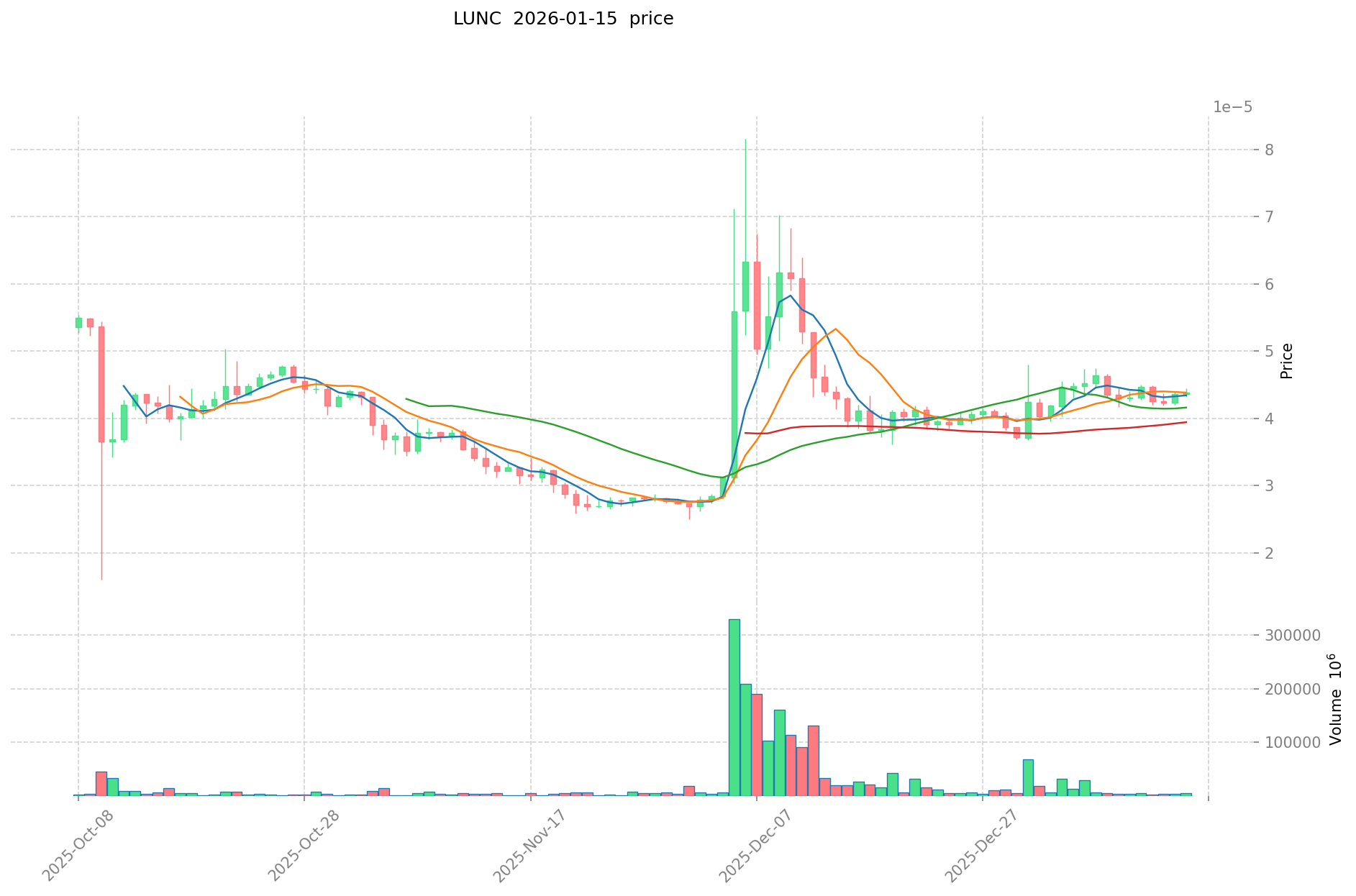
Currently, as of January 16, 2026, LUNC is trading at $0.00004216, showing a -2.97% change over the past 24 hours. Recent price movements include a -1.35% change over 1 hour, -2.39% over 7 days, +5.12% over 30 days, and -58.93% over the past year, demonstrating ongoing market volatility.
Click to view the current LUNC market price
On-Chain Metrics
- 24-Hour Trading Volume: $204,666.03 (indicating current market activity levels)
- Number of Holders: 229,951 holders (reflecting the extent of token distribution among users)
- Market Capitalization: $230,700,981.22 (representing the total market value of circulating tokens)
Terra Classic Ecosystem Applications and Partners
Core Use Cases
Terra Classic's ecosystem supports multiple applications:
- Algorithmic Stablecoins: TerraSDRs stablecoins, providing price-stable digital currency solutions through algorithmic mechanisms.
- DeFi Infrastructure: The platform enables decentralized financial applications leveraging its Proof of Stake consensus mechanism.
- Payment Networks: Terra Classic aims to power next-generation blockchain payment networks, bringing low-cost transaction advantages to merchants and consumers.
Strategic Partnerships
The Terra Classic platform was established by business, financial, and blockchain technology experts with offices in Singapore and South Korea.
These partnerships provide a solid foundation for Terra Classic's ecosystem expansion.
Controversies and Challenges
Terra Classic faces the following challenges:
- Technical Challenges: Maintaining price stability mechanisms under varying market conditions
- Market Volatility: Significant price fluctuations, with current trading at $0.00004216 compared to historical high of $119.18
- Competitive Pressure: Competition from other blockchain platforms and stablecoin solutions
These issues have sparked discussions within the community and market, while also driving Terra Classic's continuous innovation.
Terra Classic's community demonstrates significant activity, with 229,951 token holders as of January 16, 2026.
The platform maintains an active presence across multiple channels, with a circulating supply of approximately 5.47 trillion LUNC tokens.
Sentiment on social platforms shows diverse perspectives:
- Supporters praise Terra Classic's algorithmic stability mechanisms and decentralized characteristics, viewing it as an innovative approach to digital currency stability.
- Critics focus on price volatility and historical market challenges.
Recent trends indicate mixed sentiment as the token shows a 5.12% increase over 30 days while experiencing a 58.93% decline over one year.
Trending Topics
Community discussions center on Terra Classic's price stability mechanisms, tokenomics, and ecosystem recovery, showcasing both its technological innovation and the challenges in achieving mainstream adoption.
- Official Website: Visit Terra Classic Official Site for features, use cases, and latest developments.
- White Paper: Terra Classic White Paper details its technical architecture, objectives, and vision.
- Social Channels: Follow @terra_money on X platform for updates on technical upgrades, community activities, and partnership news.
- Block Explorer: Terra Finder provides on-chain data and transaction information.
Terra Classic Future Roadmap
- Ecosystem Development: Continue building decentralized application infrastructure and expanding payment network capabilities
- Platform Goals: Maintain stable mining rewards under all economic conditions through transaction fees and token burn mechanisms
- Long-term Vision: Bridge digital currency with practical applications as an open platform for innovative financial decentralized applications
How to Participate in Terra Classic?
- Purchase Options: Trade LUNC on Gate.com and other supported exchanges
- Storage Solutions: Use compatible wallets that support Terra Classic for secure storage
- Community Participation: Engage with the Terra Classic community through official channels and forums
- Ecosystem Building: Explore development opportunities within the Terra Classic ecosystem
Summary
Terra Classic represents an algorithmic stablecoin platform built on Tendermint's Proof of Stake blockchain, offering price stability mechanisms, decentralized governance, and payment network solutions.
Its innovative approach to maintaining stablecoin price stability through arbitrage mechanisms and token economics distinguishes it in the cryptocurrency space.
Despite facing market volatility and competitive challenges, Terra Classic's technical foundation and ecosystem vision position it as a noteworthy project in decentralized finance.
Whether you are new to crypto or an experienced participant, Terra Classic offers opportunities for engagement and exploration in the evolving landscape of digital currencies.
FAQ
What is LUNC (Luna Classic) and how does it work?
LUNC (Luna Classic) is a cryptocurrency from the Terra blockchain that emerged after the original ecosystem's collapse. It operates on a decentralized network, enabling users to trade and hold the currency through peer-to-peer transactions without intermediaries.
What is the difference between LUNC and the original Luna token?
LUNC is the original token from Terra Classic blockchain, while LUNA is the new token on Terra 2.0 launched after the 2022 collapse. They operate on separate blockchains with different governance and recovery paths.
How can I buy and trade LUNC cryptocurrency?
You can buy and trade LUNC on major cryptocurrency exchanges by creating an account, completing verification, and depositing funds. Trade LUNC against stablecoins or other cryptocurrencies to start your trading journey.
What happened to Luna and why was Luna Classic created?
Luna collapsed due to algorithmic stablecoin UST failure in May 2022. Luna Classic (LUNC) represents the original chain, while new Luna was created on Terra 2.0 to rebuild the ecosystem with token distribution to affected developers and UST holders.
Is LUNC a good investment and what are the risks?
LUNC offers potential upside through ecosystem recovery and community governance. Key risks include market volatility, regulatory uncertainty, and adoption challenges. Conduct thorough research before investing.
Where can I store LUNC tokens safely?
Store LUNC tokens in hardware wallets like Ledger or Trezor for maximum security, or use reputable software wallets. Paper wallets are also a secure offline option for long-term storage.
* The information is not intended to be and does not constitute financial advice or any other recommendation of any sort offered or endorsed by Gate.