Decentraland (MANA) is the native cryptocurrency of a pioneering blockchain-based virtual world platform launched in 2017 to eliminate intermediary fees and empower content creators. Built on Ethereum's decentralized infrastructure, MANA enables users to purchase virtual land as NFTs, trade digital assets, and participate in platform governance through smart contracts. With 287,847 token holders and robust on-chain metrics, MANA reflects growing interest in metaverse technology and virtual real estate. The platform supports immersive 3D experiences, creator monetization, and decentralized governance, positioning MANA as a key utility token in the virtual economy. This guide explores MANA's technical architecture, market performance, ecosystem applications, and provides insights for potential participants seeking exposure to decentralized virtual world opportunities through Gate exchange.
Decentraland's Positioning and Significance
In 2017, the Decentraland team launched Decentraland (MANA), aiming to solve the problem of platform providers extracting intermediary profits in virtual worlds, hindering direct value exchange between content creators and users.
As a pioneering blockchain-based virtual world platform, Decentraland plays a crucial role in metaverse development, NFT-based digital real estate, and decentralized content creation.
As of 2026, Decentraland has established itself as a significant player in the virtual world ecosystem, with over 287,847 holders and an active developer community.
This article will provide an in-depth analysis of its technical architecture, market performance, and future potential.
Origin and Development History
Birth Background
Decentraland was created by its founding team in 2017, aiming to solve the challenge of centralized platform control over virtual worlds and the extraction of intermediary fees from content creators.
It emerged during the blockchain technology expansion era, with the goal of enabling users to own, create, and monetize virtual experiences without intermediary costs and transforming the status quo.
Decentraland's launch brought entirely new possibilities for content creators, game developers, and virtual world enthusiasts.
Important Milestones
- 2017: Token sale conducted, establishing the foundation for the decentralized virtual world economy.
- 2020: Main platform launch, implementing user-owned virtual land parcels represented as NFTs and enabling immersive 3D experiences.
- 2021: Market growth acceleration, with price reaching significant levels during the metaverse trend surge.
- 2022-2024: Ecosystem expansion, with various experiences, galleries, games, and virtual events being continuously developed on the platform.
With support from the Decentraland Foundation and its global community, Decentraland continues to optimize its platform functionality, user experience, and real-world applications.
How Decentraland Works?
No Central Control
Decentraland operates on a decentralized network infrastructure built on Ethereum blockchain, eliminating control by traditional gaming companies or platform operators.
The distributed architecture ensures transparent governance through community voting mechanisms, providing users with true ownership of digital assets and greater autonomy while enhancing platform resilience.
Blockchain Foundation
Decentraland's infrastructure leverages Ethereum blockchain as a public, immutable digital ledger recording all land ownership and transactions.
Virtual land parcels (LAND) are represented as non-fungible tokens, with ownership records permanently stored on-chain through cryptographic verification.
Anyone can verify ownership records without intermediaries, establishing trustless asset provenance.
The platform utilizes smart contracts to automate land sales, content licensing, and in-world transactions, enhancing operational efficiency.
Ensuring Fairness
Decentraland relies on Ethereum's Proof of Stake consensus mechanism to validate transactions and maintain network integrity, preventing fraudulent activities such as unauthorized asset transfers.
Ethereum validators secure the underlying blockchain through staking ETH and validating transaction blocks, ensuring the decentralized virtual world operates reliably.
The system's innovation includes seamless integration of NFT standards for unique digital assets and programmable smart contracts enabling complex virtual economies.
Secure Transactions
Decentraland utilizes public-private key cryptography to protect asset ownership and transactions:
- Private keys (similar to secret passwords) are used to sign transactions and prove ownership
- Public keys (similar to account identifiers) are used to verify ownership and receive assets
This mechanism ensures asset security, with transactions maintaining pseudonymous privacy through blockchain addresses.
Additionally, the platform supports wallet integration and multi-signature capabilities for enhanced security of high-value virtual assets.
Circulation Overview
As of January 15, 2026, Decentraland (MANA) has a circulating supply of 1,919,092,578 tokens, with a total supply of 2,193,179,327 tokens. The token operates under an inflationary model with no maximum supply cap.
MANA tokens enter the market through the project's distribution mechanism, influencing supply and demand dynamics within the Decentraland virtual world ecosystem.
Price Fluctuations
MANA reached its all-time high of $5.85 on November 25, 2021, driven by increased interest in metaverse projects and virtual real estate during the broader crypto market expansion.
The token's all-time low of $0.00923681 occurred on October 31, 2017, during its early market phase following the initial launch.
These price movements reflect evolving market sentiment toward virtual world platforms, NFT adoption trends, and broader cryptocurrency market cycles.
Click to view current MANA market price
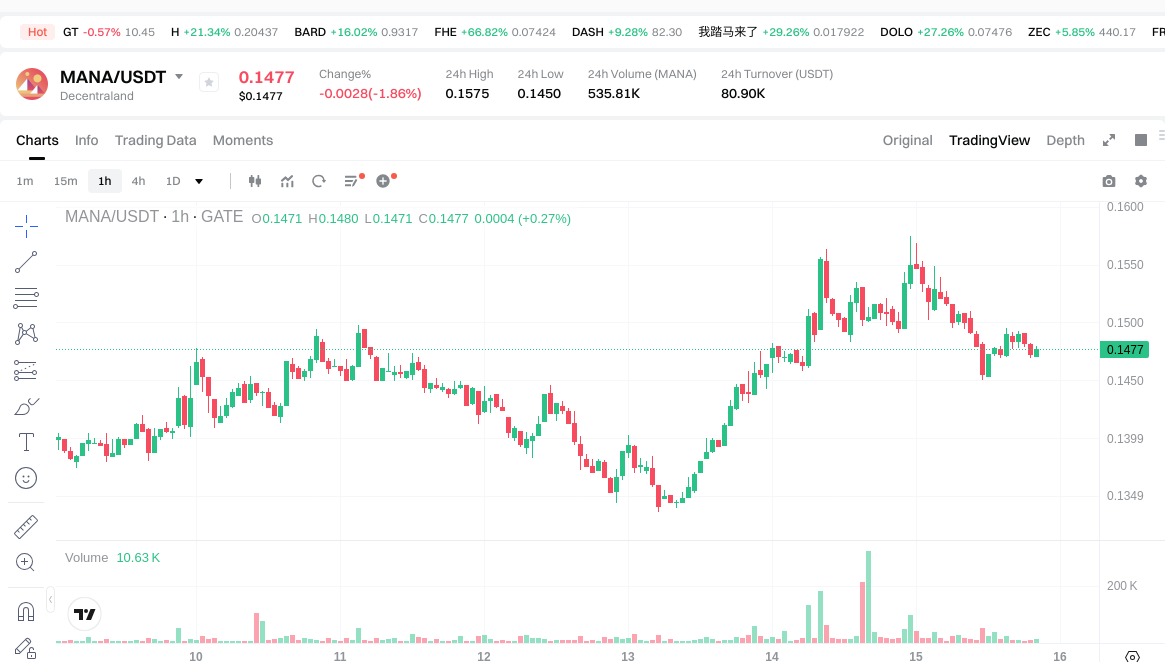
On-Chain Metrics
- Holder Count: 287,847 addresses (indicating community size and token distribution)
- 24-Hour Trading Volume: $80,732,984.52 (reflecting market liquidity and trading activity)
- Circulating Supply Ratio: 87.50% (showing the proportion of tokens currently in circulation relative to total supply)
Decentraland Ecosystem Applications and Partners
Core Use Cases
Decentraland's ecosystem supports multiple applications:
- Virtual Real Estate: Users can purchase, develop, and monetize virtual land parcels (LAND) within the metaverse, creating immersive experiences and digital venues.
- NFT Marketplace: Decentraland's marketplace enables trading of wearables, art, and virtual assets, driving digital collectibles innovation.
- Gaming and Events: The platform hosts interactive games and virtual events, allowing creators to monetize content directly without intermediaries.
Strategic Partnerships
Decentraland's partnerships enhance its technical capabilities and market reach, supporting ecosystem expansion through collaborative initiatives.
Challenges and Controversies
Decentraland faces several challenges:
- Technical Hurdles: Scalability concerns and user experience optimization remain ongoing priorities
- Competition Pressure: The emergence of alternative metaverse platforms creates a competitive landscape
- Market Volatility: Price fluctuations impact user adoption and investor sentiment
These issues have sparked community discussions while driving continuous innovation within the platform.
Decentraland's community demonstrates active participation, with 287,847 token holders as of January 15, 2026.
On X platform, related posts and hashtags (such as #MANA and #Decentraland) frequently gain traction.
Factors like platform updates and virtual events ignite community enthusiasm.
X sentiment presents mixed perspectives:
- Supporters praise Decentraland's user-owned virtual economy and content creator empowerment, viewing it as "the foundation of the metaverse economy".
- Critics focus on market volatility and platform adoption challenges.
Recent trends indicate varied sentiment patterns across different market conditions.
Trending Topics
X users actively discuss Decentraland's virtual land economics, creator monetization models, and metaverse adoption, showcasing both its transformative potential and barriers to mainstream acceptance.
- Official Website: Visit Decentraland Official Site for features, use cases, and latest updates.
- White Paper: Decentraland White Paper details its technical architecture, objectives, and vision.
- X Updates: Decentraland maintains an active presence on X platform using @decentraland, with posts covering technical developments, community events, and ecosystem news.
Decentraland Future Roadmap
- Ongoing platform enhancements focused on user experience optimization and performance improvements
- Ecosystem Goals: Expanding creator tools and virtual world capabilities
- Long-term Vision: Establishing a user-owned decentralized virtual world where creators retain full control over their content
How to Participate in Decentraland?
- Purchase Options: Buy MANA on Gate.com and other supported exchanges
- Storage Solutions: Securely store MANA using compatible wallets
- Participate in Governance: Engage in community decisions through the Decentraland DAO
- Build in the Ecosystem: Visit developer documentation to create experiences or contribute to the platform
Summary
Decentraland redefines virtual worlds through blockchain technology, providing user ownership, content creator empowerment, and direct monetization without intermediaries.
Its active community, comprehensive resources, and market presence position it distinctively in the metaverse space.
Despite facing adoption challenges and market dynamics, Decentraland's innovative approach and platform development maintain its relevance in decentralized virtual world technology.
Whether you're new to crypto or an experienced participant, Decentraland offers opportunities for exploration and engagement.
FAQ
What is MANA coin and what are its main uses?
MANA is the native currency of Decentraland, a virtual world platform. It is primarily used to purchase virtual land, assets, and items within the metaverse, as well as participate in platform governance and voting decisions.
MANA is the core utility token of Decentraland, used to purchase virtual land and in-world assets. MANA holders gain voting rights in the Decentraland DAO, enabling community governance and participation in platform decisions.
How to buy and trade MANA tokens? Where can I purchase them?
Register on crypto exchanges, deposit funds via bank transfer or payment methods, then trade MANA directly. Check platform fees and ensure secure transactions for smooth purchasing experience.
MANA powers Decentraland's virtual world, while SAND supports The Sandbox and ENJ serves the Enjin ecosystem. Each token is designed for distinct metaverse platforms with different governance, utility, and community structures.
What are the risks of holding MANA tokens and what should I pay attention to?
MANA holders face market volatility risks and metaverse adoption uncertainties. Monitor Decentraland platform development, regulatory changes, and overall crypto market trends. Diversify holdings to manage concentration risk and only invest amounts you can afford to lose.
What is the future development outlook for MANA coin?
MANA has promising prospects as virtual reality technology expands. It's positioned to become a key digital currency in the metaverse and VR sectors, with growing adoption and market optimism driving potential long-term value appreciation.
How to use MANA tokens in Decentraland?
In Decentraland, MANA tokens are used to purchase virtual land, digital items, and assets in the marketplace. You can also use MANA to participate in governance decisions through the Decentraland DAO, giving token holders voting rights on platform development and policies.
* The information is not intended to be and does not constitute financial advice or any other recommendation of any sort offered or endorsed by Gate.