MediBloc is a blockchain-based healthcare platform launched in 2017 to revolutionize medical data management by giving patients ownership and control over their health information. This comprehensive guide explores how MediBloc leverages decentralized technology to enable secure medical record integration across institutions, address fragmented healthcare data systems, and empower healthcare consumers. The article examines MediBloc's technical architecture, market performance including circulation supply of 10.6 billion MED tokens and recent price volatility, ecosystem applications through APIs and SDKs, and strategic positioning. It also analyzes community engagement on social platforms, current market challenges including adoption barriers and regulatory considerations, and practical guidance for participating in the MediBloc ecosystem through Gate.com trading and wallet storage. Ideal for healthcare technology enthusiasts, blockchain developers, and investors exploring decentralized healthcare solutions.
MediBloc's Positioning and Significance
In 2017, the MediBloc team launched MediBloc (MED), aiming to address fragmented medical data management, lack of patient control over personal health information, and inefficient medical information sharing across institutions.
As an open information service platform built on blockchain technology for healthcare data management, MediBloc plays a key role in healthcare data infrastructure, medical information services, and patient-centric data ecosystems.
As of 2026, MediBloc has established itself as a blockchain-based healthcare information platform with an active development community providing APIs and SDKs for medical information services.
This article will provide an in-depth analysis of its technical architecture, market performance, and future potential.
Origin and Development History
Birth Background
MediBloc was created by the MediBloc team in 2017, aiming to solve the problems of scattered medical information across different institutions, lack of patient ownership and control over personal health data, and inefficient medical data sharing.
It was born during the blockchain technology boom, with the goal of empowering medical consumers with complete ownership and control of their medical information through secure integration and management to change the status quo.
The launch of MediBloc brought new possibilities to healthcare consumers, medical service providers, research institutions, and healthcare software developers.
Important Milestones
- 2017: Platform launch, enabling secure integration of medical information from multiple devices including smartphones and various medical institutions.
- MediBloc has been listed on Gate.com, expanding its accessibility to global users.
- The platform has attracted 4 exchanges for trading, enhancing market liquidity.
- The ecosystem continues to evolve, with software developers utilizing APIs and SDKs provided by the MediBloc platform to create various medical information services.
With the support of the development team and community, MediBloc continues to optimize its technology, security, and real-world applications.
How MediBloc Works
No Central Control
MediBloc operates on a decentralized network of computers (nodes) distributed globally, free from control by banks or governments.
These nodes collaborate to validate transactions, ensuring the system is transparent and attack-resistant, granting users greater autonomy and enhancing network resilience.
Blockchain Core
MediBloc's blockchain is a public, immutable digital ledger that records every transaction.
Transactions are grouped into blocks and linked through cryptographic hashes to form a secure chain.
Anyone can view the records, establishing trust without intermediaries.
Ensuring Fairness
MediBloc maintains network security through its consensus mechanism, preventing fraudulent activities such as double-spending.
Network participants maintain system integrity and contribute to the platform's security infrastructure.
Secure Transactions
MediBloc uses public-private key encryption technology to protect transactions:
- Private key (similar to a secret password) is used to sign transactions
- Public key (similar to an account number) is used to verify ownership
This mechanism ensures fund security while maintaining transaction integrity.
Medical consumers can set different reading permissions for each piece of personal information as needed, thereby fully owning the ownership and control of their own medical information. Medical service providers can input medical records into MediBloc with consumer consent, and individuals, research institutions, or enterprises seeking medical information can obtain required resources with the information owner's permission.
Circulation Overview
As of January 21, 2026, MediBloc's circulating supply stands at 10,644,041,819 MED tokens, with a total supply of 11,434,259,731 MED. The token operates under an inflationary model with no maximum supply cap.
The circulating supply represents approximately 93.09% of the total supply, indicating a relatively high proportion of tokens already in market circulation. The token allocation and distribution mechanisms enable MED tokens to enter the market through various channels, influencing the supply-demand dynamics of the ecosystem.
Price Volatility
MediBloc reached its all-time high of $0.351852 on April 2, 2021, driven by favorable market conditions during the broader cryptocurrency bull market cycle. The token experienced significant upward momentum during this period, reflecting increased investor interest and adoption in blockchain-based healthcare solutions.
The lowest recorded price was $0.001614 on March 13, 2020, coinciding with the broader market downturn affecting cryptocurrency assets globally. This price floor emerged during a period of heightened market uncertainty and reduced risk appetite among investors.
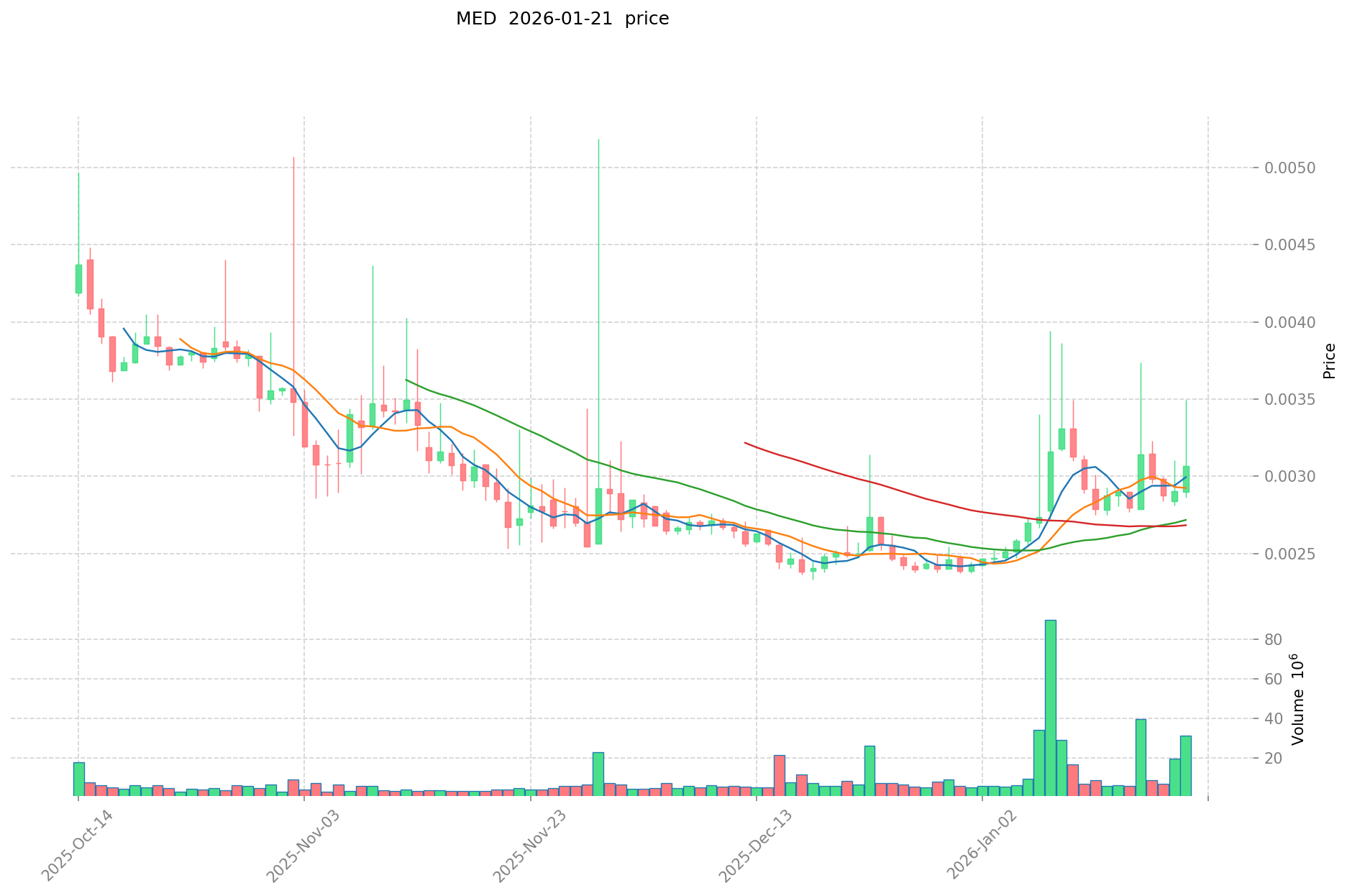
Recent price movements show mixed trends: a 24-hour increase of 2.55% and a 7-day gain of 6.2%, alongside a 30-day rise of 22.24%. However, the 1-year performance indicates a decline of 69.99%, reflecting ongoing market adjustments and shifting sentiment in the healthcare blockchain sector. These fluctuations demonstrate the dynamic nature of market forces, adoption patterns, and evolving investor perspectives on the project.
Click to view the current MED market price
On-Chain Metrics
- 24-Hour Trading Volume: Approximately $98,600.13, indicating moderate trading activity and market liquidity for the token
- Market Capitalization: $32,474,971.59, representing the token's current valuation in the cryptocurrency market
- Fully Diluted Market Cap: $34,885,926.44, reflecting the potential market value if all tokens were in circulation
MediBloc Ecosystem Applications and Partners
Core Use Cases
MediBloc's ecosystem supports multiple applications:
- Healthcare Data Management: MediBloc platform enables secure integration and management of medical information generated from various devices including smartphones and distributed across different medical institutions.
- Medical Information Services: Software developers can utilize APIs and SDKs provided by the MediBloc platform to create various medical information-based services.
Strategic Partnerships
MediBloc's partnerships enhance its technical capabilities and market influence in the healthcare blockchain sector.
These collaborative relationships provide a solid foundation for MediBloc's ecosystem expansion.
Challenges and Controversies
MediBloc faces the following challenges:
- Market Competition: Competition from other blockchain projects in the healthcare data management space
- Regulatory Considerations: Navigation of healthcare data privacy regulations across different jurisdictions
- Adoption Barriers: Challenges in encouraging medical institutions and consumers to adopt blockchain-based healthcare solutions
These issues have sparked discussions within the community and market, while also driving MediBloc's continuous innovation.
MediBloc maintains an active community presence across multiple platforms.
On X platform, related posts and hashtags (such as #MediBloc) generate regular engagement among healthcare technology enthusiasts.
Community enthusiasm is often sparked by platform updates and new feature releases.
Sentiment on X shows diverse perspectives:
- Supporters praise MediBloc's patient-centric approach to medical data ownership and secure information sharing capabilities, viewing it as an innovative solution for healthcare data management.
- Critics focus on adoption challenges and market volatility concerns.
Recent trends indicate growing interest in blockchain applications for healthcare data.
Popular Topics
X users actively discuss MediBloc's data privacy features, healthcare institution adoption, and the platform's role in medical information accessibility,
showcasing both its transformative potential and the obstacles toward mainstream adoption.
- Official Website: Visit MediBloc Official Website to learn about features, use cases, and latest developments.
- White Paper: MediBloc White Paper details its technical architecture, objectives, and vision for blockchain-based healthcare information management.
- X Updates: On X platform, MediBloc uses @_MediBloc to engage with the community,
sharing updates on technical developments, community activities, and healthcare blockchain innovations.
MediBloc Future Roadmap
- Ecosystem Goals: Expand platform adoption among medical institutions and healthcare consumers
- Long-term Vision: Establish itself as a leading platform for secure, patient-controlled medical information management
How to Participate in MediBloc?
- Purchase Options: Acquire MED tokens on Gate.com and other supported exchanges
- Storage Solutions: Securely store MED tokens using compatible cryptocurrency wallets
- Community Engagement: Participate in the MediBloc community through social media channels
- Ecosystem Building: Visit the developer documentation to explore building applications on the MediBloc platform
Summary
MediBloc leverages blockchain technology to redefine healthcare data management, offering patient ownership, secure information sharing, and decentralized medical record access.
Its community presence, available resources, and focus on healthcare innovation distinguish it in the blockchain sector.
Despite facing adoption challenges and market dynamics, MediBloc's patient-centric approach and clear vision position it as a noteworthy project in decentralized healthcare technology.
Whether you're new to blockchain healthcare solutions or an experienced participant, MediBloc represents an interesting project to follow and engage with.
FAQ
What is crypto MED and what does it do?
Crypto MED is a decentralized healthcare token designed to revolutionize medical services on blockchain. It enables peer-to-peer healthcare transactions, rewards patient participation, and provides transparent medical data management across the Web3 ecosystem.
How can I buy and store MED tokens?
You can purchase MED tokens through various cryptocurrency platforms and DEXs. For storage, use secure wallets like MetaMask, Trust Wallet, or hardware wallets such as Ledger to safely hold your MED tokens.
What are the risks and benefits of investing in MED cryptocurrency?
Benefits include exposure to innovative healthcare blockchain solutions, potential high returns from early adoption, and growing market demand. Risks involve market volatility, regulatory uncertainty, and technology adoption challenges. MED offers transformative potential in decentralized medical data management.
Which blockchain network does MED operate on?
MED operates on multiple blockchain networks including Ethereum, Binance Smart Chain, and Polygon, enabling broad accessibility and interoperability across different DeFi ecosystems.
What is the total supply and current market cap of MED?
MED has a total supply of 1 billion tokens. The current market cap fluctuates based on price movements. For real-time market cap data, check major crypto tracking platforms for the latest valuation.
MED stands out through its decentralized healthcare infrastructure, enabling direct patient-provider transactions without intermediaries. It features advanced privacy protocols, faster settlement times, and governance tokens for community-driven medical decisions, distinguishing it from traditional medical crypto projects.
* The information is not intended to be and does not constitute financial advice or any other recommendation of any sort offered or endorsed by Gate.