Mina Protocol is a revolutionary Layer 1 blockchain launched in 2020 to address blockchain scalability and accessibility challenges through its innovative constant-size architecture of approximately 22KB. Using recursive zero-knowledge proofs (zk-SNARKs), Mina enables anyone to verify the entire blockchain without downloading full transaction history, making participation accessible on ordinary devices. The protocol operates on Proof of Stake consensus, where validators secure the network by staking MINA tokens while earning rewards. Its Snapp ecosystem powers privacy-preserving decentralized applications with verified real-world data integration. As of January 2026, Mina has achieved 27 exchange listings and a market capitalization of $111.98 million, establishing itself as a credible solution for privacy-focused blockchain users and developers seeking lightweight, decentralized infrastructure on Gate and other platforms.
Mina's Positioning and Significance
In 2020, the Mina Protocol team launched Mina (MINA), aiming to address blockchain scalability and accessibility barriers that prevent widespread participation in decentralized networks.
As one of the world's lightest blockchains with a constant size of approximately 22KB, Mina plays a key role in privacy-preserving applications and verifiable computing.
As of 2026, Mina has established itself as an innovative Layer 1 blockchain solution with 27 exchange listings and an active development community focused on zero-knowledge proof technology.
This article will provide an in-depth analysis of its technical architecture, market performance, and future potential.
Origin and Development History
Birth Background
Mina was created by the Mina Protocol team in 2020, aiming to solve the problem of blockchain bloat that makes full node participation prohibitively expensive and limits true decentralization.
It emerged during the growing demand for scalable blockchain solutions, with the objective of enabling anyone to verify the blockchain from genesis using a compact cryptographic proof.
Mina's launch brought new possibilities for developers seeking to build privacy-focused decentralized applications and individuals wanting to participate in consensus without significant hardware requirements.
Key Milestones
- 2020: The project, formerly known as Coda Protocol, rebranded to Mina Protocol.
- April 2021: Mainnet launch, implementing constant-size blockchain verification through recursive zero-knowledge proofs.
- May 2021: Token price experienced significant growth in early trading periods.
- Ongoing development of Snapps (SNARK-powered applications) ecosystem, enabling privacy-preserving dApps using verified real-world data.
With support from the Mina Foundation and an active open-source community, Mina continues to optimize its technology, security, and real-world applications.
How Mina Works
No Central Control
Mina operates on a decentralized network of computers (nodes) distributed globally, free from control by banks or governments.
These nodes collaboratively verify transactions, ensuring system transparency and attack resistance, granting users greater autonomy and enhancing network resilience.
Blockchain Core
Mina's blockchain is a public, immutable digital ledger that records every transaction.
Transactions are grouped into blocks and linked through cryptographic hashes to form a secure chain.
Anyone can view the records, establishing trust without intermediaries.
Recursive zero-knowledge proofs (zk-SNARKs) enable the entire blockchain to be compressed into a constant size of approximately 22KB, allowing any participant to verify the chain's validity without downloading the full transaction history.
Ensuring Fairness
Mina employs Proof of Stake (PoS) consensus mechanism called Ouroboros Samasika to validate transactions and prevent fraudulent activities such as double-spending.
Validators maintain network security through staking MINA tokens and participating in block production, earning MINA rewards.
Its innovation includes making every node a full node capable of complete verification, achieving true decentralization without sacrificing accessibility.
Secure Transactions
Mina uses public-private key cryptography to protect transactions:
- Private keys (similar to secret passwords) are used to sign transactions
- Public keys (similar to account numbers) are used to verify ownership
This mechanism ensures fund security while maintaining pseudonymous transactions.
Zero-knowledge proof technology allows users to prove facts about their data without revealing the underlying information, enabling privacy-preserving applications such as credential verification, document verification, and balance verification.
Circulation Overview
As of January 17, 2026, Mina's circulating supply stands at 1,270,293,633.84 tokens, with a total supply of 1,270,293,633.84 tokens and an unlimited maximum supply, indicating an inflationary token model.
New tokens enter the market through block rewards and staking mechanisms, influencing supply-demand dynamics within the ecosystem.
Price Fluctuations
Mina experienced significant price movement, reaching a notable price level of $9.09 on June 1, 2021, driven by initial market enthusiasm and the launch of the protocol.
The token's lowest recorded price was $0.063436 on October 11, 2025, influenced by broader market conditions and sector-wide adjustments.
These fluctuations reflect evolving market sentiment, adoption trends, and external factors affecting the cryptocurrency ecosystem.
Click to view current MINA market price
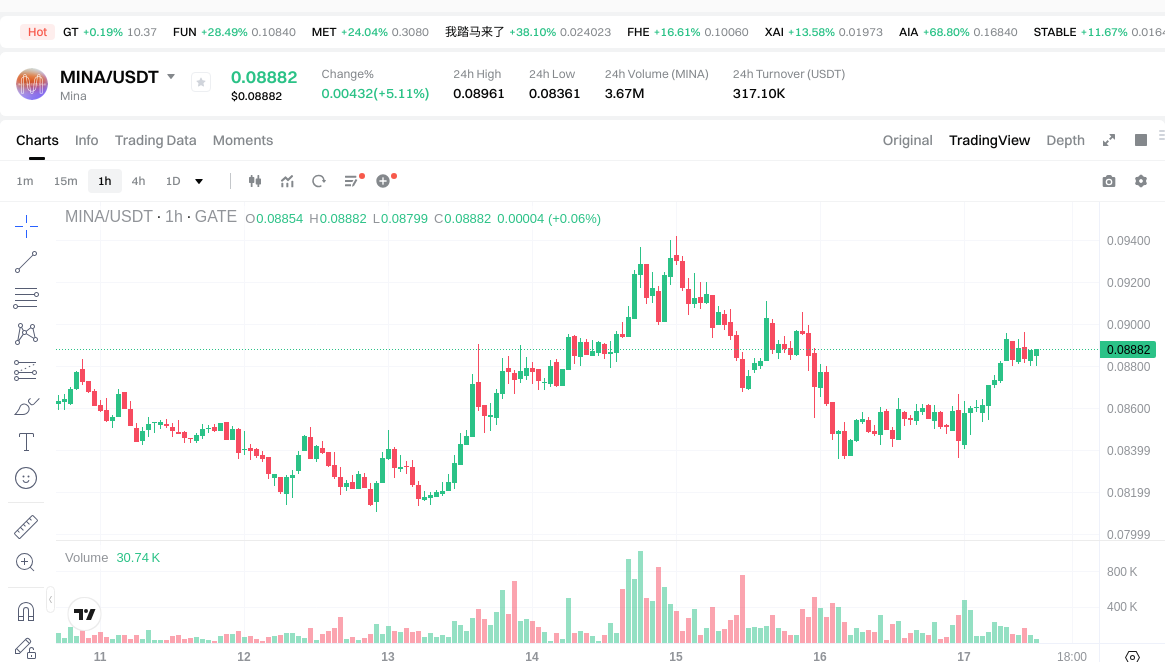
On-Chain Metrics
- Market Capitalization: $111,989,086.76 (reflecting current market valuation)
- 24-Hour Trading Volume: $323,737.57 (indicating network activity levels)
- Circulation Ratio: 100.78% (demonstrating high token circulation relative to total supply)
Mina Ecosystem Applications and Strategic Partners
Core Use Cases
Mina's ecosystem supports multiple application scenarios:
- Privacy-Preserving Applications: Snapps (SNARK-powered Apps), providing verified credential systems, including credit score verification, document authentication, and balance verification without exposing sensitive data.
- Decentralized Verification: Developer tools that enable building distributed applications using validated private real-world data from any website.
Strategic Collaborations
The reference materials do not provide specific information about Mina's strategic partnerships. The protocol continues to focus on building its zero-knowledge proof technology ecosystem and expanding its application scenarios.
Challenges and Considerations
Mina faces certain challenges in its development:
- Technical Complexity: Implementing zero-knowledge proof technology requires sophisticated development expertise and resources.
- Market Competition: Operating in a competitive blockchain landscape with various scaling solutions and privacy-focused protocols.
- Adoption Hurdles: Building awareness and developer adoption for its unique constant-size blockchain approach.
These considerations drive ongoing innovation and community engagement within the Mina ecosystem.
Mina maintains an active community presence with approximately 1.27 billion circulating tokens distributed across its network. The protocol's unique approach to blockchain compression and zero-knowledge proofs has attracted developers and privacy-focused users.
On X platform, discussions around Mina present varied perspectives:
- Supporters highlight its lightweight blockchain design, zero-knowledge proof capabilities, and innovative approach to maintaining a constant 22KB blockchain size.
- Observers discuss topics related to adoption rates, ecosystem development, and the protocol's position in the broader blockchain space.
Community discussions often center on Mina's technical innovations and potential applications in privacy-preserving scenarios.
Key Discussion Topics
X platform users engage with Mina's zero-knowledge proof technology, decentralization model, and application development possibilities, reflecting both technical interest and practical implementation considerations.
- Official Website: Visit Mina Protocol for features, use cases, and latest developments.
- GitHub Repository: Access Mina's GitHub for technical documentation and code contributions.
- X Platform: Follow Mina Protocol on X @minaprotocol for updates on technical upgrades, community activities, and ecosystem news.
- Block Explorer: Check Mina Explorer for on-chain data and transaction verification.
Mina Development Roadmap
The reference materials do not provide specific roadmap details for future years. The protocol continues to focus on:
- Expanding its Snapp ecosystem
- Enhancing zero-knowledge proof applications
- Building tools for privacy-preserving decentralized applications
How to Participate in Mina?
- Purchase Options: Acquire MINA through Gate.com and other supported platforms
- Storage Solutions: Secure your tokens using compatible wallet solutions that support the Mina protocol
- Network Participation: Join as a full node operator, as Mina's design enables all participants to run complete nodes due to its constant blockchain size
- Ecosystem Building: Visit the official GitHub repository to explore development opportunities and contribute to Snapp applications
Summary
Mina Protocol represents an innovative approach to blockchain technology through its constant-size architecture, maintaining approximately 22KB regardless of transaction volume. The protocol offers lightweight verification, zero-knowledge proof capabilities, and true decentralization where all participants can operate full nodes. Its Snapp ecosystem enables developers to build privacy-preserving applications using verified real-world data.
Despite facing adoption challenges and market competition, Mina's unique technical architecture and focus on privacy-preserving applications position it distinctively in the blockchain space. The protocol's commitment to maintaining a lightweight, accessible blockchain while supporting sophisticated zero-knowledge proof applications demonstrates its innovative approach to solving scalability and privacy challenges.
Whether you are exploring privacy-focused blockchain solutions or interested in zero-knowledge proof applications, Mina's unique architecture and ecosystem merit attention and engagement.
FAQ
What is MINA cryptocurrency and how does it work?
MINA is the native token of Mina Protocol, enabling network transactions and fee distribution. It operates on proof-of-stake consensus, allowing users to validate blocks and earn rewards while maintaining a lightweight blockchain architecture.
What are the key features and advantages of MINA blockchain?
MINA enables full nodes on ordinary devices, lowering participation barriers. It offers high scalability, fast transactions, and efficient on-chain data verification without external dependencies.
How does MINA use zero-knowledge proofs?
Mina uses zero-knowledge proofs (zk-SNARKs) to verify transactions and maintain blockchain state without revealing underlying information. This enables privacy-preserving smart contracts and keeps the blockchain size constant at just 22KB through recursive proof compression.
How can I buy and store MINA tokens?
Purchase MINA on centralized exchanges using debit/credit cards, bank transfers, or peer-to-peer trading. Transfer tokens to a secure wallet for storage and full control of your assets.
What is the difference between MINA and other cryptocurrencies like Bitcoin or Ethereum?
MINA distinguishes itself through its lightweight protocol and privacy-focused features. Unlike Bitcoin's proof-of-work or Ethereum's smart contract platform, MINA uses recursive zero-knowledge proofs, enabling a smaller blockchain size while maintaining security and decentralization.
Is MINA a safe and legitimate cryptocurrency investment?
MINA is a legitimate Layer 1 blockchain with proven technology and active development. It features innovative zero-knowledge proofs and strong community support. While all crypto investments carry market risk, MINA's unique protocol and growing ecosystem make it a credible investment opportunity.
What is the future potential and use cases of MINA?
Mina enables private, secure access to online data and decentralized apps through zero-knowledge proofs. Key use cases include privacy-preserving dapps, credential verification without data exposure, fair lending with private information verification, and creating a private gateway between the real world and crypto infrastructure.
* The information is not intended to be and does not constitute financial advice or any other recommendation of any sort offered or endorsed by Gate.