Enzyme (MLN) is a decentralized asset management protocol launched in 2017 to streamline DeFi investment strategies and decentralized fund management. Built on Ethereum's blockchain, Enzyme enables users to create, manage, and explore investment vaults without intermediaries, leveraging smart contract automation and transparency. The article provides comprehensive coverage of Enzyme's technical architecture, market performance metrics, ecosystem applications, and community engagement. With MLN trading at $4.633 and a market cap of $13.84 million, the protocol addresses key challenges in asset management through decentralized infrastructure. Explore Enzyme's innovations, purchase options on Gate, and discover how this DeFi protocol transforms on-chain investment strategies for both newcomers and experienced participants.
Enzyme's Positioning and Significance
In 2017, the Enzyme team launched Enzyme (MLN), aiming to address inefficiencies in decentralized asset management and the complexity of navigating DeFi investment strategies.
As an on-chain asset management protocol within the DeFi ecosystem, Enzyme plays a critical role in decentralized finance and investment strategy automation.
As of 2026, Enzyme has evolved into a mature DeFi infrastructure project supporting on-chain asset management, maintaining an active developer community and serving users seeking to build, share, and explore DeFi investment strategies.
This article will provide an in-depth analysis of its technical architecture, market performance, and future potential.
Origin and Development Journey
Birth Background
Enzyme (formerly known as Melon Protocol) was created by its development team in 2017, aiming to solve the challenges of managing digital assets in a decentralized manner and enabling transparent, permissionless investment strategies.
It emerged during the rapid expansion of Ethereum's smart contract ecosystem, with the goal of empowering users to create and manage investment vaults on-chain without relying on traditional financial intermediaries.
Enzyme's launch brought new possibilities for asset managers, investors, and DeFi participants seeking transparent and programmable investment solutions.
Important Milestones
- 2017: Project launched as Melon Protocol, establishing the foundation for on-chain asset management.
- The protocol evolved to support various DeFi integrations, enabling users to filter investment strategies by historical performance and risk profiles.
- The project rebranded to Enzyme, reflecting its expanded vision and capabilities within the DeFi ecosystem.
- 2026: Enzyme continues to operate as an Ethereum-based protocol, with MLN tokens serving utility functions throughout vault creation and investment lifecycles.
With support from its development community and ecosystem contributors, Enzyme continues to enhance its technical capabilities, security features, and real-world applications.
How Enzyme Works
No Central Control
Enzyme operates on Ethereum's decentralized network of computers (nodes) distributed globally, eliminating control by banks or governments.
These nodes collaborate to validate transactions, ensuring the system remains transparent and resistant to attacks, granting users greater autonomy and enhancing network resilience.
Blockchain Core
Enzyme's functionality is built on Ethereum's blockchain, a public, immutable digital ledger that records every transaction.
Transactions are grouped into blocks and linked through cryptographic hashes to form a secure chain.
Anyone can view the records, establishing trust without intermediaries.
The protocol leverages Ethereum's smart contract capabilities to enable programmable investment vaults and automated strategy execution.
Ensuring Fairness
Enzyme relies on Ethereum's Proof of Stake (PoS) consensus mechanism to validate transactions and prevent fraudulent activities such as double spending.
Validators maintain network security by staking ETH and processing transactions, earning rewards for their participation.
This mechanism contributes to Ethereum's energy efficiency and security while supporting Enzyme's operations.
Secure Transactions
Enzyme utilizes public-private key cryptography to protect transactions:
- Private keys (similar to secret passwords) are used to sign transactions
- Public keys (similar to account numbers) are used to verify ownership
This mechanism ensures fund security, with transactions maintaining pseudonymous privacy characteristics.
The protocol's smart contract architecture adds additional layers of security through auditable code and transparent vault operations.
Circulation Overview
As of January 25, 2026, Enzyme (MLN) has a circulating supply of 2,988,286.79 tokens, with a total supply of 2,988,286.79 tokens. The circulating supply represents approximately 99.996% of the total supply, indicating nearly complete token distribution. With a maximum supply marked as infinite (∞), MLN operates under a model that allows for potential future issuance, though current circulation suggests minimal inflation pressure in the near term.
Price Fluctuation
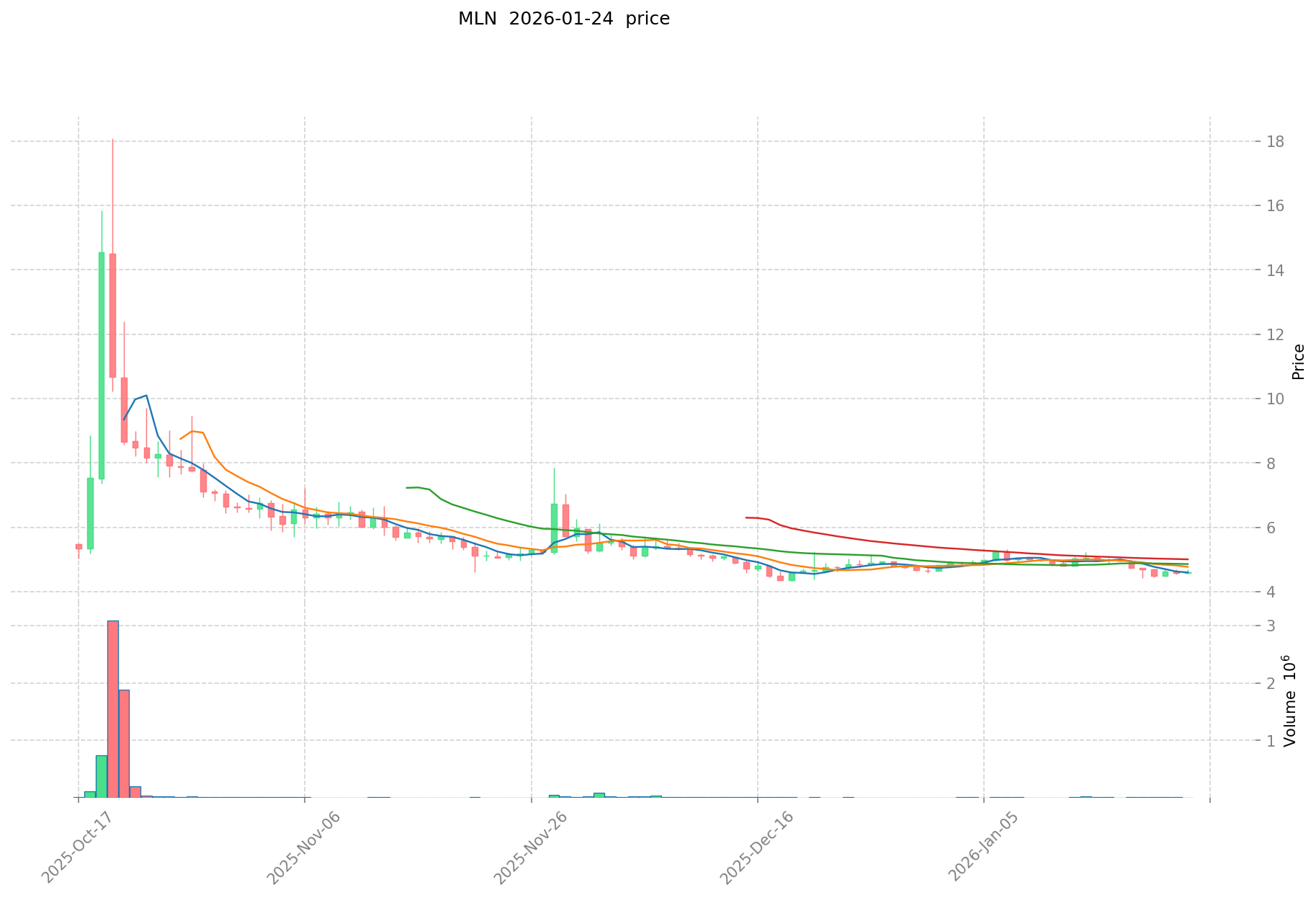
MLN reached its price peak of $258.26 on January 4, 2018, during a period characterized by broader cryptocurrency market enthusiasm and heightened interest in decentralized finance infrastructure projects. The token's lowest recorded price of $1.79 occurred on March 13, 2020, coinciding with significant market volatility and widespread risk-off sentiment across digital asset markets.
As of the current reporting period, MLN trades at $4.633, reflecting a 1.13% increase over the past 24 hours. However, the token has experienced a -7.1% decline over the past week and a -6.06% decrease over the past 30 days. The one-year performance shows a -71.13% decline, indicating sustained downward pressure. These fluctuations reflect the evolving dynamics of market sentiment, adoption trends, and broader macroeconomic factors affecting the cryptocurrency sector.
Click to view current MLN market price
On-Chain Metrics
- 24-Hour Trading Volume: The token recorded a trading volume of $17,215.37 over the past 24 hours, reflecting current market activity levels.
- Token Holders: MLN is held across 8,856 addresses, indicating a distributed ownership structure among participants in the Enzyme ecosystem.
- Market Capitalization: The total market capitalization stands at approximately $13.84 million, representing 0.00043% market dominance within the broader cryptocurrency landscape.
- Fully Diluted Valuation: With nearly complete token circulation, the fully diluted market cap closely aligns with current market capitalization at $13.84 million, suggesting minimal dilution risk from future token releases.
Enzyme Ecosystem Applications and Partners
Core Use Cases
Enzyme's ecosystem supports multiple applications:
- DeFi Asset Management: The protocol enables users to build, share, and explore DeFi investment strategies (called "vaults"), providing decentralized on-chain asset management.
- Investment Strategy Filtering: Users can filter vaults by historical performance and risk profile, promoting transparent and data-driven investment decisions.
Strategic Partnerships
Enzyme has established collaborations within the DeFi ecosystem to enhance its technical capabilities and market presence.
These partnerships provide a solid foundation for Enzyme's ecosystem expansion.
Challenges and Controversies
Enzyme faces the following challenges:
- Market Competition: Competition from other DeFi asset management protocols and platforms
- Regulatory Uncertainty: Evolving regulatory frameworks for decentralized finance platforms
- Market Volatility: MLN token price fluctuations affecting platform adoption
These issues have sparked discussions within the community and market, while also driving Enzyme's continuous innovation.
Enzyme's community demonstrates notable activity, with the token held by 8,856 wallet addresses.
On X platform, posts and hashtags related to Enzyme regularly generate engagement within the DeFi community.
Factors such as protocol updates and vault performance contribute to community enthusiasm.
Sentiment on X presents varying perspectives:
- Supporters praise Enzyme's decentralized asset management capabilities and transparency, viewing it as an important infrastructure for DeFi investment strategies.
- Critics focus on token price volatility and market competition from similar protocols.
Recent trends reflect typical DeFi market dynamics.
Hot Topics
X users actively discuss Enzyme's on-chain asset management innovation, vault strategies, and MLN token utility,
showcasing both its transformative potential and challenges in achieving broader adoption.
- Official Website: Visit Enzyme Official Website for features, use cases, and latest updates.
- Whitepaper: Enzyme Whitepaper details its technical architecture, objectives, and vision.
- X Updates: On X platform, Enzyme maintains an active presence at @enzymefinance,
with posts covering protocol upgrades, community activities, and DeFi innovations, generating engagement from the community.
Enzyme Future Roadmap
Enzyme continues to develop its protocol with focus on:
- Enhancing vault creation functionality and investment lifecycle management
- Ecosystem expansion: Supporting more DeFi strategies and integrations
- Long-term vision: Becoming a leading infrastructure for decentralized asset management
How to Participate in Enzyme?
- Purchase Channels: Buy MLN on Gate.com and other supported exchanges
- Storage Solutions: Securely store MLN using compatible Ethereum wallets
- Community Participation: Engage with the Enzyme community through official channels
- Ecosystem Building: Visit developer documentation to contribute to the protocol
Summary
Enzyme redefines decentralized asset management through blockchain technology, providing transparency, security, and efficient DeFi investment strategies.
Its active community, comprehensive resources, and market presence make it distinctive in the cryptocurrency space.
Despite facing regulatory uncertainties and competitive pressures, Enzyme's innovative approach and clear development direction position it as a notable player in decentralized finance.
Whether you are a newcomer or an experienced participant, Enzyme deserves attention and consideration.
FAQ
What is Melon (MLN) and what is its main purpose?
Melon (MLN) is a decentralized asset management protocol built on Ethereum. It enables users to create, manage, and invest in digital asset funds on-chain. MLN serves as the governance token and is used for protocol participation, voting, and incentivizing network validators.
How does Melon protocol work in decentralized fund management?
Melon protocol enables decentralized fund management by allowing users to create and manage investment funds on-chain. It provides smart contract infrastructure for fund administrators to set strategies, collect management fees, and execute trades while maintaining transparency and enabling investors to track performance in real-time.
Where can I buy and store MLN tokens?
You can purchase MLN tokens on major cryptocurrency exchanges and decentralized platforms. Store them securely in hardware wallets like Ledger or Trezor, or use trusted custodial wallets that support ERC-20 tokens for convenient access.
What are the risks and benefits of investing in MLN?
Benefits: MLN enables decentralized fund management with lower fees, transparent governance, and exposure to crypto asset growth. Risks: Market volatility, smart contract vulnerabilities, and regulatory uncertainty. Long-term potential remains strong as DeFi adoption increases.
How is Melon different from other DeFi protocols?
Melon is a decentralized asset management protocol enabling users to create and manage investment funds on-chain. Unlike other DeFi protocols, Melon combines portfolio management, fund administration, and governance in a unified framework, allowing investors to build diversified strategies with transparent on-chain execution and automated compliance.
* The information is not intended to be and does not constitute financial advice or any other recommendation of any sort offered or endorsed by Gate.