MODE is a modular DeFi Layer 2 solution built on Optimism, launched in 2024 to address Ethereum's scalability limitations and high transaction costs. As of 2026, MODE has achieved over $500 million in TVL with 300,000 monthly users and 50+ ecosystem projects. This comprehensive guide explores MODE's technical architecture leveraging Optimistic Rollup technology, market performance metrics, and strategic positioning. The article covers core use cases including DeFi protocols and customizable rollups powered by Celestia and EigenDA, while addressing market challenges and community dynamics. Learn how to participate through Gate purchasing channels, secure storage solutions, and ecosystem contribution opportunities. Discover MODE's innovative approach to decentralized finance infrastructure and its potential in the evolving blockchain landscape.
Mode's Positioning and Significance
In 2024, the Mode team launched Mode (MODE), aiming to address scalability limitations and high transaction costs on Ethereum.
As a Modular DeFi Layer 2 solution backed by Optimism, Mode plays a key role in decentralized finance and scalable blockchain infrastructure.
As of 2026, Mode has established itself as a growing Layer 2 ecosystem with over $500 million in TVL, boasting 300,000 monthly users and an active developer community with over 50 ecosystem projects.
This article will provide an in-depth analysis of its technical architecture, market performance, and future potential.
Origin and Development History
Birth Background
Mode was created by the Mode Network team in 2024, aiming to solve Ethereum's scalability challenges and expensive transaction fees that hindered DeFi adoption.
It emerged during the Layer 2 scaling solutions boom, with the goal of enabling high-throughput, low-cost transactions while maintaining Ethereum security to transform the blockchain landscape.
The launch of Mode brought new possibilities for DeFi users and developers seeking efficient blockchain infrastructure.
Important Milestones
- 2024: Mainnet launch on May 7, achieving integration with Optimism's OP Stack technology.
- 2024: Ecosystem expansion with the establishment of new economic systems rewarding network growth contributions.
- 2024-2025: Rapid TVL growth, surpassing $500 million in total value locked.
- 2025-2026: Introduction of Flare L3 ecosystem powered by Celestia and EigenDA, enabling customizable rollups.
With support from the Optimism ecosystem and strategic partners, Mode continues to optimize its technology, security, and real-world applications.
How Does Mode Work?
No Central Control
Mode operates on a decentralized network of computers (nodes) distributed globally, free from control by banks or governments.
These nodes collaborate to verify transactions, ensuring system transparency and attack resistance, granting users greater autonomy and enhancing network resilience.
Blockchain Core
Mode's blockchain is a public, immutable digital ledger that records every transaction.
Transactions are grouped into blocks and linked through cryptographic hashes to form a secure chain.
Anyone can view the records, establishing trust without intermediaries.
As a Layer 2 solution, Mode utilizes Optimism's rollup technology to bundle transactions off-chain before settling to Ethereum, significantly improving performance and reducing costs.
Ensuring Fairness
Mode employs Optimistic Rollup consensus mechanism to verify transactions and prevent fraud such as double-spending.
Validators maintain network security by operating nodes and validating transaction batches, earning MODE rewards.
Its innovation includes leveraging modular architecture for enhanced scalability and cost-efficiency.
Secure Transactions
Mode uses public-private key cryptography to protect transactions:
- Private keys (like secret passwords) are used to sign transactions
- Public keys (like account numbers) are used to verify ownership
This mechanism ensures fund security while transactions maintain pseudonymous privacy.
The Layer 2 architecture provides additional security features through fraud proofs and Ethereum's base layer security guarantees.
Circulation Overview
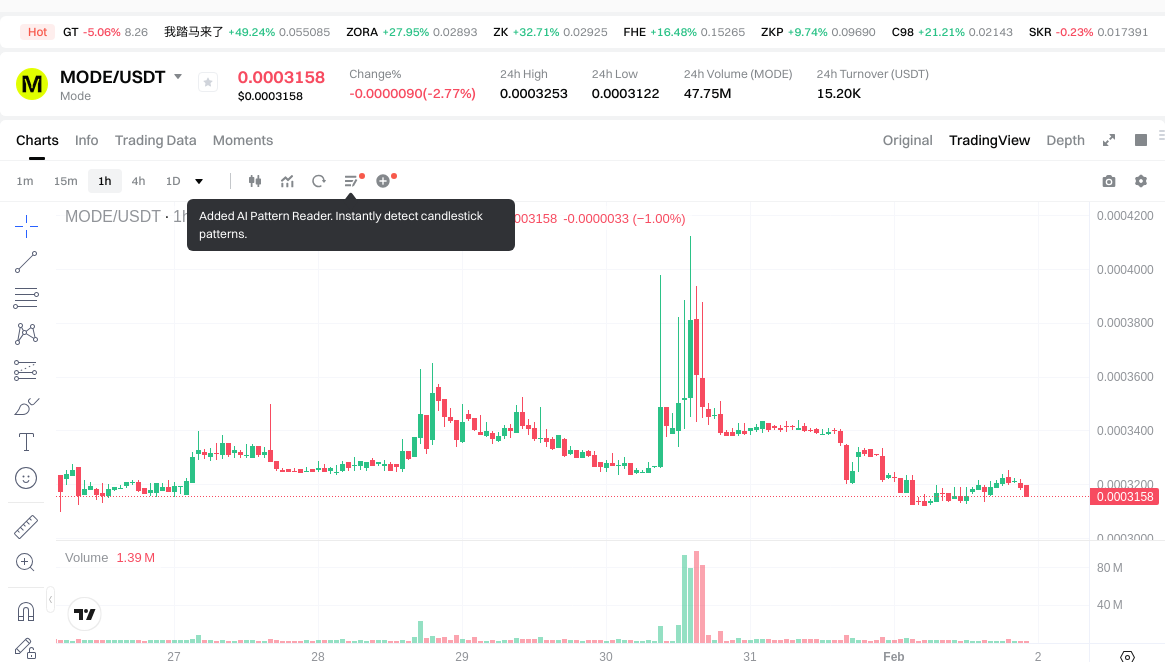
As of 01 February 2026, Mode's circulating supply stands at 5,783,333,334 tokens, with a total supply of 10,000,000,000 tokens. The maximum supply is capped at 10,000,000,000 tokens, establishing a fixed supply model. The current circulation rate is approximately 57.83% of the total supply, indicating that a significant portion of tokens remains to be released into the market, which may influence future supply-demand dynamics.
Price Fluctuations
Mode reached its peak price of $0.15 on 07 May 2024, driven by favorable market conditions during its initial launch phase and ecosystem momentum. The token's lowest price of $0.0003097 occurred on 25 January 2026, reflecting broader market downward pressures and declining sentiment in the cryptocurrency sector. As of 01 February 2026, Mode is trading at $0.0003178, representing a 2.05% decrease over the past 24 hours and an 11.61% decline over the past week. Over the past year, the token has experienced a 98.67% decrease from its peak levels. These fluctuations demonstrate the volatile nature of emerging Layer 2 tokens and their sensitivity to broader market cycles, ecosystem development progress, and shifting investor sentiment.
Click to view the current MODE market price
On-Chain Metrics
- 24-Hour Trading Volume: Approximately $15,282 (indicating current market liquidity and trading activity)
- Token Holders: 105,534 addresses (reflecting the breadth of token distribution and community participation)
- Market Capitalization: $1,837,943 (representing the current circulating value of the token)
- Fully Diluted Market Cap: $3,178,000 (indicating the potential total valuation if all tokens were in circulation)
Mode Ecosystem Applications and Partners
Core Use Cases
Mode's ecosystem supports multiple application scenarios:
- DeFi: The network hosts decentralized finance protocols, providing liquidity solutions and yield optimization.
- Customizable Rollups: Mode's Flare L3 ecosystem powered by Celestia and EigenDA enables high-throughput, low-cost customizable rollups that settle to Mode.
Strategic Partnerships
Mode has established collaboration with Optimism, enhancing its technical capabilities as a Modular DeFi L2.
These partnerships provide a solid foundation for Mode's ecosystem expansion.
Challenges and Controversies
Mode faces the following challenges:
- Market Volatility: Price fluctuations with significant decline over the past year
- Competition Pressure: Other Layer 2 solutions and blockchain networks competing for market share
- Adoption Barriers: Building and maintaining user base and developer community in a competitive environment
These issues have sparked discussions within the community and market, while also driving Mode's continuous innovation.
Mode's community demonstrates strong activity, with over 300,000 monthly users and 50 ecosystem projects.
The network has attracted 105,534 holders, indicating growing community participation.
New feature releases and ecosystem growth have ignited community enthusiasm.
Sentiment on X shows diverse perspectives:
- Supporters praise Mode's Optimism-backed infrastructure and modular design, recognizing it as an innovative DeFi infrastructure solution.
- Critics focus on price volatility and competitive landscape challenges.
Recent trends reflect mixed sentiment influenced by market conditions.
Hot Topics
X platform users actively discuss Mode's economic model that rewards network growth contribution, TVL performance, and Layer 3 ecosystem development,
demonstrating both its transformative potential and the challenges toward mainstream adoption.
- Official Website: Visit Mode Official Website for features, use cases, and latest updates.
- X Updates: On X platform, Mode actively engages through @modenetwork,
posting content covering technical upgrades, community activities, and ecosystem developments.
Mode Future Roadmap
- Ecosystem Goals: Expanding the Flare L3 ecosystem and attracting more developers to build customizable rollups
- Long-term Vision: Becoming a leading modular DeFi infrastructure with comprehensive Layer 2 and Layer 3 solutions
How to Participate in Mode?
- Purchase Channels: Buy MODE on Gate.com and other supported exchanges
- Storage Solutions: Securely store MODE using compatible wallets that support MODEETH network
- Participate in Governance: Engage with the community through official channels and contribute to ecosystem growth
- Build Ecosystem: Visit Mode Documentation to develop applications or contribute code
Summary
Mode redefines DeFi infrastructure through modular blockchain technology, providing scalability, low costs, and customizable solutions.
Its active community, growing ecosystem, and innovative approach position it distinctively in the cryptocurrency space.
Despite facing market volatility and competitive pressures, Mode's innovative spirit and clear development path secure its important position in the future of decentralized technology.
Whether you are a newcomer or an experienced player, Mode deserves attention and participation.
FAQ
What is Crypto MODE? What is its role in blockchain?
MODE is a Layer 2 network built on Ethereum that enhances transaction speed and reduces fees. It processes transactions off-chain while maintaining security through Ethereum, improving network performance and user experience.
What is the difference between Crypto MODE and other encryption modes like ECB and CBC?
Crypto MODE uses cipher block chaining to link each encrypted block with the previous one, enhancing security and error propagation. Unlike ECB, which encrypts blocks independently and is less secure, MODE provides better protection against pattern analysis and is more suitable for sensitive data encryption.
How to implement and use Crypto MODE in cryptocurrency projects?
Crypto MODE is an Ethereum Layer 2 network that enhances transaction efficiency through built-in reward systems. Developers implement MODE by deploying smart contracts on the network, while users participate through staking, transaction activities, and community engagement to earn rewards directly.
What is the security of Crypto MODE? What potential risks exist?
Crypto MODE employs advanced encryption protocols and regular security audits to ensure transaction safety. Potential risks include private key mismanagement and smart contract vulnerabilities. Users must maintain secure key storage practices and verify contract code authenticity.
What are the application scenarios of Crypto MODE in smart contracts and DeFi?
Crypto MODE enables automated trading, decentralized lending, and yield farming in DeFi. It enhances transparency, reduces intermediary costs, and improves capital efficiency through smart contract automation and trustless execution.
* The information is not intended to be and does not constitute financial advice or any other recommendation of any sort offered or endorsed by Gate.