Neo is a next-generation blockchain platform launched in 2014 by Da Hongfei and Erik Zhang, designed to address asset digitization and smart contract limitations. Often called "China's Ethereum," Neo operates through delegated Byzantine Fault Tolerance consensus, featuring a dual-token system where NEO governs the network while GAS powers operations. As of 2026, Neo boasts over 135,000 token holders with 70.53% circulating supply (70.53M tokens), trading at $3.945 with a market cap of $278.2M across 32 exchanges including Gate. The platform excels in smart contracts supporting multiple programming languages, digital identity integration, and decentralized asset management. Neo's ecosystem faces scalability and competitive challenges yet maintains strong developer community support and strategic partnerships. Whether for developers building DApps or investors exploring blockchain infrastructure, Neo represents a significant player in the smart economy ecosystem with clear technical advantages and active commun
Neo's Position and Significance
In 2014, Da Hongfei and Erik Zhang launched Neo (NEO), aiming to address the challenges of asset digitization and the limitations of smart contract platforms in supporting multiple programming languages.
As one of the pioneering smart contract platforms often referred to as "China's Ethereum", Neo plays a key role in blockchain infrastructure, digital identity, and smart economy development.
As of 2026, Neo has established itself as a recognized player in the blockchain ecosystem, with over 135,000 token holders and an active developer community.
This article will provide an in-depth analysis of its technical architecture, market performance, and future potential.
Origin and Development History
Birth Background
Neo was created by Da Hongfei and Erik Zhang in 2014 (originally as AntShares, rebranded to Neo in 2017), aiming to solve the inefficiencies in traditional asset management and the need for digital identity integration in blockchain systems.
It emerged during the early wave of blockchain innovation following Bitcoin's success, with the goal of building the infrastructure for a smart economy through the digitization of assets via smart contracts.
Neo's launch brought new possibilities to developers seeking blockchain platforms that support multiple programming languages and businesses exploring asset tokenization.
Important Milestones
- 2016: Mainnet launch, implementing dual-token mechanism with NEO and GAS, enabling smart contract functionality.
- 2018: Reached a significant price milestone, with NEO touching $198.38, reflecting strong market interest.
- 2020-2021: Major upgrade with Neo N3 introducing enhanced governance mechanisms, improved performance, and native oracle services.
- 2025: Ecosystem continues to evolve with ongoing development in digital identity solutions and cross-chain interoperability.
With the support of the Neo Foundation and a global community of developers, Neo continues to optimize its technology, security, and real-world applications.
How Neo Works
Decentralized Control
Neo operates on a decentralized network of computers (nodes) distributed globally, free from control by banks or governments.
These nodes collaborate to validate transactions, ensuring the system remains transparent and resistant to attacks, granting users greater autonomy and enhancing network resilience.
Blockchain Foundation
Neo's blockchain is a public, immutable digital ledger that records every transaction.
Transactions are grouped into blocks and linked through cryptographic hashing to form a secure chain.
Anyone can view the records, establishing trust without intermediaries.
Neo's architecture supports dual tokens (NEO for governance and GAS for network operations), which enhances its economic model and network functionality.
Ensuring Fairness
Neo employs delegated Byzantine Fault Tolerance (dBFT) to validate transactions and prevent fraudulent activities such as double-spending.
Consensus nodes maintain network security through validation and block generation and receive GAS rewards.
Its innovation includes faster finality and higher transaction throughput compared to traditional Proof of Work systems.
Secure Transactions
Neo uses public-private key cryptography to protect transactions:
- Private keys (like a secret password) are used to sign transactions
- Public keys (like an account number) are used to verify ownership
This mechanism ensures fund security while transactions maintain pseudonymous privacy.
Neo also incorporates digital identity features and supports smart contracts in multiple programming languages, enhancing both security and developer accessibility.
Circulation Overview
As of January 15, 2026, NEO's circulating supply stands at 70,530,000 tokens, with a total supply of 100,000,000 and no maximum supply cap. The circulating supply represents approximately 70.53% of the total supply, indicating a significant portion of tokens are already in circulation. NEO operates as a community-driven open source platform utilizing blockchain technology and digital identity, where developers can digitalize and automate asset management through smart contracts.
Price Volatility
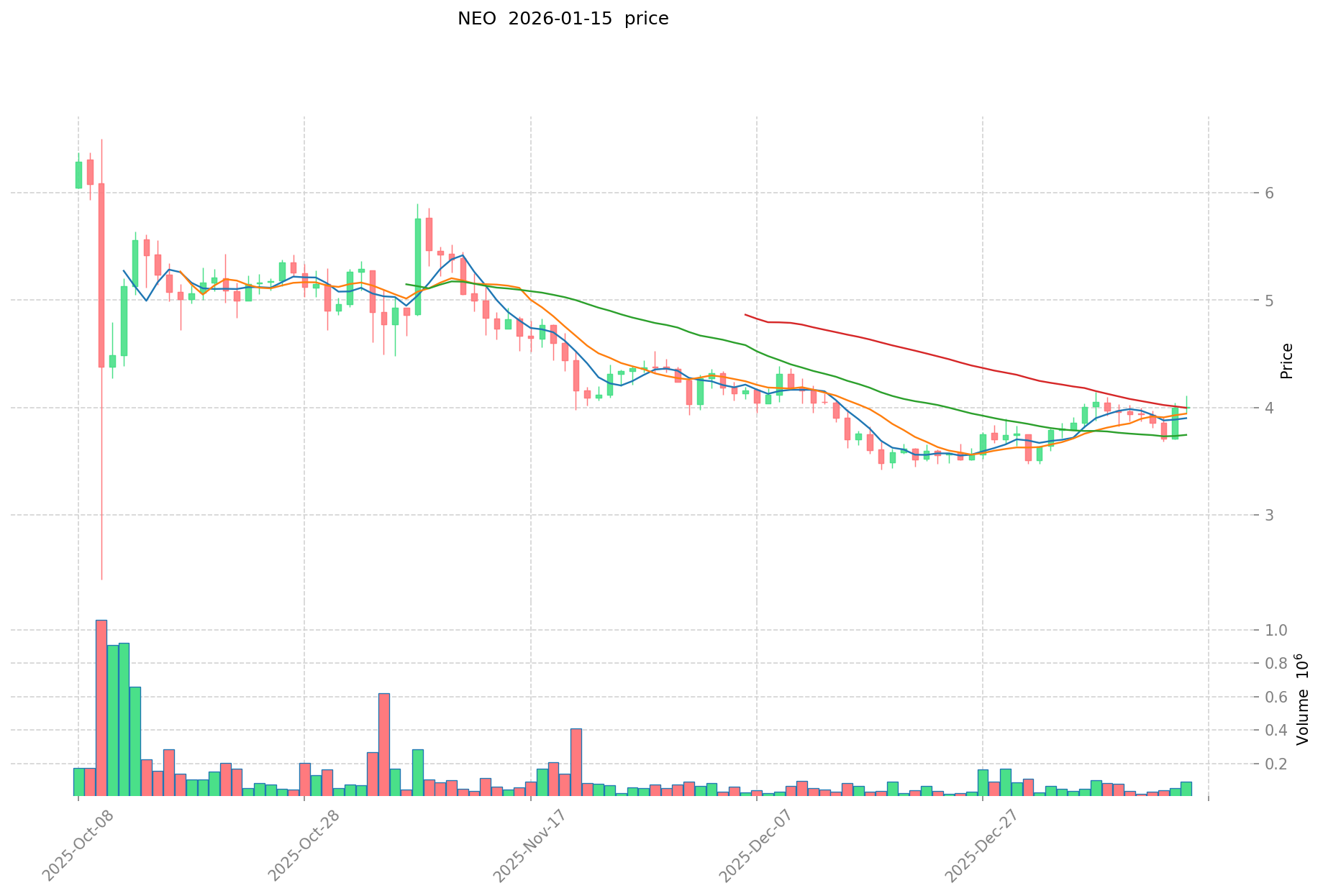
NEO reached a notable price level of $198.38 on January 15, 2018, during a period characterized by substantial market interest in blockchain technology and smart contract platforms. The lowest recorded price was $0.078349 on October 21, 2016, during the early stages of the project's development when market awareness was limited. Currently, NEO is trading at $3.945, with recent price movements showing a decline of 2.66% over the past 24 hours and a 73.47% decrease over the past year. The 24-hour trading range spans from $3.911 to $4.114, reflecting ongoing market dynamics.
Click to view the current NEO market price
On-Chain Metrics
- Market Capitalization: $278,240,850, representing 0.011% market share
- 24-Hour Trading Volume: $254,871.01, indicating current market activity levels
- Holder Addresses: 135,358 addresses hold NEO tokens, demonstrating community distribution
- Exchange Listings: Available on 32 exchanges, providing accessibility for trading
Neo Ecosystem Applications and Partners
Core Use Cases
Neo's ecosystem supports multiple applications:
- Smart Contracts: Neo enables developers to digitalize and automate asset management through smart contracts, providing decentralized asset management solutions.
- Digital Identity: Neo integrates digital identity technology, promoting secure identity verification in the blockchain space.
Strategic Partnerships
Neo has established collaborations to enhance its technical capabilities and market influence.
These partnerships provide a solid foundation for Neo's ecosystem expansion.
Controversies and Challenges
Neo faces the following challenges:
- Technical Issues: Scalability concerns and network optimization remain areas of focus
- Competition Pressure: The rise of other blockchain platforms presents ongoing competitive challenges
These issues have sparked discussions within the community and market, driving Neo's continuous innovation.
Neo's community demonstrates vitality, with 135,358 holders actively participating in the ecosystem.
On X platform, related posts and hashtags (such as #NEO) frequently trend.
Factors such as technological upgrades and ecosystem developments have ignited community enthusiasm.
Sentiment on X shows diverse perspectives:
- Supporters praise Neo's smart contract capabilities and digital identity integration, considering it a strong infrastructure for the next-generation Internet.
- Critics focus on price volatility and market performance concerns.
Recent trends indicate mixed sentiment as the market evaluates Neo's long-term positioning.
Hot Topics
X users actively discuss Neo's technological innovation, ecosystem development, and market positioning,
showcasing both its transformative potential and the challenges it faces in achieving mainstream adoption.
- Official Website: Visit Neo Official Website for features, use cases, and latest updates.
- White Paper: Neo White Paper details its technical architecture, objectives, and vision.
- X Updates: On X platform, Neo maintains an active presence through @NEO_Blockchain,
with posts covering technical upgrades, community activities, and ecosystem news, generating significant engagement.
Neo Future Roadmap
- Ongoing Development: Continue enhancing distributed network infrastructure and improving blockchain scalability
- Ecosystem Goals: Expand developer community and support more decentralized applications
- Long-term Vision: Become foundational infrastructure for smart economy
How to Participate in Neo?
- Purchase Channels: Buy Neo on Gate.com and other exchanges
- Storage Solutions: Securely store Neo using compatible wallets
- Community Participation: Engage with the Neo community through official channels
- Ecosystem Building: Visit developer documentation to build DApps or contribute to the codebase
Summary
Neo redefines digital currency through blockchain technology, providing transparency, security, and automated asset management.
Its active community, rich resources, and technological innovation make it distinctive in the cryptocurrency field.
Despite facing regulatory uncertainties and competitive pressures, Neo's innovative spirit and clear development direction position it importantly in the future of decentralized technology.
Whether you are a newcomer or an experienced player, Neo is worth following and participating in.
FAQ
What is NEO cryptocurrency and how does it work?
NEO is a blockchain platform enabling smart contracts and decentralized applications. It uses a delegated Byzantine Fault Tolerance consensus mechanism. NEO tokens serve for staking, network governance voting, and transaction fees on the NEO network.
What are the main features and advantages of NEO blockchain?
NEO offers smart contract functionality, high transaction speeds, and low fees. Key advantages include flexible asset management, robust governance model, and strong developer ecosystem support.
How is NEO different from Ethereum?
NEO offers faster transaction speeds and lower fees through optimized scalability, while Ethereum provides a broader DeFi ecosystem. NEO uses a delegated Byzantine Fault Tolerance consensus mechanism, whereas Ethereum is transitioning to Proof of Stake for enhanced efficiency.
How can I buy and store NEO tokens?
Purchase NEO tokens on reputable exchanges, then transfer them to a non-custodial wallet like HaxWallet or Ledger Hardware Wallet for optimal security and private key control.
What is the purpose of NEO's dual-token system (NEO and GAS)?
NEO serves governance rights, while GAS powers transaction fees and smart contract execution. NEO holders automatically generate GAS rewards, enabling network operations and user incentives.
Is NEO a safe and secure investment?
NEO operates with regulatory oversight from the Central Bank of Lithuania, providing institutional credibility. As a leading smart contract platform with strong security audits and a robust ecosystem, NEO maintains industry-standard security measures. However, all crypto investments carry inherent market risks that depend on individual circumstances and research.
What are the risks and challenges associated with NEO?
NEO faces regulatory inconsistencies across jurisdictions, smart contract vulnerabilities, competition from other blockchain platforms, and potential security risks. Network scalability and adoption rate fluctuations also present ongoing challenges for long-term growth.
What is the future outlook and development roadmap for NEO?
NEO's 2025 roadmap prioritizes Neon Wallet enhancement and new tool development. The project focuses on scalability improvements, user experience optimization, and strengthening community engagement for sustainable growth.
* The information is not intended to be and does not constitute financial advice or any other recommendation of any sort offered or endorsed by Gate.