Harmony (ONE) is a revolutionary Layer 1 blockchain platform that addresses cryptocurrency scalability challenges through advanced sharding technology and distributed consensus mechanisms. Launched in 2019, ONE enables high-performance decentralized applications across DeFi, gaming, and IoT sectors with over 8.3 million token holders. This comprehensive guide explores ONE's innovative technical architecture, including sharding-based transaction processing and Proof of Stake consensus, while analyzing current market performance showing a circulating supply of 14.8 billion tokens. The article examines real-world ecosystem applications, competitive positioning within the blockchain landscape, and community engagement dynamics. Whether you're evaluating ONE for investment, seeking to understand sharding technology, or exploring DeFi opportunities, this resource provides detailed market data, security mechanisms, and participation pathways through Gate and compatible platforms to support informed decision-making.
Harmony's Positioning and Significance
In 2019, Harmony Protocol launched Harmony (ONE), aiming to address blockchain scalability bottlenecks and security challenges in decentralized networks.
As a next-generation sharding-based blockchain, Harmony plays a key role in DeFi, gaming, and IoT applications.
As of 2026, Harmony has established itself as a scalable Layer 1 blockchain solution, with over 8.3 million holders and an active developer community.
This article will provide an in-depth analysis of its technical architecture, market performance, and future potential.
Origin and Development History
Background
Harmony was created by Harmony Protocol in 2019, aiming to solve scalability and security limitations in existing blockchain networks.
It emerged during the blockchain technology boom, with the goal of providing a fully scalable, secure, and decentralized infrastructure through innovative sharding technology.
Harmony's launch brought new possibilities to developers and enterprises seeking high-performance blockchain solutions.
Key Milestones
- 2019: Mainnet launch, achieving full sharding implementation including transaction confirmation, network communication, and blockchain state.
- Ongoing Development: Continuous optimization of Adaptive Information Dispersal Algorithm for cross-shard communication.
- Ecosystem Growth: Expansion in decentralized exchanges, gaming platforms, and IoT applications.
- Network Security: Implementation of DRG (Distributed Random Generation) process for unpredictable and fair shard validation.
With support from the Harmony community and development team, Harmony continues to optimize its technology, security, and real-world applications.
How Harmony Works
No Central Control
Harmony operates on a globally distributed decentralized computer network (nodes), free from bank or government control.
These nodes collaborate to validate transactions, ensuring system transparency and attack resistance, granting users greater autonomy and enhancing network resilience.
Blockchain Core
Harmony's blockchain is a public, immutable digital ledger that records every transaction.
Transactions are grouped into blocks and linked through cryptographic hashing to form a secure chain.
Anyone can view the records, establishing trust without intermediaries.
Sharding technology further enhances performance by dividing the network into multiple shards that process transactions in parallel, enabling logarithmic scaling as the number of shards increases.
Ensuring Fairness
Harmony employs Proof of Stake (PoS) with optimized PBFT consensus mechanism to validate transactions and prevent fraud such as double-spending.
Validators maintain network security through token staking and block validation, earning ONE rewards.
Its innovation includes DRG-based shard randomization for unpredictable, fair, verifiable, and scalable validator selection, while ensuring small stakers can participate and preventing malicious actors from gaining control of single shards.
Secure Transactions
Harmony uses public-private key cryptography to protect transactions:
- Private keys (like secret passwords) are used to sign transactions
- Public keys (like account numbers) are used to verify ownership
This mechanism ensures fund security while transactions remain pseudonymous.
Atomic locking mechanism enables secure cross-shard transactions, maintaining consistency across shards through direct communication between shards via Kademlia routing.
Circulation Overview
As of January 19, 2026, Harmony (ONE) has a circulating supply of 14,823,972,008.76 tokens, with a total supply of 14,824,544,762.76 tokens. The circulation ratio stands at approximately 99.996%, indicating that nearly all issued tokens are currently in circulation. Harmony employs an inflationary model with no maximum supply cap (∞), allowing for continuous token issuance to support network operations and validator rewards.
Price Volatility
Harmony (ONE) reached its all-time high price of $0.37902 on October 26, 2021, driven by increased market interest in scalable blockchain solutions and broader cryptocurrency market momentum during that period. The token experienced its lowest recorded price of $0.00127355 on March 13, 2020, coinciding with broader market volatility and early-stage project development phases. These price movements reflect the dynamic nature of market sentiment, adoption patterns, and evolving perceptions of the project's technological capabilities.
Click to view current ONE market price
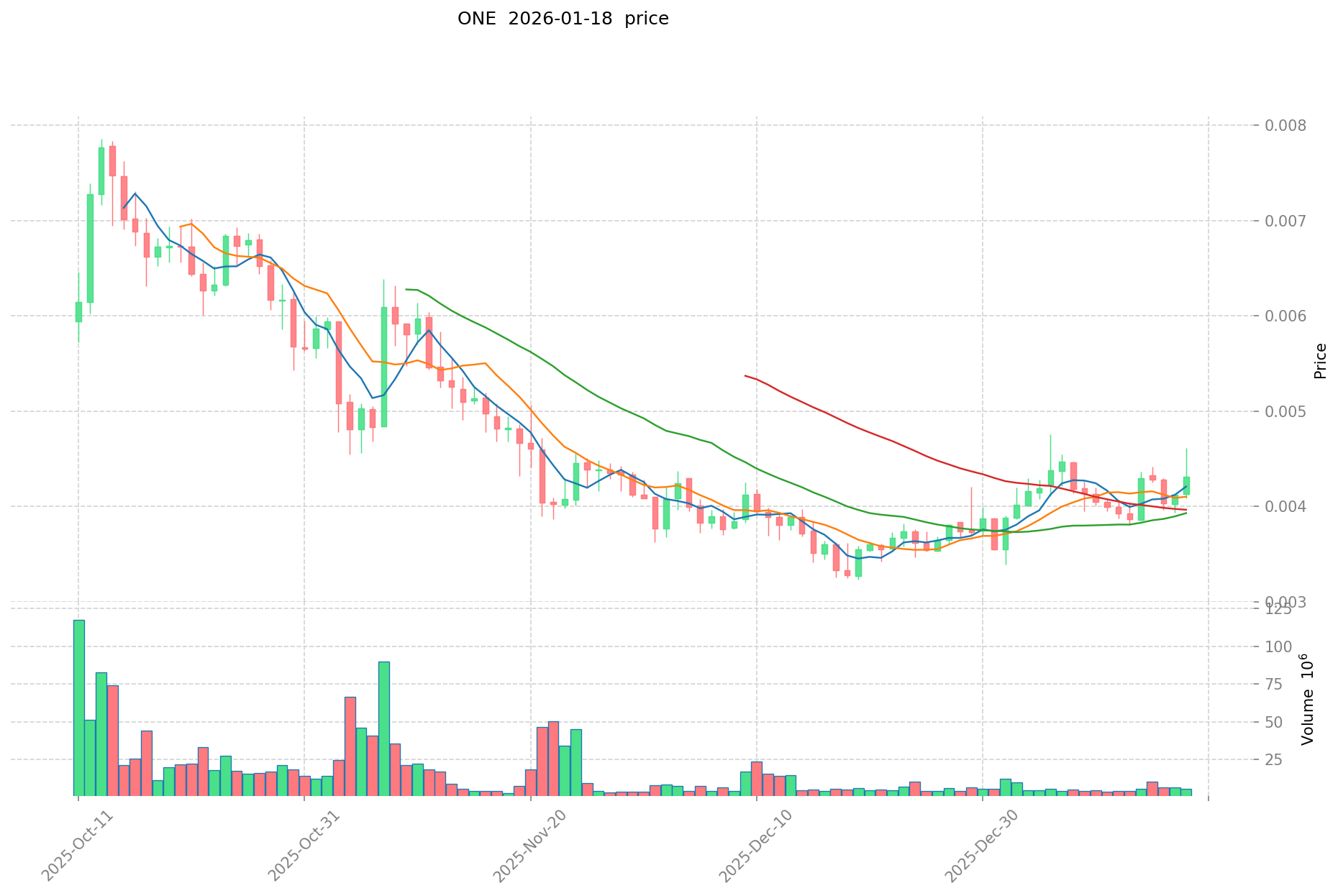
Recent Price Trends
- 1-Hour Change: +0.11% (indicating short-term stability)
- 24-Hour Change: -5.49% (reflecting recent market adjustment)
- 7-Day Change: +5.68% (showing weekly positive momentum)
- 30-Day Change: +23.83% (demonstrating monthly growth trend)
- 1-Year Change: -85.22% (reflecting longer-term market challenges)
On-Chain Metrics
- Holders: Approximately 8,334,669 addresses hold ONE tokens, indicating broad distribution and community participation
- 24-Hour Trading Volume: $52,971.89, reflecting active market engagement
- Market Capitalization: $62,735,049.54, representing the total market value of circulating tokens
- Fully Diluted Valuation: $62,737,473.44, closely aligned with current market cap due to high circulation ratio
Harmony Ecosystem Applications and Partners
Core Use Cases
Harmony's ecosystem supports multiple application scenarios:
- Decentralized Finance (DeFi): Projects like decentralized exchanges (DEX) provide permissionless trading and liquidity services.
- Gaming and NFT: Blockchain-based gaming applications leverage Harmony's infrastructure to enable digital asset ownership and in-game economies.
- Internet of Things (IoT): Harmony's architecture aims to support scalable IoT applications through its sharding technology.
Strategic Partnerships
Harmony has established collaborations with various partners to enhance its technical capabilities and market presence.
These partnerships provide a solid foundation for Harmony's ecosystem expansion.
Controversies and Challenges
Harmony faces the following challenges:
- Technical Challenges: Maintaining security across multiple shards while ensuring scalability remains an ongoing focus.
- Regulatory Risks: Evolving cryptocurrency regulations globally create uncertainty for blockchain projects.
- Competitive Pressure: The emergence of alternative layer-1 blockchains with different technical approaches creates a competitive landscape.
These issues have sparked discussions within the community and market, driving Harmony's continuous innovation.
Harmony's community remains active with a significant holder base. According to available data, the project has 8,334,669 holders.
On X platform, related posts and hashtags (such as #ONE) generate ongoing discussions.
Factors such as technical developments and ecosystem growth contribute to community enthusiasm.
Sentiment on X shows varied perspectives:
- Supporters praise Harmony's sharding technology, cross-shard communication capabilities, and adaptive consensus mechanism, viewing it as an innovative approach to blockchain scalability.
- Critics focus on price volatility and competitive positioning within the broader blockchain ecosystem.
Recent trends reflect typical crypto market dynamics with sentiment influenced by broader market conditions.
Trending Topics
X users discuss Harmony's technical architecture, sharding implementation, and DeFi ecosystem development,
showcasing both its technological potential and the challenges of mainstream adoption.
- Official Website: Visit Harmony Official Site for features, use cases, and latest updates.
- Whitepaper: Harmony Whitepaper provides detailed technical architecture, objectives, and vision.
- X Updates: Harmony maintains an active presence on X platform using @harmonyprotocol,
with posts covering technical upgrades, community events, and ecosystem developments.
Harmony Future Roadmap
- Technical Development: Continue optimizing the sharding protocol and cross-shard transaction mechanisms to enhance transaction throughput and network efficiency.
- Ecosystem Goals: Expand support for decentralized applications across DeFi, gaming, and IoT sectors.
- Long-term Vision: Establish Harmony as a scalable infrastructure for decentralized applications supporting mainstream adoption.
How to Participate in Harmony?
- Purchase Channels: ONE tokens are available on Gate.com and other supported platforms.
- Storage Solutions: Securely store ONE using compatible wallet solutions.
- Community Engagement: Participate in community discussions through official channels including Reddit and Discord.
- Ecosystem Building: Access developer documentation to build DApps or contribute to the ecosystem.
Summary
Harmony leverages blockchain technology with a focus on sharding to provide scalability, security, and decentralization.
Its technical approach, including distributed random generation (DRG) for shard formation and adaptive information dispersal algorithms, positions it as an infrastructure solution for decentralized applications.
Despite facing competitive pressures and technical implementation challenges, Harmony's focus on cross-shard communication and network optimization demonstrates its commitment to addressing blockchain scalability.
Whether you are new to cryptocurrency or an experienced participant, Harmony represents an interesting technical approach in the blockchain space worth exploring.
FAQ
What is Harmony ONE and what is its main purpose?
Harmony ONE is a blockchain platform designed for building and deploying decentralized applications with high efficiency and low transaction fees. Its main purpose is providing a scalable and fast environment for Dapps.
How does ONE cryptocurrency work and what technology does it use?
ONE operates on blockchain technology using a delegated proof-of-stake consensus mechanism. Transactions are verified by validators across a decentralized network, ensuring security and fast settlement with low transaction costs.
Where can I buy and store Harmony ONE tokens?
Purchase Harmony ONE on major cryptocurrency exchanges. Store tokens securely in the official Harmony ONE wallet or hardware wallets for enhanced security and staking opportunities.
What are the key differences between ONE and other cryptocurrencies like Ethereum or Bitcoin?
ONE uses a hybrid consensus mechanism combining Proof of Work and Proof of Stake, offering superior scalability and energy efficiency compared to Bitcoin's PoW or Ethereum's PoS. ONE prioritizes decentralized applications and smart contracts with faster transaction processing and lower fees.
Is Harmony ONE safe and what are the main risks?
Harmony ONE features robust security through sharding technology and strong validation mechanisms. Main risks include market volatility, regulatory uncertainty, and smart contract vulnerabilities. Conduct thorough research before participation.
What is the future outlook and potential of Harmony ONE?
Harmony ONE shows strong future potential with advanced cross-chain protocols driving adoption. Long-term forecasts suggest significant price growth, with predictions exceeding $5 by 2045 and potentially reaching $10, reflecting increasing ecosystem development and market recognition.
* The information is not intended to be and does not constitute financial advice or any other recommendation of any sort offered or endorsed by Gate.