This comprehensive guide explores Orderly Network (ORDER), a decentralized omnichain liquidity infrastructure launched in 2024 to solve fragmented liquidity and inefficient cross-chain derivatives trading. The article covers Orderly Network's technical architecture built on OP Stack, Celestia, and LayerZero, enabling unified orderbook liquidity across multiple blockchains. It details market performance metrics, including circulating supply and recent price movements, alongside ecosystem applications serving DeFi traders and developers. The guide examines strategic partnerships, community engagement on social media, and challenges including market competition and price volatility. Whether purchasing ORDER tokens on Gate.com or building applications on the infrastructure, readers gain actionable insights into participating in cross-chain liquidity solutions and understanding Orderly Network's role in the evolving DeFi landscape.
Orderly Network's Positioning and Significance
In 2024, the Orderly Network team launched Orderly Network (ORDER), aiming to address fragmented liquidity and inefficient cross-chain trading in decentralized derivatives markets.
As a cloud liquidity infrastructure that consolidates omnichain orderbook liquidity, Orderly Network plays a critical role in DeFi derivatives trading and cross-chain liquidity aggregation.
As of 2026, Orderly Network has established itself as an infrastructure layer serving multiple DeFi applications, with an active developer community building on its omnichain liquidity layer.
This article will provide an in-depth analysis of its technical architecture, market performance, and future potential.
Origin and Development History
Birth Background
Orderly Network was created by its development team in 2024, aiming to solve fragmented liquidity across multiple blockchains and the inefficiency of cross-chain derivative trading.
It emerged during the maturation phase of Layer 2 solutions and cross-chain infrastructure, with the goal of providing unified liquidity and seamless omnichain trading experience to transform the current landscape.
The launch of Orderly Network brought new possibilities to DeFi traders and protocol developers seeking deep liquidity.
Important Milestones
- August 2024: Token listing on Gate.com, establishing trading accessibility for global users.
- 2024: Mainnet deployment on Orderly Chain, built on OP Stack leveraging Celestia's data availability and LayerZero's cross-chain messaging protocol.
- 2024-2025: Integration with multiple DeFi protocols, enabling developers to build trading applications with unified liquidity.
- 2025: Ecosystem expansion with protocols utilizing Orderly's omnichain orderbook infrastructure.
With support from its development team and community, Orderly Network continues to enhance its technology, security, and real-world applications.
How Orderly Network Operates?
Decentralized Infrastructure
Orderly Network operates through a decentralized infrastructure layer that aggregates liquidity across multiple blockchains without relying on centralized intermediaries.
The network coordinates orderbook data and settlement across chains, ensuring transparency and resilience while giving users greater control over their trading activities.
Blockchain Foundation
Orderly Network's infrastructure is built on Orderly Chain, utilizing OP Stack architecture combined with Celestia for data availability and LayerZero for cross-chain messaging.
This architecture creates a unified ledger that records all trading activities in a transparent and immutable manner.
The shared orderbook consolidates orders from multiple chains into a single liquidity pool, eliminating fragmentation and enabling tighter spreads.
The use of Celestia's data availability layer and LayerZero's cross-chain protocol enhances scalability and interoperability.
Consensus and Security
Orderly Network leverages the security mechanisms of its underlying infrastructure components, including OP Stack's optimistic rollup validation and LayerZero's cross-chain verification protocols.
Validators and node operators maintain network integrity by processing transactions and ensuring data consistency across chains.
The architecture is designed to provide high throughput while maintaining security through cryptographic verification and fraud-proof mechanisms.
Secure Transactions
Orderly Network employs standard cryptographic security for transaction protection:
- Private keys are used to authorize trading actions and asset movements
- Public keys serve as account identifiers for verification
This mechanism ensures asset security while maintaining pseudonymous transaction privacy.
The cross-chain infrastructure includes additional security layers through LayerZero's messaging validation and Celestia's data availability guarantees.
Circulating Supply Overview
As of 24 January 2026, Orderly Network (ORDER) has a circulating supply of 212,866,111 tokens, with a total supply of 1,000,000,000 tokens. The circulating supply represents approximately 21.29% of the total supply, indicating a significant portion of tokens remains unvested or locked.
Price Volatility
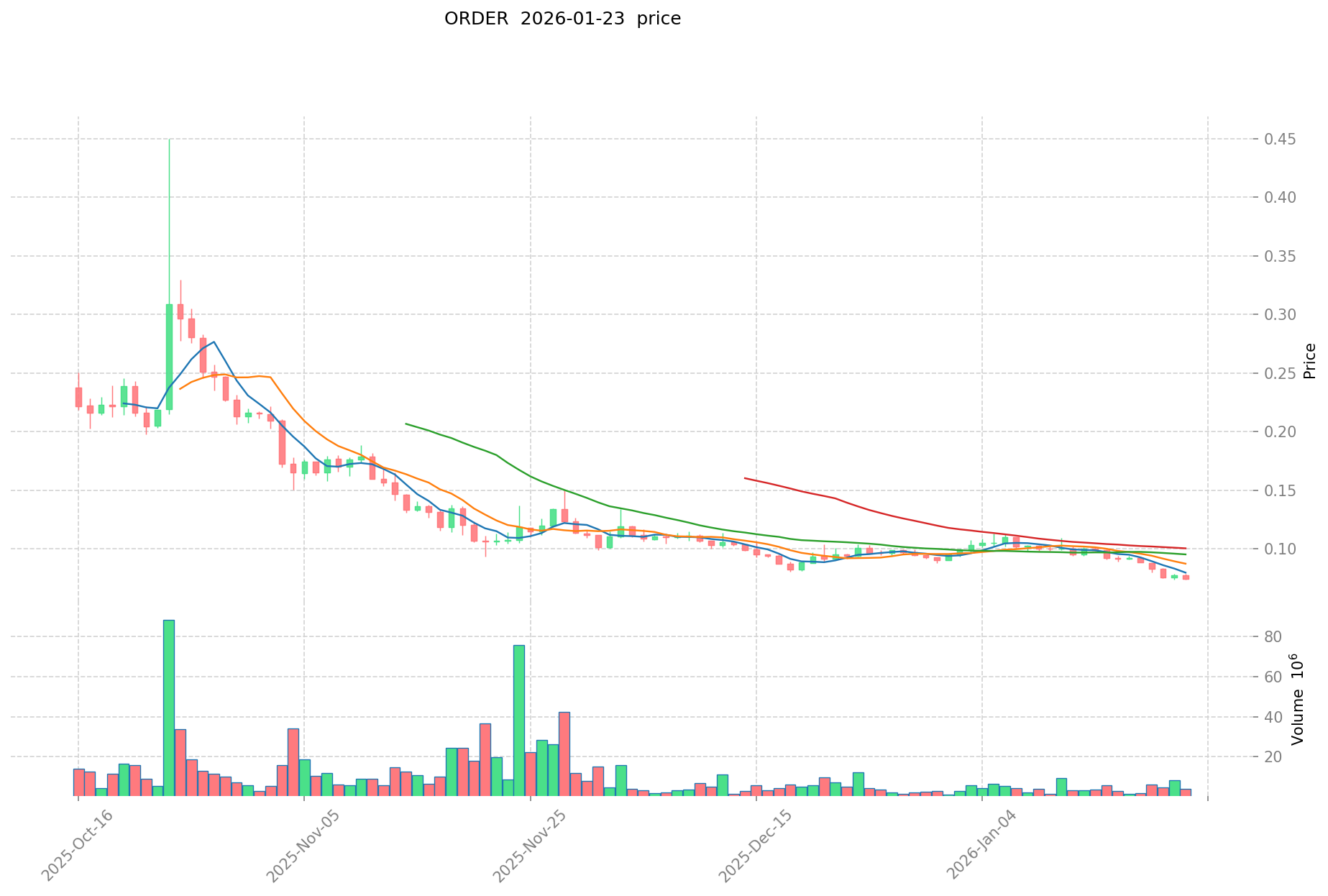
Orderly Network (ORDER) reached a notable price point of $0.497 on 6 October 2025, driven by factors such as market momentum and ecosystem developments. The token experienced its lowest price of $0.02 on 26 August 2024, reflecting early-stage market conditions and initial price discovery.
Recent market performance shows mixed trends:
- 1-hour change: +0.48%
- 24-hour change: +7.64%
- 7-day change: -12.55%
- 30-day change: -21.24%
- 1-year change: -74.47%
The 24-hour trading range spans from $0.07362 to $0.08553, with current trading volume at approximately $1.22 million. These fluctuations reflect market sentiment, adoption trends, and broader cryptocurrency market dynamics.
Click to view the current ORDER market price
On-Chain Metrics
- Token Holders: 27,862 addresses hold ORDER tokens, indicating growing community participation
- Market Capitalization: Approximately $16.99 million in circulating market cap
- Fully Diluted Valuation: $79.83 million, representing the potential market cap if all tokens were in circulation
- Token Standard: ERC-20 on Ethereum blockchain
Orderly Network Ecosystem Applications and Partners
Core Use Cases
Orderly Network's ecosystem supports multiple applications:
- DeFi Trading Infrastructure: Orderly Network provides omnichain liquidity aggregation for decentralized derivatives trading, enabling developers to build trading platforms with unified orderbook liquidity across multiple blockchains.
- Cross-Chain DeFi Solutions: By consolidating orders from different chains into a shared orderbook, Orderly Network facilitates efficient cross-chain trading without the need for asset bridging, reducing associated risks.
Strategic Partnerships
Orderly Network has built its infrastructure utilizing partnerships with established blockchain protocols including OP Stack for its chain architecture, Celestia for data availability, and LayerZero for cross-chain messaging.
These technological collaborations provide a solid foundation for Orderly Network's ecosystem expansion.
Challenges and Considerations
Orderly Network faces several challenges:
- Market Competition: The DeFi infrastructure space includes various competing protocols offering liquidity solutions and trading platforms
- Technical Complexity: Managing cross-chain liquidity and maintaining orderbook synchronization across multiple blockchains presents ongoing technical challenges
- Market Volatility: The token has experienced price fluctuations, with a decline of approximately 74.47% over the past year
These factors have generated discussion within the community and continue to drive the project's innovation efforts.
Orderly Network maintains an active community presence with approximately 27,862 token holders.
The project engages with its community through its official X platform account @OrderlyNetwork, sharing updates about technical developments and ecosystem growth.
Community interest has been influenced by factors such as platform launches, protocol updates, and partnership announcements.
Sentiment on X shows varied perspectives:
- Supporters highlight Orderly Network's omnichain liquidity infrastructure and developer-friendly approach, viewing it as innovative infrastructure for DeFi trading.
- Observers note considerations including market performance fluctuations and the competitive landscape in the DeFi infrastructure sector.
Recent trends reflect typical dynamics within the cryptocurrency market environment.
Discussion Topics
X users discuss Orderly Network's approach to cross-chain liquidity, technical architecture choices, and ecosystem development strategy,
reflecting both interest in its infrastructure capabilities and awareness of challenges in achieving widespread adoption.
- Official Website: Visit Orderly Network Official Site for features, use cases, and latest developments.
- Documentation: Orderly Network Documentation details its technical architecture, objectives, and vision.
- X Updates: On X platform, Orderly Network operates under @OrderlyNetwork,
sharing content about technical developments, ecosystem updates, and partnership announcements.
Orderly Network Future Roadmap
- Development Focus: Continue enhancing omnichain trading infrastructure to improve transaction efficiency and liquidity depth
- Ecosystem Goals: Expand developer adoption and support building of diverse financial products on the platform
- Long-term Vision: Establish itself as comprehensive cloud liquidity infrastructure serving the DeFi ecosystem
How to Participate in Orderly Network?
- Purchase Options: ORDER tokens can be acquired on Gate.com and other supported exchanges
- Storage Solutions: Use compatible wallets such as MetaMask or hardware wallets for secure storage of ERC-20 tokens
- Ecosystem Participation: Visit the developer documentation to explore building applications utilizing Orderly Network's infrastructure
- Stay Informed: Follow official channels for updates on platform developments and ecosystem growth
Summary
Orderly Network leverages blockchain technology to provide omnichain liquidity infrastructure, offering unified orderbook liquidity, cross-chain trading efficiency, and reduced bridging risks.
Its technical architecture, developer resources, and market presence position it within the DeFi infrastructure sector.
While facing challenges including market competition and price volatility, Orderly Network's infrastructure approach and development roadmap give it a role in the evolving decentralized trading landscape.
Whether you are new to DeFi infrastructure or an experienced participant, Orderly Network represents an interesting development in cross-chain liquidity solutions.
FAQ
What is a crypto order and how does it work in cryptocurrency trading?
A crypto order is a request to buy or sell digital assets at specified prices. Market orders execute immediately at current prices, while limit orders wait for your target price. Orders track transaction amounts and execute when price conditions match, enabling efficient trading operations.
What are the different types of crypto orders (market order, limit order, stop-loss order)?
Market orders execute immediately at current prices. Limit orders let you set a specific price for buying or selling. Stop-loss orders automatically sell when price drops to a target level, protecting against losses.
How do I place a crypto order on an exchange?
To place a crypto order, navigate to the trading section, select your desired cryptocurrency pair, choose between market or limit orders, enter the amount, review details, and confirm. Market orders execute immediately at current prices, while limit orders execute at your specified price.
What is the difference between a market order and a limit order in crypto trading?
Market orders execute immediately at current prices, ensuring fast transactions. Limit orders let you set a specific price, executing only when that price is reached, offering better control over transaction costs.
What are the risks and benefits of using different crypto order types?
Market orders offer instant execution but higher slippage costs. Limit orders provide better price control with execution risk. Stop orders protect against losses during volatility. Each type suits different trading strategies and market conditions.
* The information is not intended to be and does not constitute financial advice or any other recommendation of any sort offered or endorsed by Gate.