Osmosis is an advanced decentralized exchange (DEX) and automated market maker (AMM) protocol built on the Cosmos ecosystem, designed to address limitations of traditional DeFi platforms. This comprehensive guide explores Osmosis's technical architecture, market dynamics, and ecosystem applications. The article covers the protocol's origin, operational mechanisms including Proof of Stake consensus and cross-chain interoperability via IBC, and OSMO token economics with current market metrics. Discover how Osmosis enables customizable liquidity pools, governance participation, and DeFi innovation while examining challenges, community engagement, and future development roadmap. Whether you're a trader, developer, or DeFi participant, this guide explains how to purchase OSMO on Gate, participate in governance, and leverage Osmosis's unique features within decentralized finance.
Osmosis's Position and Significance
In 2021, the Osmosis team launched Osmosis (OSMO), designed to address the limitations of existing automated market maker (AMM) protocols and the need for customizable decentralized exchange solutions.
As an advanced AMM protocol built on the Cosmos SDK, Osmosis plays a critical role in decentralized finance (DeFi) and cross-chain liquidity provision.
As of 2026, Osmosis has established itself as a significant player in the Cosmos ecosystem, with an active developer community and ongoing protocol development.
This article will provide an in-depth analysis of its technical architecture, market performance, and future potential.
Origin and Development History
Background
Osmosis was created by the Osmosis Labs team in 2021, aiming to solve the inflexibility of traditional AMM protocols and enable developers to build custom trading solutions.
It emerged during the rapid expansion of DeFi and the Cosmos ecosystem, with the goal of providing a sovereign AMM platform where developers can design, build, and deploy their own customized market makers.
The launch of Osmosis brought new possibilities for DeFi developers and liquidity providers seeking tailored trading experiences.
Key Milestones
- 2021: Mainnet launch on June 19, introducing customizable AMM functionality and governance features.
- Subsequent years: Protocol upgrades enhancing cross-chain interoperability within the Cosmos ecosystem through IBC (Inter-Blockchain Communication).
- Ongoing development: Continuous expansion of supported assets and liquidity pools, strengthening its position as a hub for Cosmos-based DeFi.
With support from the Osmosis community and Osmosis Labs, the protocol continues to enhance its technical capabilities, security measures, and real-world applications.
How Osmosis Works
No Central Control
Osmosis operates on a decentralized network of computers (nodes) distributed globally, free from control by banks or governments.
These nodes collaborate to validate transactions, ensuring the system remains transparent and resistant to attacks, granting users greater autonomy and enhancing network resilience.
Blockchain Core
Osmosis's blockchain is a public, immutable digital ledger that records every transaction.
Transactions are grouped into blocks and linked through cryptographic hashes to form a secure chain.
Anyone can view the records, establishing trust without intermediaries.
The protocol leverages the Cosmos SDK and IBC protocol to enable seamless cross-chain communication and liquidity transfer.
Ensuring Fairness
Osmosis employs Proof of Stake (PoS) through the Tendermint consensus mechanism to validate transactions and prevent fraudulent activities such as double-spending.
Validators maintain network security by staking OSMO tokens and participating in block production, earning OSMO rewards in return.
Its innovative features include customizable liquidity pool parameters and flexible fee structures, allowing developers to optimize their AMMs for specific use cases.
Secure Transactions
Osmosis uses public-private key cryptography to protect transactions:
- Private keys (similar to secret passwords) are used to sign transactions
- Public keys (similar to account numbers) are used to verify ownership
This mechanism ensures fund security while maintaining pseudonymous transaction privacy.
Additional security features include on-chain governance mechanisms that allow OSMO token holders to vote on protocol upgrades and strategic decisions.
Circulation Overview
As of January 20, 2026, Osmosis (OSMO) has a circulating supply of 759,486,300 tokens, with a total supply of 985,382,460 tokens and a maximum supply cap of 1,000,000,000 tokens. The current circulation represents approximately 75.95% of the total supply, indicating a relatively high token release rate. OSMO operates under a governance-driven token economics model, where the community plays a significant role in protocol decision-making and future developments.
Price Volatility
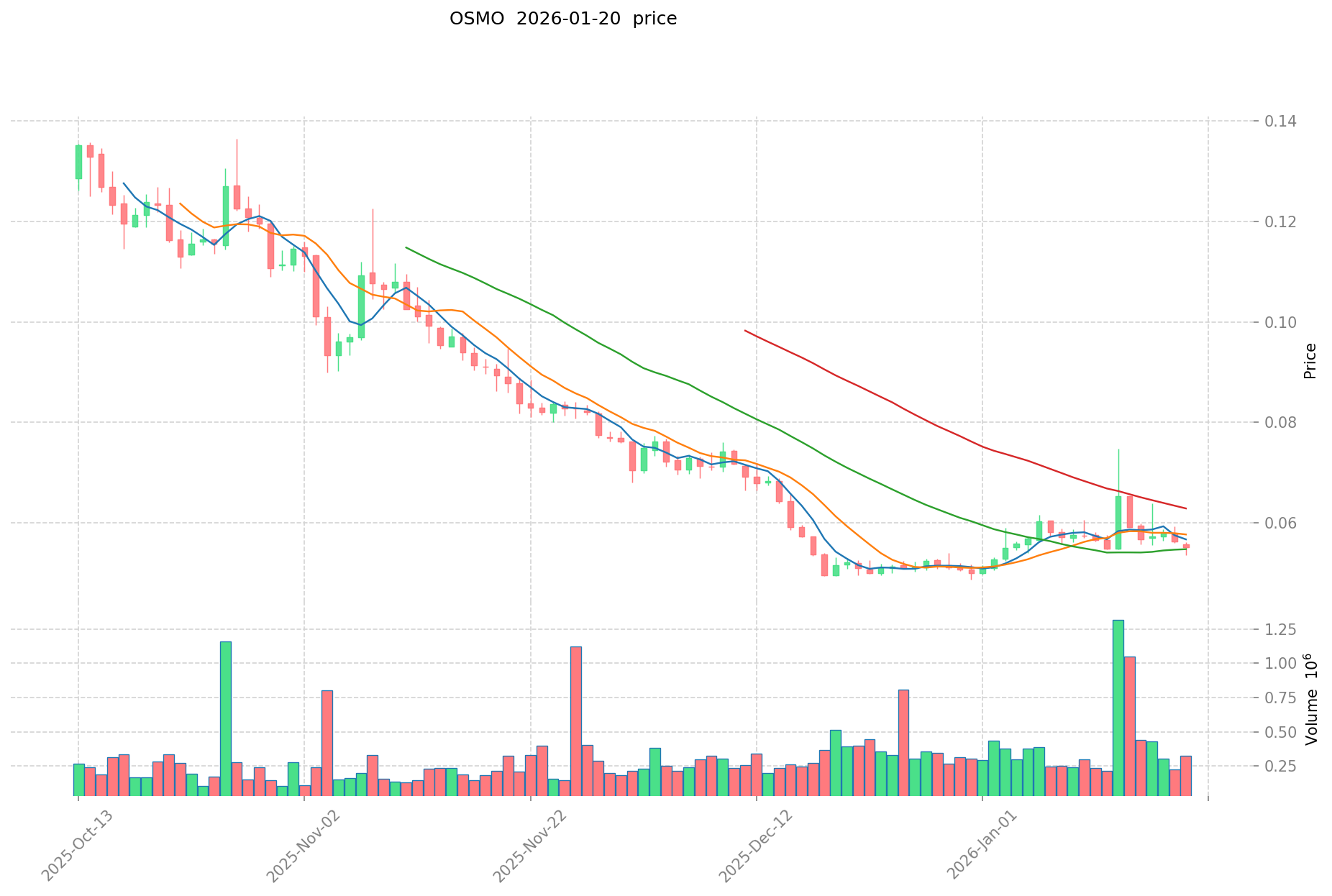
OSMO reached its peak price of $11.25 on March 4, 2022, during a period of broader market enthusiasm and increased adoption of Cosmos ecosystem protocols. The token experienced its lowest recorded price of $0.04890959 on January 1, 2026, reflecting broader market corrections and shifting sentiment in the DeFi sector. As of January 20, 2026, OSMO is trading at $0.05493, showing short-term gains with a 24-hour increase of 2.02% and a 30-day gain of 5.60%. However, the token has experienced a 86.72% decline over the past year, illustrating the significant volatility inherent in crypto markets. These price movements reflect various factors including market sentiment, protocol adoption rates, and competitive dynamics within the AMM and DEX landscape.
Click to view current OSMO market price
On-Chain Metrics
- Market Capitalization: $41,718,582.459 (representing 0.0016% market dominance)
- 24-Hour Trading Volume: $17,702.27716 (indicating current market liquidity)
- Fully Diluted Valuation: $54,127,058.53 (market cap to FDV ratio of 75.95%)
Osmosis Ecosystem Applications and Partners
Core Use Cases
Osmosis's ecosystem supports multiple applications:
- DeFi: As an advanced AMM protocol, Osmosis enables developers to design, build, and deploy custom automated market makers, providing decentralized trading and liquidity provision.
- Governance: OSMO token holders participate in protocol governance, driving strategic direction and future changes through decentralized coordination.
Strategic Partnerships
Osmosis is built using the Cosmos SDK, leveraging the interoperability and technical capabilities of the Cosmos ecosystem.
These foundations provide a solid base for Osmosis's ecosystem expansion.
Controversies and Challenges
Osmosis faces the following challenges:
- Technical Hurdles: Continuous optimization of AMM protocol performance and user experience
- Regulatory Risks: Evolving global regulatory frameworks for DeFi protocols
- Competitive Pressure: Competition from other DEX platforms and AMM protocols in the blockchain space
These issues have sparked discussions within the community and market, while also driving Osmosis's ongoing innovation.
Fan Enthusiasm
Osmosis's community demonstrates notable activity, with the token being listed on 23 exchanges.
On X platform, related posts and hashtags (such as #OSMO and #Osmosis) generate engagement within the DeFi community.
New protocol features and governance proposals spark community enthusiasm.
Sentiment on X shows diverse perspectives:
- Supporters praise Osmosis's customizable AMM features and governance mechanisms, viewing it as an innovative solution in the DeFi space.
- Critics focus on price volatility and market performance, particularly the significant decline over the past year.
Recent trends reflect mixed sentiment influenced by broader market conditions.
Hot Topics
X users actively discuss Osmosis's governance proposals, protocol upgrades, and DeFi innovation,
showcasing both its transformative potential and challenges in achieving wider adoption.
- Official Website: Visit Osmosis Official Website for features, use cases, and latest updates.
- X Updates: On X platform, Osmosis maintains an active presence using @osmosiszone,
with posts covering protocol upgrades, community events, and ecosystem developments, generating substantial engagement.
Osmosis Future Roadmap
- Ongoing Development: Continuous enhancement of AMM protocol capabilities, improving customization options and user experience
- Ecosystem Goals: Expanding the range of custom AMMs and strengthening integration within the Cosmos ecosystem
- Long-term Vision: Establishing Osmosis as a leading platform for customized decentralized exchange solutions
How to Participate in Osmosis?
- Purchase Channels: Buy OSMO on Gate.com and other supported exchanges
- Storage Solutions: Use compatible wallets that support Cosmos-based tokens for secure storage
- Participate in Governance: Engage in community decision-making through OSMO token governance mechanisms
- Build the Ecosystem: Visit the developer documentation on GitHub to develop applications or contribute code
Summary
Osmosis redefines decentralized trading through its innovative AMM protocol, offering customizability, governance participation, and interoperability within the Cosmos ecosystem.
Its active community, technical resources, and position within the DeFi landscape make it notable in the cryptocurrency field.
Despite facing regulatory uncertainties and market volatility, Osmosis's innovative approach and development roadmap position it as a significant player in the future of decentralized finance.
Whether you are new to crypto or an experienced participant, Osmosis merits attention and engagement.
FAQ
What is the OSMO token and what is its role in the Osmosis ecosystem?
OSMO is the native governance and utility token of Osmosis, a leading decentralized exchange and liquidity protocol on Cosmos. It enables holders to participate in governance decisions, earn rewards through liquidity provision, and pay transaction fees. OSMO drives the protocol's economic model and ecosystem growth.
What is Osmosis and how does it work?
Osmosis is a decentralized autonomous market maker (AMM) protocol built on Cosmos. It enables users to trade tokens, provide liquidity, and earn rewards through automated smart contracts. The platform uses a bonding curve mechanism to facilitate token swaps with minimal slippage.
What is the purpose of OSMO tokens and what can they be used for?
OSMO tokens serve as governance tokens for the Osmosis protocol, enabling holders to participate in decentralized decision-making. They facilitate liquidity provision on the platform, earn swap fees and incentives, and can be staked to secure the network while generating rewards.
How to obtain and purchase OSMO tokens? On which exchanges can it be traded?
OSMO tokens can be purchased through major cryptocurrency exchanges by depositing fiat currency or other cryptocurrencies. You can trade OSMO on leading platforms through spot trading pairs. Check exchange listings for current OSMO trading pairs and liquidity options available in your region.
What do I need to understand about liquidity mining on Osmosis? What are the risks?
Understand impermanent loss from price volatility, smart contract risks, and slippage during trades. Monitor your LP positions regularly, diversify pool selections, and start with amounts you can afford to lose. OSMO rewards incentivize participation but market conditions affect actual returns.
What are the differences and advantages of OSMO compared to other DeFi tokens like UNI and AAVE?
OSMO powers Osmosis, a specialized AMM-based DEX with superior capital efficiency and lower slippage. Unlike UNI and AAVE, OSMO offers customizable liquidity pools, inter-blockchain trading, and higher yield opportunities through innovative incentive mechanisms designed for traders and liquidity providers.
* The information is not intended to be and does not constitute financial advice or any other recommendation of any sort offered or endorsed by Gate.