This article provides a comprehensive guide to OVR, elucidating its position in decentralized virtual reality ecosystems. It delves into OVR's technical architecture, market performance, and value proposition, exploring its unique NFT-based land system and decentralized operations on the Ethereum blockchain. It outlines the historical and current market performance, offering investors insight into its trading activity and community engagement. The article targets individuals interested in augmented reality, spatial NFTs, and metaverse infrastructures, providing essential knowledge for informed participation and investment. Access to OVR trading is available through Gate.
OVR Token Analysis Report
OVR's Positioning and Significance
OVR (Ovr) is a decentralized network platform designed to unite the real and virtual worlds through augmented reality (AR) technology. The platform leverages blockchain technology and NFTs to create a spatial metaverse where users can own, trade, and lease virtual land.
As of December 2025, OVR has established itself within the Web3 and metaverse ecosystem, currently ranking #1958 by market capitalization with a circulating market cap of approximately $2.64 million USD. With 16,841 token holders and active development on GitHub, OVR demonstrates ongoing community engagement and technical development.
This report provides a comprehensive analysis of OVR's technical architecture, market performance, and value proposition.
Origin and Development History
Background and Creation
OVR was launched on May 8, 2021, with the objective of addressing the fragmentation between physical and digital spaces. The platform emerged during the rise of metaverse and Web3 technologies, aiming to create a decentralized spatial computing infrastructure powered by augmented reality.
The project's core innovation centers on bridging real-world locations with virtual digital assets through blockchain-based ownership mechanisms, enabling users to claim and monetize digital overlays of physical spaces.
- Launch (2021): OVR token was introduced with an initial price of $0.01, gaining early traction within the AR and metaverse communities.
- All-Time High (December 2, 2021): Token reached $3.33 during the peak metaverse hype cycle.
- All-Time Low (January 12, 2021): Early price discovery phase at $0.02546331.
- Current Status (December 25, 2025): Trading at $0.05141 with a 57.03% circulating supply ratio, reflecting market maturation and ongoing development.
Throughout its development, OVR has maintained a committed community and continued technological advancement, supported by active GitHub repositories and community engagement channels.
How OVR Functions
Decentralized Architecture
OVR operates on a decentralized blockchain network, specifically built on the Ethereum blockchain. The platform removes intermediaries from ownership and trading of virtual land, enabling peer-to-peer transactions without central control. This architecture grants users full autonomy over their digital assets while ensuring network resilience through distributed validation.
NFT-Based Land System
OVR's core innovation involves dividing the world into 1.6 trillion unique hexagonal parcels called OVR Land. Each parcel is represented as a non-fungible token (NFT) using the ERC-721 standard on the Ethereum network. Key features include:
- Spatial Domain Names: Each OVR Land hexagon functions as a unique spatial coordinate linked to real-world locations.
- Ownership and Trading: Users can purchase, auction, trade, or lease OVR Land using the native OVR token.
- Smart Contracts: All transactions are governed by transparent, immutable smart contracts, eliminating the need for intermediaries.
Token Economics
The OVR token serves multiple functions within the ecosystem:
- Purchase Mechanism: Used to acquire OVR Land NFTs and access platform features.
- Value Exchange: Enables peer-to-peer trading and leasing of virtual properties.
- Incentive Structure: Rewards early adopters and active participants within the platform.
Token specifications include:
- Circulating Supply: 51,265,344 OVR
- Total Supply: 87,793,866 OVR
- Maximum Supply: 89,893,756 OVR
- Circulation Ratio: 57.03% of maximum supply
Augmented Reality Integration
OVR distinguishes itself by connecting blockchain ownership to real-world locations through AR technology. This enables users to:
- Overlay digital content onto physical locations
- Create location-based experiences and applications
- Monetize AR experiences tied to real-world places
- Develop location-specific services within the metaverse
The platform bridges the gap between physical coordinates and digital ownership, creating a spatially-aware virtual ecosystem.
Current Valuation Metrics
As of December 25, 2025:
| Metric |
Value |
| Current Price |
$0.05141 |
| 24-Hour High |
$0.05173 |
| 24-Hour Low |
$0.05088 |
| Market Capitalization (Circulating) |
$2,635,551.34 |
| Fully Diluted Valuation |
$4,513,482.65 |
| 24-Hour Volume |
$12,126.50 |
| Market Dominance |
0.00014% |
Price Movement Analysis
| Time Period |
Change |
| 1 Hour |
+0.44% |
| 24 Hours |
+0.40% |
| 7 Days |
-1.13% |
| 30 Days |
-17.65% |
| 1 Year |
-83.14% |
The token demonstrates modest short-term gains with significant long-term decline from its 2021 peak, reflecting broader market conditions and evolving investor sentiment toward metaverse projects.
Trading Activity
- Circulating Supply: 51,265,344 OVR (57.03% of max supply)
- Token Holders: 16,841 addresses
- Trading Pairs: Available on 4 major cryptocurrency exchanges
- Contract Address (Ethereum): 0x21bfbda47a0b4b5b1248c767ee49f7caa9b23697
OVR is available for trading on Gate.com and other supported platforms, offering accessible entry points for interested investors and participants.
Community and Development
Active Development
OVR maintains an active development presence with:
- GitHub Repositories: Multiple technical repositories at github.com/OVR-Platform and github.com/OVR-Platform/unity-sdk
- Documentation: Comprehensive whitepaper available at docs.overthereality.ai
- Technical Resources: Unity SDK for developer integration
The project sustains active community channels including:
- Official Website: ovr.ai
- Twitter: @OVRtheReality
- Reddit Community: r/OVR_AR_Platform
- YouTube Channel: OVRofficial
- Facebook Community: OVERmetaverse
These channels reflect ongoing community participation and project advocacy within the Web3 ecosystem.
Conclusion
OVR represents an innovative approach to combining augmented reality with blockchain technology, creating a decentralized spatial metaverse. While experiencing significant price volatility typical of emerging technologies, the project maintains active development, community engagement, and technical advancement.
The platform's unique value proposition—linking real-world locations to digital ownership through NFTs—positions it distinctly within the metaverse and AR technology landscape. However, potential investors should conduct thorough research and consider the project's market position, development progress, and broader market conditions when making investment decisions.
For those interested in exploring OVR, the token can be acquired through Gate.com and other supported exchanges, with detailed trading information available on the platform.
Circulating Supply Overview
As of December 25, 2025, OVR's circulating supply is 51,265,344 tokens, with a total supply of 87,793,866 tokens and a maximum supply of 89,893,756 tokens. The circulating supply represents approximately 57.03% of the fully diluted supply.
Price Volatility
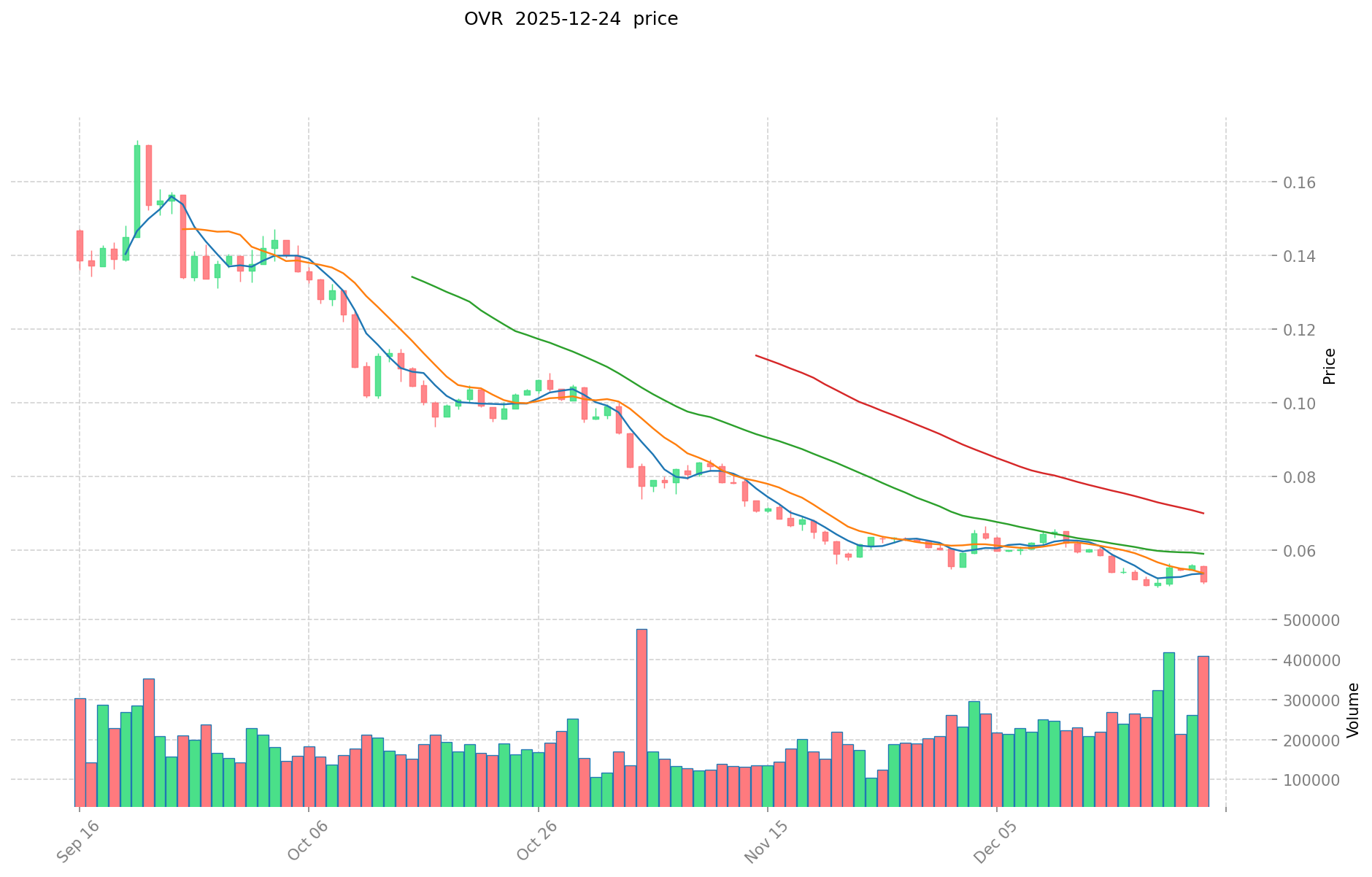
OVR reached its all-time high of $3.33 on December 2, 2021, reflecting market enthusiasm during the peak of the crypto bull cycle. Conversely, its all-time low of $0.02546331 occurred on January 12, 2021, representing significant market correction.
As of the latest update on December 25, 2025, OVR is trading at $0.05141, with a 24-hour trading range between $0.05088 and $0.05173. The token has experienced substantial long-term decline, down 83.14% over the past year, reflecting broader market challenges and shifting investor sentiment toward AR and metaverse projects.
View current OVR market price
Market Metrics
- Market Capitalization: $2,635,551.33 (circulating) / $4,513,482.65 (fully diluted)
- 24-Hour Trading Volume: $12,126.50
- Market Dominance: 0.00014% of total crypto market cap
- Token Holders: 16,841 active addresses holding OVR
OVR Ecosystem Applications and Partners
Core Use Cases
OVR's ecosystem supports multiple applications centered on augmented reality (AR) and spatial computing:
- Spatial Domain Names (NFTs): OVR Land represents unique hexagonal parcels across a 1.6 trillion hexagon grid, functioning as ERC-721 NFTs that users can auction, trade, or lease in a decentralized manner.
- Augmented Reality Integration: The platform bridges the real world and virtual world through AR technology, enabling users to interact with digital content overlaid on physical locations.
- Token Economics: OVR tokens serve as the primary medium of exchange for purchasing, trading, and leasing OVR Land parcels within the decentralized network.
OVR maintains an active community with 16,841 token holders as of December 25, 2025. The project demonstrates ongoing community participation across multiple platforms, with active presence on social channels including X (formerly Twitter), Reddit, and GitHub.
Community members actively contribute to the ecosystem through open-source development, as evidenced by the project's GitHub repositories including the Unity SDK and platform infrastructure.
- Official X Account: @OVRtheReality serves as the primary channel for project updates, announcements, and community engagement.
- Community Forums: Active discussions occur on Reddit at r/OVR_AR_Platform, Facebook communities at OVERmetaverse, and YouTube channel OVRofficial.
- Development Community: GitHub repositories at OVR-Platform showcase ongoing technical development and contributions from developers building on the protocol.
Market Sentiment Overview
The token has experienced significant price volatility since its peak in December 2021 at $3.33. Current trading at $0.05141 (as of December 25, 2025) reflects the broader market challenges faced by many AR and metaverse-focused projects. Despite this, the maintained holder base and active development suggest continued community commitment to the project's long-term vision.
- Official Website: Visit OVR's official website for detailed information about the platform, use cases, and latest developments.
- Whitepaper: The OVR Whitepaper provides comprehensive technical documentation of the platform's architecture, tokenomics, and vision for spatial computing.
- Smart Contract: OVR token is deployed on Ethereum (ETH) at address
0x21bfbda47a0b4b5b1248c767ee49f7caa9b23697. View the full contract details on Etherscan.
- Social Channels: Follow @OVRtheReality on X for the latest project updates, community discussions, and ecosystem developments.
How to Acquire and Participate in OVR
- Purchase Channels: OVR is available for trading on Gate.com and select cryptocurrency exchanges. Visit Gate.com's how-to-buy guide for OVR for step-by-step instructions.
- Token Storage: Securely store OVR tokens using standard Ethereum-compatible wallets that support ERC-20 tokens.
- Participate in Governance: Engage with the community through social channels and governance proposals as the protocol evolves.
- Build on the Platform: Developers can access the OVR Unity SDK and documentation via the GitHub repositories to create AR experiences and applications on the platform.
Summary
OVR represents an innovative approach to spatial computing and augmented reality through blockchain technology, offering a decentralized platform for creating, trading, and leasing spatial digital assets. With 1.6 trillion hexagonal parcels available as NFTs and an ERC-721 based tokenization system, OVR envisions a future where the physical and digital worlds seamlessly integrate.
The project maintains an active developer community and sustained token holder base despite significant market headwinds since its 2021 peak. The ongoing development of the platform's technical infrastructure and community engagement through multiple social channels demonstrates commitment to realizing its long-term vision.
Whether you are exploring emerging AR technologies, interested in spatial NFT opportunities, or seeking to participate in next-generation metaverse infrastructure, OVR warrants consideration as part of a diversified digital asset portfolio. As with all cryptocurrency investments, thorough research and risk assessment are essential before participation.
FAQ
What does OVR stand for?
OVR stands for Ovrland, a decentralized metaverse platform built on blockchain technology. It enables users to create, explore, and monetize virtual worlds and digital assets in a Web3 environment.
Who is eligible for OVR in PA?
Individuals with disabilities who are residents of Pennsylvania and have a documented disability that presents a substantial impediment to employment are eligible for OVR services. Applicants must demonstrate a need for vocational rehabilitation services to achieve an employment goal.
What is OVR in medical terms?
OVR stands for Occurrence Variance Report, a hospital internal reporting system documenting incidents affecting patient care, including near misses and sentinel events. It enables confidential staff reporting to ensure corrective actions without blame, with submissions required within 72 hours.
What does OVR pay for?
OVR is a virtual reality metaverse token that pays holders through ecosystem participation, virtual land ownership, and decentralized application usage rewards. It incentivizes engagement in immersive digital environments and platform activities.
How do I apply for OVR services?
To apply for OVR services, visit the official OVR website or contact your local OVR office directly. Complete the application form with required information, submit supporting documents, and an OVR representative will review your eligibility and contact you to begin the application process.
What is the difference between OVR and other vocational rehabilitation programs?
OVR is a state-run agency specializing in pre-employment services for students with disabilities, while other vocational rehabilitation programs often provide broader job placement and ongoing employment support. OVR's focus is narrower and specifically state-administered, whereas alternative programs may operate at federal or private levels with more comprehensive scope.
What are the success rates and outcomes of OVR programs?
OVR programs demonstrate strong outcomes with approximately 57% overall case success rates. Rural and Appalachian regions show slightly higher success rates at 57.3% and 57.9% respectively, reflecting effective consumer support and program effectiveness.
* The information is not intended to be and does not constitute financial advice or any other recommendation of any sort offered or endorsed by Gate.