This comprehensive guide explores Orchid Protocol (OXT), a decentralized VPN marketplace launched by Orchid Labs in 2019 to address privacy concerns and centralized control in internet services. Built on Ethereum blockchain, Orchid operates as a transparent, user-controlled privacy solution with approximately 49,987 token holders. The guide covers Orchid's technical architecture including its decentralized node network, staking mechanisms, and nanopayment system for bandwidth transactions. It analyzes current market metrics showing 591.5 million circulating OXT tokens with significant price volatility, alongside ecosystem applications, regulatory challenges, and community engagement. The article provides actionable participation methods through Gate.com exchanges, storage solutions, and development opportunities, positioning Orchid as foundational infrastructure for decentralized internet privacy despite facing scalability and competitive pressures.
Orchid's Positioning and Significance
In 2019, Orchid Labs launched Orchid (OXT), aiming to address privacy concerns and centralized control in VPN services.
As a decentralized VPN marketplace built on blockchain technology, Orchid plays a key role in privacy protection and decentralized internet access.
As of 2026, Orchid has established itself as a decentralized privacy solution with approximately 49,987 token holders and an active community of developers and users.
This article will provide an in-depth analysis of its technical architecture, market performance, and future potential.
Origin and Development Journey
Background of Creation
Orchid was created by Orchid Labs in 2019, aiming to solve the centralization problem of traditional VPN services and enhance user privacy protection.
It emerged during the growing awareness of digital privacy and data security, with the goal of providing a decentralized bandwidth marketplace where users control their privacy to change the status quo.
The launch of Orchid brought new possibilities to internet users seeking enhanced privacy and freedom from centralized service providers.
Major Milestones
- 2019: Official launch, establishing a decentralized VPN marketplace on Ethereum blockchain.
- Ongoing: Continuous development of privacy-enhancing features and network expansion.
- The project continues to evolve under the support of Orchid Labs and its community, consistently optimizing its technology, security, and real-world applications.
How Does Orchid Work?
No Central Control
Orchid operates on a decentralized network of nodes distributed globally, free from control by any single entity or government.
These nodes collaborate to provide bandwidth services, ensuring the system remains transparent and resistant to attacks, giving users greater autonomy and enhancing network resilience.
Blockchain Foundation
Orchid's infrastructure is built on Ethereum blockchain, providing a public and immutable ledger for tracking transactions and service payments.
Transactions are grouped into blocks and linked through cryptographic hashes to form a secure chain.
Anyone can view the records, establishing trust without intermediaries.
The system utilizes staking mechanisms to ensure service quality and network participation.
Ensuring Fairness
Orchid employs a staking-based system to ensure network integrity and prevent malicious behavior.
Node operators maintain network security by providing bandwidth services and staking OXT tokens, earning OXT rewards in return.
The innovation includes a nanopayment system that enables efficient micropayments for bandwidth usage.
Secure Transactions
Orchid uses public-private key cryptography to protect transactions:
- Private keys (similar to secret passwords) are used to authorize payments
- Public keys (similar to account numbers) are used to verify ownership
This mechanism ensures fund security while transactions maintain pseudonymous privacy.
The platform incorporates multiple layers of encryption and random node selection to enhance user privacy and prevent traffic analysis.
Circulation Overview
As of January 25, 2026, Orchid's circulating supply stands at 591,544,728.95 OXT tokens, with a total supply of 1,000,000,000 tokens and an unlimited maximum supply, indicating an inflationary model.
The circulating supply represents approximately 59.15% of the total supply, with tokens entering the market through network participation and bandwidth provision rewards. The token distribution supports the decentralized VPN infrastructure, where node operators receive OXT tokens for providing bandwidth services.
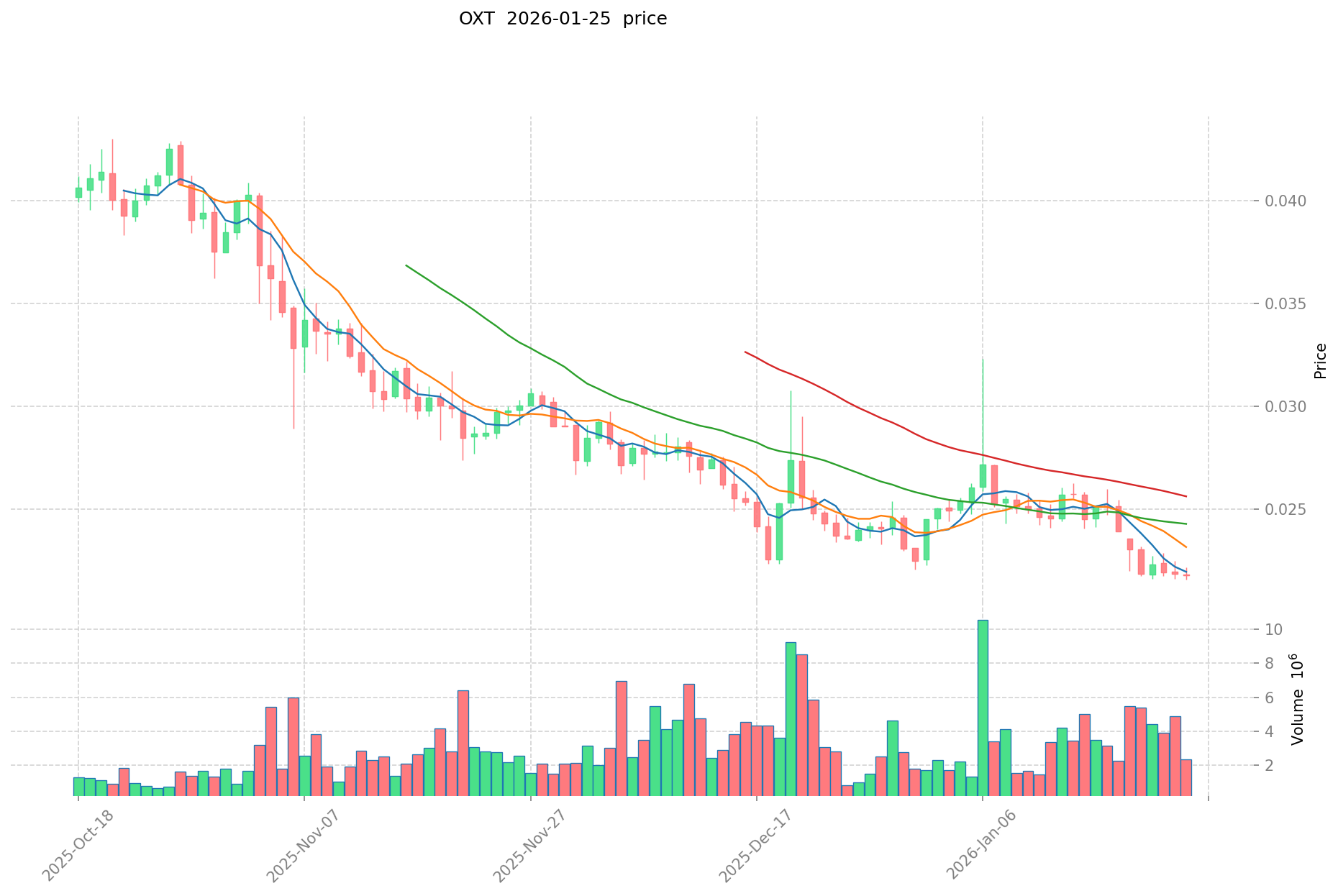
Price Volatility
Orchid reached its all-time high of $1.026 on April 5, 2021, driven by broader market momentum and increased interest in privacy-focused blockchain solutions during the cryptocurrency market expansion.
The token hit its all-time low of $0.02161676 on January 25, 2026, reflecting challenging market conditions and broader cryptocurrency sector headwinds. Over the past year, OXT has experienced significant volatility with a -79.19% price change, declining from higher valuation levels.
Recent short-term performance shows:
- 1-hour change: +0.37%
- 24-hour change: -0.22%
- 7-day change: -12.16%
- 30-day change: -9.02%
These fluctuations reflect evolving market sentiment, adoption trends, and external factors affecting privacy-focused cryptocurrency projects.
Click to view the current OXT market price
On-Chain Metrics
- Token holders: Approximately 49,987 addresses hold OXT tokens, indicating community distribution and user engagement
- 24-hour trading volume: $60,050.56, reflecting current market liquidity and trading activity
- Market capitalization: $12,942,998.67, representing the total value of circulating tokens
- Market dominance: 0.00069% of the total cryptocurrency market
Orchid Ecosystem Applications and Partners
Core Use Cases
Orchid's ecosystem supports multiple applications:
- Privacy & VPN Services: Orchid Protocol provides decentralized VPN services, enabling users to browse the internet privately by routing traffic through a distributed network of bandwidth providers.
- Bandwidth Marketplace: The OXT token powers a decentralized bandwidth market on the Ethereum blockchain, where users pay node operators for bandwidth services using a staking-based mechanism.
Strategic Partnerships
Orchid leverages the Ethereum blockchain infrastructure to deliver its services, utilizing smart contracts for transparent and trustless bandwidth transactions.
These partnerships provide a solid foundation for Orchid's ecosystem expansion.
Controversies and Challenges
Orchid faces the following challenges:
- Technical Issues: Scalability concerns related to Ethereum network congestion and transaction costs may impact user experience during peak periods.
- Regulatory Risks: Privacy-focused services face potential scrutiny from regulatory authorities concerned about anonymity and data protection compliance.
- Competitive Pressure: Other privacy solutions and VPN services, including both traditional centralized providers and emerging decentralized alternatives, create a competitive landscape.
These issues have sparked discussions within the community and market, while also driving Orchid's continuous innovation.
Orchid's community demonstrates active participation, with the token held by approximately 49,987 wallet addresses.
On X platform, related posts and hashtags (such as #Orchid and #OXT) generate regular discussions among privacy advocates and cryptocurrency enthusiasts.
Factors such as protocol updates, privacy feature enhancements, and growing concerns about internet surveillance fuel community enthusiasm.
Sentiment on X shows mixed perspectives:
- Supporters praise Orchid's decentralized architecture, privacy-preserving features, and innovative staking mechanism, viewing it as "essential infrastructure for internet privacy" and "the future of anonymous browsing".
- Critics focus on price volatility, dependency on Ethereum's performance, and competition from established VPN providers.
Recent trends indicate cautious optimism as privacy concerns continue to drive interest in decentralized solutions.
Hot Topics
X platform users actively discuss Orchid's regulatory positioning in various jurisdictions, the balance between privacy and compliance, and the sustainability of its bandwidth marketplace model,
showcasing both its transformative potential and the obstacles it faces toward mainstream adoption.
- Official Website: Visit Orchid Official Website for features, use cases, and latest developments.
- White Paper: Orchid White Paper details its technical architecture, objectives, and vision for a decentralized privacy network.
- X Updates: On X platform, Orchid actively engages using @orchidprotocol, with posts covering protocol enhancements, community initiatives, privacy technology developments, and partnership announcements, generating engagement from privacy-conscious users and blockchain enthusiasts.
Orchid Future Roadmap
- Ongoing Development: Continued optimization of bandwidth marketplace efficiency and user experience, improving transaction speed and cost-effectiveness
- Ecosystem Goals: Expansion of node provider network and enhancement of cross-chain compatibility
- Long-term Vision: Establishing Orchid as a foundational layer for internet privacy and decentralized VPN infrastructure
How to Participate in Orchid?
- Purchase Channels: Acquire OXT on Gate.com and other cryptocurrency exchanges
- Storage Solutions: Securely store OXT using Ethereum-compatible wallets
- Participate in Governance: Engage with the community through official channels to influence protocol development
- Build the Ecosystem: Visit Orchid GitHub to explore development opportunities and contribute to the codebase
Summary
Orchid redefines internet privacy through blockchain technology, providing decentralized VPN services, transparent bandwidth marketplace, and user-controlled privacy protection.
Its active community, comprehensive resources, and innovative approach position it uniquely in the cryptocurrency and privacy technology space.
Despite facing regulatory uncertainties and competitive challenges, Orchid's commitment to innovation and clear development direction secure its important position in the future of decentralized privacy solutions.
Whether you are a newcomer or experienced participant, Orchid deserves attention and engagement.
FAQ
What is OXT (Orchid Protocol) and what is its main purpose?
OXT is the native token of Orchid Protocol, a decentralized VPN platform built on blockchain. Its main purpose is to incentivize network participants, facilitate peer-to-peer bandwidth sharing, and enable secure, private internet access through a decentralized infrastructure powered by cryptocurrency payments.
How does Orchid Protocol work and what problem does it solve?
Orchid Protocol is a decentralized VPN service using blockchain technology. It solves privacy concerns by enabling peer-to-peer bandwidth sharing with OXT token incentives, allowing users to browse anonymously while providers earn rewards for sharing internet bandwidth.
Where can I buy OXT tokens and how do I store them?
OXT tokens are available on major cryptocurrency platforms. Store them in secure wallets like MetaMask, Ledger, or Trezor for maximum security. Consider hardware wallets for long-term holdings.
What are the risks and security considerations of using Orchid Protocol?
Orchid Protocol users should consider smart contract risks, node operator reliability, and bandwidth quality variations. VPN security depends on chosen exit nodes, while market volatility affects OXT token value. Users must verify node credentials and maintain account security practices.
How is OXT different from other privacy-focused cryptocurrencies or VPN services?
OXT is a decentralized proxy network cryptocurrency that enables privacy through distributed node infrastructure, unlike traditional VPN services. It combines blockchain technology with incentivized privacy routing, offering transparent, censorship-resistant privacy solutions with community-driven governance and economic incentives for network participants.
* The information is not intended to be and does not constitute financial advice or any other recommendation of any sort offered or endorsed by Gate.