PaLM is a decentralized AI utility token leveraging Google's Pathways Language Model technology to democratize advanced AI access through multi-platform chatbot services, coding assistance, and image generation. Launched in November 2023 and listed on Gate.com in January 2026, PaLM addresses accessibility barriers and unequal AI-generated revenue distribution with over 16,110 token holders. The token operates on Ethereum's ERC-20 standard using Proof of Stake consensus, ensuring transparent, secure transactions without central control. This comprehensive guide explores PaLM's technical architecture, market performance, ecosystem applications, and future roadmap, providing insights for developers, content creators, and users seeking accessible Web3-based AI solutions while navigating market volatility and competitive challenges.
PaLM AI's Positioning and Significance
In 2023, the PaLM AI team launched PaLM AI (PALM), aiming to address accessibility barriers in advanced AI technology and unequal distribution of AI-generated revenue.
As a multi-platform AI chatbot leveraging Google's PaLM technology, PaLM AI plays a key role in democratizing AI access for conversations, coding assistance, and image generation.
As of 2026, PaLM AI has established itself as an accessible AI utility token with over 16,000 holders and an active development community.
This article will provide an in-depth analysis of its technical architecture, market performance, and future potential.
Origin and Development History
Birth Background
PaLM AI was created by the PaLM AI development team in 2023, designed to solve the accessibility gap in advanced AI technology and provide equitable revenue sharing opportunities.
It emerged during the global AI revolution and increased demand for user-friendly AI tools, with the goal of democratizing access to sophisticated AI capabilities through blockchain integration.
The launch of PaLM AI brought new possibilities to developers, content creators, and everyday users seeking AI assistance.
Key Milestones
- November 2023: Token launch, establishing the foundation for AI-powered chatbot services across multiple platforms.
- December 2024: Price reached an all-time high of $1.81, reflecting strong market interest in AI-utility tokens.
- 2024-2025: Ecosystem expansion with continued development of chatbot capabilities for coding, conversation, and image generation features.
- January 2026: Token listed on Gate.com, enhancing accessibility and liquidity for global users.
With support from its development community and early adopters, PaLM AI continues to refine its AI capabilities, security features, and real-world applications.
How PaLM AI Works
No Central Control
PaLM AI operates on a decentralized blockchain network distributed globally, removing reliance on centralized AI service providers.
These network participants collaborate to validate transactions, ensuring system transparency and attack resistance, granting users greater autonomy and improving network resilience.
Blockchain Foundation
PaLM AI's blockchain serves as a public, immutable digital ledger recording every transaction.
Transactions are grouped into blocks and linked through cryptographic hashing to form a secure chain.
Anyone can view these records, establishing trust without intermediaries.
The token operates on the Ethereum network using the ERC-20 standard, ensuring compatibility with the broader DeFi ecosystem.
Ensuring Fairness
PaLM AI leverages Ethereum's Proof of Stake (PoS) consensus mechanism to validate transactions and prevent fraudulent activities such as double-spending.
Validators maintain network security through staking ETH and processing transactions, receiving rewards for their contributions.
This approach offers energy efficiency and high transaction throughput.
Secure Transactions
PaLM AI utilizes public-private key cryptography to protect transactions:
- Private keys (similar to secret passwords) are used to sign transactions
- Public keys (similar to account numbers) are used to verify ownership
This mechanism ensures fund security while transactions remain pseudonymous.
As an ERC-20 token, PaLM AI benefits from Ethereum's robust security infrastructure and established wallet compatibility.
Circulation Overview
As of January 30, 2026, PaLM AI (PALM) has a circulating supply of 77,129,726.30 tokens, with a total supply of 77,500,000 tokens. The maximum supply is capped at 100,000,000 tokens, indicating a controlled supply model with potential future issuance. The current circulation ratio stands at approximately 77.13% of the total supply. Token distribution reflects the project's focus on accessible AI and revenue-sharing mechanisms, though specific allocation details among community, team, and foundation have not been disclosed in available materials.
Price Fluctuations
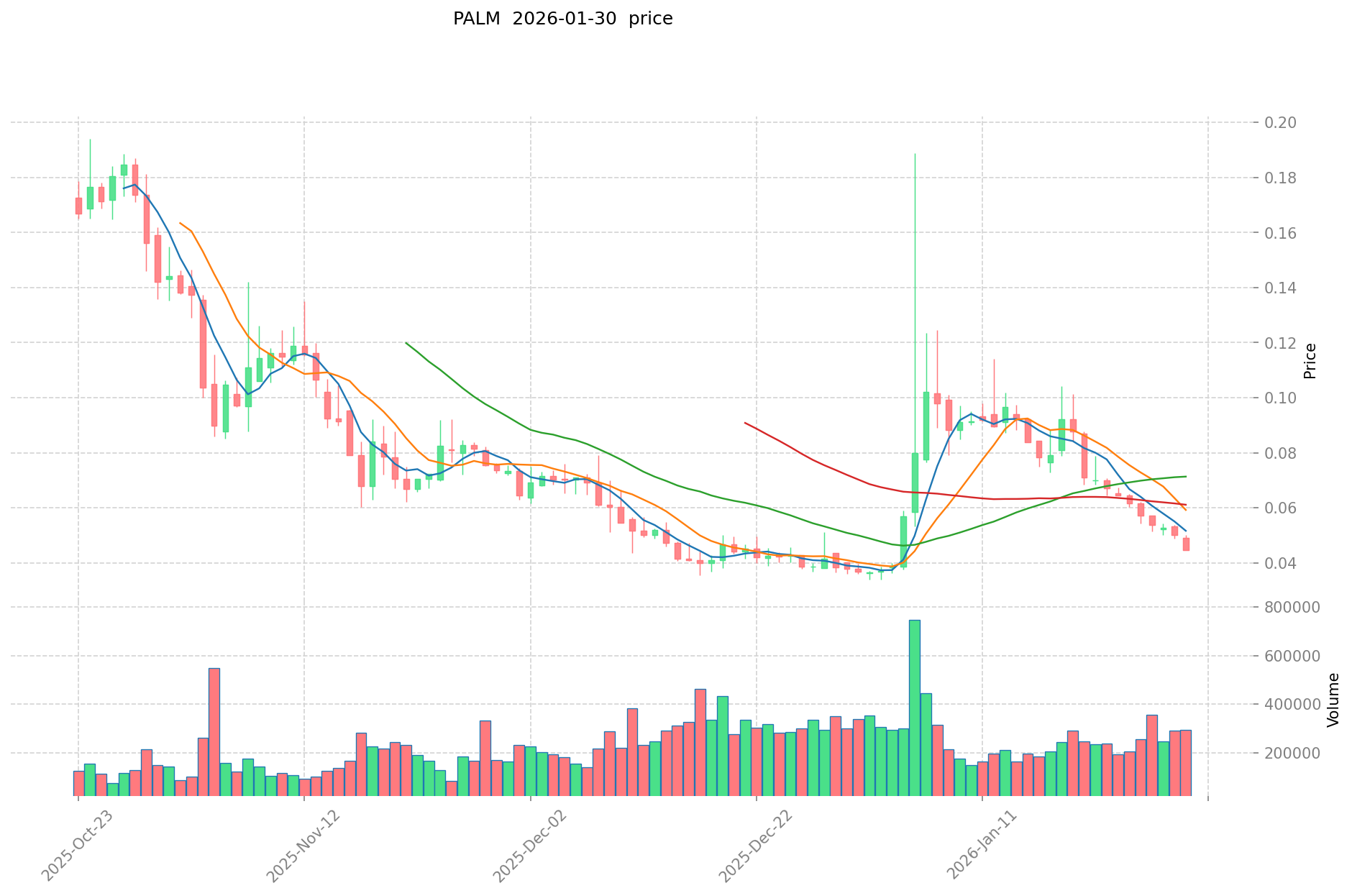
PaLM AI (PALM) reached its all-time high of $1.81 on December 1, 2024, during a period of increased interest in AI-focused cryptocurrency projects. The token experienced its lowest price of $0.0099 on April 12, 2024, reflecting early-stage market discovery and volatility typical of emerging digital assets. Recent price movements show mixed signals: the token gained 11.82% in the past hour but declined 6.51% over 24 hours and 30.81% over the past week. Over the past 30 days, PALM has appreciated by 13.56%, though it remains down 93.35% from its peak over the past year. These fluctuations reflect shifting market sentiment, adoption trends, and broader conditions in the cryptocurrency ecosystem.
Click to view current PALM market price
On-Chain Metrics
- Holder Count: Approximately 16,110 addresses hold PALM tokens, indicating growing user participation in the ecosystem
- 24-Hour Trading Volume: $15,228.11, reflecting current market activity levels
- Market Capitalization: $3,611,985.08, representing 0.00012% of the total cryptocurrency market share
PaLM AI Ecosystem Applications and Partners
Core Use Cases
PaLM AI's ecosystem supports multiple applications:
- AI Chatbot Services: PaLM AI chatbot platform, providing multi-platform conversational AI, coding assistance, and image generation capabilities.
- Revenue Sharing Model: The platform implements a revenue-sharing mechanism, promoting accessible AI technology distribution.
Strategic Partnerships
PaLM AI leverages Google's AI technology to enhance its technical capabilities and market positioning.
These partnerships provide a solid foundation for PaLM AI's ecosystem expansion.
Controversies and Challenges
PaLM AI faces the following challenges:
- Technical Challenges: Maintaining competitive AI performance in a rapidly evolving landscape
- Regulatory Risks: Navigating the uncertain regulatory environment for AI and cryptocurrency projects
- Competitive Pressure: Competition from established AI platforms and emerging blockchain-based AI solutions
These issues have sparked discussions within the community and market, while also driving continuous innovation for PaLM AI.
PaLM AI's community shows active participation, with over 16,110 token holders.
On X platform, related posts and hashtags (such as #PALM) generate consistent engagement.
Recent developments and platform updates have fueled community enthusiasm.
Sentiment on X presents a mixed picture:
- Supporters praise PaLM AI's integration of Google's AI technology and accessible AI approach, viewing it as "democratizing advanced AI capabilities".
- Critics focus on price volatility and the competitive nature of the AI-crypto space.
Recent trends show mixed sentiment following significant price movements.
Hot Topics
X users actively discuss PaLM AI's price performance, technological development, and market positioning,
reflecting both its transformative potential and the challenges in achieving mainstream adoption.
- Official Website: Visit PaLM AI Official Website for features, use cases, and latest updates.
- White Paper: PaLM AI White Paper details its technical architecture, objectives, and vision.
- X Updates: On X platform, PaLM AI maintains an active presence at @palmaierc,
with posts covering technological updates, community events, and platform developments.
PaLM AI Future Roadmap
- Ongoing Development: Enhancement of AI chatbot capabilities and cross-platform integration, improving user experience and functionality
- Ecosystem Goals: Expanding the platform's user base and enhancing revenue-sharing mechanisms
- Long-term Vision: Becoming a leading accessible AI platform in the Web3 space
How to Participate in PaLM AI?
- Purchase Options: Purchase PALM on Gate.com and other supported exchanges
- Storage Solutions: Use compatible Ethereum wallets for secure storage
- Engage with Platform: Utilize PaLM AI chatbot services for conversations, coding, and image generation
- Community Participation: Follow official channels for updates and community initiatives
Summary
PaLM AI leverages blockchain and AI technology to redefine accessible artificial intelligence, offering multi-platform chatbot services, Google AI integration, and revenue-sharing mechanisms.
Its growing community, comprehensive resources, and innovative approach position it uniquely in the AI-crypto intersection.
Despite facing market volatility and competitive challenges, PaLM AI's innovative approach and clear development direction establish its role in the future of decentralized AI technology.
Whether you're a newcomer or experienced participant, PaLM AI presents opportunities worth exploring and engaging with.
FAQ
What is PALM cryptocurrency? What are its basic characteristics?
PALM is a decentralized token trading on multiple exchanges with primary pair PALM/WETH. It features real-time price and market cap updates on CoinGecko, supporting both centralized and decentralized trading infrastructure with strong liquidity.
PALM项目的核心用途和应用场景是什么?
PALM is a large-scale language model powering generative AI applications. Its core use cases include intelligent dialogue systems, content generation, natural language processing tasks, and enabling developers to build next-generation AI-driven applications across various industries.
What is the total supply of PALM tokens? What is the current circulating supply and price?
PALM has a total supply of 77.12M tokens. The current circulating supply is 77.12M PALM, trading at ₺0.07892 with a market cap of ₺6.11M.
Who created the PALM project? What about the development team and community behind it?
PALM was co-founded by Jeff Hawkins and Donna Dubinsky in 1993. The development team and community subsequently disbanded due to business reasons. The project had significant historical impact on mobile computing innovation.
What are the ways to buy and store PALM tokens? Which exchanges are supported?
You can purchase PALM tokens through major crypto exchanges and store them in secure wallets like Ledger or other hardware wallets for maximum security and control over your assets.
What risks should I consider when investing in PALM? How is security protected?
PALM investment carries market volatility and regulatory risks. Security is safeguarded through blockchain technology, smart contract audits, and compliance with industry standards. Diversify your portfolio and conduct thorough due diligence before investing.
What is the difference between PALM and other mainstream cryptocurrencies such as Bitcoin and Ethereum?
PALM is a decentralized payment system, while Bitcoin focuses on peer-to-peer transactions and Ethereum enables complex smart contracts. PALM offers unique features optimized for efficient, low-cost transfers within its ecosystem.
* The information is not intended to be and does not constitute financial advice or any other recommendation of any sort offered or endorsed by Gate.