Pendle is a permissionless yield trading protocol launched in 2021 that addresses DeFi yield optimization inefficiencies by enabling tokenization and separate trading of future yields through Principal Tokens (PT) and Yield Tokens (YT). This comprehensive guide covers Pendle's technical architecture, including its capital-efficient v2 AMM design, market performance metrics, and key tokenomics, with PENDLE trading at $2.224 and available on Gate and 51 other exchanges. The article explores core use cases spanning yield management and DeFi integration, examines challenges including technical complexity and market volatility, and outlines participation methods through purchasing on Gate, governance staking as vePENDLE, and ecosystem development. Positioned as a leading protocol for fixed-rate opportunities and yield derivatives, Pendle continues expanding supported assets while driving innovation in decentralized finance's yield optimization landscape.
Pendle's Positioning and Significance
In 2021, the Pendle team launched Pendle (PENDLE), aiming to address the inefficiencies in yield trading and the lack of flexibility in managing future returns within DeFi ecosystems.
As a permissionless yield trading protocol, Pendle plays a key role in the decentralized finance (DeFi) sector.
As of 2026, Pendle has established itself as a notable protocol in the yield trading space, with an active developer community and growing adoption.
This article will provide an in-depth analysis of its technical architecture, market performance, and future potential.
Origin and Development History
Background
Pendle was created by its development team in 2021, aiming to solve the challenges of limited yield optimization strategies and the inability to trade future yields separately from underlying assets.
It emerged during the DeFi boom, with the goal of providing users with the ability to tokenize and trade future yields, enabling advanced yield management strategies and transforming how participants interact with yield-generating assets.
The launch of Pendle brought new possibilities to DeFi users seeking greater control over their yield strategies.
Key Milestones
- 2021: Seed funding round raised $3.7 million at a fully diluted valuation (FDV) of $35 million, representing 14.9% of total supply.
- Pendle v2: Introduction of the v2 AMM, a capital-efficient design model enabling Principal Token (PT) and Yield Token (YT) swaps using a single liquidity pool through flash swaps.
- June 2023: Total supply reached 251 million PENDLE, with circulating supply approximately 140 million (about 56% of total supply).
- 2023: Weekly emissions of 460,000 PENDLE with a 1.10% weekly reduction rate until April 2026, transitioning to a terminal inflation rate of 2.00% annually as ongoing incentives.
With support from its community and development team, Pendle continues to optimize its technology, security, and real-world applications.
How Pendle Works
No Central Control
Pendle operates on a decentralized network of nodes distributed globally, free from control by banks or governments.
These nodes collaborate to validate transactions, ensuring the system remains transparent and resistant to attacks, granting users greater autonomy and enhancing network resilience.
Blockchain Core
Pendle's blockchain is a public, immutable digital ledger that records every transaction.
Transactions are grouped into blocks and linked through cryptographic hashes to form a secure chain.
Anyone can view the records, establishing trust without intermediaries.
The protocol's Pendle v2 AMM design further enhances performance by enabling efficient swaps within a single liquidity pool.
Ensuring Fairness
Pendle relies on the underlying blockchain's consensus mechanism (such as Ethereum's Proof of Stake) to validate transactions and prevent fraud like double-spending.
Validators maintain network security through staking and node operation, earning rewards in return.
Its innovation includes capital-efficient AMM design and yield tokenization, enabling separation of principal and yield components.
Secure Transactions
Pendle leverages public-private key cryptography to protect transactions:
- Private keys (like secret passwords) are used to sign transactions
- Public keys (like account numbers) are used to verify ownership
This mechanism ensures fund security while maintaining pseudonymous transaction privacy.
The protocol also implements yield tokenization through Standardized Yield (SY) tokens, which are split into Principal Tokens (PT) and Yield Tokens (YT), providing users with flexible yield management options.
Circulation Overview
As of January 15, 2026, Pendle's circulating supply stands at 168,968,847.80 PENDLE tokens, with a total supply of 281,527,448.46 tokens. The circulating supply represents approximately 60.02% of the total supply.
New tokens enter the market through weekly emissions, which were reported at 460,000 tokens per week as of June 2023, decreasing by 1.10% weekly until April 2026. Following this period, the tokenomics model allows for a terminal inflation rate of 2.00% annually as an incentive mechanism.
The token distribution reflects a structured allocation approach, with the seed round in April 2021 accounting for 14.9% of the total supply at a fully diluted valuation of $35 million. Post-listing circulation was approximately 140 million tokens, representing around 56% of the total token supply as of June 30, 2023.
Price Volatility
Pendle reached its all-time high of $7.50 on April 11, 2024, reflecting strong market momentum during a period of increased interest in DeFi yield optimization protocols.
The token's lowest price point was $0.0338 on November 15, 2022, coinciding with broader cryptocurrency market challenges and reduced risk appetite among investors.
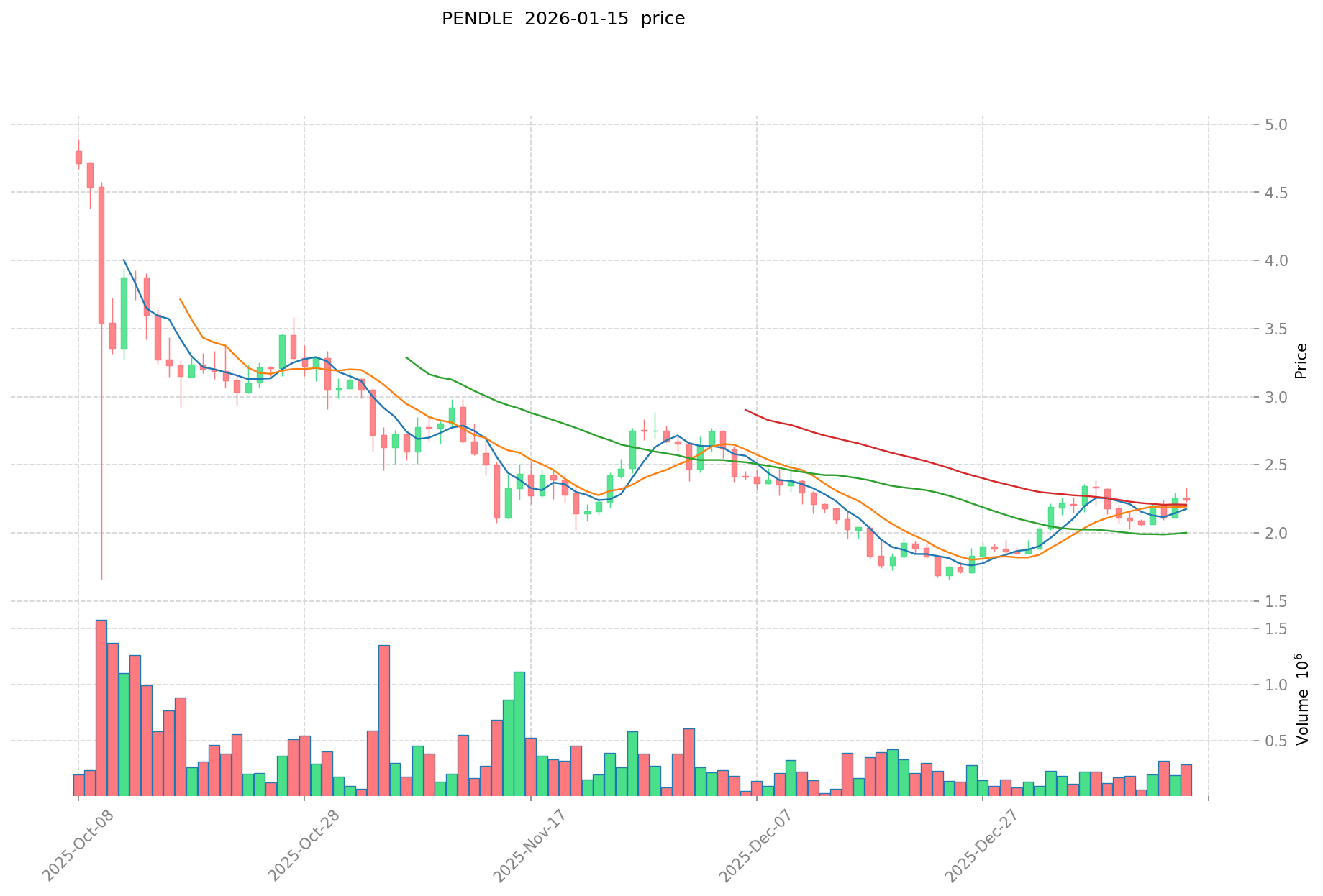
Recent price movements show mixed signals: the token experienced a 0.32% increase over 1 hour and a 1.00% gain over 7 days, while registering an 11.95% increase over 30 days. However, the 1-year performance indicates a -42.18% decline, reflecting evolving market conditions and competitive dynamics in the DeFi sector.
As of the latest update, Pendle is trading at $2.224, with a 24-hour trading volume of $624,394.80 and a market capitalization of $375,786,717.51.
Click to view current PENDLE market price
On-Chain Metrics
- Holder Count: 71,219 addresses hold PENDLE tokens, indicating a distributed ownership structure
- Exchange Listings: The token is available on 52 exchanges, providing multiple access points for traders and investors
- Market Dominance: Pendle represents 0.018% of the total cryptocurrency market capitalization
- Fully Diluted Valuation: $626,117,045.37, with the market cap to FDV ratio at 60.02%, suggesting a moderate proportion of tokens currently in circulation
Pendle Ecosystem Applications and Partners
Core Use Cases
Pendle's ecosystem supports multiple applications:
- DeFi: Platforms integrated with Pendle enable users to perform yield tokenization and trading, allowing sophisticated strategies like locking in fixed rates or speculating on future yields.
- Yield Management: Projects leveraging Pendle's protocol facilitate advanced yield strategies, helping users optimize returns from their yield-bearing assets through Principal Tokens (PT) and Yield Tokens (YT).
Strategic Partnerships
Pendle has established collaborations with various DeFi protocols and platforms to enhance its technical capabilities and market reach.
These partnerships provide a solid foundation for Pendle's ecosystem expansion and adoption across the DeFi landscape.
Controversies and Challenges
Pendle faces the following challenges:
- Technical Complexity: The tokenization mechanism and AMM design may present learning curves for new users unfamiliar with yield trading concepts.
- Market Volatility: Price fluctuations and yield rate changes can affect the protocol's adoption and user strategies.
- Competition Pressure: Other yield optimization protocols and DeFi platforms continue to emerge, creating competitive dynamics in the yield trading space.
These issues have sparked discussions within the community and market, while also driving Pendle's continuous innovation and development.
Pendle's community demonstrates notable activity, with its protocol supporting various yield management strategies.
On X platform, related posts and hashtags (such as #Pendle) appear regularly in DeFi discussions.
Protocol updates, new pool launches, and yield opportunities generate community enthusiasm.
Sentiment on X shows diverse perspectives:
- Supporters praise Pendle's innovative yield tokenization mechanism and capital-efficient AMM design, recognizing it as a valuable tool for sophisticated DeFi users.
- Observers discuss yield rate volatility, protocol complexity, and market adoption challenges.
Recent trends indicate interest in the protocol's unique approach to yield trading and fixed-rate opportunities.
Popular Topics
X users actively discuss Pendle's yield strategies, tokenomics with vePENDLE, and protocol developments,
showcasing both its innovative potential and the complexities involved in yield optimization.
- Official Website: Visit Pendle Official Website for features, use cases, and latest updates.
- White Paper: Pendle White Paper details its technical architecture, objectives, and vision for permissionless yield trading.
- X Platform: Pendle maintains active presence on X using @pendle_fi,
with posts covering protocol upgrades, community activities, partnership announcements, and yield opportunities, generating engagement from the DeFi community.
Pendle Future Roadmap
- Ongoing Development: Continue expanding supported yield-bearing assets and pools, enhancing protocol efficiency and user experience
- Ecosystem Goals: Grow adoption across DeFi platforms and increase total value locked (TVL)
- Long-term Vision: Establish Pendle as a leading protocol for yield trading and fixed-rate opportunities in decentralized finance
How to Participate in Pendle?
- Purchase Options: Acquire PENDLE on exchanges including Gate.com
- Storage Solutions: Securely store PENDLE using compatible wallets that support Ethereum-based tokens
- Participate in Governance: Lock PENDLE as vePENDLE for up to 2 years to vote on pool emission rewards and earn protocol fees
- Build the Ecosystem: Access developer documentation on GitHub to integrate with Pendle protocol or contribute to development
Summary
Pendle redefines DeFi yield strategies through blockchain technology, providing innovative yield tokenization, capital-efficient trading, and governance mechanisms.
Its active community, comprehensive resources, and unique protocol design distinguish it within the cryptocurrency space.
Despite facing adoption challenges and market complexity, Pendle's innovative approach and clear development direction position it as a notable player in decentralized finance's evolution.
Whether you're a newcomer or experienced DeFi user, Pendle offers compelling opportunities for yield optimization and participation.
FAQ
What is Pendle and how does it work?
Pendle Finance is a DeFi protocol enabling trade of interest rate derivatives by separating yield from assets. It uses a specialized AMM accounting for time-decay to prevent mispricing. The PENDLE token provides governance and ecosystem incentives.
What are the main use cases of Pendle protocol?
Pendle's main use cases include yield trading, allowing users to buy or sell future yields separately from principal, fixed-rate yield strategies for predictable returns, and yield derivatives trading for hedging and speculation.
How can I buy and hold PENDLE tokens?
Purchase PENDLE through major cryptocurrency platforms, then store tokens in your personal crypto wallet or exchange account for safekeeping and future transactions.
What is the difference between Pendle and other DeFi yield protocols?
Pendle specializes in yield tokenization, enabling users to separate and trade future yields from principal. Unlike traditional DeFi protocols focusing on staking or liquidity provision, Pendle offers unique yield derivatives for advanced yield farming strategies.
What are the risks associated with using Pendle?
Pendle carries technical risks including potential code defects, security breaches, and hacking vulnerabilities. Regulatory uncertainties exist regarding its classification as a security or derivative, which could impact its legal status and availability.
How does Pendle's tokenomics and governance system work?
Pendle locks over two-thirds of token supply, reducing circulation and enhancing value. Token holders participate in governance by voting on protocol changes and decisions, aligning community interests with platform development.
* The information is not intended to be and does not constitute financial advice or any other recommendation of any sort offered or endorsed by Gate.