Pirate Nation (PIRATE) is a blockchain gaming utility token launched by Proof of Play in 2024, designed to solve inefficiencies in gaming economies and cross-chain liquidity barriers. Operating on Ethereum with cross-chain capabilities via Proof of Play Apex, it enables low-cost, seamless transactions within gaming ecosystems. With over 14,300 holders and 535 million circulating tokens, Pirate Nation demonstrates active community engagement. The token fluctuated from $0.6 to $0.004, reflecting market dynamics. This comprehensive guide explores its technical architecture leveraging Ethereum's PoS consensus, market performance metrics, ecosystem applications, community sentiment, and participation methods on Gate exchange, offering insights for both newcomers and experienced crypto participants interested in GameFi innovation.
Pirate Nation's Positioning and Significance
In 2024, Proof of Play launched Pirate Nation (PIRATE), aiming to address inefficiencies in blockchain gaming economies and cross-chain liquidity barriers.
As a utility token designed for seamless cross-chain gaming transactions, Pirate Nation plays a key role in blockchain gaming and decentralized entertainment.
As of 2026, Pirate Nation has established itself as a gaming-focused utility token with over 14,000 holders, featuring an active community and expanding use cases within the Pirate Nation game ecosystem.
This article will provide an in-depth analysis of its technical architecture, market performance, and future potential.
Origin and Development History
Birth Background
Pirate Nation was created by Proof of Play in 2024, aiming to solve fragmentation in blockchain gaming economies and high gas fees that hinder player engagement.
It emerged during the evolution of Web3 gaming and the push for more accessible on-chain experiences, with the goal of providing low-cost, cross-chain functionality while maintaining security on Ethereum mainnet.
The launch of Pirate Nation brought new possibilities for blockchain gaming communities and developers seeking efficient token utility models.
Important Milestones
- June 2024: Token deployed on Ethereum, enabling spendable utility within the Pirate Nation game ecosystem.
- 2024: Integration with Proof of Play Apex enabled seamless cross-chain execution of delivered items with low gas costs.
- 2024-2025: Adoption by gaming communities drove initial trading activity and ecosystem expansion.
- 2026: Token holder base expanded to over 14,000 participants, reflecting growing ecosystem engagement.
With support from Proof of Play and the gaming community, Pirate Nation continues to evolve its utility, security features, and real-world gaming applications.
How Pirate Nation Works
Decentralized Infrastructure
Pirate Nation operates on Ethereum's decentralized network of nodes distributed globally, eliminating dependence on centralized gaming platforms or payment processors.
These nodes collaborate to validate transactions, ensuring the system remains transparent and resistant to manipulation, empowering users with greater control and enhancing network resilience.
Blockchain Foundation
Pirate Nation's blockchain infrastructure leverages Ethereum's public, immutable digital ledger that records every transaction.
Transactions are grouped into blocks and cryptographically linked through hashes to form a secure chain.
Anyone can verify records without intermediaries, establishing trustless verification.
The integration with Proof of Play Apex enables cross-chain execution capabilities that enhance performance and reduce transaction costs for gaming-related activities.
Consensus Mechanism
Pirate Nation utilizes Ethereum's Proof of Stake (PoS) consensus mechanism to validate transactions and prevent fraudulent activities such as double-spending.
Validators secure the network by staking ETH and processing transactions, earning rewards for maintaining network integrity.
The token's cross-chain functionality through Proof of Play Apex represents an innovation in enabling low-gas Layer 1 purchases across chains while maintaining supply integrity on Ethereum mainnet.
Secure Transactions
Pirate Nation employs public-private key cryptography to protect transactions:
- Private keys (similar to secret passwords) are used to authorize transactions
- Public keys (similar to account numbers) are used to verify ownership
This mechanism ensures fund security while transactions maintain pseudonymous privacy characteristics typical of Ethereum-based tokens.
The ERC20 standard implementation provides additional compatibility with established Ethereum wallet infrastructure and decentralized applications.
Circulating Supply Overview
As of 01 February 2026, Pirate Nation's circulating supply stands at 535,213,932 tokens, with a total supply of 1,000,000,000 PIRATE tokens following a fixed supply model.
The token operates on Ethereum and utilizes cross-chain execution capabilities on Proof of Play Apex, enabling seamless low-gas transactions while maintaining the entire supply on ETH Mainnet.
The current circulating supply represents approximately 53.52% of the total supply, with 14,321 holders participating in the ecosystem.
Price Fluctuations
Pirate Nation reached a notable price point of $0.6 on 13 June 2024, driven by initial market enthusiasm following its launch and early adoption within the gaming ecosystem.
Its lower price point of $0.004 occurred on 31 January 2026, reflecting broader market conditions and adjustments in trading activity.
These fluctuations demonstrate the dynamic nature of market sentiment, adoption patterns, and evolving ecosystem developments surrounding the gaming utility token.
Click to view current PIRATE market price
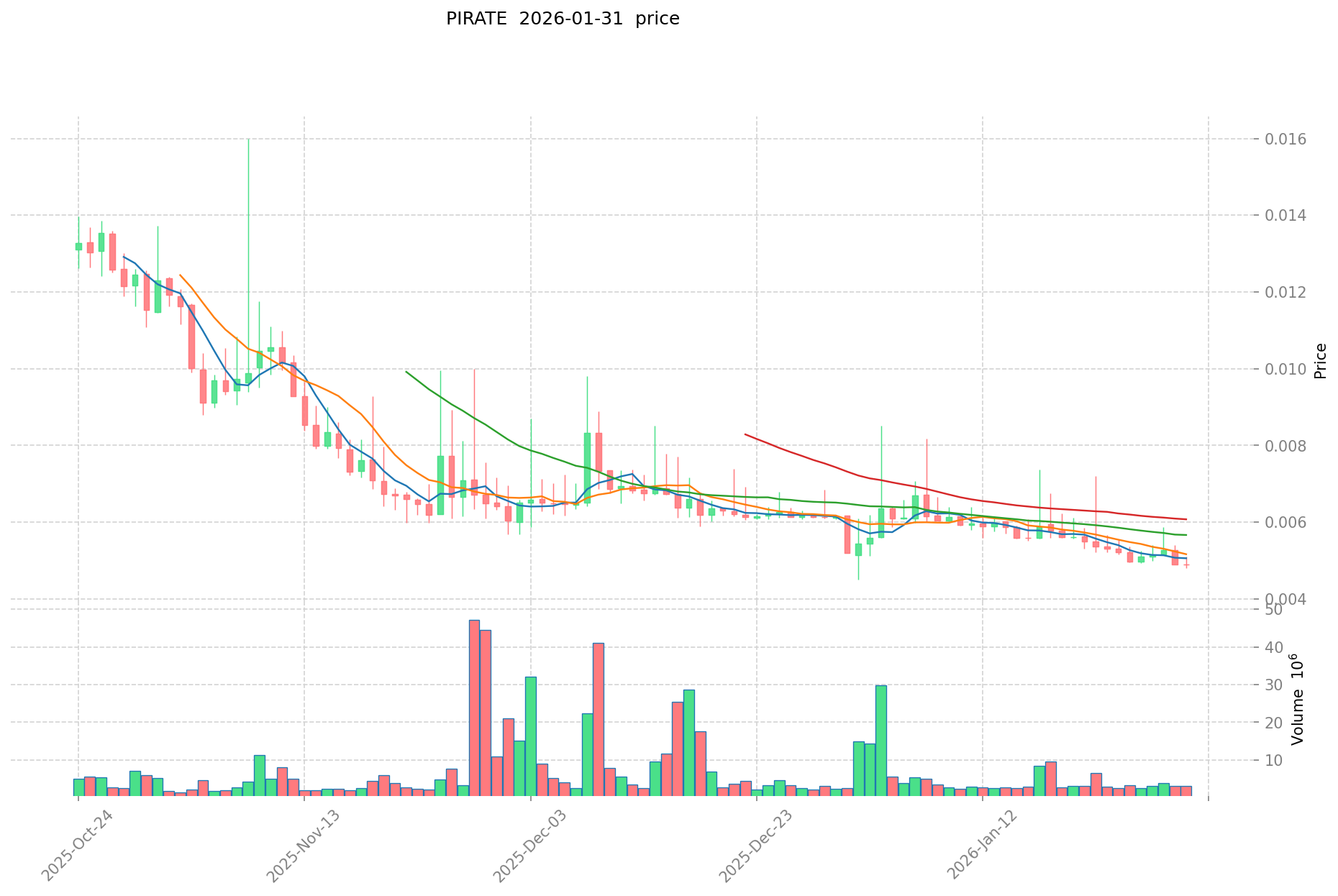
On-Chain Metrics
- 24-Hour Trading Volume: $17,991.23 (indicating current market activity levels)
- Active Holders: 14,321 addresses (reflecting community participation)
- Contract Standard: ERC20 on Ethereum (deployed at 0x7613C48E0cd50E42dD9Bf0f6c235063145f6f8DC)
Pirate Nation Ecosystem Applications and Partners
Core Use Cases
Pirate Nation's ecosystem supports multiple applications:
- Gaming: Pirate Nation, providing on-chain gaming experience with utility token mechanics.
- Cross-chain Technology: Proof of Play Apex, enabling seamless low-gas L1 purchases across chains while maintaining supply on Ethereum mainnet.
Strategic Partnerships
Pirate Nation leverages Ethereum's infrastructure to enhance its technical capabilities and market presence.
These foundational relationships provide a solid base for Pirate Nation's ecosystem expansion.
Controversies and Challenges
Pirate Nation faces the following challenges:
- Market Volatility: Significant price fluctuations with recent declines of over 22% in the 7-day period
- Competition Pressure: Other blockchain gaming platforms and utility tokens competing for market share
- Adoption Hurdles: Building user base and maintaining engagement in the competitive GameFi sector
These issues have sparked discussions within the community and market, while also driving Pirate Nation's continuous innovation.
Pirate Nation's community shows activity with 14,321 token holders and circulating supply metrics.
On X platform, related posts and hashtags (such as #PirateNation) generate discussions around gaming and utility token developments.
New feature releases and game updates have energized community participation.
Sentiment on X presents diverse perspectives:
- Supporters praise Pirate Nation's innovative cross-chain mechanics and gaming integration, viewing it as advancing blockchain gaming utility.
- Critics focus on price volatility and market performance challenges.
Recent trends reflect cautious optimism amid market fluctuations.
Trending Topics
X users actively discuss Pirate Nation's gaming mechanics, tokenomics, and cross-chain functionality,
showcasing both its innovative potential and the challenges in achieving mainstream adoption in the GameFi space.
- Official Website: Visit Pirate Nation Official Site for features, use cases, and latest updates.
- Documentation: Pirate Nation Documentation details its technical architecture, objectives, and vision.
- X Updates: On X platform, Pirate Nation actively engages through @PirateNation,
posts covering technical developments, community events, and gaming updates, generating community interactions and discussions.
Pirate Nation Future Roadmap
- Ongoing Development: Enhancing cross-chain execution capabilities and gaming features, improving user experience and transaction efficiency
- Ecosystem Goals: Expanding utility token applications and gaming integrations
- Long-term Vision: Establishing position as leading utility token in blockchain gaming
How to Participate in Pirate Nation?
- Purchase Channels: Acquire PIRATE on Gate.com and other supported platforms
- Storage Solutions: Use compatible Ethereum wallets for secure storage
- Engage with Ecosystem: Participate in Pirate Nation gaming platform and community activities
- Explore Development: Visit developer documentation to explore integration opportunities
Summary
Pirate Nation leverages blockchain technology to introduce innovative gaming utility, offering cross-chain functionality, low-gas transactions, and gaming integration.
Its active community, comprehensive documentation, and market presence position it within the GameFi sector.
Despite facing market volatility and competitive pressures, Pirate Nation's innovative approach and development roadmap establish its role in the evolving blockchain gaming landscape.
Whether you are new to crypto or an experienced participant, Pirate Nation presents opportunities worth exploring.
FAQ
What is Pirate (ARRR) and how does it work?
Pirate Chain (ARRR) is a privacy-focused cryptocurrency launched in 2018, providing 100% transaction anonymity through advanced cryptographic protocols. It enables completely private and untraceable transactions on the blockchain.
What are the main features and use cases of Pirate cryptocurrency?
Pirate is a privacy-focused cryptocurrency offering advanced anonymity, security, and fungibility. Its main features include cutting-edge privacy protocols for secure transactions. Primary use cases are anonymous digital transactions and storing value while maintaining complete transaction privacy.
How do I buy and store Pirate (ARRR) tokens?
Purchase ARRR tokens through cryptocurrency exchanges. Store them securely in the official Pirate Chain wallet, such as Treasure Chest or Skull wallet, for optimal security and privacy protection.
Is Pirate a privacy coin? How does it compare to Monero or Zcash?
Yes, Pirate is a privacy coin utilizing zk-SNARKs technology. Compared to Monero, which has mandatory privacy, Pirate offers optional privacy. Against Zcash, Pirate provides stronger default privacy protections with better fungibility for everyday transactions.
What are the risks and security considerations of using Pirate?
Pirate carries market volatility risks and smart contract vulnerabilities. Users should conduct thorough research, use secure wallets, enable two-factor authentication, and only invest amounts they can afford to lose. Always verify official sources before transactions.
Who developed Pirate and what is the project's roadmap?
Pirate was developed by Ben Sufiani. The project's roadmap focuses on growth marketing strategies and expanding market presence. Details are available through official project channels.
Pirate trades actively with current price at $0.00493517, showing a 0.87% increase in the last 24 hours. Trading volume reflects steady market interest in this crypto asset.
* The information is not intended to be and does not constitute financial advice or any other recommendation of any sort offered or endorsed by Gate.










