This comprehensive guide explores Marlin (POND), a high-performance decentralized network protocol launched in 2020 to address infrastructure inefficiencies in DeFi and Web3 applications. The article examines Marlin's technical architecture, including its staking-based participation model, blockchain foundation, and decentralized node network that optimizes data transmission. It covers market performance metrics—currently 11,258 token holders with $30.13 million market capitalization—and practical applications for protocol layer services. The guide details how to participate through POND token acquisition on Gate and other exchanges, network staking, and governance involvement. Whether exploring blockchain infrastructure solutions or seeking Web3 participation opportunities, readers gain actionable insights into Marlin's ecosystem, community engagement, and long-term development roadmap.
Marlin's Positioning and Significance
In 2020, the Marlin team launched Marlin (POND), aiming to address inefficiencies in network infrastructure for decentralized applications and the lack of high-performance programmable networks for DeFi and Web 3.0.
As an open protocol providing high-performance programmable network infrastructure, Marlin plays a critical role in DeFi and Web 3.0 ecosystems.
As of 2026, Marlin has established itself within the blockchain infrastructure space, with 11,258 holders and an active developer community.
This article will provide an in-depth analysis of its technical architecture, market performance, and future potential.
Origin and Development History
Background of Creation
Marlin was created by its founding team in 2020, aiming to solve network latency and inefficiency issues that hinder decentralized applications, particularly in DeFi and Web 3.0.
It emerged during the rapid expansion of blockchain technology and DeFi adoption, with the goal of providing a high-performance, programmable network layer to enhance data transmission efficiency and improve user experience.
The launch of Marlin brought new possibilities to developers building decentralized applications and protocols requiring optimized network infrastructure.
Key Milestones
- 2020: Official launch with initial token offering, establishing the foundation for network infrastructure services.
- Ongoing development has focused on expanding node participation and optimizing network performance.
- The protocol has been integrated into various DeFi projects seeking improved data relay capabilities.
- The ecosystem continues to evolve with community governance participation through POND token holders.
With support from its community and development team, Marlin continues to optimize its technology, security, and real-world applications.
How Does Marlin Work?
Decentralized Control
Marlin operates on a decentralized network of nodes distributed globally, independent of centralized authorities.
These nodes collaborate to relay and optimize data transmission, ensuring the system remains transparent and resilient, empowering users with greater autonomy and enhancing network robustness.
Blockchain Foundation
Marlin leverages blockchain technology built on Ethereum (ERC-20 standard) to maintain transparency and security.
The POND token serves as the native utility token within the ecosystem, facilitating governance, protocol incentives, and network participation.
Anyone can view network activities, establishing trust without intermediaries.
The protocol's architecture focuses on optimizing data relay and caching mechanisms to enhance performance for decentralized applications.
Ensuring Fairness
Marlin employs a staking-based participation model to maintain network integrity and prevent malicious behavior.
Network nodes contribute by staking POND tokens and providing relay services, maintaining network security while earning POND rewards.
The innovation includes optimized routing algorithms and incentive structures designed to enhance data transmission efficiency across the network.
Secure Participation
Marlin utilizes cryptographic mechanisms to protect network operations:
- Private keys secure node operations and token management
- Public addresses enable transparent verification of network participation
This structure ensures network security while maintaining transparent on-chain governance and reward distribution.
Additional features include governance voting mechanisms where POND token holders can participate in decisions regarding fund allocation and network resource distribution.
Circulation Overview
As of January 21, 2026, Marlin (POND) has a circulating supply of 8.20 billion tokens, with a total supply of 10 billion tokens. The maximum supply is capped at 10 billion tokens, representing a fixed supply model.
New tokens enter the market through the protocol's predefined distribution mechanism, which influences the supply and demand dynamics of the token ecosystem.
Price Fluctuation
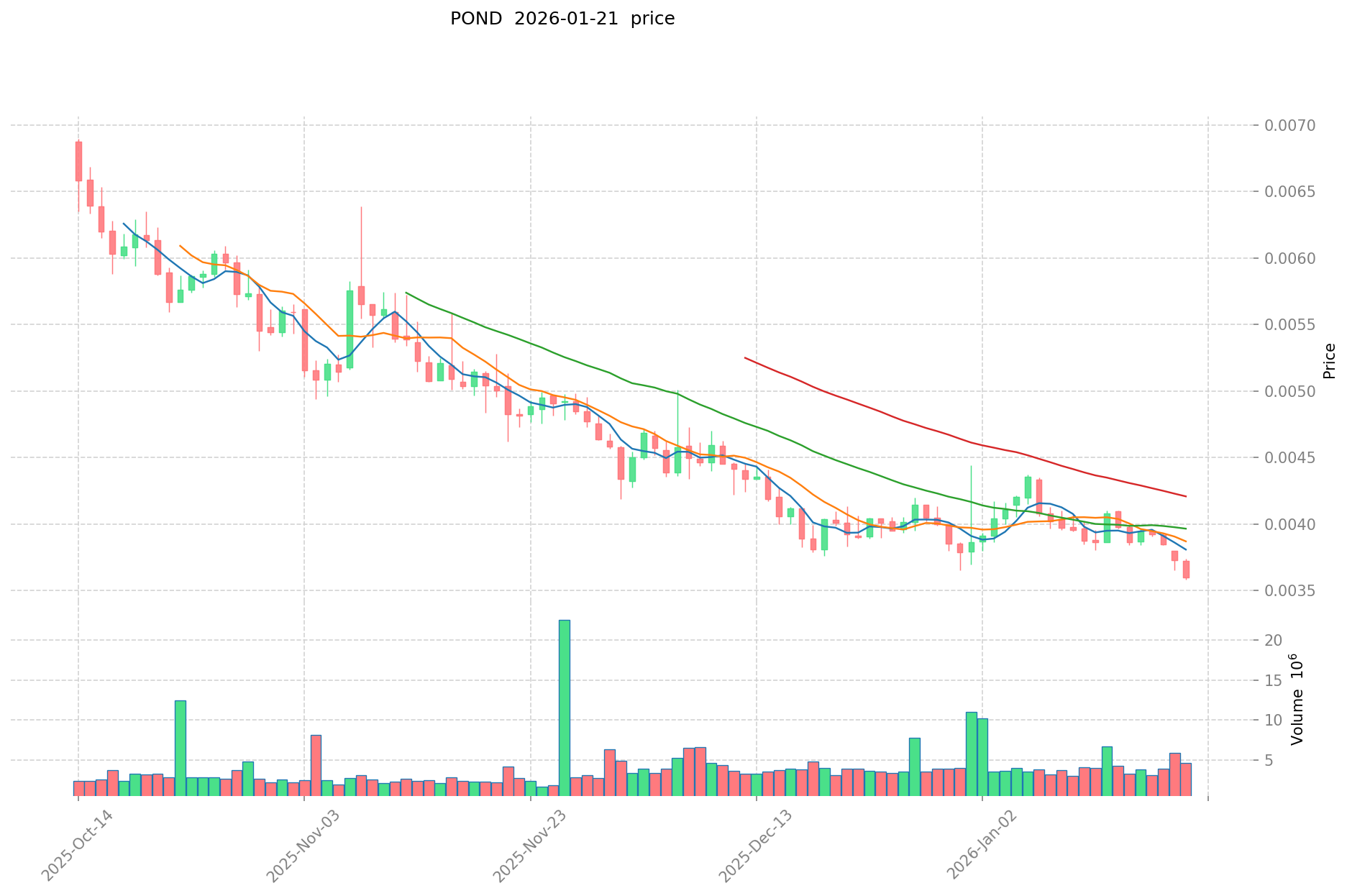
Marlin (POND) reached a notable price level of $0.323362 on December 22, 2020, driven by strong market momentum during the broader cryptocurrency market expansion and increasing interest in Web 3.0 infrastructure solutions.
The token experienced a low price point of $0.00358793 on January 21, 2026, reflecting broader market corrections and adjusted investor sentiment in the decentralized infrastructure sector.
These price movements reflect the dynamic nature of market conditions, adoption trends, technological developments, and external macroeconomic factors affecting the cryptocurrency ecosystem.
Click to view the current POND market price
On-Chain Metrics
- Holder Count: Approximately 11,258 addresses hold POND tokens, indicating a distributed community base
- Market Capitalization: The current market capitalization stands at approximately $30.13 million
- Circulating Ratio: Approximately 82.02% of the total supply is currently in circulation
Marlin Ecosystem Applications and Strategic Partners
Core Use Cases
Marlin's ecosystem supports multiple application scenarios:
- Network Infrastructure: Marlin provides high-performance programmable network infrastructure for DeFi and Web 3.0 applications, enabling enhanced data transmission and network optimization.
- Protocol Layer Services: The network facilitates efficient data routing and relay services, promoting improved performance for decentralized applications.
Strategic Collaborations
Marlin continues to develop its technical capabilities and expand its ecosystem through strategic partnerships within the blockchain and Web3 space.
These collaborative relationships provide a solid foundation for Marlin's ecosystem expansion and network growth.
Challenges and Considerations
Marlin faces several challenges in its development:
- Technical Evolution: Maintaining network performance and scalability as adoption grows
- Market Competition: Competing infrastructure solutions in the blockchain networking space
- Regulatory Environment: Navigating evolving regulatory frameworks for blockchain protocols
These factors drive ongoing innovation and community engagement within the Marlin ecosystem.
Marlin's community demonstrates active participation, with the token currently holding 11,258 holders according to on-chain data.
The project maintains an active presence on X platform through its official account, fostering regular community interaction and updates.
Community interest tends to increase around network upgrades, partnership announcements, and protocol developments.
Sentiment on X regarding Marlin shows diverse perspectives:
- Supporters highlight Marlin's infrastructure capabilities, network optimization features, and utility in the DeFi ecosystem, viewing it as a valuable component of Web3 infrastructure.
- Observers focus on market performance, adoption metrics, and competitive positioning within the blockchain networking sector.
Community discussions reflect ongoing interest in the project's technical developments and ecosystem growth.
Discussion Topics
X users engage with topics related to Marlin including network performance, staking mechanisms, governance participation, and protocol updates,
reflecting both the technical innovation and the practical considerations of network infrastructure development.
Additional Resources for Marlin
- Official Website: Visit Marlin's official website for comprehensive information about features, use cases, and latest developments.
- X Updates: On the X platform, Marlin maintains an active presence through @marlinprotocol,
with posts covering protocol updates, community initiatives, partnership announcements, and technical developments, generating engagement from the community.
- Development Hub: Explore the GitHub repository for technical documentation and open-source contributions.
Marlin Future Roadmap
- Ongoing Development: Continue enhancing network performance, protocol efficiency, and infrastructure capabilities
- Ecosystem Goals: Expand network adoption and support for decentralized applications across DeFi and Web3 sectors
- Long-term Vision: Establish Marlin as a foundational infrastructure layer for high-performance decentralized networks
How to Participate in Marlin?
- Purchase Options: Acquire POND tokens through Gate.com and other supported cryptocurrency exchanges
- Storage Solutions: Securely store POND tokens using compatible wallets such as MetaMask or hardware wallets
- Network Participation: Participate in network staking by pledging POND tokens to join as a node operator
- Governance Involvement: Engage in protocol governance decisions through token-holder voting mechanisms
- Ecosystem Development: Access development resources to build applications utilizing Marlin's network infrastructure
Summary
Marlin provides programmable network infrastructure for decentralized applications, offering enhanced data transmission, network optimization, and protocol-level services for the DeFi and Web3 ecosystem.
Its active community, development resources, and technical focus position it as a specialized infrastructure solution in the blockchain space.
While facing competitive pressures and technical evolution challenges, Marlin's infrastructure approach and governance model contribute to its role in the decentralized networking landscape.
Whether you're exploring network infrastructure solutions or interested in Web3 protocols, Marlin presents opportunities for participation and engagement in the evolving blockchain ecosystem.
FAQ
What is POND? What kind of cryptocurrency project is it?
POND is a decentralized protocol token designed for data verification and validation across blockchain networks. It powers a distributed ecosystem enabling users to participate in network consensus and earn rewards through stake-based mechanisms.
What are the practical uses of POND and what problems does it solve?
POND powers Marlin Protocol's decentralized network infrastructure, enabling fast and secure data streaming for blockchain applications. It incentivizes node operators to maintain network quality while solving scalability and latency challenges in Web3 ecosystems.
How to buy and hold POND tokens? On which exchanges can I trade?
You can purchase POND tokens through major cryptocurrency exchanges by creating an account, completing verification, and placing buy orders. POND can be held in compatible wallets for long-term storage. Check official channels for current supported trading platforms and ensure you use secure wallets for asset management.
What are the risks of investing in POND and what should I pay attention to?
POND carries market volatility risk. Monitor ecosystem developments, token supply changes, and liquidity conditions. Diversify your portfolio and only invest capital you can afford to lose. Stay updated on project updates and community sentiment.
What are the advantages and disadvantages of POND compared to similar crypto projects?
POND excels in ecosystem integration, offering robust DeFi capabilities and strong community governance. Its advantages include efficient transaction speeds and lower fees. Disadvantages include smaller market capitalization compared to established competitors and limited institutional adoption. However, POND's innovative tokenomics and development roadmap position it favorably for long-term growth potential.
* The information is not intended to be and does not constitute financial advice or any other recommendation of any sort offered or endorsed by Gate.